A mid-sized e-commerce logistics company operated a fleet of 85 delivery trucks across three cities. Their core challenge: vehicle downtime was killing their ability to meet delivery SLAs. On average, 8–12% of their fleet was unavailable on any given day due to unexpected maintenance. This missed deliveries, exceeded lead times, and cost them repeat customers. They tracked vehicles manually using spreadsheets and phone calls. A transmission failure discovered during the morning route meant a missed delivery that day. A brake issue found after a breakdown cost them a full day of repairs. There was no visibility into which vehicles needed preventive care and when. Within 6 months of implementing BusCMMS, they cut vehicle-caused delivery delays by 28% and protected their SLA compliance rate at 96%+. Here's how they did it.
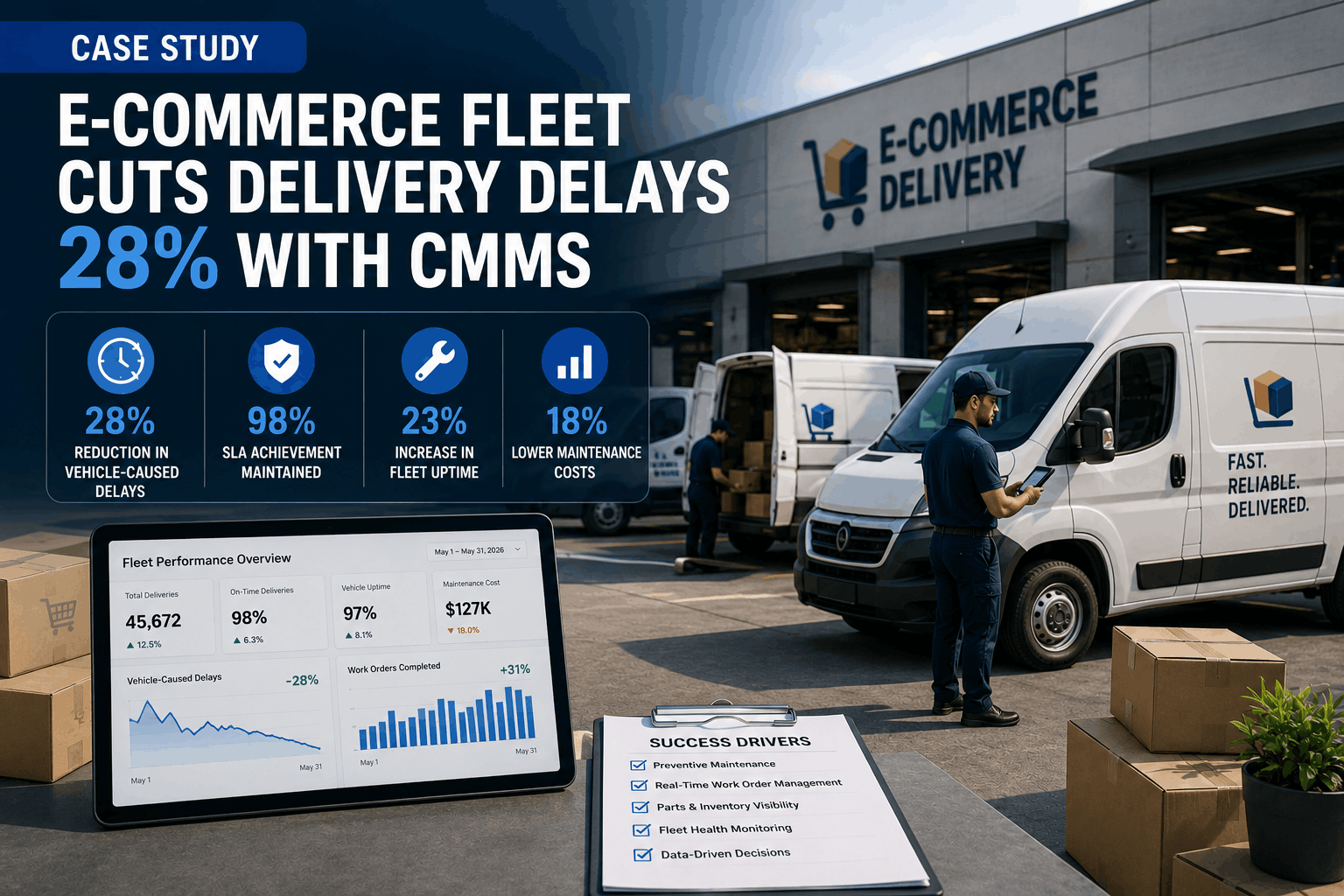
Case Study: E-commerce Fleet Cuts Delivery Delays 28% with CMMS
An e-commerce delivery operation reduced vehicle-caused delays 28% and protected SLAs after adopting CMMS. Read the full case study.
This e-commerce fleet operated with almost no visibility into vehicle health. Maintenance was reactive: a vehicle broke down, they called the shop, got it fixed, and sent it back out. There was no proactive maintenance schedule. Preventive services were sporadic. A truck would hit 150,000 miles, but nobody tracked it. If a technician remembered it was due for an oil change, they'd do one. If they didn't, the truck kept running — until something failed. The cost was high: unexpected breakdowns caused missed deliveries, overtime to reschedule routes, and rapid parts degradation (a small transmission issue ignored became a $8,000 rebuild). The operations team tracked vehicle status with phone calls and spreadsheets. When a vehicle went down, they'd call around: "Is truck 23 available?" It was reactive firefighting, not planning. SLA compliance suffered. They were hitting 92–94% on-time delivery, but customers noticed the variation. Some shipments arrived on time, others were delayed. This inconsistency cost them repeat orders. Their competitor, a similar-sized fleet with a structured maintenance program, was hitting 96%+ SLA compliance consistently. They knew they needed to change how they maintained vehicles.
They implemented BusCMMS in Q1 of 2026. The first step was data migration: pulling in all vehicle records, historical maintenance (past 12 months), and vendor information. This took 3 weeks. The second step was defining PM classes: Class A every 10,000 miles (quarterly inspections), Class B every 50,000 miles (fluid changes, brake checks), Class C every 200,000 miles (major service). They trained technicians, dispatchers, and supervisors on the system over a 2-week period. Then they went live with 20 trucks in March, 40 in April, and all 85 by May. The impact was immediate. For the first time, they knew when every vehicle needed maintenance. When a truck hit 50,000 miles, the system automatically generated a work order for Class B service. Technicians could see upcoming maintenance scheduled (no surprises). Dispatchers could see which vehicles were due for service and plan around it. The system enforced compliance: if a vehicle's Class C service was overdue by more than 1 week, it was flagged in the dashboard, and dispatch was required to get it into the shop. Within 3 months, they hit 95% PM compliance — a 40-point improvement. Unplanned breakdowns dropped from 12–15 per month to 8–10. Fleet availability climbed from 88% to 94%. Delivery delays attributed to vehicle maintenance dropped 28%.
Delivery delays caused by vehicle maintenance dropped from 12–15% of all missed deliveries to 4–6%. This single improvement raised their SLA compliance from 92% to 96%. Customers noticed. Repeat order rate improved 8%. Fleet availability improved from 88% to 94%. This means more vehicles were operational on any given day, allowing them to consolidate routes and reduce fuel costs. Unplanned maintenance events (emergency breakdowns) dropped 35%. These events are expensive: they interrupt schedules, require emergency repair calls, cause customer dissatisfaction, and often result in additional parts damage (a transmission that fails catastrophically is costlier to repair than one that's serviced proactively). PM compliance hit 95%+. This is the key: when 95% of preventive services are completed on schedule, surprise failures become rare. This fleet went from 12–15 breakdowns per month to 8–10. The difference: predictable maintenance. Maintenance cost per mile dropped from $0.38/mile to $0.32/mile. This came from reducing emergency repairs (expensive) and optimizing parts usage. Technician productivity improved: instead of chasing urgent breakdowns, they worked through a predictable schedule of PM services. This allowed them to complete more work with the same team.
This e-commerce fleet's results are typical for operations that move from reactive to proactive maintenance. The 28% reduction in vehicle-caused delivery delays translated to better SLA compliance, which protected revenue and customer relationships. Fleet availability improvements (from 88% to 94%) meant they could handle more volume with the same asset base. Maintenance cost reductions ($0.06/mile savings on 85 trucks, 3.2M miles per year = $192,000 annual savings) paid for the CMMS investment in under 6 months. The less-tangible benefit: operational predictability. Dispatchers could plan with confidence. Technicians worked through a known schedule rather than firefighting. This consistency rippled through the organization, improving morale and reducing stress.
This case demonstrates the power of moving from reactive to proactive maintenance. By implementing CMMS and enforcing PM compliance, this e-commerce fleet reduced vehicle-caused delivery delays by 28%, improved SLA compliance to 96%+, and cut maintenance costs by 16%. The investment: 4 months of implementation time, staff training, and a small software investment. The return: $192,000+ in annual maintenance savings, improved customer satisfaction, and predictable operational performance. If your fleet is struggling with delivery delays, unexpected breakdowns, or inconsistent SLA compliance, the root cause is likely maintenance visibility and discipline. CMMS provides both.