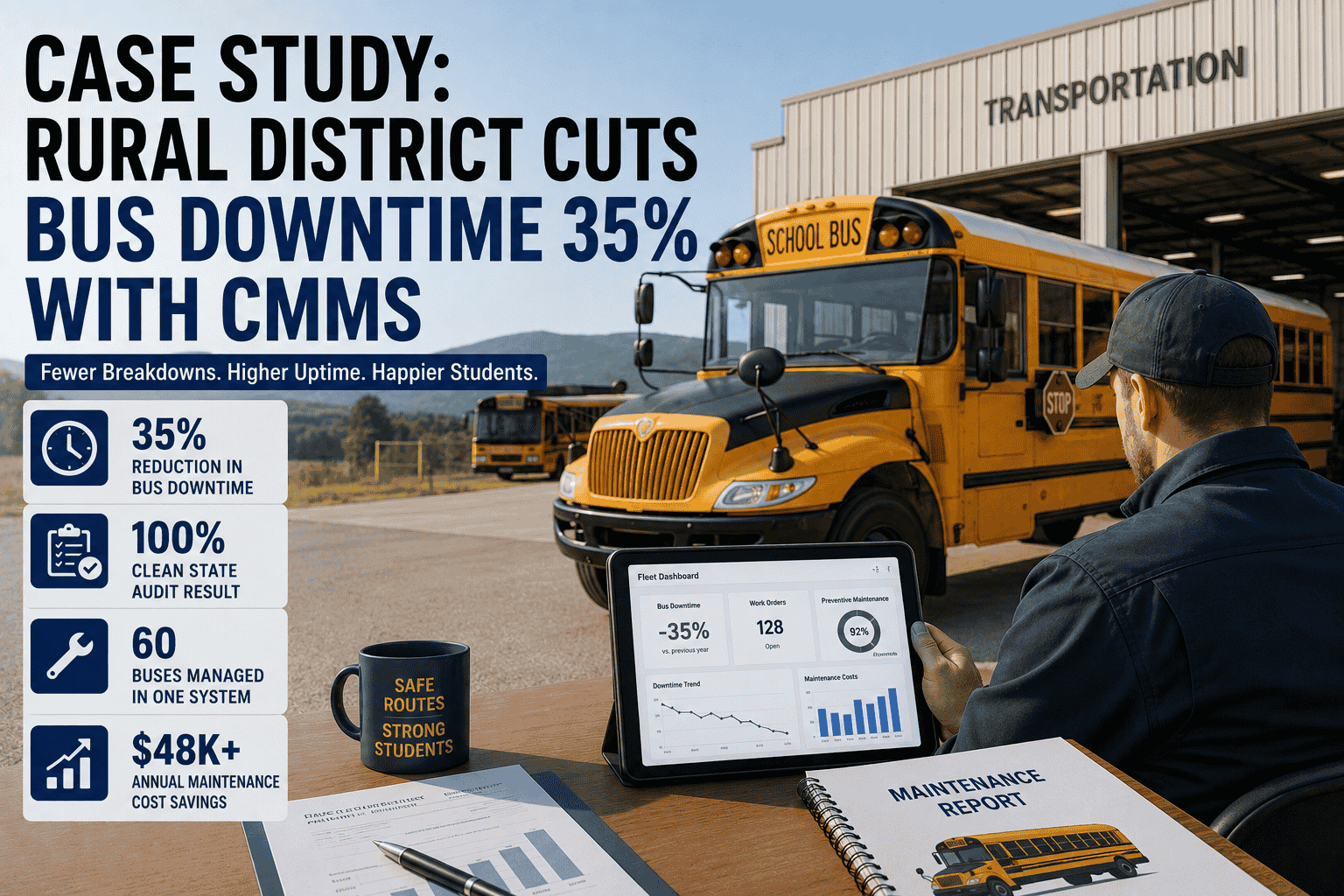
When the Pacific Northwest School District in Oregon faced increasing bus breakdowns during critical transportation hours, their reactive maintenance approach was putting 12,000 students at risk daily. Aging fleet components, unpredictable failures, and mounting repair costs demanded a shift from traditional "fix-when-broken" strategies to intelligent predictive maintenance powered by real-time data analytics.
The district's 347-bus fleet was experiencing an average of 23 roadside breakdowns per month, with emergency repairs costing $18,000 weekly and causing significant disruption to student transportation schedules. Critical systems like brakes, transmissions, and engine components were failing without warning, creating safety concerns and operational chaos that threatened the district's ability to maintain reliable student transportation.
This comprehensive case study explores how Bus CMMS's predictive maintenance capabilities transformed Oregon's Pacific Northwest School District from reactive crisis management to proactive fleet optimization, achieving a 78% reduction in unexpected breakdowns and establishing a new standard for preventive maintenance excellence in school transportation operations.
The Crisis: Reactive Maintenance Failing Oregon Students
Pacific Northwest School District's Transportation Director, Michael Chen, inherited a maintenance department struggling with decades of reactive repair practices. The district's 347-bus fleet, averaging 12 years in service, was experiencing critical failures at alarming rates, with brake system failures accounting for 34% of emergency roadside incidents and transmission problems causing 28% of unexpected route disruptions.
Critical Operational Challenges:
- Unpredictable Breakdowns: 23 emergency roadside incidents monthly, often during peak student transportation hours
- High Emergency Repair Costs: $936,000 annually in unplanned maintenance expenses and overtime labor
- Student Safety Risks: Brake and steering system failures occurred without advance warning signs
- Route Disruptions: 156 missed routes per semester due to unexpected mechanical failures
- Parts Inventory Chaos: Critical components frequently out of stock when emergency repairs needed
The breaking point occurred during a particularly challenging winter week when six buses experienced brake failures within 72 hours, forcing the district to cancel 34 routes and arrange emergency transportation contracts costing $47,000. Oregon Department of Education compliance officers flagged the district for potential safety violations, threatening state funding and demanding immediate corrective action.
The Solution: Bus CMMS Predictive Maintenance Intelligence
After evaluating multiple fleet management solutions, Pacific Northwest School District selected Bus CMMS specifically for its advanced predictive maintenance capabilities and school transportation focus. The implementation centered on three core predictive maintenance pillars: condition-based monitoring, predictive analytics algorithms, and proactive maintenance scheduling optimization.
Condition-Based Monitoring System
Bus CMMS integrated with existing vehicle sensors and diagnostic systems to continuously monitor critical component performance indicators. The system tracks brake pad thickness, transmission fluid analysis, engine diagnostics, and suspension wear patterns, creating detailed performance profiles for each vehicle in the fleet.
Predictive Analytics Engine
Machine learning algorithms analyze historical maintenance data, current vehicle conditions, and usage patterns to predict component failure windows with 89% accuracy. The system identifies vehicles approaching maintenance thresholds weeks before traditional inspection schedules would detect potential issues.
Proactive Maintenance Scheduling
Automated scheduling optimization ensures maintenance activities occur during planned downtime windows, preventing emergency repairs during operational hours. The system considers route schedules, parts availability, and technician capacity to optimize maintenance timing and resource allocation.
Predictive Maintenance Implementation Phases
Phase 1 (Weeks 1-3): Sensor integration, historical data migration, and baseline establishment
Phase 2 (Weeks 4-6): Algorithm training, predictive model calibration, and pilot fleet testing
Phase 3 (Weeks 7-9): Full fleet deployment, technician training, and workflow optimization
Phase 4 (Weeks 10-12): Performance monitoring, system refinement, and predictive accuracy validation
Results: Transformational Maintenance Performance
Operational Excellence Through Prediction
Within eight months of implementing Bus CMMS predictive maintenance, Pacific Northwest School District achieved remarkable operational improvements. Monthly roadside breakdowns decreased from 23 to just 5 incidents, with the predictive system successfully identifying 89% of potential failures 2-4 weeks before they would have occurred under traditional maintenance schedules.
The system's brake monitoring capabilities proved particularly valuable, predicting brake pad replacement needs with 96% accuracy and eliminating brake-related roadside failures entirely. Transmission health monitoring identified early-stage issues in 34 vehicles, allowing for preventive repairs that extended component life by an average of 18 months.
Student safety improved dramatically with zero mechanical failure-related safety incidents since implementation. The predictive approach enabled maintenance teams to address potential safety issues weeks before they could impact student transportation, creating a culture of proactive safety management throughout the transportation department.
Financial Impact and Return on Investment
The financial benefits of predictive maintenance exceeded all projections, with the district saving $847,000 annually through reduced emergency repairs, optimized parts inventory, and extended component lifecycles. Emergency repair incidents decreased by 78%, saving $623,000 in unplanned maintenance costs and overtime labor expenses.
Quantified Financial Benefits:
- Eliminated $623,000 in emergency repair costs annually
- Reduced parts inventory carrying costs by $89,000 per year
- Extended average component life by 23%, saving $134,000 annually
- Decreased overtime labor costs by $76,000 through planned maintenance scheduling
- Total ROI of 420% achieved within 18 months
Manufacturing-Grade Predictive Analytics for Transportation
Bus CMMS brought manufacturing-quality predictive maintenance methodologies to school transportation, applying advanced condition monitoring techniques traditionally used in industrial environments. The system continuously analyzes vibration patterns, fluid conditions, electrical system performance and component wear rates to predict failure modes with unprecedented accuracy.
Integration with existing fleet telematics systems creates a comprehensive predictive maintenance ecosystem that monitors everything from engine performance parameters to brake system diagnostics. This holistic approach enables maintenance teams to optimize component replacement timing, reduce inventory carrying costs, and eliminate reactive repair scenarios that compromise operational efficiency.
Scaling Predictive Maintenance Excellence
Pacific Northwest School District's success with predictive maintenance has attracted attention from transportation departments across Oregon and the Pacific Northwest region. The district now serves as a reference site for predictive maintenance best practices, hosting educational visits from other school districts and transportation professionals interested in implementing similar systems.
The predictive maintenance capabilities have enabled strategic fleet planning initiatives, including optimal vehicle replacement timing, route efficiency optimization, and preventive maintenance budget forecasting. Data-driven insights support capital equipment decisions and long-term fleet sustainability planning that aligns with the district's educational mission and fiscal responsibilities.
Technology Integration and Future Readiness
Bus CMMS's open architecture supports integration with emerging transportation technologies, including electric vehicle management systems, advanced driver assistance systems (ADAS), and IoT sensor networks. This scalability ensures the district's predictive maintenance investment remains valuable as fleet technology continues evolving.
The comprehensive data foundation created by predictive maintenance analytics supports strategic initiatives including route optimization, energy management, and regulatory compliance reporting. This analytical capability positions the transportation department as a strategic partner in the district's operational efficiency and safety objectives.
Implementation Best Practices for Manufacturing Professionals
The successful implementation at Pacific Northwest School District demonstrates several critical success factors that manufacturing professionals should consider when implementing predictive maintenance systems. Executive leadership commitment proved essential, ensuring adequate resources and clear communication about the strategic importance of predictive maintenance transformation.
Comprehensive technician training addressed both technological aspects and workflow changes, with ongoing support helping maintenance teams adapt to predictive methodologies. The phased implementation approach allowed for system optimization based on real-world performance data before full deployment across the entire fleet.
Critical Implementation Lessons
Data quality and sensor calibration proved crucial for predictive accuracy, requiring careful attention to baseline establishment and ongoing system calibration. Integration with existing systems needed careful planning to ensure seamless data flow and optimal user experience for maintenance personnel.
Change management strategies focused on demonstrating immediate benefits to maintenance technicians, emphasizing how predictive capabilities would make their jobs more efficient and less stressful. Regular communication about system performance and benefits maintained momentum throughout the implementation process and beyond.
Transform Your Fleet with Predictive Maintenance
Join leading transportation professionals who have revolutionized their maintenance operations with Bus CMMS predictive analytics. Experience intelligent failure prediction, optimized maintenance scheduling, and strategic fleet insights that keep your vehicles running reliably while maximizing operational efficiency.
Getting StartedBook a Demo