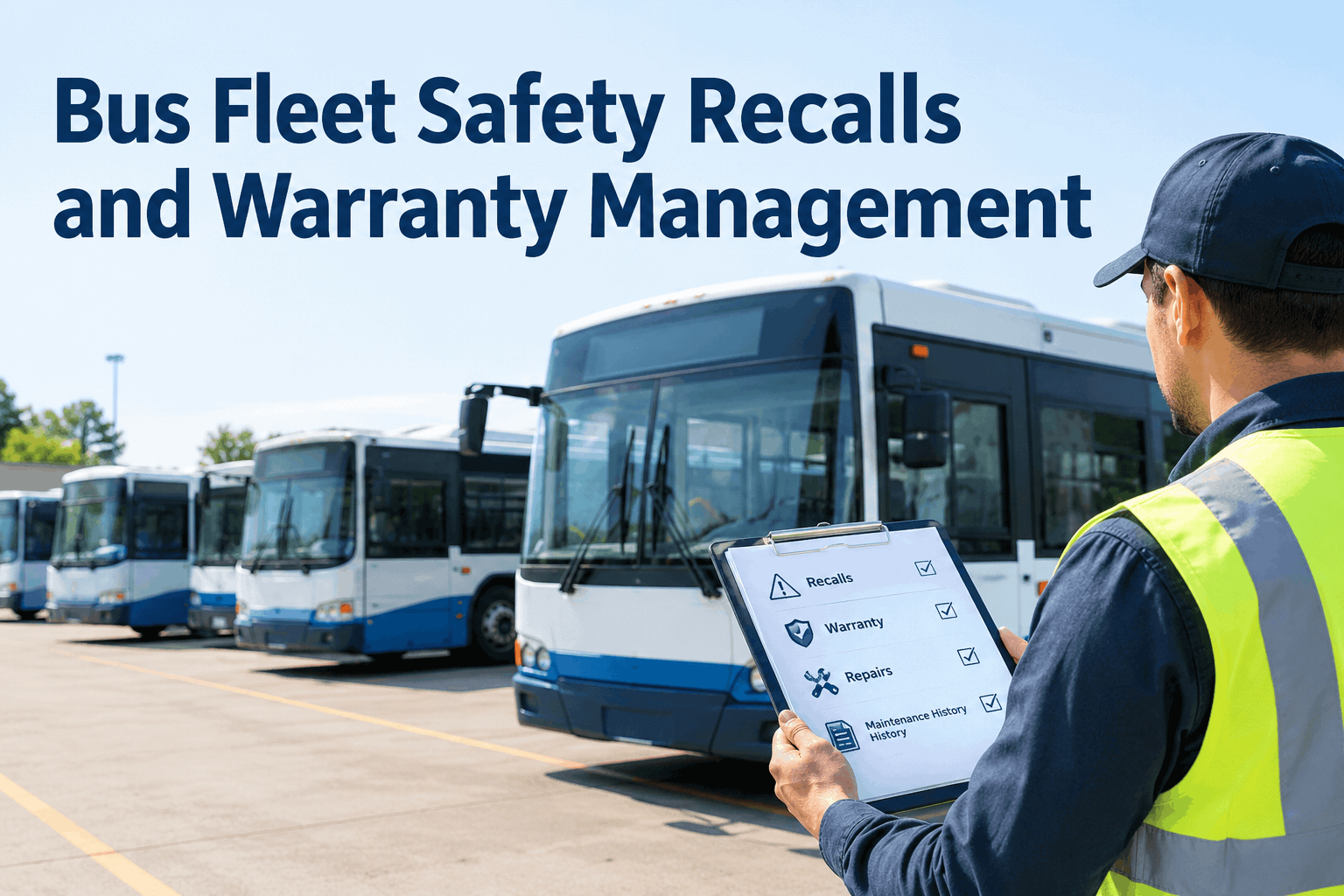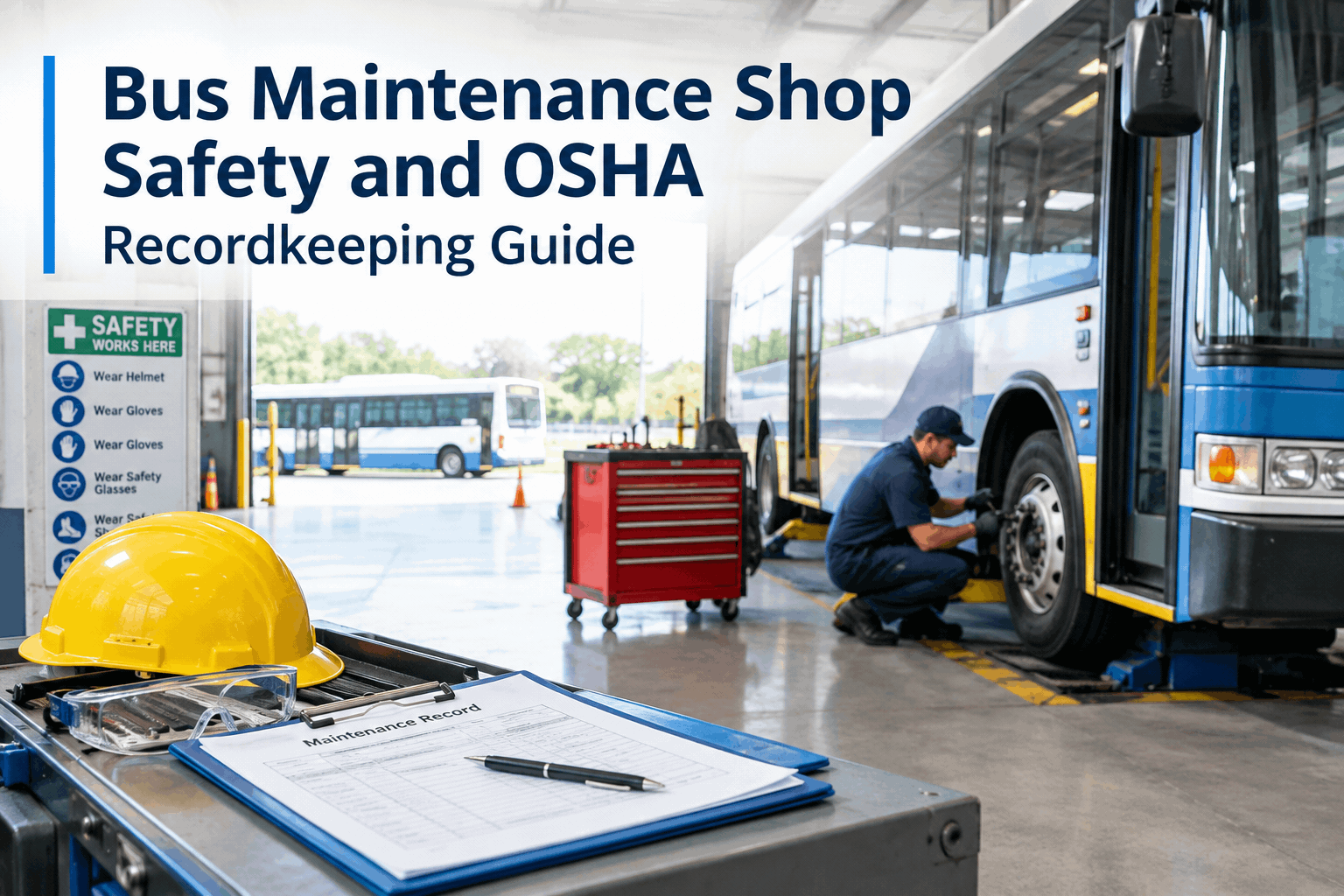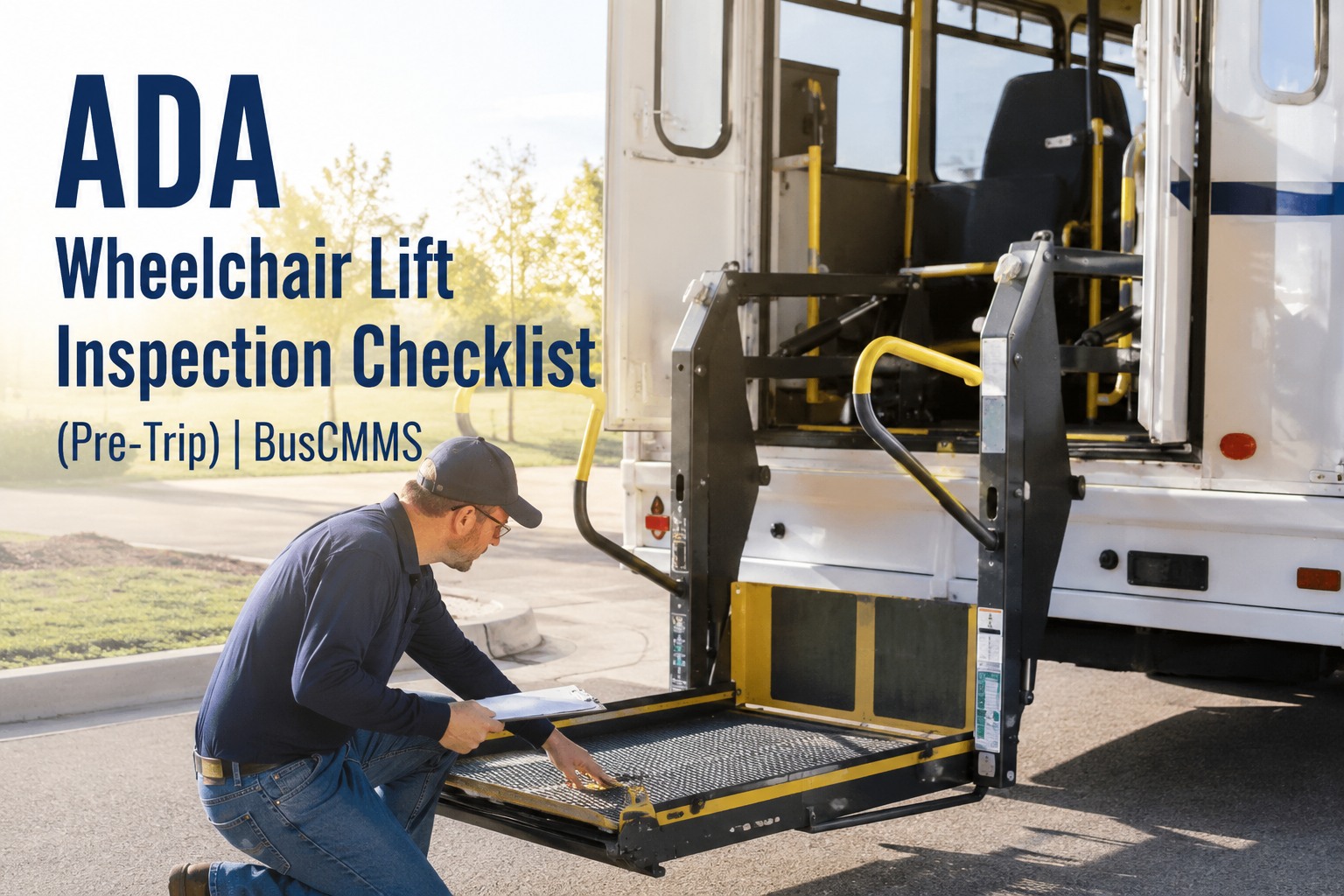
Your paratransit driver rolls up to the 7:14 a.m. pickup. The passenger is already outside in a power chair, waiting in the cold. The driver hits the lift deploy button. Nothing. Second try -- the platform grinds halfway out and freezes. The passenger cannot board. Dispatch scrambles for a backup vehicle thirty minutes away. The passenger misses their dialysis appointment. That two-minute mechanical failure just became an ADA complaint, a formal FTA incident report, and a very uncomfortable board meeting three weeks later. Every one of those consequences is preventable with a disciplined ADA wheelchair lift inspection checklist run before that bus ever pulls out of the yard. This is that checklist -- what to verify, what pulls the bus out of service, and how to document it so an FTA auditor cannot poke a single hole in your compliance record.
The ADA Wheelchair Lift Inspection Checklist Every Transit Fleet Needs
A field-tested, 14-point pre-trip inspection grouped by lift subsystem -- with the exact verify criteria and reject triggers that satisfy 49 CFR Part 37 and Part 38.
- 600 lb min. design load
- 30 x 48 platform (inches)
- 3-5 day service cap
- $75K+ ADA penalty floor
The Lift Isn’t Equipment. It’s a Civil Rights Obligation.
A wheelchair lift that fails to deploy is not a maintenance inconvenience. Under 49 CFR Part 37, it is a civil rights violation. The FTA requires transit agencies to establish regular and frequent maintenance checks (49 CFR 37.163), remove any bus with an inoperable lift from service before its next service day, and provide alternative accessible transportation within thirty minutes when a passenger is stranded mid-service. Miss any one of those and you have a documented ADA complaint on your desk before lunch.
More than 3.6 million Americans use wheelchairs daily and depend on accessible transit to reach work, medical appointments, and daily life. FTA compliance reviewers in 2026 are asking pointed questions about daily pre-trip lift records, out-of-service documentation, and driver training. Fleets without a repeatable inspection process are getting flagged. Book a demo to see how BusCMMS captures FTA-ready lift inspection records.
-
$75K+ Civil Penalty
ADA accessibility violations begin at $75,000 per finding and compound with repeat infractions.
-
Out of Service
An inoperable lift pulls the bus before next service day. The 37.163(e) exception caps at 3 to 5 days.
-
Formal FTA Complaint
A stranded rider triggers an Office of Civil Rights complaint that stays on your record for years.
-
Board & Public Trust
One viral incident of a stranded rider undoes years of goodwill and stalls grant approvals.
The 14-Point ADA Wheelchair Lift Inspection Checklist (Tap to Expand)
FTA best practice is a full deployment cycle before every day of revenue service -- not a walk-around, not a visual, but an actual power-up, extend, lower, raise, and stow with load simulation. The checks below are grouped by the four lift subsystems in the hero diagram. Tap any item to reveal what to verify and what pulls the bus out of service. Sign up free and load this exact checklist into your digital DVIR.
Deployment System
4 checkpoints-
1.1Full-cycle deployment test
Verify Platform extends, lowers to ground, raises, and stows in one smooth cycle -- no hesitation, grinding, or hydraulic whine.
Reject if Any stall, chatter, drift, or manual override needed to complete the cycle.
-
1.2Hydraulic pressure & fluid level
Verify Reservoir at spec level. No external weep or seepage on cylinders, hoses, or fittings.
Reject if Visible leak, milky fluid, or lift will not hold platform at height under load.
-
1.3Motor & pump function
Verify Motor engages within one second of button press. Consistent hum, no burnt-electrical smell.
Reject if Delayed start, clicking relay, burnt odor, or thermal cutoff trips during cycle.
-
1.4Load capacity confirmation
Verify Lift holds and cycles with test load simulating minimum 600 lb per 49 CFR 38.23.
Reject if Platform sags, motor labors, or hydraulic drift is measurable under load.
Platform & Barriers
4 checkpoints-
2.1Platform surface (30 x 48 clear area)
Verify Slip-resistant surface intact. No protrusions greater than 1/4 inch. Clear area meets ADA minimums.
Reject if Worn tread, cracked platform, exposed hardware, or debris embedded in surface.
-
2.2Outer barrier deployment
Verify Outer barrier auto-raises to full height as platform lifts from ground. Latches securely.
Reject if Barrier fails to rise, sits below spec height, or wobbles when pressure applied.
-
2.3Handrails and side guards
Verify Both handrails mounted firmly, no play at anchor points, protective coating intact.
Reject if Loose mount, bent rail, corrosion on anchor, or missing side guard.
-
2.4Inboard roll-stop
Verify Roll-stop lays flat during boarding, raises during lift travel, no slack.
Reject if Roll-stop stuck upright at ground level or fails to raise during travel.
Interlock & Securement
3 checkpoints-
3.1Vehicle-motion interlock
Verify Bus cannot shift out of park or move while lift is deployed. Dash indicator active.
Reject if Interlock allows transmission engagement or shows fault at ignition cycle.
-
3.2Occupant safety belt
Verify Platform belt buckles fully, retracts, and shows no fraying or UV damage on webbing.
Reject if Frayed webbing, cracked buckle, or belt fails to hold under gentle tension.
-
3.34-point wheelchair securement
Verify All four floor anchors accept and lock retractor straps. Separate lap and shoulder belt available.
Reject if Any anchor missing, retractor jammed, or WC18-rated strap frayed.
Controls & Emergency Backup
3 checkpoints-
4.1Pendant control operation
Verify Every button responds. Cord free of nicks. Connector seats cleanly.
Reject if Sticky button, exposed wire, or control drops signal mid-cycle.
-
4.2Manual backup pump
Verify Hand pump handle is stored in the marked location and can lower a loaded platform with power off.
Reject if Handle missing, pump seized, or manual valve inoperative.
-
4.3ADA signage & door height
Verify International accessibility symbol visible. Door opening at least 56 inches per Part 38.
Reject if Signage faded, missing, or door frame obstructs clear passage.
Fourteen checks. Under five minutes if the driver knows the sequence. Every one of them lands on the DVIR record with a timestamp, driver ID, and reject reason if flagged. That is the record an FTA reviewer wants to see. Book a demo to see this checklist inside a digital DVIR.
The 6 Wheelchair Lift Failures That Cause Most Out-of-Service Reports
If you have run a paratransit or fixed-route fleet for more than a season, the same failures keep landing on the shop board. They are predictable, they are catchable during pre-trip, and they are almost entirely preventable with a real PM schedule. Here is what actually breaks, in the order it shows up in fleet incident logs.
-
01
Hydraulic Leaks & Low Fluid
Seals fail slowly, then all at once. Cracked lines, weeping cylinders, and thermal-cycle pinholes bleed pressure until the platform will not hold at height.
Very frequent · catch at check 1.2 -
02
Interlock Sensor Faults
Corroded grounds and dirty proximity switches confuse the interlock, stranding the lift mid-cycle or throwing a false parking-brake fault.
Frequent · catch at check 3.1 -
03
Outer Barrier Won’t Latch
Debris, salt, and worn cams keep the barrier from reaching full deployment height. The lift will not travel with an unlatched barrier -- the bus is stuck at the curb.
Common · catch at check 2.2 -
04
Pendant / Control Wear
Coiled cords fatigue at the strain relief. One broken conductor and the deploy button dies with a passenger halfway up.
Common · catch at check 4.1 -
05
Roll-Stop Solenoid Failure
The small solenoid that raises the inboard roll-stop during travel is often overlooked in PM. When it sticks, the bus fails inspection on the spot.
Recurring · catch at check 2.4 -
06
Frayed Securement Straps
UV, cleaning chemicals, and hard use fray the webbing on WC18-rated retractors. A visibly frayed strap is an automatic reject on any audit.
Recurring · catch at check 3.3
Every one of these has a matching PM interval, a matching part number, and a matching test procedure. The reason they still take fleets out of service is that most maintenance systems do not connect the failed DVIR item to an auto-generated work order and a triggered parts pull. A bus-specific CMMS does. Book a demo to see failed-DVIR to work-order automation live.
The PM Cadence Behind a Reliable Wheelchair Lift
The daily pre-trip is the visible part. The base is the preventive-maintenance cadence that keeps the lift from ever getting flagged in the first place. FTA does not prescribe a fixed interval, but the practical rhythm most transit and paratransit fleets converge on -- and the one BusCMMS ships as a default -- looks like this.
-
1
Every day
Driver Pre-Trip
Full deployment cycle, barrier check, control response. Driver signs the DVIR before the bus leaves the yard.
-
2
Every 30 days
Monthly Service
Hinges, pivots, rollers lubed. Reservoir topped and inspected. Retractor webbing scanned for wear.
-
3
Every 90 days
Quarterly Deep Inspection
600-lb load test, interlock diagnostic, anchor points torqued to spec, full DOT-equivalent inspection.
-
4
Annual
Certification & Overhaul
Manufacturer-recommended intervals, cylinder rebuild if due, full compliance-document refresh for FTA records.
The industry benchmark for a well-maintained lift is 200,000+ deployment cycles before major service. Fleets that hit that number are running the schedule above with software that actually holds them to it -- not sticky notes on a shop wall. Book a demo to see the 30-90-annual lift PM schedule live inside BusCMMS.
What a Transit Maintenance Supervisor Actually Watches For
The number I track every single Monday is lift availability by bus. Not fleet-wide -- by bus. If Bus 14 is missing a lift cycle in the DVIR three times in a month, I want to know before I get a call from the OCR. Half the failed inspections I have seen in twenty years came from something a driver would have caught in the pre-trip if the checklist was in his hand -- and if he actually had a way to log the reject. That is what changes with a real system. It stops being paperwork and starts being a safety net.
The supervisor’s point is the whole game. A checklist that lives on paper -- or worse, in a driver’s head -- is not evidence. A checklist that lives in a digital DVIR with a timestamp, a photo of the flagged item, and an auto-generated work order is evidence. It is also the difference between a five-figure ADA finding and a clean audit. Book a demo to see lift availability tracked bus-by-bus.
How BusCMMS Turns This Checklist Into an Audit-Ready System
Generic fleet software does not know that a stop-arm inspection is different from a wheelchair lift barrier check. A bus-specific CMMS does. Here is what changes the day a paratransit or transit fleet moves this checklist off paper and into BusCMMS.
-
ADA-Ready Digital DVIRs
Pre-loaded lift, barrier, interlock, and securement items. Driver signs off from the tablet, no paper handoff.
-
Auto Work Orders on Reject
A flagged reject on any lift item generates a work order and pulls the bus from the next-day schedule automatically.
-
30-90-Annual PM Scheduling
Lift PM triggers on the right day and the right mileage. No lift misses a quarterly load test.
-
Lift Availability Dashboard
Per-bus lift uptime, cycles since last PM, and reject frequency, reviewed weekly not annually.
-
FTA-Ready Reports
Triennial review documentation, out-of-service logs, and repair histories exported in one click.
-
Driver Training Records
ADA lift operation training documented per driver, tied to expiry alerts before certifications lapse.
BusCMMS reports agencies moving this checklist into its platform typically hit 95%+ lift availability and cut lift-related road calls sharply within the first quarter. Those are BusCMMS’s own reported figures across its transit customer base, and they line up with what supervisors describe when the checklist finally has a system behind it. Book a demo to see BusCMMS lift compliance metrics in action.
How often should a wheelchair lift be inspected on a transit bus?
FTA best practice per 49 CFR 37.163 is a full deployment cycle before every day of revenue service -- a driver pre-trip that actually cycles the lift, not just a visual. On top of daily pre-trip, most fleets run a 30-day lubrication and inspection, a 90-day quarterly deep inspection with a 600-pound load test, and an annual manufacturer-recommended service. All of it should be documented with driver ID and timestamp.
What happens if a wheelchair lift fails during passenger service?
Under 49 CFR 37.163, the driver must radio dispatch immediately and the agency must arrange alternative accessible transport for the stranded passenger. The bus must be pulled from service before its next service day. The 37.163(e) spare-vehicle exception allows a maximum of 3 days in areas over 50,000 population or 5 days in smaller areas -- with documented justification -- but that is not a loophole. It is a narrow window that requires evidence of active repair effort.
What are the ADA specifications for a wheelchair lift under 49 CFR Part 38?
Per 49 CFR 38.23, wheelchair lifts must have a minimum design load of 600 pounds, a minimum clear platform area of 30 inches by 48 inches, an outer barrier that automatically deploys, an inboard roll-stop, handrails, an occupant safety belt, a vehicle-motion interlock, and a manual backup deployment method. The door opening must be at least 56 inches high. Failure of any of these is an out-of-service trigger.
What documentation do FTA auditors ask for during a lift compliance review?
FTA compliance reviewers typically request daily pre-service inspection logs with timestamps and driver ID, records of any lift failures with response times and repair timelines, quarterly and annual servicing records, driver training documentation for ADA lift operation, and any complaints received related to lift availability. A bus-specific CMMS such as BusCMMS captures all of this automatically and exports triennial-review-ready reports.
Do school buses need to follow the same ADA wheelchair lift inspection rules?
ADA Title II and 49 CFR Part 37 apply primarily to public transit and paratransit agencies. School districts operating special-education transportation with lift-equipped buses are subject to Section 504 of the Rehabilitation Act, which carries parallel maintenance obligations. School bus routes operated under a public transit contract are subject to the full 49 CFR Part 37 requirements. Either way, the practical pre-trip lift checklist -- deployment cycle, barriers, interlock, securements, backup -- is the same.