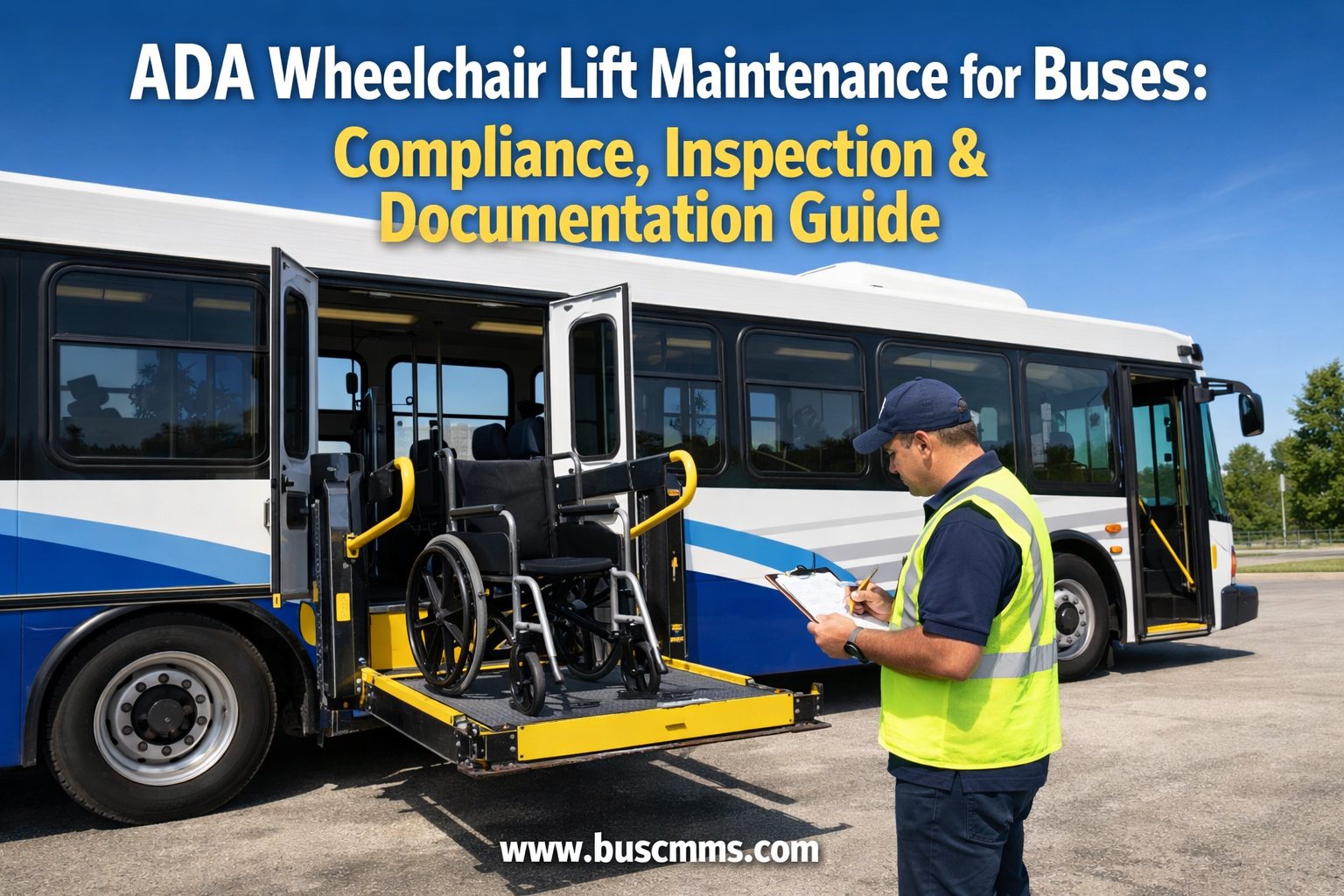
That grinding sound your wheelchair lift made this morning? The hydraulic hesitation your driver mentioned last week? Those aren't minor annoyances—they are warnings. FTA compliance reviews have found agencies where 63% of the entire bus fleet had inoperable wheelchair lifts. The result: federal enforcement action, mandatory corrective measures, and passengers with disabilities stranded at stops across the city. This guide shows you exactly what federal law requires and how digital tracking prevents your agency from becoming the next cautionary tale.
The 4 Federal Requirements You Must Meet
49 CFR Part 37 establishes non-negotiable wheelchair lift maintenance standards. These aren't best practices—they're legally enforceable requirements that determine pass or fail during FTA audits.
Non-compliance triggers federal complaints, FTA reviews, corrective orders, and funding suspension. Ready to build an audit-proof system? Sign up free and start tracking lift compliance in minutes.
What Happens When a Lift Fails In-Service
When a wheelchair lift fails during revenue service, a strict federal protocol kicks in. Miss any step and you've created a documented violation.
Manual tracking makes it nearly impossible to prove you hit every deadline. Book a demo to see how automated incident tracking works.
Daily Pre-Trip Checklist: What FTA Expects
Visual checks alone don't satisfy federal requirements. FTA guidance requires physically cycling the lift—deploying and stowing completely. Lifts must handle 600 lbs minimum load.
Paper checklists get lost, rushed, or skipped. Digital inspections ensure 100% completion with timestamps and photos. Sign up now to digitize your pre-trip inspections.
Expert Review: Paper vs. Digital Compliance
FTA reviews consistently find documentation gaps as the primary compliance failure—even when maintenance was actually performed. Here's how the systems compare:
Ready to see how digital compliance tracking works for your fleet? Schedule your free demo and our team will walk you through implementation for your specific fleet size.
Building Your Audit-Ready Program
ADA wheelchair lift compliance isn't about avoiding fines—it's about the 3.6 million Americans with travel-limiting disabilities who depend on accessible transit. Every lift failure represents a real person who can't get to work, a medical appointment, or family. The agencies excelling at compliance have digitized their inspection workflows, automated their work order generation, and built searchable documentation systems that prove compliance at a moment's notice.
Frequently Asked Questions
How often must wheelchair lifts be inspected under federal ADA regulations?
Under 49 CFR Part 37.163, transit agencies must establish regular and frequent maintenance checks to verify lift operability. FTA best practice recommends daily pre-trip lift cycling—physically deploying and stowing the lift, not just visual inspection. Some agencies test with weight periodically to verify lifts meet the 600-pound minimum capacity requirement.
What happens if a wheelchair lift fails during passenger service?
The driver must radio dispatch immediately. The agency must provide alternative accessible transport within 30 minutes for any stranded passenger. Under 49 CFR 37.163(d), the vehicle must be removed from service before the next service day. If no spare is available, the vehicle may operate maximum 3 days (50k+ population) or 5 days—with documented justification.
What are the penalties for ADA wheelchair lift violations?
Federal civil penalties reach $75,000 for first violations and $150,000 for subsequent violations under Title III. Beyond fines, agencies face federal complaints, mandatory FTA compliance reviews, corrective action plans, potential funding suspension, private lawsuits, and significant reputational damage.
What documentation is required to prove ADA compliance?
FTA reviews require daily pre-trip inspection records with timestamps and driver ID, defect reports with resolution tracking, preventive maintenance logs, repair histories showing parts and labor, out-of-service incident reports with 30-minute response documentation, exception period tracking, and operator training records. Missing records constitute findings even when maintenance was performed.
Do ADA lift requirements apply to school buses and charter operations?
Yes. ADA requirements under 49 CFR Part 37 apply to public transit agencies, school districts operating accessible buses, paratransit providers, and private charter companies providing accessible transportation. Private entities under contract with public agencies must comply as if they were the public entity directly.