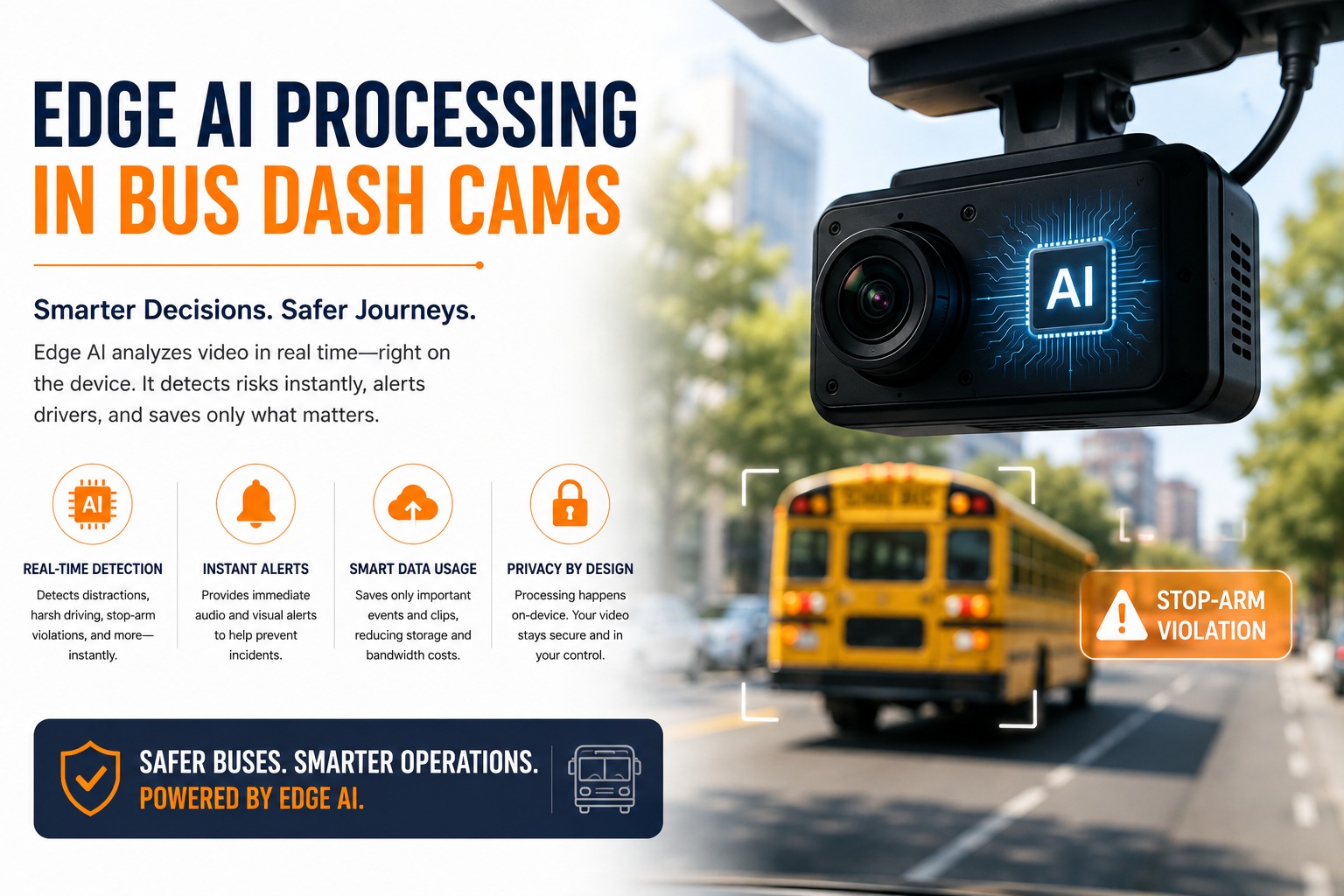
A driver drifting toward a stopped school bus has maybe a second and a half before it matters. If that detection has to travel to a cloud server and back before triggering an alert, the moment's already gone. Edge AI dash cams solve this by running detection directly on the camera hardware itself, inside the bus, with no round trip required — that's the entire reason the "edge" architecture exists, not a marketing distinction from cloud-based systems. See edge-detected events feed BusCMMS in real time → book a demo.
Edge AI Processing in Bus Dash Cams
Why detection has to happen on the device, what that actually saves in bandwidth, and how models stay current without a truck roll to every bus.
Why Detection Has to Run on the Device, Not the Cloud
The physics of the problem, not a vendor preference.
A cloud-based detection system requires the camera to send footage out over cellular, a server somewhere to process it, and a response to come back — three trips across a network connection that may be weak, intermittent, or entirely absent, depending on where the bus is on its route. For an in-cab alert meant to warn a driver about a following-distance violation or a stop-arm risk in real time, that round trip is disqualifying on its own; by the time the alert would arrive, the moment it was meant to catch has already passed. Edge AI processing runs the detection model directly on a chip inside the camera or MDVR unit, so the alert fires locally within a fraction of a second, with zero dependency on network conditions at that instant.
No single federal mandate governs edge AI processing specifically in bus cameras; the compliance bar here is 49 CFR 396 maintenance record requirements and district policy. But the underlying safety motivation connects directly to 49 CFR 673.25, which requires large urbanized area transit providers and their safety committees to consider mitigations that reduce operator visibility impairments — and a detection system that only works when connectivity happens to be strong doesn't reliably mitigate anything. See real-time edge detection demonstrated live → book a demo.
What Bandwidth Actually Gets Consumed When Only Events Upload
Edge processing doesn't just fix latency — it changes the entire data economics of the system.
Because the detection decision happens on the device, the camera only needs to upload the specific short clip tied to a flagged event, plus GPS and metadata — not a continuous stream of raw footage for a cloud server to analyze. That distinction is the difference between a bus needing to transmit hours of video per day and needing to transmit a handful of short clips. On a fleet where buses spend meaningful time outside strong cellular coverage, this matters practically: event-only upload can complete in the brief window a bus has signal, where a continuous stream simply couldn't.
Continuous footage streamed for remote analysis — high, sustained bandwidth demand, impractical outside strong, consistent connectivity.
Detection happens locally; only flagged event clips upload, typically seconds of footage per event rather than hours of continuous stream — practical even on intermittent connections.
Model Updates: How the AI Improves Without a Truck Roll
Fixed hardware, evolving detection — the update mechanics matter more than the initial spec.
A reasonable concern with edge AI is that if the detection runs entirely on the device, does the system get stuck with whatever the model could do on install day? In practice, well-designed edge AI cameras support over-the-air model updates — the detection software itself gets pushed to the device the same way a phone receives an app update, typically the next time the bus connects to wifi at the depot, without requiring a technician to physically access the unit. This means improved detection accuracy, new event types, or refined thresholds can roll out fleet-wide without a service visit to every bus.
Improved model released
Vendor refines detection accuracy or adds a new event type based on fleet-wide data.
Update queues for depot wifi
The bus doesn't need cellular bandwidth for this — the update waits for a strong depot connection.
Model installs locally
No technician visit, no physical access to the unit — the device updates itself overnight in the yard.
The Spec Mistake: Buying an Edge AI Camera on Resolution Alone
The AI processing chip matters more than the sensor for this specific technology.
Here's the failure worth naming directly: fleets sometimes evaluate an "AI dash cam" purchase by comparing resolution numbers, the same way they'd evaluate a basic recording camera, and skip the specs that actually determine whether the AI processing works well. Low-light performance affects detection accuracy just as much as it affects human-viewable footage — a fatigue or distraction detection model can't identify an eyelid-closure pattern it can't clearly see. Vibration rating matters because the processing chip and its connections need to survive the same chassis conditions as any other bus-mounted electronics. Retention window still matters because a flagged event's clip needs to actually be there when someone reviews it, regardless of how good the detection was at the moment it fired.
Resolution
SUPPORTS DETECTION, ISN'T THE WHOLE STORYA sharp image feeds the model good input, but processing quality and low-light handling matter just as much.
Low-Light Rating
DIRECTLY AFFECTS DETECTION ACCURACYA fatigue or distraction model can't detect what it can't clearly see in dim cabin or dawn-route conditions.
Vibration Rating
PROCESSING CHIP MUST SURVIVE THE CHASSISThe AI chip and its connections face the same chassis vibration as any other bus-mounted electronics.
Retention Window
GOOD DETECTION MEANS NOTHING WITHOUT SAVED FOOTAGEA correctly flagged event still needs its clip retained long enough to actually be reviewed.
A Scenario From a Real Bus Operation
The one-second gap that mattered when it counted.
A transit agency piloted edge AI cameras on ten buses running routes with known weak-cellular zones — a valley stretch and an industrial corridor with spotty coverage. During the pilot, a following-distance violation triggered an in-cab alert exactly in the middle of the known dead zone, where a cloud-dependent system would have had no connectivity to send footage out for processing at all. Because detection ran locally on the device, the driver received the alert within a fraction of a second regardless of the connectivity gap, and the flagged clip queued for upload automatically, syncing the moment the bus exited the dead zone twenty minutes later. The agency's conclusion after the pilot: the exact routes where connectivity was weakest were the routes where edge processing mattered most, not least.
We almost bought a cheaper cloud-based system before running the pilot. Our worst-coverage route is also our longest route — it would have been useless exactly where we needed it most. The edge system doesn't care whether the bus has signal at the moment something happens. That's the whole point, and it's easy to miss if you're just comparing spec sheets side by side.
Have known weak-connectivity zones on your routes? That's exactly where this comparison matters most. Sign up free and map your coverage gaps →
Quick Spec Reference
Scannable on a phone during a vendor call.
| Spec | What to actually check |
|---|---|
| Detection location | On-device (edge) for real-time alerts, not cloud round-trip dependent |
| Alert latency | Sub-second response required for in-cab warnings to be useful |
| Bandwidth model | Event-only clip upload, not continuous footage streaming |
| Model updates | Over-the-air via depot wifi, no technician visit required |
| Low-light performance | Directly affects detection accuracy, not just picture quality |
| Vibration rating | Processing chip must survive the same chassis conditions as other electronics |
Frequently Asked Questions
Why does AI detection need to run on the camera device instead of in the cloud?
In-cab alerts, like a following-distance or stop-arm warning, need to fire within a fraction of a second to be useful. A cloud-based system requires sending footage out over a network, processing it remotely, and sending a response back — a round trip that's too slow for real-time alerts and unreliable wherever cellular coverage is weak or absent. Edge AI runs the detection model locally on the device, so alerts fire immediately regardless of connectivity at that moment.
How much bandwidth does an edge AI dash cam actually use?
Because detection happens on the device, only the short clip tied to a flagged event needs to upload, along with GPS and metadata — not continuous raw footage. This is a small fraction of the bandwidth a cloud-dependent system streaming continuous video would require, making edge AI practical even on buses that spend significant time outside strong cellular coverage.
How do edge AI camera models get updated without visiting every bus?
Well-designed edge AI cameras support over-the-air model updates, typically downloaded automatically the next time the bus connects to wifi at the depot. This allows improved detection accuracy or new event types to roll out fleet-wide without requiring a technician to physically access each unit.
Is there a federal requirement for edge AI processing in bus cameras?
No single federal mandate governs edge AI processing specifically. The compliance bar for bus records is set by 49 CFR 396 maintenance requirements and district policy. The safety motivation connects to 49 CFR 673.25, which requires transit safety committees to consider visibility-impairment mitigations, though it doesn't mandate a specific processing architecture.
What specs matter most when evaluating an edge AI dash cam beyond resolution?
Low-light performance directly affects detection accuracy, since a fatigue or distraction model can't identify patterns it can't clearly see. Vibration rating matters because the AI processing chip must survive the same chassis conditions as other bus electronics. Retention window still matters because a correctly flagged event needs its clip saved long enough to actually be reviewed.