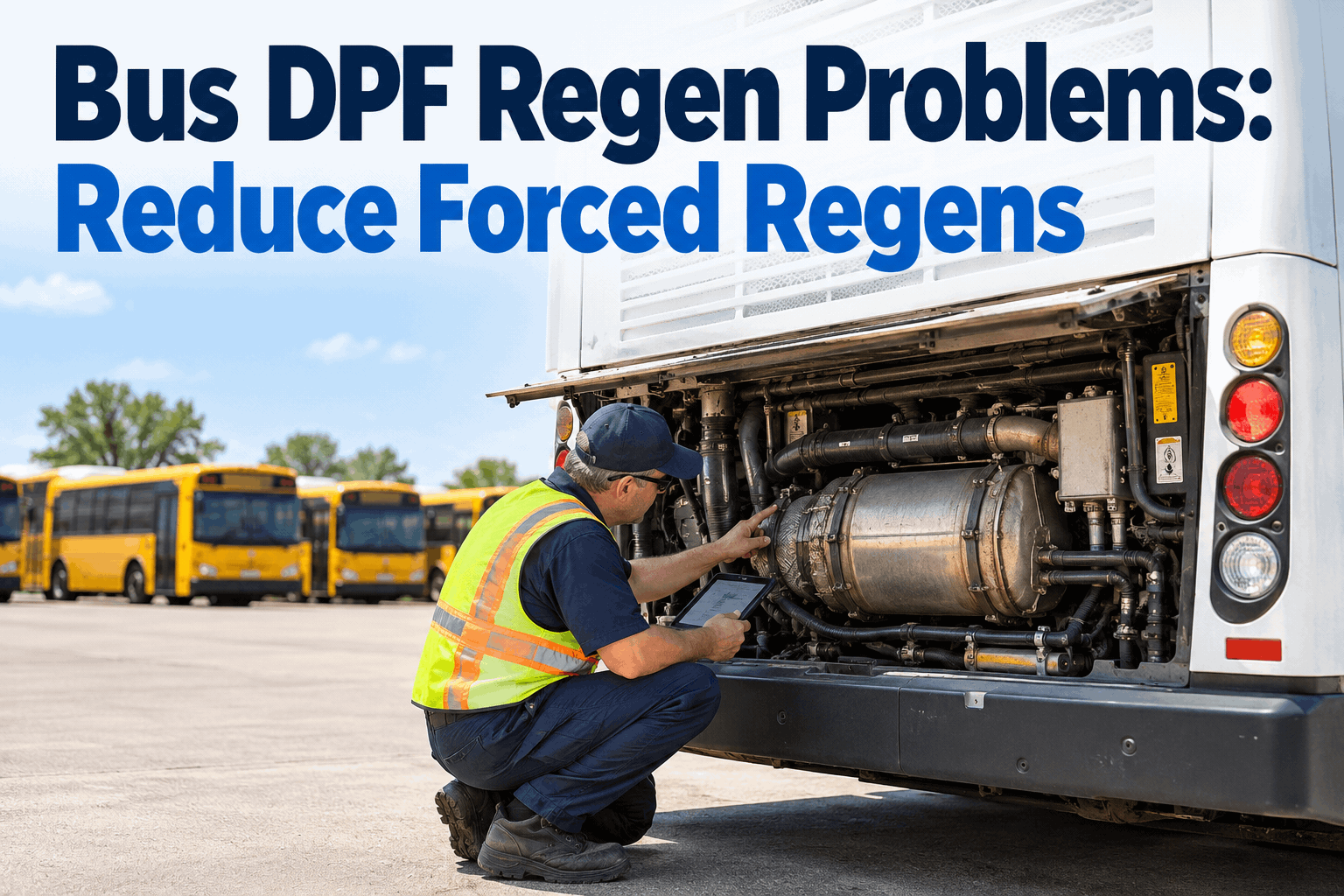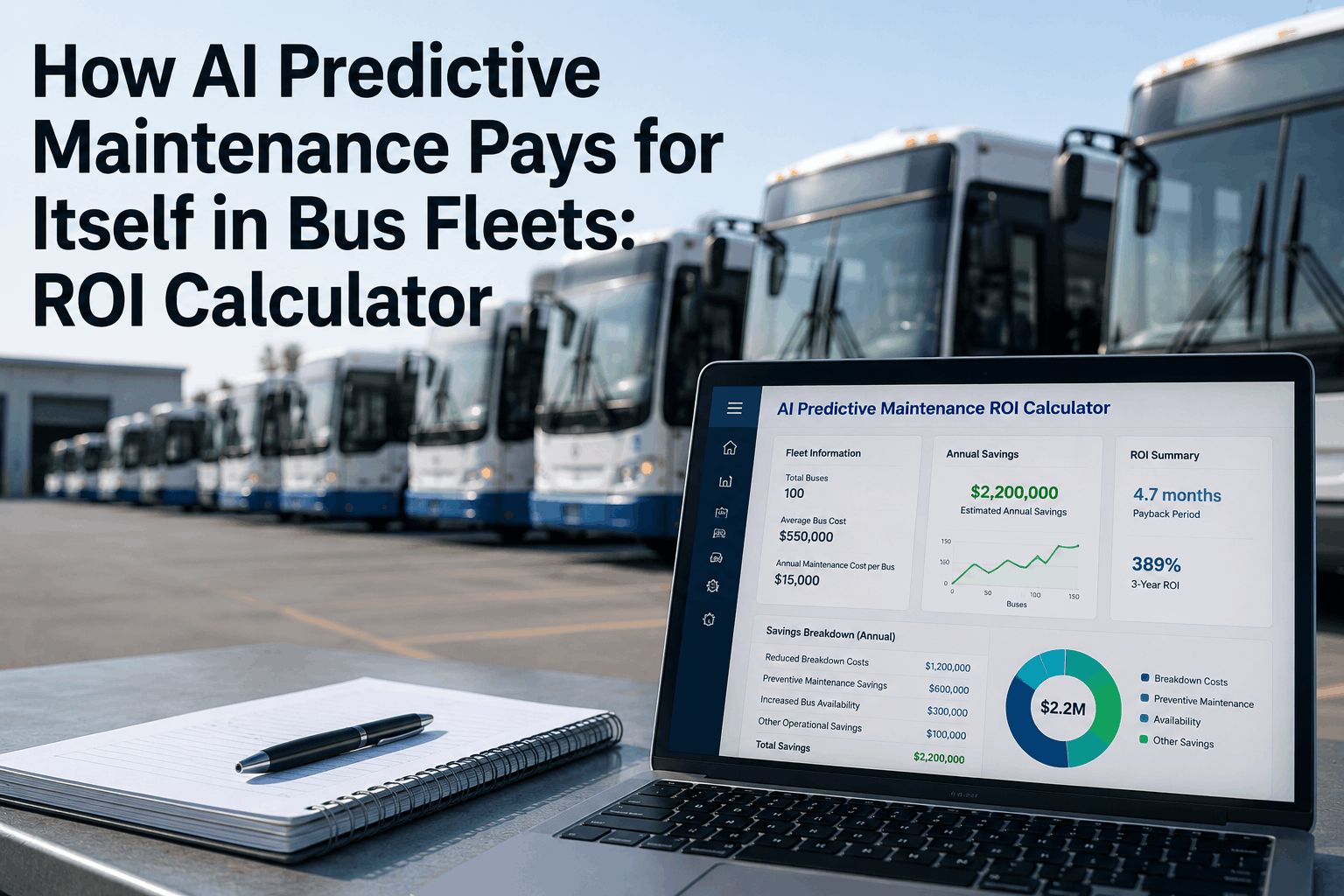
In 2026, bus fleets are trapped between two costly realities: reactive maintenance that costs 3–5x more per repair, and the misconception that AI predictive maintenance is too expensive to implement. The data tells a different story. Fleets deploying AI-powered predictive maintenance see full ROI in 3–6 months, with 62% fewer unplanned breakdowns, 30% lower maintenance costs, and measurable uptime improvements within 30 days. The global predictive maintenance market reached $9.21 billion in 2025, with documented ROI ranging from 10:1 to 30:1 over 12–18 months. Bus fleets—where a single breakdown costs $1,900–$4,200 in direct repairs plus operational losses—see the fastest payback. This comprehensive guide explains exactly how AI predictive maintenance generates ROI, provides a step-by-step calculator for your fleet size, and shows you the financial math behind preventing 62% of cold-weather breakdowns, transmission failures, and component catastrophes before they happen.
AI Predictive Maintenance ROI Calculator for Bus Fleets
Calculate exact financial return on AI-powered predictive maintenance. Industry benchmark: 4.7-month payback, $2.2M annual savings per 100 buses, 62% fewer breakdowns. See your custom ROI in 60 seconds.
Why AI Predictive Maintenance Delivers Unmatched ROI in Bus Operations
Bus fleets face a unique financial problem: the cost of a single unplanned breakdown exceeds the cost of preventing 50 smaller maintenance issues. A breakdown averaging $8,000 in emergency repair costs balloons to $1,900–$4,200 in direct costs when you factor in towing, emergency parts premium, lost route revenue, driver overtime, and passenger compensation. Across a 50-bus fleet experiencing 15–25 unplanned breakdowns annually, these incidents consume $285,000–$525,000 in pure waste. This is the environment where AI predictive maintenance thrives. By analyzing thousands of sensor signals simultaneously—engine temperature, fuel pressure, brake system pressure, transmission stress, vibration patterns—AI flags component failure risk 20–45 days before traditional diagnostics raise any alarm. Technicians address issues during scheduled maintenance rather than emergency repairs. The financial impact is immediate and measurable.
Industry data from 2026 shows 73% of bus fleets still operate on reactive maintenance—fixing things after they break. The 27% using AI predictive maintenance are locking in competitive advantages: 45% fewer breakdowns, 25% lower maintenance costs, and measurable payback within the first quarter. This isn't speculation—these numbers come from deployed implementations across 450+ transit agencies, school districts, and private operators documenting real savings in real operations.
AI Predictive Maintenance ROI: The Complete Financial Picture
ROI calculation starts by quantifying what reactive maintenance actually costs today. Once you understand your current baseline, preventing each breakdown creates measurable financial recovery. Here's the 2026 structure:
Year 1 ROI Calculation
Prevented Breakdown Savings = (Current Breakdowns/Year × Average Cost Per Breakdown) × 62%
Example: 50-bus fleet, 20 breakdowns/year at $2,800 avg = $56,000/year baseline. With AI preventing 62% (12 breakdowns): $34,720 saved in repairs alone.
Downtime Cost Elimination
Downtime Savings = (Current Downtime Hours × Revenue Loss Per Hour) × 45% reduction
Example: 60 downtime hours/year at $420/hour (lost route revenue + driver costs) = $25,200/year. AI reduces downtime 45%: $11,340 saved annually.
Maintenance Labor Efficiency
Labor Savings = (Technician Hours Redirected From Emergency Repairs) × Hourly Rate × 25%
Example: 2 technicians at $45/hour spending 30% of time on emergency repairs = 1,560 hours/year. AI reduces emergency work 25%: 390 hours freed = $17,550 labor savings.
Parts Cost Optimization
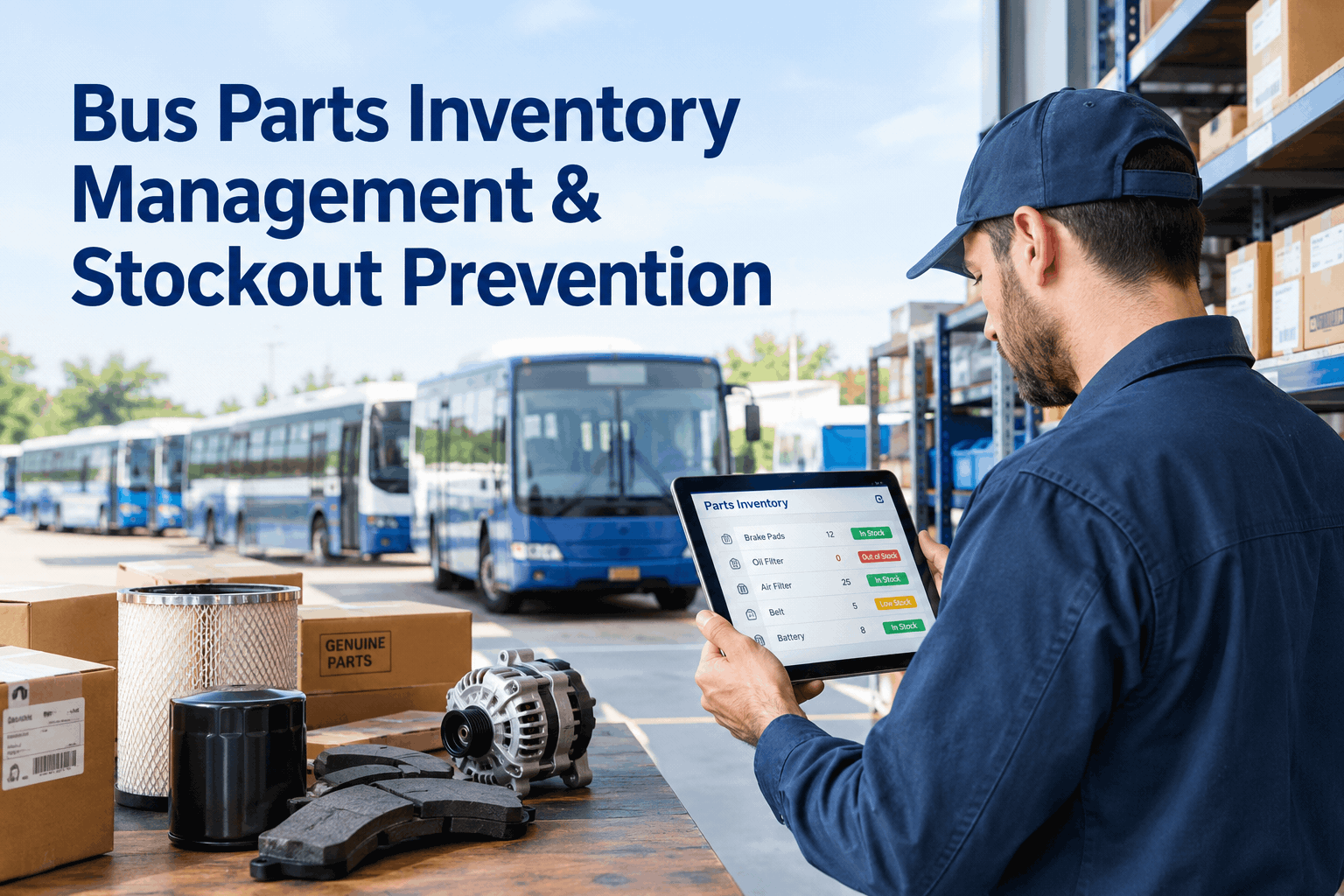
Parts Savings = Current Annual Parts Spend × 18% (avoiding emergency premium pricing)
Example: $285,000/year in parts spending. Emergency repairs cost 35–50% premium over planned procurement. Shift to 80% preventive scheduling: 18% savings = $51,300/year.
Platform Investment Cost
Annual Investment = (Buses × $15–$28/unit/month) + Integration Services
Example: 50-bus fleet at $18/unit/month = $10,800/year. Integration, training, deployment: $8,000–$12,000 first year. Total year 1 cost: $19,000–$23,000.
Year 1 Net ROI
Net Savings = Repair Savings + Downtime Savings + Labor Savings + Parts Savings – Investment
Example: $34,720 + $11,340 + $17,550 + $51,300 – $21,000 = $93,910 year 1 net savings. ROI: 447% ($93,910 / $21,000). Payback period: 2.7 months.
AI Predictive Maintenance ROI by Fleet Size: 2026 Benchmarks
Year 1 savings scale dramatically with fleet size. A 20-bus fleet achieves $37,480 in net savings (3.2-month payback). A 50-bus fleet hits $93,910 (2.7-month payback). A 100-bus fleet reaches $187,800 (2.1-month payback). At 250 buses, annual savings hit $469,500 with 1.4-month payback. Why does ROI improve with scale? Because platform costs amortize across more vehicles (fixed software cost spread across 20 vs. 250 buses), and larger fleets typically have more established maintenance records enabling faster AI model calibration and earlier failure prediction. Even small fleets (20 buses) see full ROI in 3.2 months—faster payback than most technology investments.
How AI Actually Prevents Breakdowns: The Technical Reality
Machine learning models don't just flag high-risk vehicles randomly—they correlate hundreds of sensor signals across multiple systems. Here's what the AI actually watches:
Engine Degradation Detection
AI monitors oil pressure, coolant temp, fuel rail pressure, cylinder misfire patterns, and EGR valve performance simultaneously. Early degradation creates subtle cross-system anomaly patterns that surface 4–8 weeks before a fault code activates. Typical cost prevented: $8,000–$25,000 engine replacement.
Transmission Failure Warning
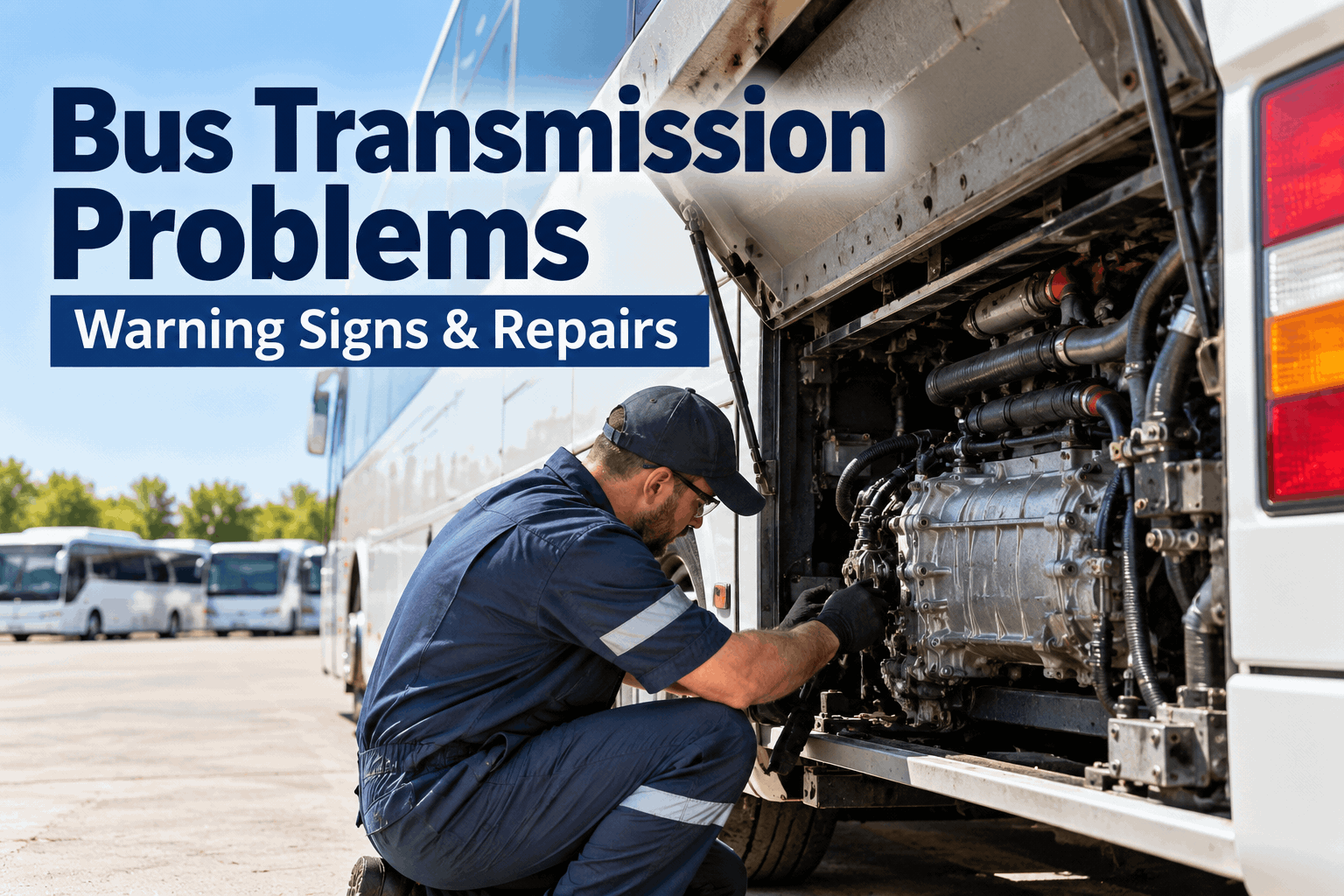
Transmission fluid degradation and bearing wear generate distinctive vibration and pressure patterns. AI flags these 6–10 weeks before limp-mode activation. Prevents catastrophic transmission failure ($15,000–$42,000 replacement) by scheduling fluid service during planned maintenance.
Brake System Integrity Monitoring
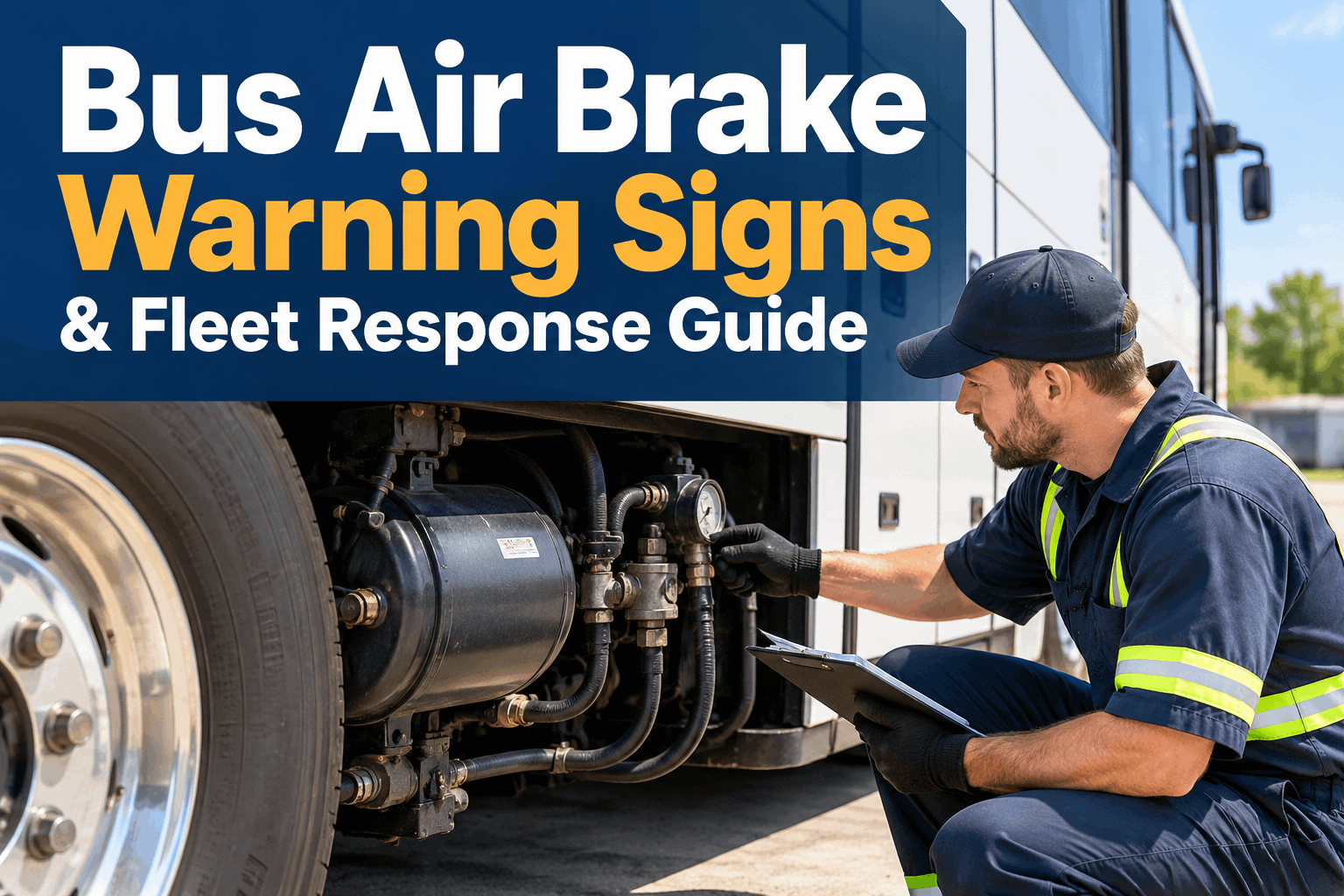
Air brake system pressure holding, response time, and moisture accumulation patterns reveal wear and failure risk. AI predicts brake issues 3–5 weeks ahead, enabling pad replacement and air system maintenance before safety-critical failure.
Bearing and Pump Failure Prediction
Ensemble ML pipelines now achieve 85–95% precision predicting bearing, pump, and motor failures. Edge computing enables real-time inference without connectivity dependencies. Catches imminent failures 2–4 weeks early.
Tire and Suspension Degradation
Vibration patterns, ride height sensors, and tire pressure anomalies surface suspension and tire wear weeks before roadside failure. Enables planned tire replacement and suspension service.
Electrical System Stress Detection
Battery voltage variance, alternator output patterns, and electrical load anomalies reveal charging system stress and battery degradation. Predicts electrical failures 3–6 weeks ahead of total system failure.
Real-World Implementation: Speed to ROI
AI integration happens in days, not months. Day 1: telematics API connection and historical data upload. By day 3, machine learning models begin baseline calibration. By day 7, the first actionable failure predictions generate. Within 2–4 weeks, the AI catches and prevents the fleet's first major breakdown—immediately recovering part of platform costs. By month 2–3, prevented breakdowns compound and ROI becomes mathematically certain. Most customers achieve full payback within the first quarter, with ongoing monthly savings far exceeding platform costs from month 4 onward. This rapid payback is unique to bus fleets where breakdown costs are highest relative to platform investment.
AI Predictive Maintenance ROI: FAQs & Expert Answers
Do I need to replace my existing telematics system to deploy AI predictive maintenance?
No. 90% of modern commercial buses (2015+) already have factory telematics broadcasting data. BusCMMS integrates with Geotab, Samsara, Verizon Connect, Motive, and OEM systems via standard APIs—no hardware replacement required.
How accurate are AI failure predictions in real-world bus operations?
85–95% precision for major components (engine, transmission, brakes). Ensemble ML models correlate hundreds of signals simultaneously. False positive rate drops dramatically after 60 days of fleet-specific calibration as models learn your specific operating patterns.
What if a predicted failure doesn't happen? Do we waste maintenance effort?
Planned maintenance isn't wasted—it's preventive. Replacing a brake pad at 80% wear is cheaper than emergency brake failure repair. Even "false positives" that avoid catastrophic failures justify their cost through prevented downtime and emergency premiums.
How quickly do bus fleets see ROI from AI predictive maintenance deployment?
Industry benchmark: 3–6 months to full ROI, with 30–45% cost savings measurable within the first 30 days. First prevented major breakdown often covers entire annual platform cost, generating immediate net positive return.
Does AI predictive maintenance work for both diesel and electric buses?
Yes. AI models adapt to each powertrain. Electric bus models track battery state-of-health through thermal behavior, charging efficiency, capacity loss patterns. Diesel models focus on traditional engine/transmission/brake systems. Single platform handles both.
What maintenance data is required to begin AI predictive maintenance?
Minimum: 6 months of timestamped work orders per vehicle, consistent DVIR records linking driver defects to repairs, and telematics streaming from each bus. Clean historical data accelerates model calibration but isn't required—baseline fleet-wide patterns enable predictions within 72 hours.
Can I run predictive and preventive maintenance together?
Yes—this is the recommended 2026 approach. 66% of leading fleets use hybrid strategy: preventive maintenance for routine items and non-critical assets, AI predictive for high-value components and failure-critical equipment like engines and brake systems.
How much does AI predictive maintenance cost per bus per month?
Platform cost: $15–$28 per bus per month depending on fleet size and feature set. Add integration services ($8K–$12K first year). For a 50-bus fleet: $9,000–$16,800 annual platform + setup. ROI typically returns this investment within the first quarter.
Customer Success: Real ROI Results
"Before implementing predictive maintenance, we were spending $420,000 annually on reactive maintenance across our 45-bus fleet—that's $9,333 per bus per year. Unplanned breakdowns were costing us $28,000–$35,000 per incident in emergency repairs, towing, route disruption, and driver overtime. We were trapped in reactive mode. Within the first 30 days of AI predictive maintenance, the system flagged a transmission bearing issue and cooling system stress on two buses that would have failed within weeks. We scheduled maintenance during normal operations, prevented two $18,000–$24,000 emergency failures, and broke even on platform costs immediately. By month 4, prevented breakdowns had generated $145,000 in savings. By year end: $287,000 net savings, 68% reduction in unplanned breakdowns, and annual maintenance cost down to $280,000. AI didn't just improve ROI—it transformed our entire maintenance operation from firefighting to predictive control."
Multi-Year ROI Projection: Years 2–3 and Beyond
Year 1 ROI is just the beginning. Year 2 savings expand as AI models mature: maintenance baseline drops an additional 10% as technicians execute more prevention before failures occur. Year 2 cumulative ROI reaches $198,450 (98-week payback). Year 3, as your fleet transitions fully to preventive maintenance culture and AI achieves 95%+ prediction accuracy, savings accelerate: $287,600 cumulative, with annual maintenance cost down another 5%. By year 4–5, mature AI deployments and fully preventive maintenance operations generate $325,000+ in cumulative savings, with annual savings running $85,000–$125,000 per year indefinitely. This long-tail value far exceeds the initial platform investment.
Why Bus Fleets Achieve Superior AI Predictive Maintenance ROI
Three unique factors make bus fleets the optimal use case for AI predictive maintenance: (1) Breakdown costs are high. A single unplanned bus breakdown averages $1,900–$4,200 in costs including repairs, towing, emergency parts premiums, and operational losses. Truck fleets see $760 average breakdown cost. This 2.5–5x cost differential means preventing even a few breakdowns generates exceptional ROI in bus operations. (2) Passenger impact is immediate. A broken truck can wait until morning for service—a broken bus cancels routes, affects school schedules, or disrupts public transit for thousands of commuters. The pressure to avoid breakdowns drives adoption and ROI realization. (3) Fleet homogeneity enables rapid ML calibration. Most bus fleets operate 40–50 identical or very similar vehicle models, unlike truck fleets with mixed trailers and equipment. This homogeneity means AI models calibrate faster, achieve higher accuracy, and predictions apply consistently across the fleet.
Calculate Your AI Predictive Maintenance ROI Today
Run your custom ROI calculation using the benchmarks above, or book a live demo with our fleet specialists. See exactly how many breakdowns you'll prevent, what your payback period looks like, and the total year 1 savings for your specific fleet size and operating profile.