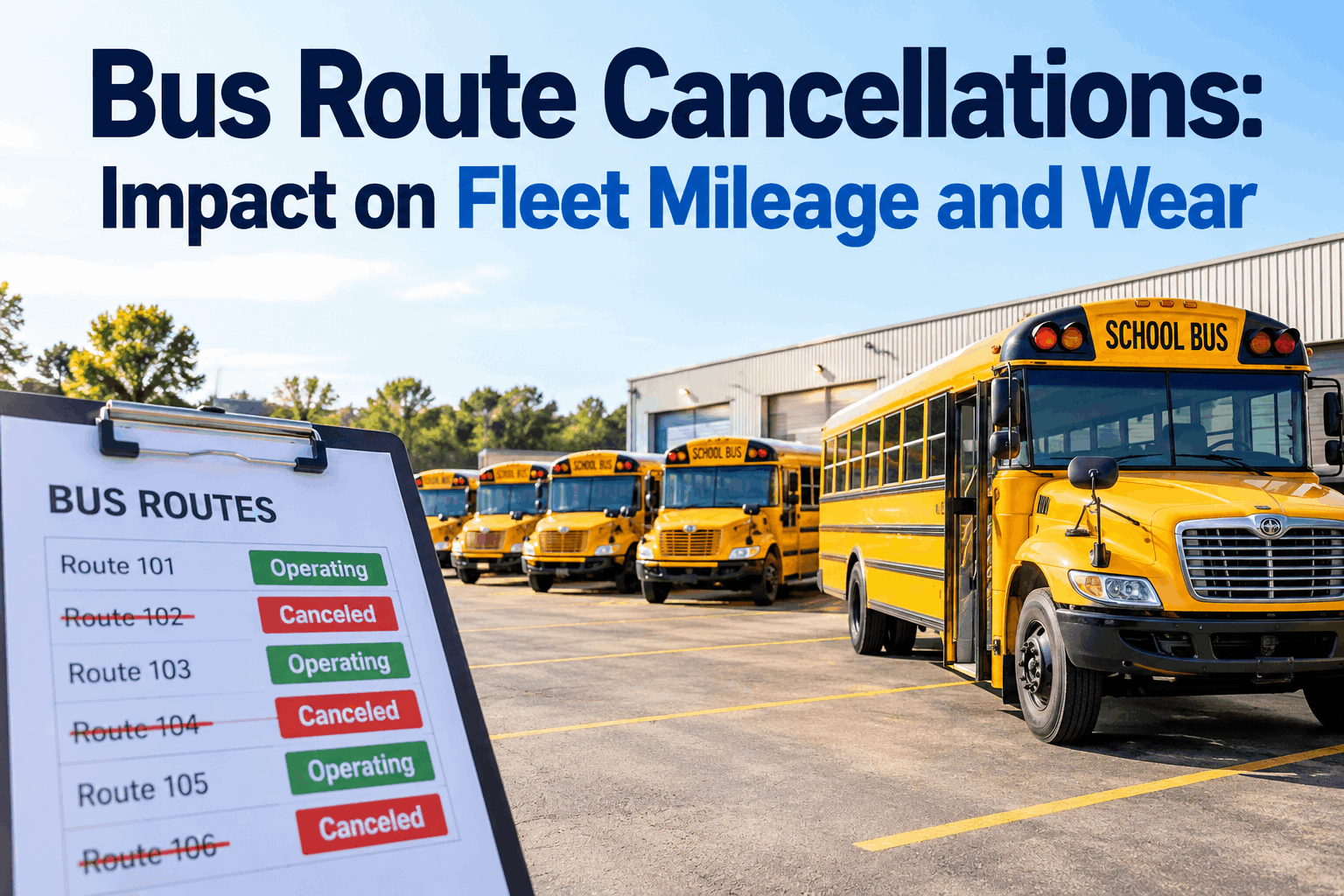
Bus Route Cancellations: Impact on Fleet Mileage and Wear
When a bus route gets cancelled — a driver shortage, a budget cut, a consolidation — everyone focuses on the students or riders affected. Almost nobody thinks about the fleet. But bus route cancellations don't make miles disappear; they move them. The cut route's students still need covering, so its miles pile onto the buses that remain, and the bus that ran it goes quiet. Both create wear problems no one is watching.
ROUTE CHANGES + UTILIZATION
Bus Route Cancellations: Impact on Fleet Mileage and Wear
A cancelled route doesn't erase its miles — it redistributes them. Remaining buses wear faster, parked buses quietly decay, and PM intervals drift. Here's how to manage the fleet-side ripple.
0miles actually disappear — they just move
2wear problems: overworked survivors + idle decay
PMintervals drift when the load shifts
THE REDISTRIBUTION RIPPLE
Route cancelleddriver shortage / budget cut
splits into
Miles pile onremaining buses wear faster
Bus sits idleparked unit quietly decays
The Two Fleet Problems Bus Route Cancellations Create
A cancellation hits the fleet from both ends at once. The buses still running take on more, and the bus that stops running starts to rot in place — opposite problems, same root cause.
OVERWORKED SURVIVORS
Whatremaining buses absorb the cut miles
Effecthit PM & wear intervals sooner
Riskearly rebuilds, more road calls
Missed ifPM still runs on the old schedule
IDLE DECAY
Whatthe cut route's bus sits parked
Effectbrakes rust, fluids age, battery drains
Riskwon't start / fails when recalled
Missed ifparked buses drop off the PM radar
Both problems share one cause: PM and wear tracking that assumes routes never change. When the load shifts, a fixed schedule over-services the idle bus and under-services the overworked one.
The costs of a cancellation's fleet ripple are real but delayed — they show up months later as failures nobody connects back to the route change.
Accelerated wear
Survivor buses rack up miles fast, reaching rebuilds and replacement years ahead of plan.
Missed PM windows
A bus doing 50% more miles hits its service interval early — and a calendar-only schedule misses it.
Dead parked buses
The idle unit you meant to save won't start when you recall it — flat battery, seized brakes, bad fuel.
Blindsided planning
Replacement forecasts built on old mileage go wrong fast when the real load quietly redistributed.
The trap is that a cancellation feels like less work for the fleet — fewer routes running. In wear terms it's often more: concentrated miles on fewer buses plus idle-decay risk on the rest.
A cancellation should trigger a fleet response, not just an operations one. Four steps keep the wear ripple from turning into failures down the line.
1
Re-measure the New Load
After the change, pull updated miles per bus. The survivors' numbers will jump — you need the real new baseline before anything else.
2
Re-trigger PM on Real Miles
Shift the overworked buses onto mileage-based PM so their services fire on actual use, not the old calendar that assumed the previous load.
3
Rotate to Spread the Hit
Don't let the same few buses absorb every cut route. Rotate assignments so the added miles distribute, instead of burning out a handful of units.
4
Put Parked Buses on Idle-Care
A stored bus still needs periodic starts, brake exercise, and fluid checks — a light PM schedule so it actually runs when you recall it.
Step 2 is the linchpin: the moment PM fires on real miles instead of a fixed calendar, a route change stops silently pushing your survivor buses past their service windows.
The BusCMMS Analytics for Managing Route Change Impact
Route changes are constant; the fleet fallout only hurts when it's invisible. BusCMMS makes the redistribution visible and keeps both the busy and the parked buses on the right schedule.
Per-Bus Mileage Analytics
See how miles redistribute after a cancellation, so the newly overworked buses are obvious right away.
see the shift
Mileage-Based PM Triggers
Service fires on each bus's real odometer, so a survivor's added miles pull its PM forward automatically.
PM on real use
Telematics Odometer Feed
Auto-pull live miles from Samsara, Geotab, and others, so the new load is measured, not estimated after a change.
live data
Idle-Bus Care Schedules
Put parked units on a light PM loop — periodic starts, brake exercise, fluid checks — so they start when recalled.
no dead spares
Replacement Re-Forecasting
Re-project end-of-life on the new mileage, so capital plans reflect the real load after the change.
plan on truth
Board-Ready Impact Reports
Show the fleet cost of a route decision with data, so cuts are made with the wear impact on the table.
full picture
A generic tool never notices a route changed; a bus-built platform re-baselines the whole fleet around the new reality — BusCMMS is typically live in 2–4 weeks. Sign up free and manage route-change impact on rails.
A Transportation Director's Take
Key Takeaways on Bus Route Cancellations
A cancelled route is a fleet event, not just an operations one. Five things to act on.
The key thing to understand is that cancelling a route doesn't make its miles disappear — it redistributes them. The students or riders on a cut route usually still need covering, so those miles shift onto the buses that remain in service. That creates two opposite fleet problems at once. First, the surviving buses now run more miles than before, which means they reach mileage-based service intervals, wear items, and rebuilds sooner than planned — and if those buses are still on a fixed calendar PM schedule, the service windows get missed. Second, the bus that used to run the cancelled route often goes idle or parked, and an idle bus decays: brakes rust, fluids and fuel age, batteries drain, and it may not start when you try to recall it. So a cancellation that feels like less work for the fleet is often more wear, just concentrated differently. The right response is to treat any route change as a fleet event: re-measure per-bus mileage, reset preventive maintenance to the new real load, rotate assignments to spread the added miles, and put parked buses on a light idle-care schedule.
Why is a parked bus a maintenance risk?+
Because vehicles are designed to run, and sitting still causes its own kind of damage. When a bus is parked for weeks or months after a route is cancelled, several things degrade even though it's not accumulating miles. The battery slowly self-discharges and can sulfate, losing capacity or dying entirely. Brake rotors corrode because they're not being used and cleaned by regular braking. Fluids age and can lose their protective properties, and fuel can degrade or gum up over time. Tires can develop flat spots and lose pressure. Seals and rubber components can dry out. The result is that the idle bus you set aside to save wear may not start — or may fail almost immediately — when you try to bring it back into service. That's especially painful because parked buses are often exactly the units you're counting on as reserves. The fix is a light idle-care PM schedule: periodic engine starts, brake exercise, battery maintenance, and fluid checks, so a stored bus stays genuinely ready rather than quietly rotting in the yard.
How should preventive maintenance change after a route is cut?+
The core shift is from a fixed schedule to one that reflects each bus's new real load. Before a cancellation, your PM intervals were calibrated to a certain distribution of miles across the fleet. After it, that distribution changes — some buses take on significantly more miles, and others take on far fewer or none. If PM keeps running on the old calendar, two errors follow: the overworked survivor buses get under-serviced relative to their heavier use, drifting past the mileage where they actually need attention, while the parked buses get over-serviced on a calendar basis for work they no longer need. The correction is to move the busy buses onto mileage-based PM triggers, so their services fire on actual odometer readings and automatically pull forward as the miles climb. Meanwhile, the parked buses shift to a light idle-care schedule focused on the decay risks of sitting rather than the wear risks of running. Re-measuring mileage right after the change and resetting the schedules to match is the single most important maintenance response to a route cancellation.
Should you keep or sell buses when routes are cancelled?+
That's a capital decision, but it should be made with accurate fleet data rather than assumptions — and route cancellations tend to distort that data. If a cancellation is expected to be temporary (a driver shortage you're actively hiring against, for example), keeping the bus as a reserve can make sense, but only if you actually maintain it with an idle-care schedule so it's usable when you need it. A parked bus that decays into an unstartable unit gives you the worst of both: you've kept the capital tied up and lost the availability anyway. If the cancellation is likely permanent, then the redistribution data matters for the sizing call: once you re-measure how the remaining routes load your buses, you can see whether you genuinely have surplus units or whether the survivors are now running hot enough that you need every bus. The mistake is deciding fleet size on pre-cancellation mileage. Re-baseline first, confirm how the real load redistributed, then decide — and factor the accelerated wear on the survivors into your replacement forecast.
How does BusCMMS help manage route change impact?+
BusCMMS makes the fleet-side ripple of a route change visible and keeps both busy and parked buses on the right schedule. Per-bus mileage analytics show how miles redistribute after a cancellation, so the newly overworked buses are obvious immediately rather than discovered months later as failures. Mileage-based PM triggers fire each bus's service on its real odometer, so a survivor's added miles automatically pull its preventive maintenance forward instead of drifting past a fixed calendar. A telematics odometer feed auto-pulls live mileage from systems like Samsara and Geotab, so the new load is measured, not estimated. Idle-bus care schedules put parked units on a light PM loop — periodic starts, brake exercise, fluid checks — so reserves actually run when recalled. Replacement re-forecasting re-projects end-of-life on the new mileage so capital plans reflect reality. And board-ready impact reports let you show the fleet cost of a route decision with data, so cuts are made with the wear consequences on the table. Because it's purpose-built for bus fleets, it's typically live in two to four weeks.