A 52-bus Missouri school district ran every bus on a fixed 90-day PM calendar. Their rural routes hit 6,500 miles in those 90 days. Their summer driver-ed buses hit 900. Same calendar. Same oil changes. Same brake inspections — regardless of what the odometer said. The high-mileage buses were running late on every service. The low-mileage buses were getting unnecessary PMs that burned labor and parts budget. Nobody flagged it because the calendar said it was time. That is the core problem with choosing the wrong PM scheduling method — and it costs U.S. bus fleets an estimated $2.1 billion in avoidable maintenance costs every year.
Data from 400 U.S. fleets shows mileage-based PM scheduling reduces unnecessary maintenance by 22% and catches 31% more real-world wear events than calendar-only intervals. Here is why — and how to automate both triggers simultaneously.
Most U.S. bus fleets pick a lane — either they schedule PMs by calendar (every 90 days, every 6 months) or by mileage (every 5,000 miles, every 15,000 miles). Neither approach alone is correct. The reason is simple: buses in the same fleet operate under radically different conditions. A school bus running urban routes in Chicago may accumulate 500 miles per week. A backup activity bus in a rural Nebraska district may accumulate 80 miles per week. Apply the same 90-day calendar PM to both, and you are over-maintaining the rural bus and dangerously under-maintaining the urban one.
According to BusCMMS fleet data, the industry average PM completion rate sits between 70–75%, meaning roughly one in four scheduled preventive maintenance tasks is either late or missed entirely. Top-performing fleets — those using automated PM scheduling software with dual-trigger logic — maintain PM completion rates of 92% or higher. That 17–22 percentage point gap translates directly into fewer breakdowns, longer vehicle lifespans, and lower cost-per-mile across the fleet.
The U.S. Department of Energy data confirms that preventive maintenance programs save 12–18% compared to reactive maintenance — and when you factor in emergency labor rates running 1.5–2× standard, expedited parts, towing, and DOT compliance exposure, a reactive repair costs 3–5× more than the same job done preventively. A $420 brake job scheduled on time becomes $1,850+ after failure. The scheduling method you choose directly determines which of those numbers your fleet faces.
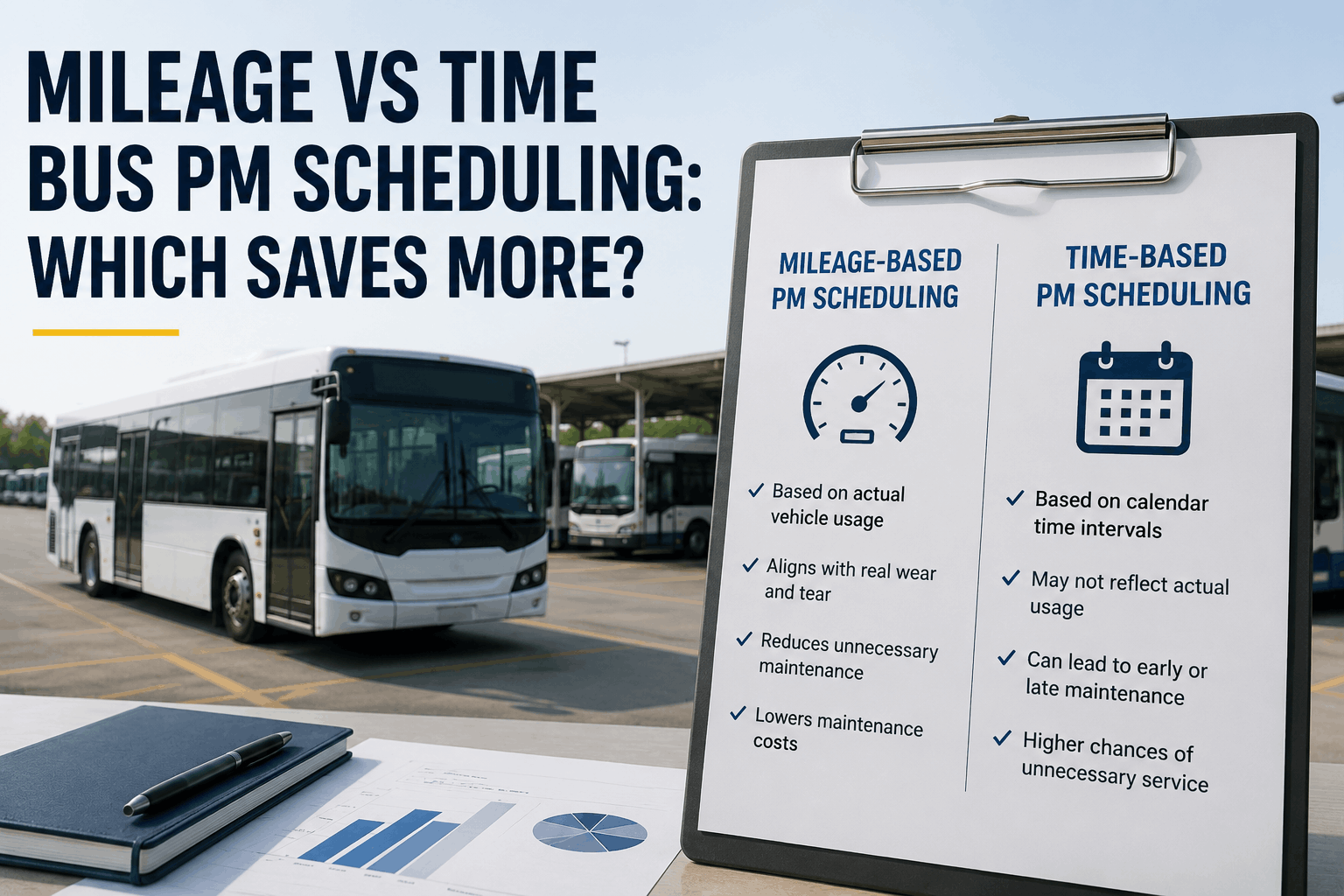
Mileage-based PM scheduling triggers maintenance tasks when an odometer threshold is reached — typically structured as Class A (5,000–10,000 miles), Class B (10,000–20,000 miles), Class C (30,000–50,000 miles), and Class D major overhaul intervals (100,000+ miles). The logic is grounded in mechanical reality: brake pads, engine oil, transmission fluid, belts, and tires wear proportionally to distance traveled, not to the passage of time. A bus that sits in the yard for 60 days has not worn its brake pads. A bus that runs a 45-mile double route every school day has.
For high-utilization fleets — urban transit, charter operators, and school districts with dense route networks — mileage-based scheduling ensures that service happens when components actually need attention. It eliminates the "calendar creep" problem where a bus exceeds its service window because the route ran longer than planned. It also eliminates the opposite problem: performing oil changes on a backup bus every 90 days when the bus only accumulated 900 miles and the oil has another 4,100 miles of useful life remaining.
The challenge with pure mileage-based scheduling is idle time and fluid degradation. Engine oil breaks down chemically over time, not just through use. Coolant, brake fluid, and power steering fluid have calendar-based degradation characteristics regardless of mileage. A bus that sits through a 10-week summer break with no route miles accumulating still needs its fluids checked on a calendar basis. Mileage-only scheduling misses this entirely — which is why it cannot stand alone as a complete PM strategy.
Calendar-based PM scheduling triggers maintenance at fixed time intervals — monthly safety checks, quarterly fluid inspections, semi-annual brake evaluations, and annual DOT compliance inspections. For components that degrade over time regardless of vehicle use, calendar triggers are not just useful — they are the only correct approach. Rubber seals, belts, hoses, and brake fluid absorb moisture over time. Battery terminals corrode. Air bags develop micro-cracks during temperature cycling. None of these processes care about your odometer.
Calendar-based scheduling also aligns naturally with federal and state compliance requirements. FMCSA annual inspection requirements are calendar-based. DOT inspection windows are calendar-based. State school bus inspection certifications are calendar-based. A fleet that schedules entirely by mileage will still need calendar anchors for compliance — meaning a hybrid approach is operationally mandatory for any regulated U.S. fleet operator.
Where time-based scheduling fails is in its assumption of uniform utilization. When a fleet manager sets a 90-day PM interval, that interval implicitly assumes every bus in the fleet accumulates roughly the same mileage per day. In reality, utilization variance across a typical U.S. school bus fleet ranges from 80 miles per week to 600+ miles per week on the same property. A single calendar interval applied across that range creates a maintenance program that is simultaneously too aggressive for low-use buses and dangerously inadequate for high-use buses. The result: wasted labor budget on unnecessary services and missed wear events on the vehicles that carry the most students.
The debate between mileage-based and time-based scheduling is somewhat of a false choice. The correct answer — and the one adopted by every top-performing fleet in the BusCMMS 12-month study — is dual-trigger PM scheduling: whichever threshold arrives first, mileage or calendar, initiates the service. This approach closes the coverage gaps that exist on both sides of the single-trigger debate.
The financial stakes of choosing the wrong PM scheduling method are documented across thousands of U.S. fleet operations. BusCMMS data from 400 fleets shows that fleets running time-only PM scheduling average $0.31 per mile in maintenance costs, while fleets running dual-trigger automated scheduling average $0.19 per mile — a 38% reduction that compounds across every bus in the fleet, every mile of the year. For a 50-bus fleet running an average of 15,000 miles per bus per year, that difference amounts to $90,000 in annual maintenance savings. For a 200-bus district, it exceeds $360,000 per year.
The breakdown incident rate tells an equally clear story. The BusCMMS case study of Interstate Transport Services — a 400-bus operator running routes from Arizona to Minnesota — documented 312 monthly roadside breakdowns under their old time-based PM program, at $3,800 per incident. After switching to automated PM scheduling with mileage and calendar dual triggers, breakdowns dropped 78% and the fleet achieved 99.3% availability — a $4.2 million annual saving on a fleet of 400 buses.
Emergency repairs — the direct consequence of missed PMs — cost 3–9× more than the preventive service they replace according to BusCMMS fleet data. A single missed oil change can cascade into diagnostics, towing, emergency repair, extended downtime, and DOT compliance fines totaling $8,000–$14,000 versus an $85 scheduled service. The math is not complex: every missed PM is a gamble with a terrible expected value, and the scheduling method determines how many PMs get missed.
Setting the right PM intervals requires matching trigger type to component wear characteristics, then adjusting for your specific fleet's operating conditions. OEM schedules assume average conditions — most U.S. bus fleets operate in conditions that are meaningfully different from average, either more severe (urban stop-and-go, mountain routes, extreme climates) or lighter (rural low-mileage, reserve fleet). Here is the standard framework used by top-performing U.S. fleets, which BusCMMS encodes into automated PM profiles for each bus type.
BusCMMS auto-assigns each bus a PM profile based on its type — diesel, CNG, or electric — and adjusts trigger thresholds for severe duty cycles. Fleets running mountain routes, extreme heat, or frequent stop-and-go operations typically reduce mileage intervals by 15–25% from OEM baseline to account for accelerated component wear. The system tracks your fleet's actual failure patterns over time and flags when brake wear, tire wear, or fluid degradation is consistently occurring ahead of the standard interval — signaling that an interval adjustment is warranted.
For electric buses — now representing a growing segment of U.S. school and transit fleets following the EPA's Clean School Bus program — BusCMMS handles battery state-of-health monitoring, thermal management coolant intervals, regenerative braking system checks, and charging infrastructure reliability in the same unified PM scheduling platform as traditional diesel maintenance. As fleets move toward mixed diesel-electric operations, a single platform that handles both is no longer a luxury — it is an operational requirement.
The scheduling method debate — mileage vs. time — becomes somewhat academic when the underlying tracking system is manual. Spreadsheets, paper PM cards, and whiteboard schedules all share the same fundamental failure mode: they require someone to remember to check them, to update them accurately, and to act on what they say. When a bus runs an unexpected detour route for three weeks and accumulates 800 extra miles, a spreadsheet does not know. When a bus returns from summer storage after 14 weeks of sitting, a paper PM card does not trigger a fluid check. When a mechanic marks a PM complete but skips three items, there is no audit trail.
BusCMMS solves this through live telematics integration. The platform connects directly to your GPS and telematics provider, pulling real-time odometer data for every bus in the fleet. When a bus hits its mileage threshold — regardless of whether that happens in week 8 or week 14 of the cycle — the system fires a work order automatically. When the calendar trigger hits first because the bus has been running light miles, the calendar fires instead. No human has to remember to check. No spreadsheet has to be manually updated. The system runs the math on every bus, every day, and surfaces exactly what needs service and when.
The most common cause of missed PMs in U.S. bus fleets, according to BusCMMS data, is manual scheduling without real-time mileage integration. Buses running heavier routes — summer surges, detours, extra service days — exceed their service windows with no alert firing because the spreadsheet still shows the next service as three weeks away. The solution is not a better spreadsheet. It is a system that removes humans from the tracking loop entirely and lets the odometer drive the schedule.
BusCMMS is built exclusively for bus fleets — not adapted from a generic CMMS, not a fleet management tool that handles buses as an afterthought. The PM scheduling engine is pre-loaded with federal and state inspection schedules for all 50 U.S. states, meaning compliance windows are built into the system at setup — not manually configured by your maintenance manager. DOT annual inspection deadlines, FMCSA 49 CFR 396.11 DVIR requirements, state school bus certification intervals — all are tracked automatically with 30-, 60-, and 90-day alert windows before any deadline expires.
The scheduling engine supports four trigger types simultaneously: mileage, engine hours, calendar date, and fuel consumption. For each bus, each component, and each service class, BusCMMS fires the work order on whichever trigger arrives first. A high-mileage urban bus gets its Class A service when the odometer hits 5,000 miles — even if the calendar says it has three more weeks. A summer-idle backup bus gets its fluid checks when the 90-day calendar trigger fires — even if the odometer has barely moved. The system does not treat all buses the same because they are not the same.
When a PM trigger fires, BusCMMS auto-generates a work order assigned to your mechanic, with parts pre-populated from the PM template, labor time estimated from historical data, and priority ranked against other open work orders. Your mechanic closes the work order on their phone from under the bus — checking each component individually, not as a single "PM — complete" checkbox. When they find a worn component, the failed item auto-generates a follow-up repair order that stays in the system until resolved. Every step is timestamped, digitally signed, and stored permanently — audit-ready in one click when the DOT inspector arrives.
Should my bus PM intervals be based on mileage or calendar time?
What is the standard mileage-based PM interval for school buses in the U.S.?
What happens to my PM schedule when a bus runs extra mileage during summer programs?
How much can switching to mileage-based PM scheduling save my fleet?
Do DOT and FMCSA compliance requirements use mileage or time triggers?
Can BusCMMS handle both diesel and electric bus PM scheduling in the same platform?
What is a good PM completion rate benchmark for a U.S. bus fleet?
How does BusCMMS know when to adjust PM intervals for my specific routes?
What is the cost difference between preventive and reactive bus maintenance in the U.S.?
The mileage vs. time debate is really a question about which buses your fleet is willing to under-maintain. A time-only schedule under-maintains your high-mileage buses. A mileage-only schedule under-maintains your low-mileage and idle buses. Neither answer is acceptable when the vehicles carry children or fare-paying passengers. The correct approach — dual-trigger scheduling with live odometer integration — is not a premium option. It is the minimum viable PM strategy for any U.S. fleet operator who takes roadworthiness seriously. BusCMMS is the only platform built specifically for bus fleets that delivers this out of the box, pre-loaded with every federal and state compliance schedule, without requiring a maintenance manager to configure it from scratch.
Mileage-based PM scheduling reduces unnecessary maintenance and catches more real-world wear events on high-utilization buses. Time-based scheduling covers fluid degradation, seal and rubber deterioration, and all federal compliance windows. Neither approach alone is sufficient for a mixed-utilization U.S. bus fleet. The answer — automated dual-trigger scheduling where the odometer and the calendar both drive work orders — is what separates the 92%+ PM completion fleets from the 70–75% industry average. BusCMMS delivers that system pre-built, connected to your telematics, and loaded with every state compliance deadline your fleet faces. The $85 oil change or the $14,000 engine repair — your scheduling method determines which one your fleet pays.