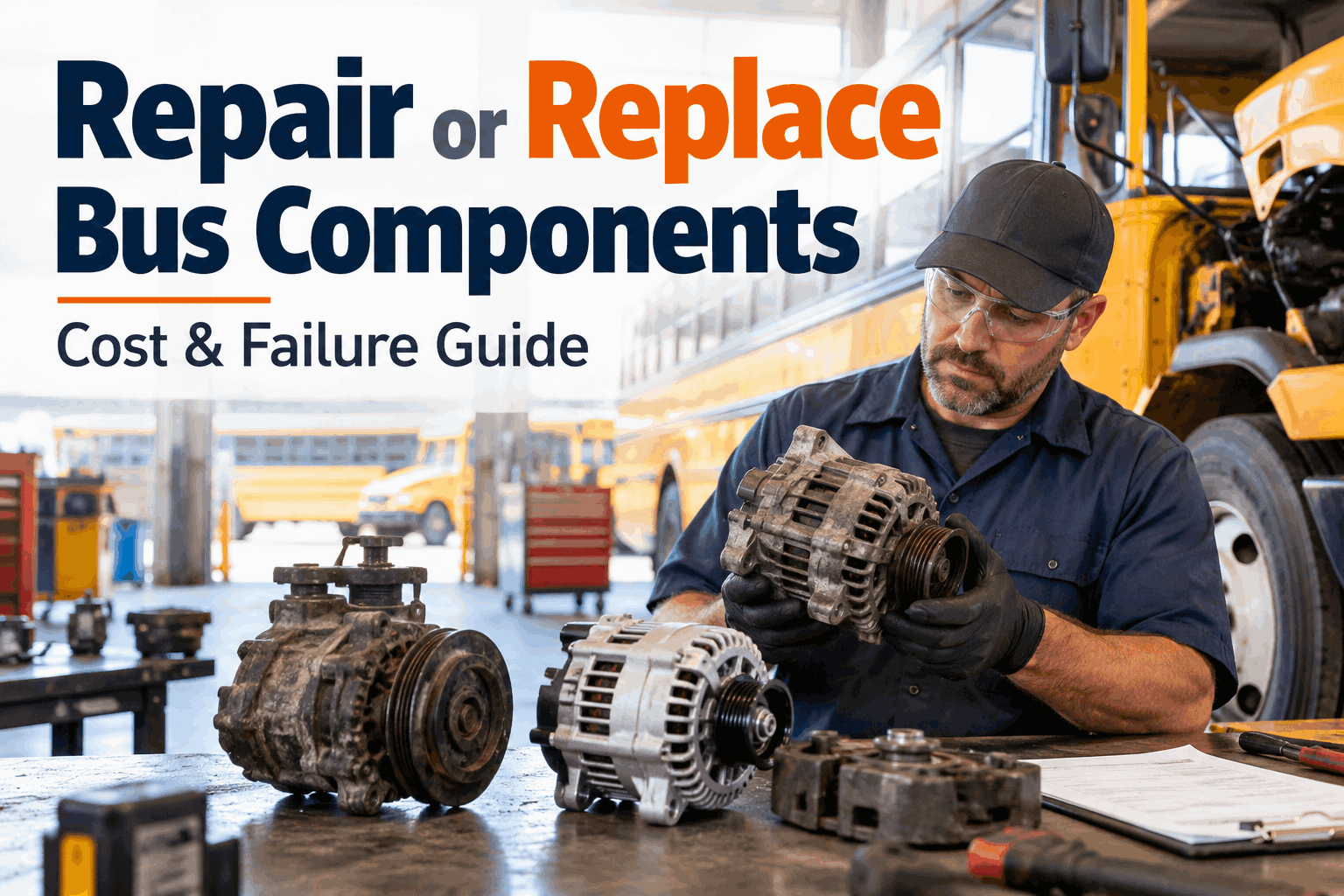
A compressor fails on bus 14. The shop can rebuild it for a few hundred dollars, or drop in a new one for more. Rebuild looks cheaper — until you remember this is the third time that compressor has been in your bay this year. The decision to repair or replace bus components is made at the parts counter every week, usually on gut feel and the lower invoice, and that is exactly how fleets bleed money on parts that were never going to last. Getting it right takes four numbers you can actually pull, and you can see those numbers on your own parts history in a demo.
Repair or Replace Bus Components: A Cost and Failure Decision Guide
The cheaper invoice is not always the cheaper decision. Weigh repair cost, failure history, downtime, and remaining part life — and know when a repeat failure is telling you to stop rebuilding.
The Four Factors That Decide Repair or Replace
Every component decision comes down to the same four questions. The shop that asks all four — not just "what does the repair cost?" — stops paying twice for the same failure.
1. Repair cost ratio
What does the repair cost as a share of a new part? A rebuild at 20 percent of new is easy; one at 60 percent or more rarely pays, because the new part resets the clock and the repair does not.
2. Failure history
How many times has this exact component failed on this bus? A first failure is bad luck; a third is a pattern. Repeat failures are the single strongest signal to replace rather than repair again.
3. Downtime cost
A cheap repair that keeps a bus down two extra days is not cheap. Factor the cost of the bus being out of service — a missed route, a spare pulled, overtime — not just the part and labor.
4. Remaining part life
How much life is left in the component and the bus around it? Rebuilding a part on a unit near retirement, or a part already near its service limit, throws good money after short runway.
Three of these four factors live in your repair history, not on the invoice — which is why fleets without that history default to the cheaper-looking repair. You can see all four factors on one screen in a demo.
A Simple Rule for Repair vs Replace Bus Parts
You do not need a spreadsheet model to make a good call — you need a consistent rule the whole shop applies the same way. Here is a practical one, read left to right.
- Repair under ~50% of new
- First or second failure
- Part and bus have life left
- Repair 50-70% of new
- Second failure this year
- Downtime is biting routes
- Repair over ~70% of new
- Third failure or more
- Part or bus near end of life
The percentages are a starting point — tune them to your fleet. The rule that matters is: a repeat failure overrides a cheap invoice every time.
The Repeat-Failure Trap
Here is how a good component decision goes wrong — one cheap repair at a time. Watch the real cost of bus 14's compressor stack up while each individual invoice looked like a bargain.
By the third rebuild, the fleet has spent more than a new compressor would have cost — and still has an old part on the bus. The only thing that would have caught it earlier is a failure count tied to that specific component, which is exactly what a parts system tracks. Sign up free and start counting repeat failures by part.
Component-by-Component: Where Repair or Replace Usually Lands
Different parts tilt the decision differently. These are the common bus components and the usual starting lean — always checked against the four factors and this unit's own history.
- Alternators & startersRebuilds are common and cheap, but a unit that fails twice is usually a replace — cores wear and a reman only buys so much.OFTEN REBUILD
- Air compressorsRebuildable, but repeat failures often point to an upstream cause. Replace and fix the root, or you rebuild forever.CHECK ROOT CAUSE
- TransmissionsHigh-value, so a quality rebuild usually beats new — unless the bus is near retirement, where the remaining runway does not justify it.USUALLY REBUILD
- Brakes & friction partsWear items on a safety-critical system. Replace to spec — this is rarely a repair decision, and never one to stretch.REPLACE
- Batteries & electricalLow unit cost and a clear end of life. Testing settles it fast — a weak battery is a replace, not a repair, every time.REPLACE
This is where the whole-bus question starts to matter: once several components on one unit are all screaming replace, you may be looking at a retirement decision, which we cover in the guide on when to repair, replace, or retire an aging bus.
How BusCMMS Makes the Repair-or-Replace Call Easy
Every factor in this decision is data you already generate — it just has to be tied to the right part. Because BusCMMS logs repairs, parts, and costs against each component and bus, the call stops being a guess at the counter.
Failure count per component
Every repair logged against the exact part and bus, so a third failure is a flag, not a surprise you notice too late.
Repair-vs-new cost on hand
Parts pricing and repair history side by side, so the cost ratio is in front of you at the moment you decide.
Downtime tracked per repair
See how long each fix kept a bus down, so the real cost of a cheap-but-slow repair is counted, not ignored.
BusCMMS reports that fleets on its platform cut maintenance costs by roughly 25 to 35 percent in the first year — a company-reported figure from its own customer data, and much of that comes from catching the repairs that should have been replacements. To see it on your parts data, book a demo and bring your repeat offenders.
A Shop Foreman's Take
Key Takeaways on Repair or Replace Bus Components
The decision to repair or replace bus components is not about the cheapest invoice — it is about the lowest cost over the life of the part. Four things to carry to the parts counter.
Weigh four factors, not one
Cost ratio, failure history, downtime, remaining life.
Repeat failure beats cheap invoice
The third rebuild is the one to never make.
Count downtime as cost
A slow cheap fix can be the expensive one.
You need part-level history
Without it, the cheaper repair always wins by default.
Make the repair-or-replace call on the full picture — not the invoice in front of you — and your parts budget stretches further while your repeat breakdowns drop. You can sign up free and put part-level history behind every decision. That is the difference between reacting to failures and managing the components that cause them.