Meta Description: Learn how bus fleets can reduce roadside violations by catching defects during yard inspections, completing certified repairs on time, and tracking recurring compliance issues before a CVSA inspector finds them first.
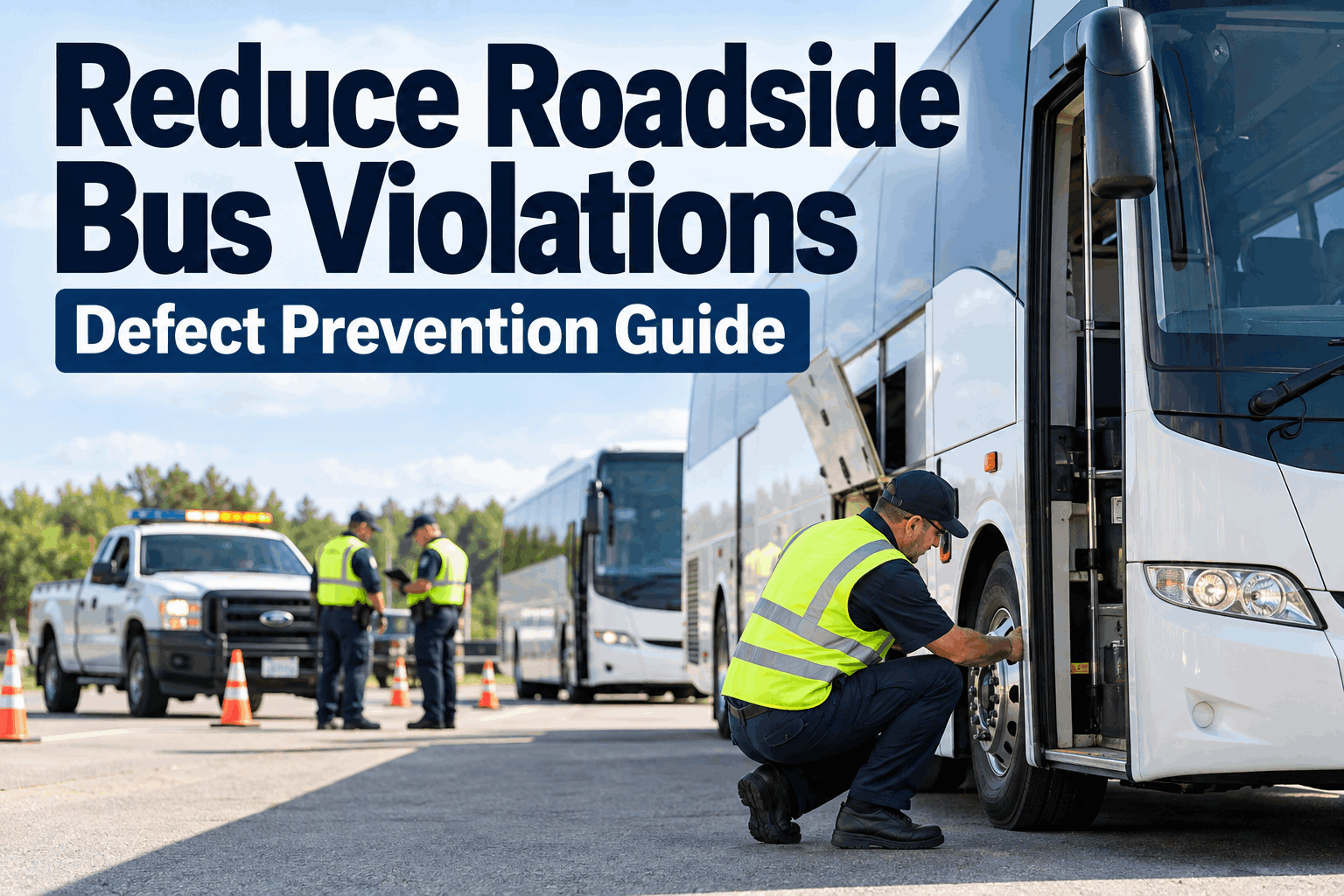
Stop Roadside Bus Violations Before They Happen
1 in 5 buses inspected at roadside is placed Out-of-Service. Every single one of those defects existed — and was catchable — before the bus ever left the yard. This guide shows you the exact 4-stage process to find them first.
Roadside violations don't start at the roadside. They start in your yard — with a brake that drifted out of adjustment two weeks ago, a DVIR defect that was logged but never certified as repaired, or an annual inspection that expired quietly while the schedule kept running. By the time a CVSA inspector finds any of these, the violation is already written. The only moment you had to prevent it was before the bus left your lot.
This guide walks through the four-stage prevention process that safety and maintenance managers use to drive roadside violation rates below the national average: yard detection, certified repair, documentation discipline, and recurring defect tracking. Each stage maps to a specific operational practice — and a specific capability in BusCMMS's inspection and maintenance system.
The 4-Stage Defect Prevention Process
Every preventable roadside violation skipped one or more of these four stages. Fleets that run all four consistently are the ones whose violation rates drop below the national average — and stay there.
The 4 Defect Categories That Drive 70% of Roadside Violations
You don't need to defend against every possible inspection finding with equal intensity. CVSA data shows that four defect categories account for more than 70% of all roadside bus OOS violations. Concentrate your yard inspection effort here, and you cover the majority of your exposure. For a full breakdown of why fleets fail, see our guide on the top DOT inspection failure reasons in 2026.
Want to see how BusCMMS flags every one of these defect categories automatically during yard inspection? See your fleet's real violation risk in 15 minutes — a live walkthrough shows exactly which gaps are active in your operation right now.
The DVIR Problem: Why Most Fleets Are Half-Compliant
Most fleets complete DVIRs. The failure point is not the inspection — it's what happens after a defect is noted. Under 49 CFR §396.11, a vehicle with a noted safety defect cannot be operated until a qualified mechanic certifies in writing that the defect was repaired. That certification must be signed and retained with the DVIR record.
In practice, this is where paper-based systems break down. A driver notes a lighting defect on a paper DVIR. The form goes to the shop clipboard. The shop is busy. The bus goes out the next morning without a signed repair certification on file. Three weeks later a roadside inspector requests the DVIR. The defect entry is there. The certification is not. That is a violation — regardless of whether the light was actually fixed.
The difference between these two workflows is not effort — it's structure. Learn more about how to automate DVIR checklists in 5 steps and close the gap between defect detection and certified repair.
Recurring Defects: The Pattern Most Fleets Miss
A single brake defect repaired and certified is a compliance success. The same brake defect on the same bus three months later is a pattern — and patterns indicate the root cause was never resolved. Recurring defects are one of the clearest predictors of repeat roadside violations, because the underlying condition keeps regenerating the same finding on a cycle that will eventually align with a roadside inspection.
Manual systems cannot realistically track recurring defects across a fleet of any size. When DVIRs are on paper, repair orders are in one system, and inspection records are in another, no one has the cross-referenced view to spot a pattern. See how preventive maintenance reduces bus fleet operating costs by 30% when defect patterns are tracked and resolved at root cause level.
Preventive Maintenance Intervals That Prevent the Top Violations
Preventive maintenance ensures that defect precursors are found and corrected before they reach the threshold at which a roadside inspector must write a violation. The difference between a brake pushrod at 1.6" and one at 1.75" (the OOS threshold) is not a mechanical failure — it is a maintenance interval miss. The vehicle is fine. The compliance record is not.
| Defect Category | OOS Threshold | PM Interval | What PM Catches Early |
|---|---|---|---|
| Brake Adjustment | Pushrod stroke ≥ limit per 49 CFR §393.47 | Every 30 days | Drift before violation threshold — catch at 80%, not 100% |
| Tire Tread Depth | < 4/32" front / 2/32" other axles | Weekly | Gradual wear trend — replace before threshold, not at it |
| Lighting Systems | Any required lamp inoperative | Every pre-trip + monthly full check | Intermittent failures that pass pre-trip but fail under sustained inspection |
| Steering & Suspension | Excessive play per spec | Every 90 days | Progressive wear in linkage, ball joints, king pins before play exceeds limit |
| Annual Inspection | Not completed within 12 months | Schedule at month 10 | 2-month buffer ensures inspection is current even with scheduling delays |
| Driver Medical Cert | Expired certificate | Alert at 60 / 30 / 7 days | Prevents drivers from operating on an expired cert — a pure documentation violation |
Fleets running longer intervals — or no defined intervals — are not in a worse mechanical position. They are in a worse information position: they don't know the current status of these measurables, which means they can't act before an inspector does. Explore how BusCMMS's preventive maintenance module automates interval scheduling and alerts across your entire fleet.
Most fleet managers don't know which buses in their fleet are within 30 days of a PM interval miss right now. Book a 15-minute walkthrough and we'll show you how BusCMMS surfaces that visibility on a single dashboard.
Documentation Readiness: The Violations Nobody Expects
A bus can be mechanically perfect and still generate violations at a roadside inspection. Documentation violations — expired annual inspection records, missing repair certifications, incomplete DVIR chains, absent driver qualification files — carry their own civil penalty exposure entirely separate from mechanical findings. An inspector conducting a Level 1 inspection will request documentation as a standard part of the process.
BusCMMS keeps every one of these records in a single vehicle compliance file — retrievable on any device in under 60 seconds. Start your free account and load your first vehicle's complete compliance record today.
Is Your Fleet Actually Protected? — 60-Second Honest Check
Three or more checked items means your fleet has active, unmonitored violation exposure right now — not potential exposure. A roadside inspector could find it on any route, any day this week.
BusCMMS gives safety managers and maintenance teams a single system for digital inspection checklists, automatic repair work order creation, DVIR certification tracking, PM interval alerts, and recurring defect pattern analysis — everything the four-stage prevention process requires.
Frequently Asked Questions
What are the most common defects found during roadside bus inspections?
Brake system defects account for approximately 28% of all roadside bus OOS violations nationally. Tire and wheel defects follow at 19%, lighting and electrical at 14%, and driver qualification documentation at 12%. Together these four categories represent over 70% of all roadside violations — and all four are preventable through structured yard inspection and preventive maintenance programs.
How often should a bus fleet conduct yard defect inspections?
At minimum, 49 CFR Part 396.11 requires a driver vehicle inspection report before and after every trip. Beyond this legal minimum, safety managers should conduct structured yard inspections on a weekly or bi-weekly cycle for brake system measurements, lighting checks, and tire condition assessments. High-mileage vehicles warrant more frequent cycles.
What is a recurring defect and why does it matter?
A recurring defect is any defect type that appears on the same vehicle two or more times within a 90-day window. Recurring defects indicate that the root cause was not addressed during initial repair. Tracking recurring patterns reduces roadside violation rates because systemic issues are resolved at the source rather than just surface symptoms being treated repeatedly.
Does a DVIR defect entry automatically prevent a vehicle from operating?
Yes — under 49 CFR §396.11, if a driver notes a safety defect on the DVIR, the vehicle must not be operated until a qualified mechanic certifies in writing that the defect has been repaired or that the vehicle is safe to operate. Operating a vehicle with an uncertified DVIR defect is itself a violation and can result in OOS status during roadside inspection.
How does preventive maintenance reduce roadside violation risk?
Preventive maintenance creates scheduled inspection and service intervals that catch brake adjustment drift, tire wear progression, and lighting degradation before they reach violation threshold. Fleets with documented PM programs and digital tracking report 30–40% lower roadside violation rates than fleets managing maintenance reactively. The key is interval consistency — missed PM cycles are as risky as no PM program at all.
What documentation does a fleet need to produce during a roadside inspection?
During a roadside inspection, the inspector may request: the most recent signed DVIR with all defect certifications, the vehicle's annual inspection record (within the last 12 months per 49 CFR §396.17), the driver's CDL and medical examiner's certificate, hours of service records, and vehicle registration and insurance documentation. Missing documentation is a violation separate from any mechanical finding.
Roadside violations are preventable. Every single one.
BusCMMS closes the four gaps — yard detection, certified repair, documentation discipline, recurring defect tracking — that let preventable violations reach the roadside. Fleets using BusCMMS report 40% fewer violations and audit-ready records available on demand.