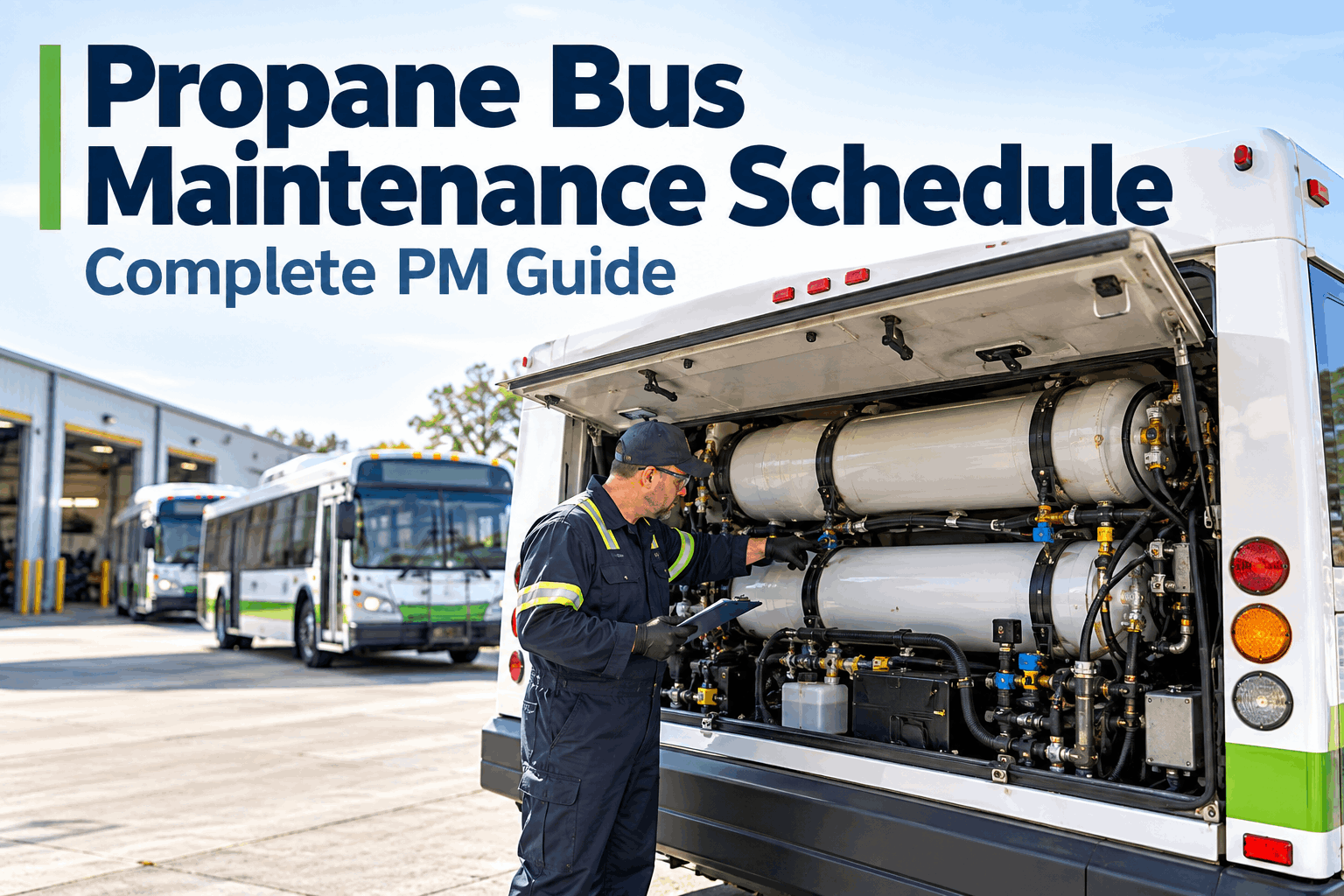
Propane Bus Maintenance Schedule: Complete PM Guide
Switch a route to propane autogas and the buses get simpler to maintain — but the propane bus maintenance schedule isn't the diesel one with a new label. Some tasks disappear entirely, a few gasoline-style ones appear, and the fuel system runs on its own service clock. Miss the propane-specific items and the savings evaporate fast.
PREVENTIVE MAINTENANCE · PROPANE
Propane Bus Maintenance Schedule: Complete PM Guide
Autogas buses drop the diesel aftertreatment burden but add ignition and fuel-system tasks on their own intervals. Here's the propane PM schedule that keeps the savings real and no task missed.
~8 qtoil vs ~34 on a comparable diesel bus
~50k mispark plug interval — a task diesel never had
0DPF, DEF, or EGR aftertreatment to service
PROPANE PM SCHEDULE
DailyPre-trip & leak check
Each PMOil & oil-level check
IntervalFuel filters (often two)
~50k miSpark plugs
Annual+Propane tank inspection
What Changes When You Move to a Propane Bus Maintenance Schedule
The propane program is lighter than diesel in some places and heavier in others. The mistake is assuming it's "diesel minus the emissions stuff." Here's what leaves the schedule and what joins it.
DROPS OFF
Aftertreatmentno DPF regen, no DEF, no EGR service
Oil volume~8 qt vs ~34 — cheaper oil changes
Filter costoil filter ~$4 vs ~$18 on diesel
Cold-start aidsno diesel warm-up / gelling issues
JOINS THE LIST
Spark plugs~every 50,000 mi (or ~4 oil changes)
Fuel filtersoften two — both on interval
Oil checksmore frequent — lower volume, higher use
Tank & leakpropane tank inspection + leak checks
The oil trap catches new propane fleets: a propane engine holds far less oil yet can burn more of it than diesel — so skipping oil-level checks between changes is how you starve an engine.
Manufacturers back this with dedicated training — Blue Bird's tiered tech certification, ROUSH CleanTech's web-based courses, PERC-sponsored NAFTC training — a signal the schedule really is different. More on the shift in the propane guide for diesel managers. Book a demo to see propane PM built out.
The Propane Autogas Service Intervals, by Cadence
A working propane PM schedule is a set of tasks each on its own cadence — daily, per-PM, mileage-based, and annual. Grouping them this way is how you make sure a long-interval item like spark plugs doesn't get lost between quick services.
DAILY
Pre-Trip & Leak Check
Driver pre-trip / DVIR items
Visual fuel-system leak check
Frost on fuel lines = leak signal
EACH PM
Oil & Core Service
Oil & oil-level check (low volume)
Oil filter replacement
Brakes, tires, chassis as usual
INTERVAL
Fuel System
Fuel filters — often two
Fuel pump service / contamination
Safe de-pressurizing first
~50K MI
Ignition
Spark plugs (or ~4 oil changes)
Ignition components as specified
Per manufacturer schedule
ANNUAL+
Tank & Safety
Propane tank / cylinder inspection
Mounting & valve checks
Per DOT & manufacturer rules
PLAN
Scheduling Fit
Some run full PM every ~91 days
By mileage or calendar, whichever first
Aligned to your route calendar
Always de-pressurize the fuel system per the manufacturer before service — propane holds pressure after shutdown. Confirm exact intervals against your engine builder; ROUSH and Blue Bird schedules can differ.
The fuel system is where propane needs the most new attention. These are the areas techs watch — each a small task that prevents a much bigger problem on the road.
Fuel pump
Serviced on interval — contamination from leaking oil is a common propane failure point.
Fuel filters
Some systems run two — both need changing on schedule, not just the one you remember.
Leak inspection
Frost forming on a fuel line points to a leak — a visual cue to catch and fix immediately.
De-pressurizing
Propane holds pressure after shutdown — follow OEM de-pressurizing steps before any fuel work.
Oil & oil filter
Low oil volume with higher use means checks between changes matter — filters are cheap, engines aren't.
Tank & mounting
Propane tank, valves, and mounting inspected per DOT and manufacturer requirements.
How BusCMMS Runs a Propane Bus Maintenance Schedule
Propane PM is a scheduling problem at heart: the right task has to fire on the right interval, by mileage or calendar, and never blur into the diesel plan. BusCMMS is built fuel-type-aware, so propane runs on its own logic.
Fuel-Type-Aware PM Logic
Propane intervals — spark plugs, dual filters, oil checks — run separate from diesel and electric, all on one dashboard.
propane's own plan
Mileage or Calendar Triggers
Fire a task by 50k-mile odometer or a 91-day calendar — whichever comes first, matched to your routes.
whichever first
Digital Propane Checklists
Fuel-system, tank, and leak checks as digital forms — captured, stored, and searchable, not on paper.
records that last
Auto Work Orders From PM
A due interval or failed check auto-generates a work order, so no propane-specific task sits forgotten.
nothing missed
Parts Tied to Intervals
Filters, plugs, and fuel-system parts linked to their PM, so the right part is on hand when the task fires.
parts ready
Mixed-Fleet Dashboard
Propane, diesel, CNG, and electric each on their correct logic — one screen, no mixed-up schedules.
one dashboard
A diesel-first tool can't tell a spark-plug interval from a DPF regen — BusCMMS ships with fuel-type PM logic built in and is typically live in 2–4 weeks. Sign up free and run propane PM on rails.
A Fleet Maintenance Manager's Take
Key Takeaways on the Propane Bus Maintenance Schedule
Propane is lighter maintenance than diesel — but only if you run its own schedule, not a trimmed diesel one. Five things to lock in.
01
Aftertreatment is gone
No DPF, DEF, or EGR service — real, ongoing savings.
02
Watch the oil
Low volume, higher use — check levels between changes.
03
Spark plugs are back
~50k miles — a gasoline-style task diesel never had.
Propane Bus Maintenance Schedule: Common Questions
How is a propane bus maintenance schedule different from diesel?+
It's lighter in some areas and different in others — not simply diesel with fewer tasks. On the lighter side, propane autogas buses have no diesel particulate filter (DPF) to regenerate, no diesel exhaust fluid (DEF) to refill, and no EGR aftertreatment to service, which removes a whole category of diesel maintenance. Oil changes are cheaper too: a propane engine holds roughly 8 quarts versus about 34 on a comparable diesel, and the oil filter can cost around $4 versus $18. But propane adds gasoline-style tasks diesel never had — most notably spark plugs at roughly every 50,000 miles (or about every four oil changes). It also demands closer attention to oil level, because the engine holds far less oil yet can consume more of it than diesel, so checking between changes matters. And the fuel system needs its own routine: dual fuel filters on many systems, fuel pump service, leak inspection, and safe de-pressurizing before any work. The practical takeaway is to run propane on its own PM intervals rather than forcing it onto the diesel calendar.
What are the key propane autogas service intervals?+
Think of propane PM as tasks grouped by cadence. Daily: driver pre-trip/DVIR items plus a visual fuel-system leak check — frost forming on a fuel line is a classic leak signal. Each PM service: oil and oil-level check (critical given the low oil volume), oil filter replacement, and the usual brakes, tires, and chassis work. On interval: fuel filters (often two on a system, and both need changing), plus fuel pump service. Around 50,000 miles or every four oil changes: spark plugs and ignition components per the manufacturer. Annually or per DOT and manufacturer rules: propane tank/cylinder inspection along with mounting and valve checks. Some districts run a complete inspection and filter change on a fixed calendar — every 91 days is one reported cadence — to fit their scheduling. The exact numbers vary by engine builder (ROUSH CleanTech and Blue Bird schedules can differ), so always confirm intervals against your specific OEM guidance and then lock them into a schedule that fires by mileage or calendar, whichever comes first.
Do propane buses really need less maintenance?+
In most respects, yes — but with a catch. The biggest savings come from eliminating diesel aftertreatment: no DPF regenerations, no DEF, and no EGR service means fewer parts, fewer failure points, and less downtime tied to emissions systems. Oil changes are cheaper by both volume and filter cost, and propane avoids diesel cold-weather headaches like fuel gelling. Fleets running propane commonly report meaningfully lower maintenance costs overall. The catch is that "less" doesn't mean "less careful." Propane introduces its own must-do tasks — spark plugs, dual fuel filters, diligent oil-level monitoring, and fuel-system and tank inspections — and skipping them erases the advantage fast. The savings are real, but they're conditional on actually running the propane-specific schedule. Fleets that treat a propane bus like a diesel with the emissions parts removed tend to miss the new tasks and give back the gains in avoidable repairs.
What propane fuel system safety steps matter most?+
Two stand out. First, always de-pressurize the fuel system following the manufacturer's procedure before doing any fuel-system work — a propane system stays pressurized after the engine shuts down, so you can't treat it like an unpressurized diesel line. Second, take leak detection seriously as a routine check: frost forming on a fuel line or fitting is a visible sign of a leak and should be addressed immediately, not at the next scheduled service. Beyond those, the propane tank (cylinder), its valves, and mounting must be inspected per DOT and manufacturer requirements, and fuel filters and the fuel pump should be serviced on their intervals since contamination is a common issue. Many manufacturers offer dedicated technician training — Blue Bird runs a tiered certification program, ROUSH CleanTech offers web-based courses, and PERC sponsors free training through NAFTC — precisely because safe propane fuel-system service has its own procedures. Making these steps part of a documented, scheduled routine is what keeps them from being skipped.
How does BusCMMS help manage propane bus PM?+
BusCMMS treats propane as its own maintenance track rather than a diesel variant. Its fuel-type-aware PM scheduling runs propane intervals — spark plugs, dual fuel filters, oil checks, tank inspections — separately from diesel, CNG, and electric, all visible on one dashboard. Tasks can fire by mileage (like a 50,000-mile spark-plug interval) or by calendar (like a 91-day full inspection), whichever comes first, matched to your route schedule. Propane fuel-system, tank, and leak checks become digital checklists that are captured, stored, and searchable instead of living on paper. When an interval comes due or a check fails, a work order is auto-generated so no propane-specific task sits forgotten. Filters, plugs, and fuel-system parts can be tied to their PM so the right part is on hand when the task fires. And a mixed-fleet dashboard keeps propane, diesel, CNG, and electric buses each on their correct maintenance logic, so a diverse fleet doesn't turn into a mixed-up schedule. Because it's purpose-built for bus fleets, it's typically live in two to four weeks.