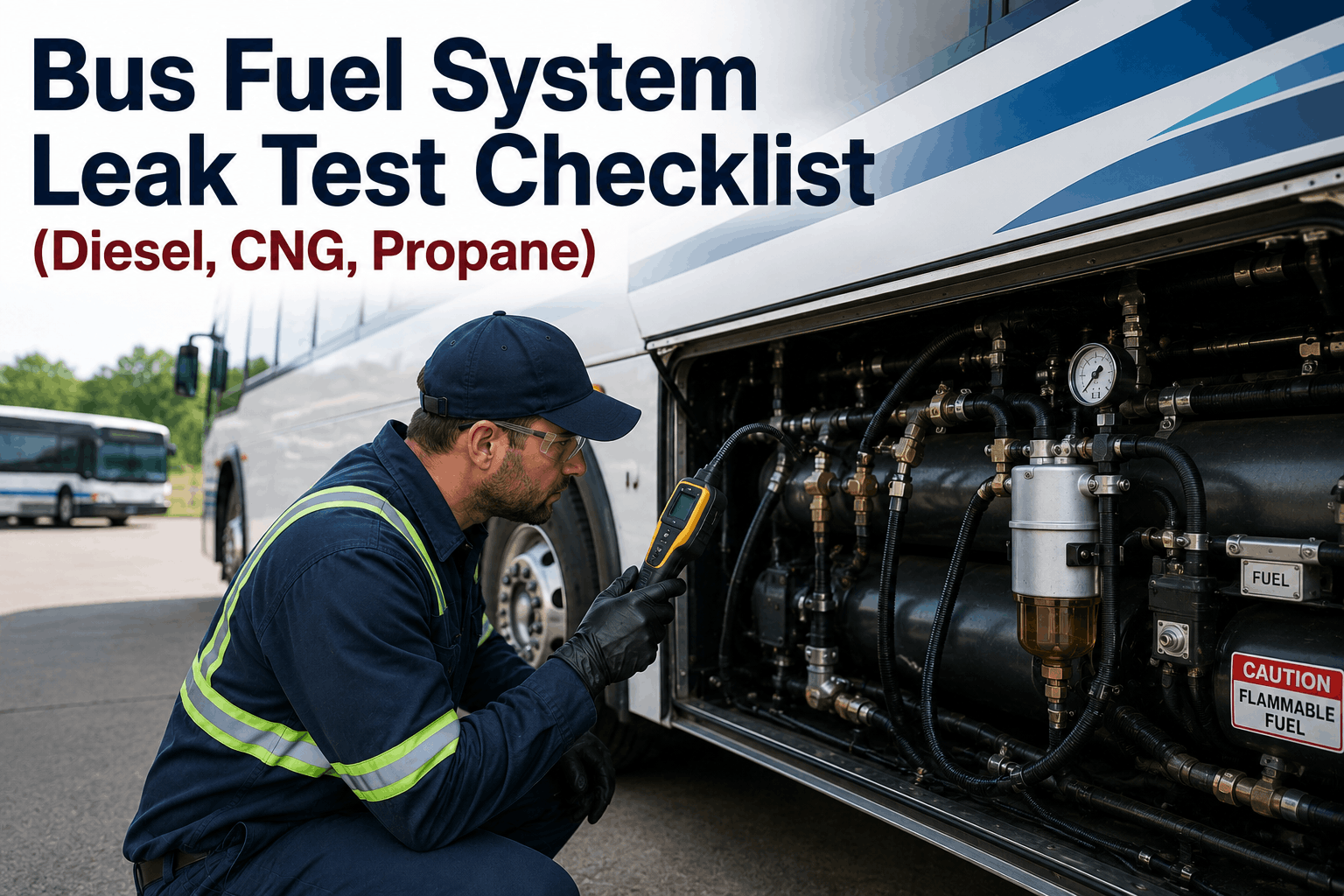
Fuel system leaks are the leading ignition source for vehicle fires in commercial bus operations — and unlike brake fade or tire wear, a fuel leak does not degrade performance gradually before failure. It creates an immediate fire risk that can escalate from first ignition to total loss in under three minutes on a vehicle carrying passengers. For school and transit bus fleets operating diesel, CNG, or propane-powered vehicles, bus fuel system leak testing is both a safety imperative and an FMCSA compliance requirement under 49 CFR 393.65, which prohibits any fuel system leak and defines specific out-of-service conditions for fuel tank mounting, fuel line condition, and cap security. For CNG and propane alternative fuel buses, the compliance framework extends further — NFPA 52 (CNG) and NFPA 58 (LPG) govern system design and inspection intervals, and many state inspection programs require certified fuel system technician sign-off on annual leak tests for alternative fuel vehicles. This bus fuel system leak test checklist covers diesel, CNG, and propane systems in separate sections — with leak detection methods, methane sniffer protocols, soap-bubble test procedures, and OOS trigger thresholds for each fuel type. Start your free trial to run this checklist as a mileage-triggered digital work order in BusCMMS with technician sign-off and automatic FMCSA record retention.
Run Fuel System Leak Tests as Digital Work Orders — Every Interval, Every Bus
BusCMMS pre-loads this complete multi-fuel leak test checklist for technician sign-off, schedules fuel system PM by mileage trigger, and retains every inspection record automatically per FMCSA 49 CFR 396 retention requirements.
Regulatory Framework: Bus Fuel System Compliance Standards
FMCSA 49 CFR Part 393 Subpart E establishes fuel system integrity requirements for all commercial motor vehicles. For alternative fuel vehicles (CNG and propane), additional standards from NFPA, DOT, and state inspection programs apply. Any fuel system leak — regardless of fuel type — is both a safety hazard and a compliance violation that results in an immediate out-of-service order at roadside inspection.
Fuel system requirements — no fuel system leaks, tank security, fuel cap requirements, fuel line condition and routing standards for diesel
Vehicular Natural Gas Fuel Systems Code — CNG system inspection intervals, pressure test requirements, qualified inspector standards
Liquefied Petroleum Gas Code — propane bus system inspection, pressure relief valve testing, tank recertification requirements
Fuel system OOS criteria — any fuel leak, missing fuel cap, unsecured tank, or fuel line chafing contact with frame or exhaust is an immediate OOS
Bus Fuel System Leak Test Checklist
Complete the applicable fuel type section(s) for your fleet. Diesel inspection applies to all diesel-powered buses. CNG and Propane sections apply only to alternative fuel vehicles. All sections require the technician to record the inspection method used, findings, and corrective actions taken. Fuel system inspections must be performed with the engine at operating temperature to detect leaks that only appear under thermal expansion.
Fuel Leak OOS Thresholds: Quick Reference
| Fuel System Condition | OOS Trigger | Regulatory Reference | Detection Method |
|---|---|---|---|
| Diesel Fuel Leak (Any) | Any active drip or seepage | 49 CFR 393.65 / CVSA OOSC Sec 2 | Visual; UV dye + blacklight |
| Missing Fuel Cap | Any missing or non-sealing cap | 49 CFR 393.65(d) | Visual inspection |
| CNG Leak (High Pressure) | Any detectable leak; ≥10% LEL | NFPA 52 / CVSA OOSC Sec 2 | CGD sweep; soap bubble test |
| CNG Cylinder Past Service Date | Any cylinder past certification date | NFPA 52 Section 7 | Visual — date stamp on cylinder |
| Propane Leak | Any detectable leak; ≥10% LEL | NFPA 58 / CVSA OOSC Sec 2 | CGD sweep at low level; soap test |
| Fuel Line Chafing on Exhaust | Any contact with exhaust components | CVSA OOSC Section 2.4 | Visual — trace full line routing |
| Unsecured Fuel Tank | Any movement under pressure | 49 CFR 393.65(b) | Visual + hand pressure test |
How BusCMMS Manages Fuel System Inspection Records
FMCSA 49 CFR 396 requires that fuel system inspection records document the specific defects found, corrective actions taken, and technician identity — a generic pass/fail fuel check does not satisfy this requirement. BusCMMS pre-loads this complete fuel system leak test checklist as a digital work order — with separate sections for diesel, CNG, and propane inspection items, technician sign-off on each line item, and defect documentation fields. For CNG and propane buses, BusCMMS also tracks cylinder certification dates and generates replacement alerts before cylinders pass their recertification deadline. Book a demo to see the fuel system PM workflow in a live fleet environment.
We operate 22 propane buses and 41 diesel units. Tracking CNG cylinder recertification dates on a spreadsheet was a constant risk — we came within one month of operating a propane bus with an expired cylinder before our state caught it at annual inspection. After moving propane cylinder dates into BusCMMS, the system flags expiring cylinders 90 days out and auto-generates a recertification work order. We have not had an expired cylinder since deployment.
Frequently Asked Questions: Bus Fuel System Leak Testing
How often should bus fuel system leak tests be performed?
FMCSA 49 CFR 396.3 requires systematic inspection of fuel system components as part of the vehicle's PM program. For diesel buses, fuel system inspection should be performed at every PM-A or PM-B service (typically every 5,000–10,000 miles). For CNG and propane buses, a full leak test using a combustible gas detector should be performed at every PM interval and as part of the annual inspection — NFPA 52 and 58 both require annual qualified inspector sign-off for alternative fuel systems.
What is the correct tool for detecting CNG or propane leaks on a bus?
A calibrated combustible gas detector (CGD) — also called a methane sniffer or gas leak detector — is the required tool for CNG and propane leak detection. Visual inspection and smell alone are insufficient for detecting small leaks at system pressure. CGD units should be calibrated annually and verified against a known gas reference before each use. The sensor sweep speed matters — moving too fast (more than 3 inches per second) can miss small leaks, particularly at threaded connections.
Is any diesel fuel leak a DOT out-of-service condition?
Yes. Under CVSA OOSC Section 2 and 49 CFR 393.65, any active fuel leak — including a seeping fitting, a weeping fuel filter gasket, or a dripping injector line connection — is an immediate roadside out-of-service condition. There is no threshold below which a fuel leak is acceptable. A bus found leaking any amount of fuel by a roadside inspector will be placed OOS on the spot and cannot move until the leak is repaired and re-inspected.
How are CNG cylinder recertification dates tracked in a mixed-fuel fleet?
Each CNG cylinder has a manufacture date and service life stamped on the cylinder collar or label. Type 2, 3, and 4 composite cylinders require re-inspection every 3 years; Type 1 steel cylinders every 5 years. In a mixed fleet, this creates multiple concurrent expiration dates that are easily missed without a tracking system. Fleet maintenance software should flag each cylinder's recertification date and generate an alert 90 days before expiration.
What soap solution is safe for testing propane and CNG fittings?
Use a non-petroleum-based, commercial leak detection solution specifically formulated for gas systems — products like Snoop or equivalent. Standard dish soap mixed with water is a field alternative but produces smaller bubbles that can be harder to see in low-contrast lighting. Petroleum-based soaps or lubricants must never be used on oxygen or compressed gas fittings. After testing, wipe all fittings clean to prevent long-term corrosion from soap residue.
Does a diesel fuel line that smells of fuel always indicate a leak?
Not always — residual fuel odor from a prior spill during filter changes or cap-off can linger for days on engine surfaces. A fuel odor without a visible leak source should be investigated with UV dye injection into the fuel system, followed by UV blacklight inspection of all lines, fittings, and the injection pump after several heat cycles. UV dye trace is the most reliable method for finding intermittent or small-volume diesel leaks that do not produce a visible drip at inspection time.
How does BusCMMS support CNG and propane fuel system compliance?
BusCMMS pre-loads separate fuel system inspection checklists for diesel, CNG, and propane buses — with line-item sign-off, defect documentation, and measurement fields for gas detector readings. For alternative fuel vehicles, BusCMMS tracks cylinder certification dates and generates recertification alerts 90 days before expiration. All fuel system inspection records are retained automatically for FMCSA audit with no paper filing required.
Keep Every Bus Fuel System Leak-Free & Compliant — Automatically
BusCMMS pre-loads complete multi-fuel leak test checklists, tracks CNG cylinder recertification dates, and retains every inspection record audit-ready — so your fleet is always prepared for FMCSA review without manual tracking.