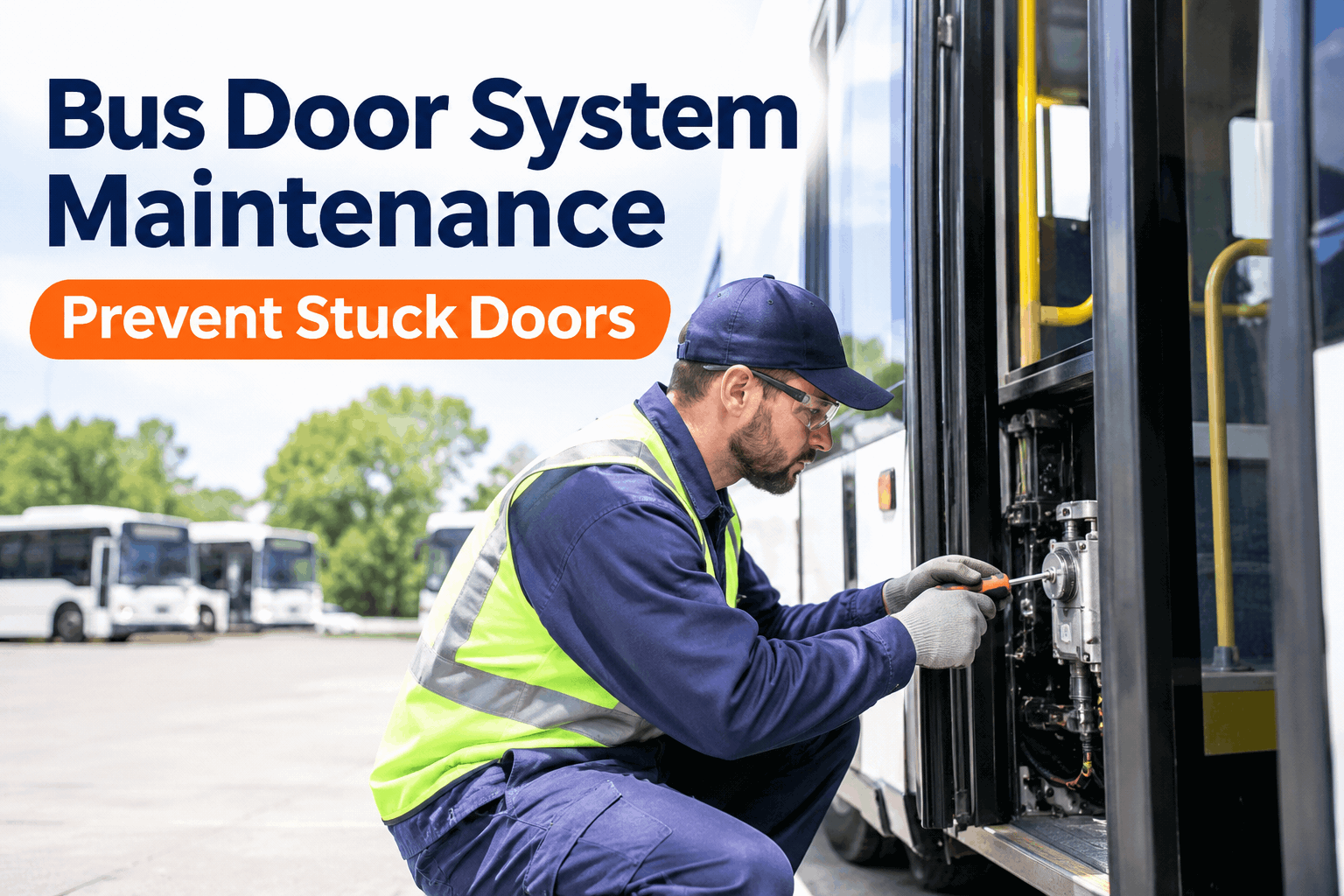
The 7:10 route is boarding and the front door jams half open — won't seal, won't release the interlock, won't let the bus move. One stuck door and the whole bus is out of service. Bus door system maintenance keeps that from being a weekly event, because a door fault is a fixable mechanism, not a mystery. Want recurring door faults tracked per bus? See it in a quick demo.
Bus Door System Maintenance: Cut Stuck-Door Downtime
A stuck door takes the whole bus out of service — and it almost always traces to one point along the mechanism. Learn the system, catch the fault early, and keep doors out of the downtime column.
Why One Stuck Door Takes the Whole Bus Down
A door is not a minor system. It is safety-critical and tied into the interlock, so a bus will not — and should not — move with a door that cannot confirm it is closed and sealed. That is why a single door fault pulls an entire bus and route out of service, and why the door earns a real place in your PM.
It ties into the interlock
The door interlock connects to the brakes and throttle. If the door can't prove it's safely closed, the bus is held — by design, for passenger safety.
It cycles constantly
A transit door opens and closes at every stop, dozens of times an hour. That wear adds up fast on linkage, seals, rollers, and the actuator.
It is a safety system
The door has to detect a person and never close on them or leave with clothing caught. A reversing or sensor fault is a safety issue, not just an annoyance.
The door is often called one of the most important and least thought-about control systems on a bus — which is exactly why it quietly becomes a top source of unplanned downtime.
Pneumatic vs. Electric: Know Which You're Maintaining
Transit buses run two kinds of door systems, and they fail in different places. Most buses use pneumatic (air) doors for their simplicity and reliability; electric doors show up on some fleets and newer vehicles. Knowing which you have points you at the right components when a door sticks.
Air-powered doors
The most common on transit buses — a solenoid and valve send compressed air to the actuator, the same air source as the brakes. Speed is set by air-metering screws.
- Watch: air leaks, valve faults, metering drift
- Simple, robust, widely used
- Door too fast, too slow, or rattling = adjust air
Motor-driven doors
An electric controller drives a rotary actuator through linkage. More control and diagnostics, but more electronics in the fault path — controller, motor, and switches.
- Watch: controller faults, overheating, switch wear
- More adjustable, more electronic
- Faults often trace to the controller or micro-switches
Both types share the same wear points downstream — linkage, rollers, seals, and the closed micro-switch — so alignment and adjustment matter no matter which power source you run.
Match the diagnosis to the system and you stop swapping parts that were never the problem. You can sign up free and record each bus's door type and fault history so techs know what they're walking up to.
Diagnosing a Stuck Door: Start With the Symptom
A stuck door is three different problems wearing one complaint. What the door does — won't open, won't close, or won't seal — points you straight at the likely cause, so you check the right part first instead of chasing the whole system.
Never force a sticking door — slamming or forcing it shifts the actuator and loosens linkage, turning a simple adjustment into a real repair and hiding the original fault.
Diagnose by symptom and most door faults are a quick adjustment, not a teardown. A demo shows the fault captured on the work order with its cause, so a pattern is easy to spot.
Door Maintenance Runs on a Cadence
OEMs and transit practice put door checks on a layered schedule — some things daily, some weekly, some monthly. The daily checks are fast and catch most trouble early; the deeper ones keep the mechanism in adjustment before it strands a bus.
Check door function and operating speed, and confirm the reversing / obstacle-detection system works. Quick, and catches the most common faults.
Verify the emergency release works from inside and out. This is a safety-critical function that must never be assumed.
Inspect and adjust linkage, seals, rollers, sensors, and interlock; lubricate pivots and check air or electrical components for wear.
Always confirm the exact items and intervals against your door OEM and APTA guidance — the point is that the daily, weekly, and monthly checks each actually get done, on every bus, instead of only when a door has already failed.
Your Bus Door Inspection Checklist
Build these into the door PM, not your memory. The red items are safety-critical or will strand a bus; the amber ones keep the door in adjustment so it never gets there. Exact items vary by door type and OEM — confirm against your manuals and APTA practice.
- Test the reversing / obstacle detection dailyThe door must stop and reverse on an obstruction and never close on a person or catch clothing. Safety-critical — verify every day.CRITICAL
- Verify the interlock holds and releasesConfirm the bus is held with the door open and releases cleanly when closed. A faulty interlock is both a safety and a downtime problem.CRITICAL
- Check the emergency release weeklyConfirm the emergency release opens the door from inside and out. Required, and never something to take on faith.CRITICAL
- Inspect and adjust linkage, rollers, and sealsLook for worn pivots, loose rods, worn rollers, and damaged seals. Adjust alignment so the door opens and closes square.ADJUST
- Set door speed and check for leaks or faultsAdjust air-metering (pneumatic) or controller settings (electric) so speed is right; check for air leaks or controller overheating.TUNE
- Log every door fault by bus and doorRecord the symptom and fix per unit so a door that keeps sticking stands out as a root-cause problem, not a repeat patch.TRACK IT
Run the cadence and a stuck door becomes a rare, quick fix instead of a weekly route-killer. You can see this checklist run as a scheduled PM in a demo.
How BusCMMS Cuts Stuck-Door Downtime
BusCMMS does not adjust an actuator or clean a sensor — it makes sure the door checks happen on cadence and that a recurring fault gets root-caused instead of re-patched. The door stops being the system nobody tracks until it strands a bus.
Daily, weekly, monthly door PM
The layered door cadence scheduled automatically, so the reversing, interlock, and adjustment checks never get skipped.
DVIR door flag to work order
A driver's "door slow" or "won't seal" note becomes a work order, so a small door issue is fixed before it strands the bus.
Recurring-fault history per door
Faults logged by bus and door position surface the chronic one, so you fix the root cause instead of the same door twice.
The result is fewer buses sidelined by a door and a service history you can prove. Book a demo and bring your worst repeat-offender door.
A Fleet Maintenance Manager's Take
Key Takeaways on Bus Door Maintenance
A stuck door is preventable and fixable — if you treat it as the system it is. Four things to hold onto.
One door, the whole bus
The interlock means a stuck door sidelines the entire bus and route — so the door earns real PM.
Know your door type
Pneumatic and electric doors fail in different places — diagnose to the right system.
The symptom points to the part
Won't open, won't close, won't seal each lead to a different component — never force it.
Track the repeat offender
Logging faults by door surfaces the chronic one so you fix the cause, not the symptom.
Run the door cadence, diagnose by symptom, and log every fault by bus — and the door stops being the quiet system that pulls a bus from the line. It cycles thousands of times a week; give it the attention a system that important deserves, and it will keep moving passengers instead of stranding them.