A transit agency in the Midwest lost $287,000 last year—not from accidents or fuel costs, but from a single missed battery maintenance interval that voided the warranty on three electric bus battery packs. Electric bus fleet maintenance software is no longer optional—it has become the operational backbone of successful EV transit fleets. Yet 68% of organizations still attempt to manage electric buses using spreadsheets and paper logs designed for diesel vehicles.
The complexity gap between what electric buses demand and what manual tracking delivers isn't just inconvenient—it's operationally dangerous and financially devastating. Electric bus CMMS platforms have emerged as the solution, but adoption remains dangerously slow across North America, the UK, and Australia.
This guide examines why a digital maintenance system for buses has become non-negotiable in 2026, what specific EV requirements make manual tracking obsolete, and how these platforms protect against the compliance, warranty, and operational risks that spreadsheets cannot address.
What Is a Digital Maintenance System for Electric Bus Fleets?
A digital maintenance system for electric bus fleets (often called CMMS—Computerized Maintenance Management System) is software that automates maintenance scheduling, tracks EV-specific components like batteries and charging infrastructure, documents compliance requirements, and provides real-time visibility into fleet health. Unlike spreadsheets or paper logs, these systems automatically trigger work orders based on mileage, hours, dates, or condition monitoring—ensuring nothing falls through the cracks as fleet complexity increases.
For electric bus operations, digital maintenance systems extend beyond traditional fleet management. They track battery state-of-health trends, manage high-voltage technician certifications, document charging infrastructure maintenance, and create the audit-ready records that manufacturers require for warranty claims and regulators demand for compliance verification.
The distinction matters because electric buses aren't simply diesel buses with different powertrains. They're fundamentally different machines requiring fundamentally different maintenance approachesand the tracking systems capable of managing that complexity. Ready to see how it works? Schedule a quick demo to explore EV-specific tracking features.
Why Manual Maintenance Fails for Electric Bus Fleets
Spreadsheet tracking worked adequately for diesel fleets because the maintenance variables were manageable: oil changes every X miles, brake inspections every Y months, annual DOT inspections. A competent administrator could track 50 diesel buses in Excel with reasonable accuracy.
Electric buses shatter that simplicity. The maintenance variables multiply exponentially while the consequences of missed service become catastrophic.
Tracking Complexity Explosion
Each electric bus requires tracking battery state-of-health, cell balancing status, thermal management performance, HV cable inspections, isolation testing, charger maintenance, multiple technician certifications, and traditional bus systems—simultaneously. Spreadsheets can't manage conditional scheduling (service when SOH drops below X% OR when miles exceed Y).
No Automated Alerts
Spreadsheets don't send notifications. They require someone to actively review them—and review them correctly. When maintenance supervisors are handling daily emergencies, proactive schedule reviews get postponed until missed services become visible failures.
Documentation Fragmentation
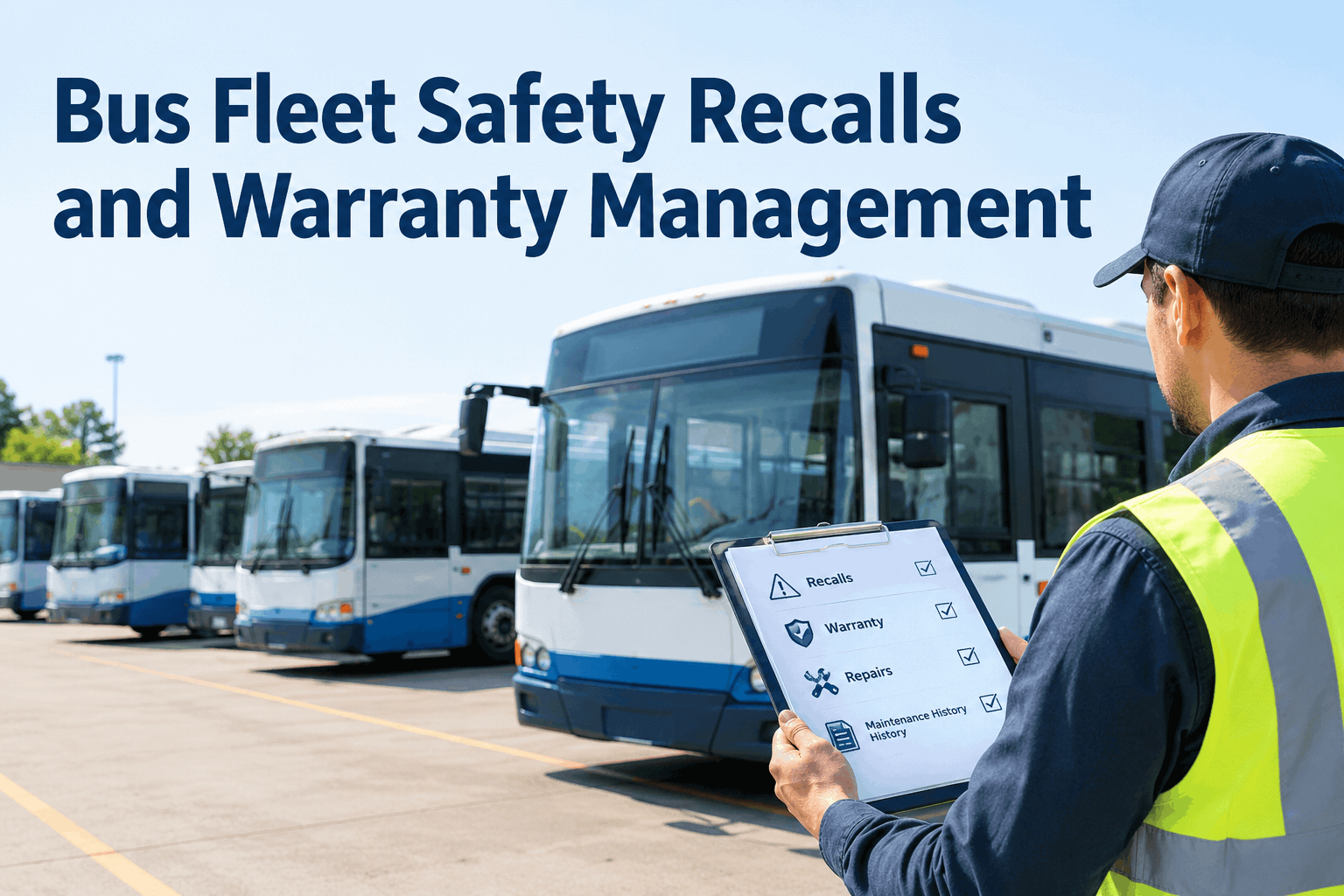
Manual systems scatter records across files, folders, emails, and paper. When warranty claims require proof of maintenance at specific intervals, reconstruction takes days or weeks—if complete records even exist. Manufacturers regularly deny claims citing inadequate documentation.
Scaling Impossibility
Manual tracking that barely works for 20 buses collapses at 50. The administrative burden grows linearly while accuracy degrades exponentially. Fleet growth becomes operationally limited by maintenance tracking capacity.
Still managing EV maintenance in spreadsheets? See how transit fleet maintenance software eliminates tracking complexity while protecting your warranty investments.
EV Complexity That Demands Digital Tracking
Electric buses introduce maintenance requirements that simply didn't exist in diesel fleets. Each requirement carries significant financial or safety implications—and each requires systematic tracking that manual methods can't reliably provide.
Battery System Management
Battery packs worth $150,000–$300,000 require documented maintenance at manufacturer-specified intervals. This includes monthly state-of-health recording, cell balancing verification, thermal management inspection, and charging pattern analysis. Missing a single documented service can void warranty coverage entirely.
Digital systems automatically track SOH trends, alert when values fall outside parameters, and create timestamped records that satisfy warranty requirements. Spreadsheets require manual entry, manual trend analysis, and manual documentation compilation—with no automated verification.
High-Voltage Safety Compliance
Every technician working on HV systems requires specific certifications that must be tracked, renewed, and documented. Work assignments must match certified personnel. PPE inspections require logging. Emergency procedures need verification. The liability exposure from uncertified personnel performing HV work is enormous.
Electric bus CMMS platforms track certifications automatically, prevent work order assignment to unqualified technicians, and document compliance at every step. Manual systems rely on supervisors remembering who's certified for what—a recipe for compliance gaps.
Charging Infrastructure
Chargers are fleet assets requiring their own maintenance schedules: connector cleaning, cable inspection, firmware updates, error log reviews, electrical panel inspections. Charger failures ground buses just as effectively as vehicle failures—yet manual tracking systems rarely include infrastructure assets.
Digital maintenance systems treat chargers as tracked assets with automated scheduling, work order generation, and performance trending. This visibility prevents charger-caused downtime that catches manually-tracked fleets by surprise. Want to see charger tracking in action? Start your free trial and add your first charging asset in minutes.
Integrated Diagnostics
Modern electric buses generate diagnostic data continuously: battery performance metrics, motor efficiency, charging session logs, fault codes. This data enables predictive maintenance—but only if systems exist to capture, analyze, and act on it. Spreadsheets can't integrate with vehicle telematics.
EV fleet maintenance management software connects diagnostic streams to maintenance workflows, triggering inspections when parameters indicate developing issues rather than waiting for scheduled intervals or failures.
For fleet managers building comprehensive maintenance strategies, our guide on electric bus preventive maintenance programs for fleets provides the complete framework.
Compliance, Warranty, and Audit Risks
The financial and operational risks of inadequate maintenance tracking concentrate in three areas that can each independently devastate fleet operations.
Warranty Claim Denials
EV battery manufacturers require specific maintenance documentation to honor warranties. Claims for $150,000+ battery replacements are routinely denied when fleets cannot produce records proving maintenance was performed at required intervals. The burden of proof falls entirely on the fleet operator.
Real Impact: One transit authority lost warranty coverage on a battery pack failure because their Excel records showed an 8-week gap in documented inspections—exceeding the manufacturer's 6-week maximum interval requirement.
Regulatory Audit Failures
FTA, FMCSA, and state/provincial regulators require systematic maintenance documentation. Auditors expect complete records available on demand—not requests to "give us a few days to compile everything." Audit findings can trigger funding delays, increased oversight, and operational restrictions.
Real Impact: A school district under state audit couldn't produce complete brake inspection records for three buses. The resulting findings required a corrective action plan, monthly reporting for 12 months, and delayed their federal grant application.
Insurance Complications
Insurance carriers increasingly require maintenance documentation for claims involving mechanical failures. Poor records create grounds for claim denial or coverage disputes. Some carriers now require CMMS implementation as a condition of coverage for electric fleets.
Real Impact: An insurance claim following an electric bus fire was contested for 14 months while the carrier investigated maintenance records. The fleet eventually received payment but faced significant cash flow disruption during investigation.
Understanding specific compliance requirements helps fleets prepare properly. Review our comprehensive electric bus fleet audit checklist covering all inspection and documentation requirements.
Manual vs Digital Maintenance: Comparison Table
The operational differences between manual tracking and digital maintenance system for buses become stark when examined across key capabilities.
| Capability | Manual/Spreadsheet | Digital CMMS |
|---|---|---|
| PM Scheduling | Manual calendar review required; relies on administrator vigilance | Automatic triggers by mileage, hours, date, or condition; zero missed services |
| Battery SOH Tracking | Manual entry; no trend analysis; gaps go unnoticed | Automated recording; trend visualization; alerts when degradation accelerates |
| Technician Certifications | Separate tracking required; assignment verification manual | Integrated certification management; automatic assignment restrictions |
| Warranty Documentation | Records scattered; compilation required for claims; gaps common | Automatic documentation; claim-ready reports; complete audit trail |
| Charger Maintenance | Often untracked; failures surprise operations | Tracked as fleet assets; scheduled maintenance; performance monitoring |
| Compliance Reporting | Time-intensive compilation; accuracy uncertain; audit-stressful | One-click report generation; always audit-ready; instant access |
| Diagnostic Integration | Not possible; vehicle data unused | Telematics integration; condition-based maintenance triggers |
| Multi-Location Visibility | Siloed tracking; inconsistent processes; no fleet-wide view | Centralized platform; standardized processes; complete visibility |
| Knowledge Retention | Leaves with employees; training intensive; institutional loss | Preserved in system; standardized workflows; continuity assured |
| Fleet Scaling | Administrative burden grows linearly; accuracy degrades | Marginal effort increase; accuracy maintained; growth-ready |
The Inflection Point
Most organizations reach manual tracking failure between 20–30 vehicles. With electric buses, that threshold drops to 10–15 vehicles due to increased tracking complexity. If you're operating EVs with spreadsheets, you're likely already experiencing symptoms: missed services, documentation gaps, compliance concerns, or administrative overload. Book a 15-minute demo to see how digital tracking eliminates these pain points.
ROI of Digital Maintenance for Electric Bus Fleets
Preventive maintenance software for buses delivers measurable returns across multiple operational dimensions. Understanding these returns helps justify implementation investment.
ROI Calculation: 40-Bus Electric Fleet
Downtime Reduction
40% fewer unplanned breakdowns × $1,800 avg. incident cost × 60 annual incidents = $43,200 saved
Warranty Protection
Documentation prevents 1 denied claim per year × $175,000 avg. battery pack = $175,000 protected
Administrative Efficiency
15 hours/week saved × $35/hour × 52 weeks = $27,300 saved
Compliance Cost Avoidance
Eliminated audit findings, reduced insurance premiums, avoided penalties = $12,000 saved
Total Annual Value: $257,500
Less CMMS Investment: ~$15,000–$24,000/year
Net Annual Benefit: $233,500–$242,500
ROI: 970–1,600% | Payback Period: Under 30 days
Even without warranty savings, ROI remains above 200%. Preventing a single denied claim pays for years of software licensing.
For detailed guidance on measuring maintenance performance, explore our fleet maintenance reporting and analytics guide.
Calculate your fleet's specific ROI potential. Our team will analyze your current operations and demonstrate exactly how bus fleet digitalization reduces costs while improving compliance.
Key Features to Evaluate in Electric Bus CMMS
Not all maintenance software handles EV requirements equally. When evaluating smart fleet maintenance systems, prioritize these capabilities:
Multi-Trigger Scheduling
System should trigger maintenance by mileage, engine hours, calendar date, or condition thresholds—using whichever arrives first. EV maintenance requires this flexibility.
Battery Tracking Module
Dedicated functionality for SOH recording, cell balance monitoring, thermal management tracking, and charging pattern analysis with trend visualization.
Certification Management
Track technician certifications, prevent assignment of HV work to unqualified personnel, and automate renewal notifications.
Infrastructure Asset Tracking
Treat chargers and charging infrastructure as maintained assets with their own schedules, work orders, and performance monitoring.
Audit-Ready Reporting
Generate compliance reports instantly without manual compilation. Reports should satisfy FTA, FMCSA, state/provincial, and manufacturer requirements.
Warranty Documentation
Automatic creation of maintenance records in formats manufacturers accept for warranty claims, with complete timestamps and verification.
How to Choose the Right Electric Bus CMMS
Selecting the right electric bus fleet maintenance software requires evaluating vendors against your specific operational requirements. Not every platform handles EV complexity equally, and choosing the wrong system creates implementation headaches and capability gaps that undermine the investment.
1. Evaluate EV-Specific Capabilities
General fleet maintenance software often lacks dedicated EV functionality. Verify the platform includes battery health tracking, HV certification management, charging infrastructure maintenance, and EV-specific reporting. Ask vendors to demonstrate these features with electric bus examples—not just passenger EVs or generic fleet scenarios.
2. Assess Integration Capabilities
Your CMMS should connect with existing systems: telematics platforms, parts inventory, accounting software, and potentially vehicle diagnostic systems. Isolated software creates data silos that reduce value. Request integration documentation and references from similar-sized transit or school bus operations.
3. Verify Implementation Support
The best software fails without proper implementation. Evaluate vendor support for data migration, system configuration, user training, and ongoing assistance. Ask about typical implementation timelines for fleets your size and what resources you'll need to commit internally.
4. Consider Total Cost of Ownership
Monthly licensing tells only part of the story. Factor implementation fees, training costs, integration development, and ongoing support charges. Request a comprehensive pricing proposal that includes all costs for the first two years. Compare against projected ROI to ensure positive returns.
5. Request References from EV Fleets
Ask vendors for references specifically from electric bus operators—transit agencies, school districts, or charter companies running EVs. Speak with those references about implementation experience, ongoing support quality, and whether the system delivered promised capabilities for electric fleet management.
6. Test Before Committing
Insist on a trial period or pilot implementation before signing long-term contracts. Use this time to verify the system handles your specific workflows, your team can operate it effectively, and the vendor delivers responsive support. Start a free trial to test BusCMMS with your actual fleet data—no commitment required.
The Future of EV Fleet Maintenance: Automation and Predictive Analytics
The evolution of electric bus maintenance technology extends beyond digitizing current processes. Forward-looking fleet operators are preparing for predictive maintenance capabilities that transform how EV fleets are managed.
Predictive maintenance for electric buses leverages continuous data streams from battery management systems, motor controllers, and charging infrastructure to identify developing issues before they cause failures. Rather than servicing components on fixed schedules, AI-powered analytics determine optimal intervention timing based on actual condition and degradation patterns. Early adopters report 25–35% additional downtime reductions beyond what traditional preventive maintenance achieves.
EV fleet automation is accelerating across maintenance workflows. Automated diagnostic interpretation triggers work orders without human review for routine issues. Technician assignment algorithms match job requirements to available certified personnel. Parts ordering initiates automatically when inventory reaches reorder points tied to upcoming scheduled maintenance. These automations reduce administrative overhead while improving response speed and accuracy.
The integration trajectory points toward fully connected maintenance ecosystems where vehicles, chargers, parts suppliers, and maintenance systems communicate continuously. Fleet managers shift from scheduling and tracking to exception handling and strategic optimization. Organizations implementing digital maintenance systems today are building the foundation for these capabilities—while those delaying fall further behind with each passing quarter.
For comprehensive guidance on leveraging maintenance data effectively, explore our electric bus maintenance data tracking strategies.
Frequently Asked Questions
What is the best maintenance software for electric bus fleets?
The best electric bus CMMS combines traditional fleet management with EV-specific capabilities: battery health tracking, HV certification management, charging infrastructure maintenance, and warranty documentation. Look for systems designed specifically for transit and school bus operations rather than generic fleet software adapted for buses. Key differentiators include multi-trigger scheduling, audit-ready reporting, and integration capabilities with vehicle diagnostics.
How much does digital maintenance software cost for bus fleets?
Electric bus fleet maintenance software typically costs $15–$50 per vehicle per month depending on features and fleet size. For a 40-bus fleet, expect annual costs of $7,200–$24,000. However, ROI calculations consistently show 200–1,600% returns through downtime reduction, warranty protection, and administrative efficiency. Most fleets achieve payback within 30–90 days of implementation.
Can spreadsheets work for small electric bus fleets?
Spreadsheets become problematic for electric fleets at 10–15 vehicles—significantly lower than the 25–30 vehicle threshold for diesel fleets. The tracking complexity of battery systems, HV certifications, and warranty documentation overwhelms manual systems quickly. The risk of a single denied warranty claim typically exceeds several years of CMMS costs.
How long does CMMS implementation take for bus fleets?
Most bus fleets complete implementation in 4–8 weeks, including asset import, schedule configuration, user training, and parallel operation. Cloud-based systems implement faster than on-premise solutions. The key success factor is dedicated project ownership—assign someone responsible for driving implementation to completion.
How does digital maintenance software help with FTA compliance?
Transit fleet maintenance software automates FTA compliance documentation by creating timestamped records of all maintenance activities, generating required reports on demand, and ensuring scheduled maintenance occurs within required intervals. During audits, compliant organizations produce complete documentation instantly rather than scrambling to compile records.
Warranty claims denied for documentation gaps don't get second chances. Compliance audit findings create lasting regulatory relationships. Battery failures that proper monitoring would have predicted still strand passengers and destroy budgets. The organizations leading in EV fleet operations have already recognized that EV maintenance automation isn't a technology luxury—it's an operational necessity.
The transition to digital maintenance systems isn't complex, expensive, or disruptive when approached properly. What's complex, expensive, and disruptive is continuing to operate without them—and discovering the consequences through denied warranty claims, failed audits, and preventable vehicle failures.
Ready to Protect Your Electric Bus Investment?
BusCMMS provides the electric bus fleet maintenance software that EV operations demand: battery tracking, certification management, warranty documentation, and compliance reporting designed specifically for transit and school bus fleets.