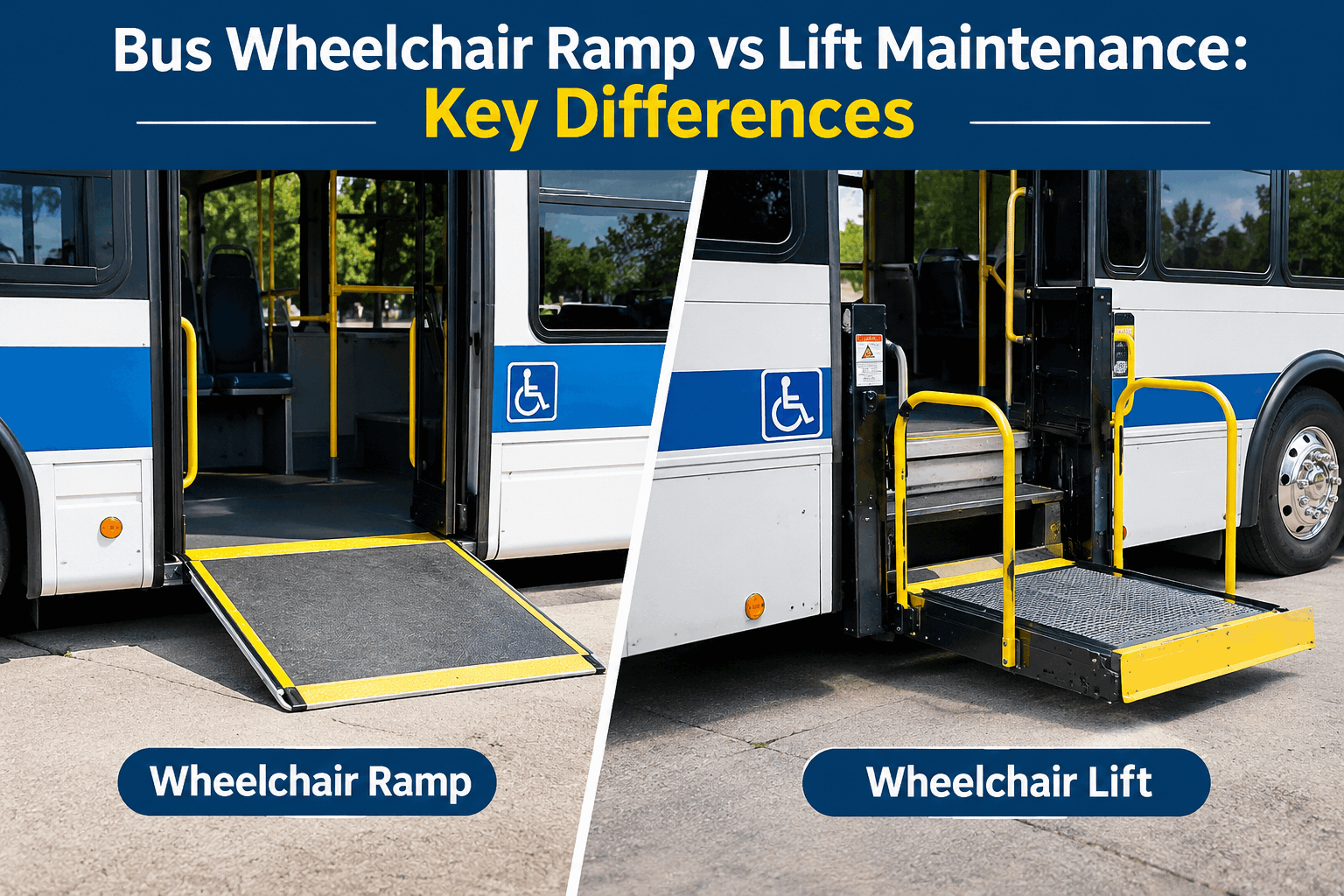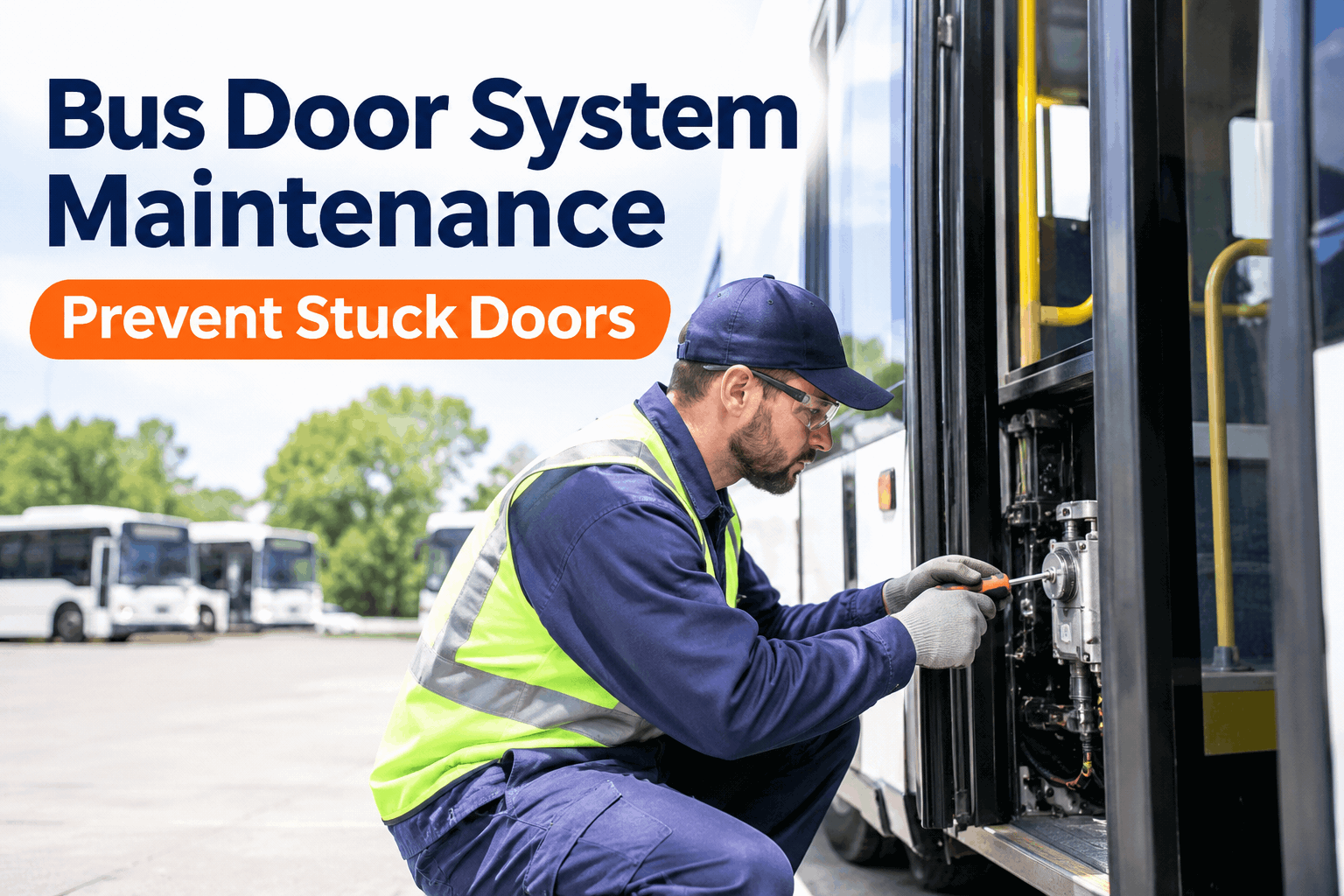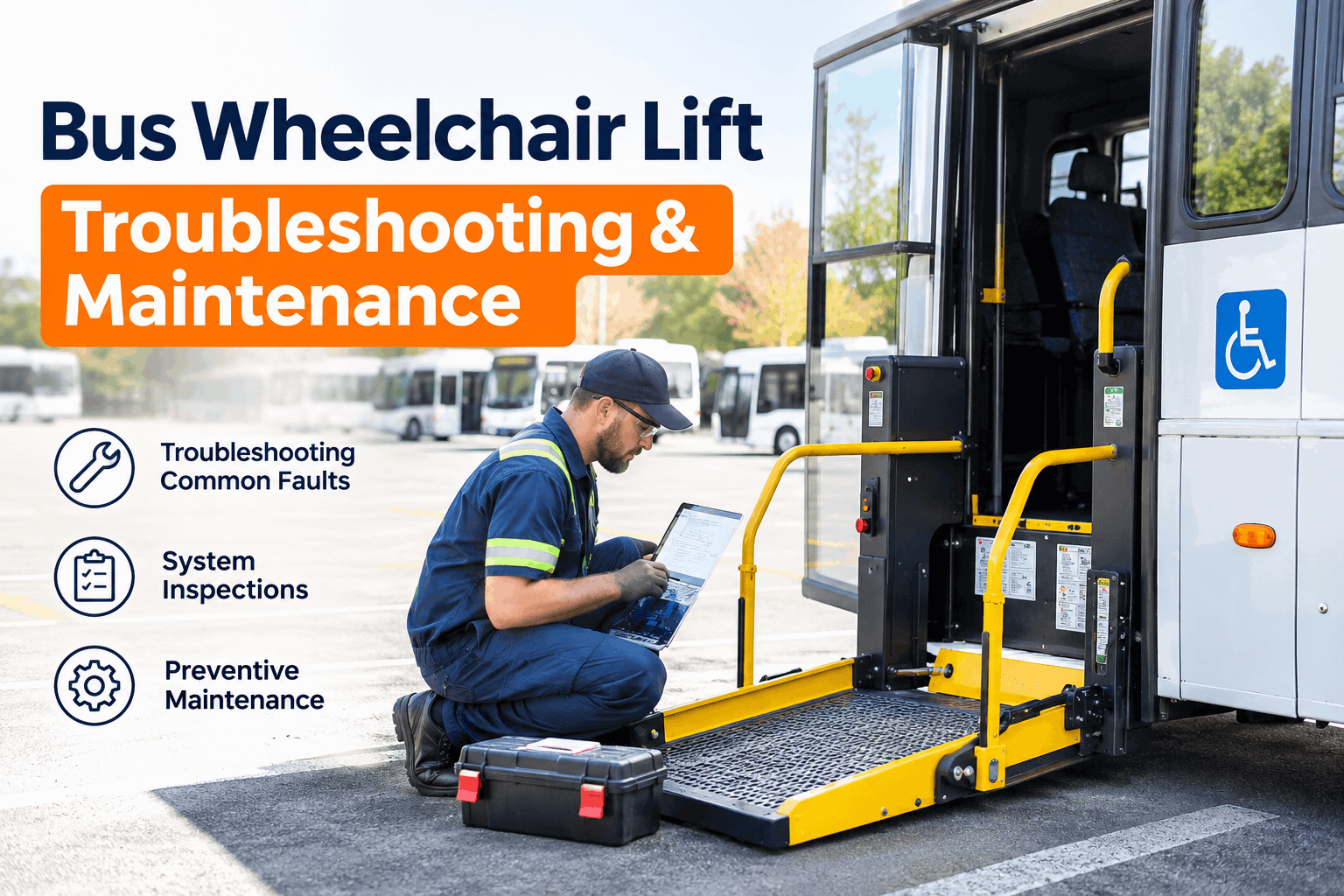
The lift won't deploy, the rider is waiting, and an ADA compliance clock is already running. Yet half these calls are not a failure — a door not fully open, the interlock not set, weight on the platform edge. Bus wheelchair lift troubleshooting starts by ruling those out, then follows the symptom to the real fault. Want every lift fault and fix logged? See it in a quick demo.
Bus Wheelchair Lift Troubleshooting & Maintenance
Most "dead lift" calls fail one of four safe-condition checks, not a real part. Clear the gate first, then diagnose by symptom — and keep the cycle-based PM that stops the fault coming back.
Rule Out the Safe-Condition Checks First
A wheelchair lift is full of safety interlocks designed to stop it moving in an unsafe situation. That is a feature, not a fault — but it means a lift that "won't work" is often a lift doing exactly what it should. Clear these four before you touch a tool, because they catch a large share of no-deploy calls.
Doors fully open
Most lifts will not deploy unless the vehicle doors are fully open. A door switch that is not made reads as a dead lift.
Interlock set, power on
Verify ignition on, emergency brake set, lift power on, and the pendant powered. If the interlock is not satisfied, the lift stays put by design.
Level surface
A lift may not fully deploy on an uneven surface. Re-park on level ground before assuming the mechanism has failed.
Platform clear of weight
Weight detected on a boundary or edge sensor stops the lift. Confirm the platform is clear and nothing is resting on a stop flap.
If any sign of real damage or improper function shows up, the rule is simple: stop using the lift immediately and route it to a qualified technician — never work around a safety device to force a cycle.
Diagnose by Symptom: Deploy, Raise, or Stow
Once the gate is clear, what the lift fails to do points you at the likely cause. A powered lift moves through deploy, lower, raise, and stow — and each stage has its own common faults. Here is the quick read for the most frequent complaints.
Swipe sideways to see all columns.
Trapped air is a common culprit after service — cycling the lift through its full travel several times purges it. You can sign up free and log each symptom and fix against the bus so a chronic lift is easy to spot.
Hydraulic or Electrical? The Symptom Tells You
A powered lift is really two systems sharing one platform: a hydraulic side that does the lifting, and an electrical side that controls and senses it. Knowing which the symptom points to keeps you from chasing a wiring fault with a wrench, or a leak with a multimeter.
A frequent electrical trap is a bad ground — a lift that is not securely grounded to the vehicle usually fails to operate, and it looks like a dead unit until you check the connection.
Internal hydraulic and electrical repairs need the proper tools, training, and the OEM manual — and most lifts include a manual backup pump to lower a rider safely if power is lost. A demo shows the fault captured and routed to a qualified tech.
PM That Follows Cycles, Not Just the Calendar
A lift's wear tracks how many times it cycles, not how many days pass — so the best programs schedule service by cycle count read off the pump-mounted counter, layered with daily and periodic checks. That is what keeps a high-use paratransit lift from aging on a low-use calendar.
Cycle the lift through its full travel, confirm it deploys, lifts, and stows, and check for any sign of damage or improper function.
Read the cycle counter on the pump unit and service on the OEM interval — clean the lift and lubricate hinges and drive-arm pivots as specified.
Deeper service: hydraulic fluid level and condition, seals and cylinder, electrical controls and switches, and a full load-cycle test.
Cycle-based scheduling is exactly what a maintenance system is for — reading the counter, firing the service at the right interval, and keeping the pre-trip cycle logged, on every lift-equipped bus, without anyone having to remember.
Your Wheelchair Lift Inspection Checklist
Build these into the lift PM. The red items are safety-critical — a miss is a passenger-safety and ADA issue; the amber ones catch wear before it strands a bus. Exact items, intervals, and cycle counts vary by lift make and model, so always follow the OEM manual.
- Cycle the lift fully at every pre-tripDeploy, lower, raise, and stow through full travel. This is the core ADA maintenance check and the fastest way to catch trouble early.SAFETY
- Stop use on any sign of damage or improper functionUnusual noise, drift, slow movement, or a failed safety device means the lift is out of service until a qualified tech clears it.SAFETY
- Verify safety devices and the manual backupTest boundary and stop-flap sensors, the interlock, and confirm the manual backup pump can lower a rider if power is lost.SAFETY
- Check hydraulic fluid level, condition, and leaksUse the correct fluid, look for leaks at fittings and the cylinder, and top up or service per the OEM — low fluid is a common no-raise cause.HYDRAULIC
- Inspect ground, connections, switches, and controllerConfirm a secure ground, tight connections, working switches, and no controller error codes — a bad ground alone stops a lift cold.ELECTRICAL
- Log cycle count, service, and fix per busRecord the cycle count and every repair so PM lands on the right interval and a repeat fault flags a root-cause problem.TRACK IT
Run the list and most lift faults are caught at inspection, not on a route with a rider waiting. You can see this checklist run as a scheduled PM in a demo.
How BusCMMS Keeps Lifts Working
BusCMMS does not bleed a cylinder or chase a wiring fault — it makes sure the pre-trip cycle gets logged, the cycle-based PM fires, and a lift fault becomes a tracked work order routed to a qualified tech, with the record an FTA review expects.
Cycle-count and pre-trip PM
Service scheduled on cycle count and calendar together, so a high-use lift is maintained on its real wear, not a generic date.
Fault to work order
A driver's or tech's lift note becomes a work order and pulls the bus if needed, so a fault is acted on, not ridden out.
Audit-ready lift history
Every cycle check and repair timestamped by unit, so a repeat offender stands out and an FTA review is a quick export.
The result is lifts that work when a rider needs them and a record you can prove. Book a demo and bring your lift makes and cycle counts.
A Shop Technician's Take
Key Takeaways on Lift Troubleshooting
A lift that won't move is a diagnosis, not a mystery — if you work it in order. Four things to hold onto.
Clear the safe-condition gate first
Doors, interlock, level surface, clear platform — these catch a big share of no-deploy calls.
The symptom names the system
Won't raise or drifts is usually hydraulic; dead or intermittent is usually electrical.
Stop on any safety doubt
A sign of damage or a failed safety device means out of service and a qualified tech — never force it.
Schedule by cycles
Lift wear tracks cycles, not days — service off the counter, logged per bus.
Clear the gate, diagnose by symptom, respect the safety line, and maintain by cycle count — and bus wheelchair lift troubleshooting turns from a scramble at the curb into a short, logged routine. The rider is counting on that lift; give it the diagnostic discipline and the cycle-based PM it needs, and it will be ready when they are.