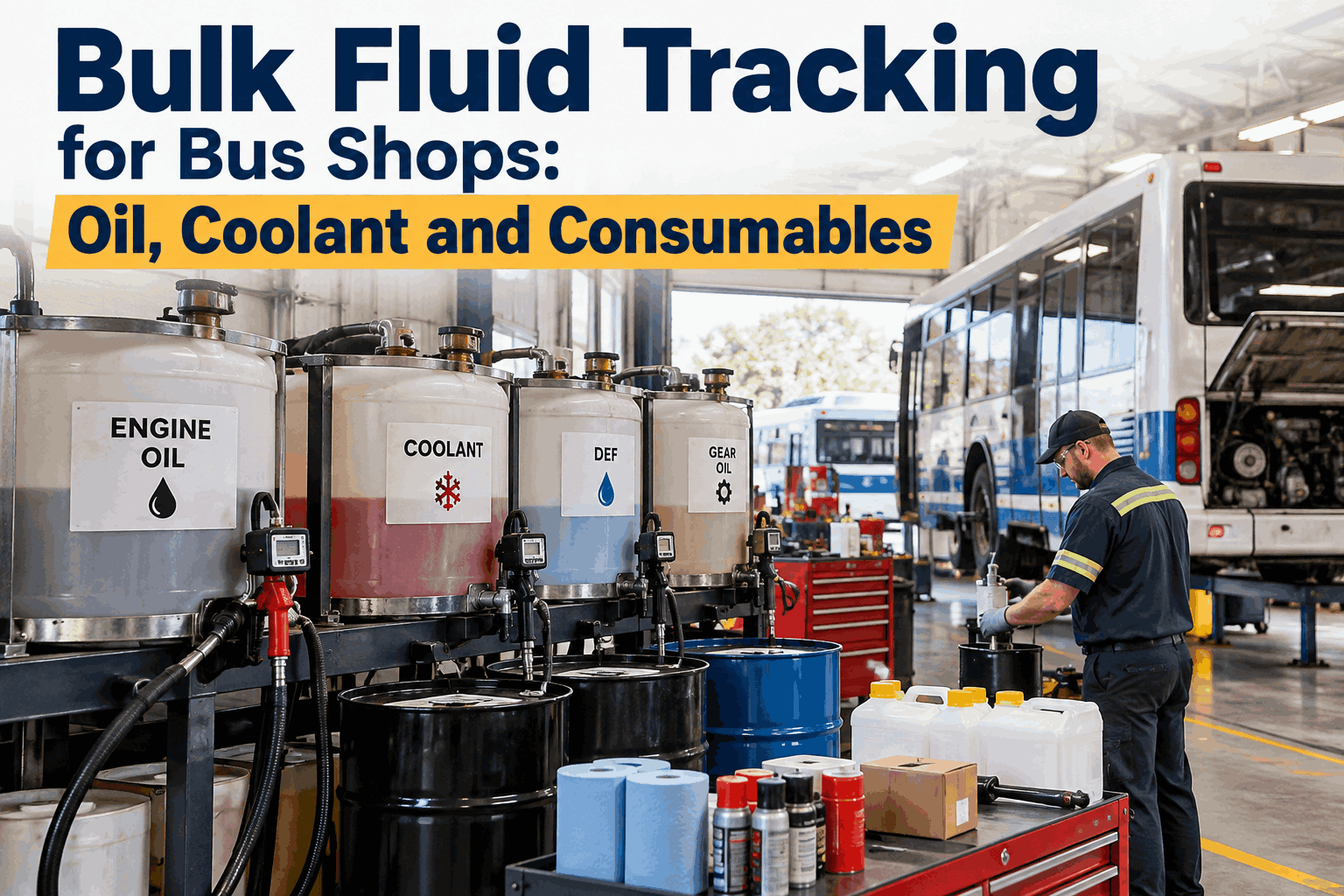
Here's a number that should bother any shop manager: you buy a 55-gallon drum of engine oil, and by the time it's empty, the work orders you can tie oil to account for maybe 45 gallons. Where did the other ten go? Nobody topped off a crankcase with a stopwatch and a logbook — a tech grabbed the dispenser, filled what the bus needed, and moved on. That's the whole problem with bulk fluid tracking in a bus shop: oil, coolant, DEF, grease, and the box of shop rags and gloves don't get counted the way an alternator does. They pour, they get used, and the usage disappears into the gap between the drum and the work order. Multiply that across a fleet and a year, and unaccounted consumable usage is one of the quietest cost leaks in the building.
Bulk Fluid Tracking for Bus Shops: Oil, Coolant & Consumables
Bulk oil, coolant, and shop consumables don't count like discrete parts — so their usage leaks. Here's how to charge fluids to a work order and a bus, reconcile against the drum, and close the gap.
Where Bulk Fluid and Consumable Usage Disappears
The leak in a bus shop isn't dramatic — nobody's stealing drums. It's a hundred small pours that never get written down, because the moment fluid leaves the dispenser it stops being tracked. Bulk fluid tracking fails at these handoff points, where the fluid moves but the record doesn't follow it:
The unlogged top-off
A tech adds two quarts to a low crankcase between services. Real oil, real cost — but it's not a scheduled job, so it never lands on a work order.
The shared job
One drum of coolant serves three buses in an afternoon. Without a way to split usage, it all gets guessed at — or charged to whichever bus was open on the screen.
Spill, waste & overfill
Some volume is lost to spills, a cracked container, or an overfill that gets drained back out. Real shrinkage that inventory never sees if you only count what's on the shelf.
The quick consumable grab
Gloves, rags, brake cleaner, zip ties — grabbed by the handful, never charged to a job. Individually cheap, collectively a line item nobody can explain at budget time.
Every one of these is legitimate usage — the fluid genuinely went into a bus or got consumed in the shop. The failure isn't waste, it's that the record stops at the drum. When your inventory says you should have twenty gallons of coolant left and you have twelve, you can't tell whether it's spillage, unlogged top-offs, or a miscount, because none of it was tied to a work order or a bus in the first place. That's the difference between a shop that can explain its consumable spend and one that just eats it. Closing the gap starts with treating bulk fluids as trackable usage, the same discipline a well-run CMMS storeroom brings to discrete parts — capturing usage where it happens instead of hoping the count adds up later.
Why Bulk Fluids Don't Track Like Discrete Parts
The reason most inventory systems fail at fluids is that they were built to count things — one alternator in, one alternator out. Bulk oil, coolant, and consumables break every assumption a discrete-parts system makes, which is exactly why usage slips through. Line the two up side by side and the mismatch is obvious.
- Counted bywhole units — you have 3 or you have 2
- Issuedone at a time, to one bus, one work order
- Shrinkageobvious — a missing unit is visible
- Auditcount the shelf, done
- Counted byvolume — a partial drum is a guess
- Issuedin varying amounts, often across several buses
- Shrinkageinvisible — spills and top-offs leave no trace
- Auditdipstick a drum and hope
That's why "just do a physical count" doesn't fix fluids the way it fixes parts. You can't eyeball a half-empty drum to the quart, and even if you could, a count only tells you what's left — not where the rest went or which bus it went into. The fix has to happen at the point of use: capture the amount every time fluid is dispensed, and tie it to the work order and the bus right then. Do that, and the drum reconciles itself — opening volume, minus what got charged to jobs, should equal what's in the drum, and any gap is a real signal instead of a shrug. This is the same accuracy problem behind getting your min-max stock levels right: you can't set reorder points on consumption you never measured. Sign up free and start tracking fluid usage by bus.
How to Set Up Bulk Fluid Tracking in a Bus Shop
Getting control of bulk fluids and consumables isn't about a fancy dispensing rig — it's about a clean chain from purchase to work order that captures usage at the moment it happens. Five steps, in order, turn a leaking drum into a tracked, reconcilable consumable.
Receive Bulk in Trackable Units
Log each drum, tote, or case into inventory with its volume or count and cost when it arrives. That opening quantity is the baseline everything reconciles against — no baseline, no accounting.
Charge Every Pour to a Work Order
When a tech dispenses oil or coolant, record the amount against that work order and bus — including top-offs that aren't a scheduled service. If it left the drum, it lands on a job.
Split Shared Usage by Bus
When one drum serves several buses in a session, apportion the volume to each unit instead of dumping it on one. That's what makes per-bus fluid consumption real rather than a rounding error.
Reconcile Drum vs. Charged Usage
Periodically compare opening volume minus charged usage against what's physically left. A small gap is normal shrinkage; a widening one is a process problem to chase down.
Track Consumables the Same Way
Gloves, rags, cleaners, and shop supplies get issued to jobs or a shop-overhead bucket — not grabbed and forgotten — so the small stuff stops being unexplainable.
The step that does the most work is charging every pour to a work order, because it's the one that closes the biggest leak — the unlogged top-off. It sounds like friction, but in practice it's a few taps at the dispenser or on the mobile work order the tech already has open. Everything downstream — per-bus cost, reconciliation, accurate reorder points — depends on that single habit being in place. Once usage is captured at the point of dispense, the rest is reporting, and the drum finally tells you the truth about where it went. Book a walkthrough to see the pour-to-work-order flow.
Reconciliation: Turning the Gap Into a Signal
Reconciliation is where bulk fluid tracking earns its keep. Once every pour is charged to a job, the math on a drum becomes simple — and the gap between what you bought and what you can account for turns from an unknown into a number you can read and act on.
A 1.5-gal gap on a well-run drum is normal spill and measurement slack. The same drum running a 10-gal gap month after month is a process leak — and now you can actually see it.
The point of reconciliation isn't to hunt down every ounce — some slack is unavoidable with liquids. The point is that a tracked drum gives you a baseline for normal, so an abnormal gap stands out. A shop that suddenly can't account for a quarter of a drum has a real question to answer: is it spillage, a dispensing habit, a miscount, or something worse? Without tracking, that question never even gets asked, because there's no expectation to measure against. With it, unaccounted usage becomes a managed metric instead of a mystery on the budget line — and it feeds straight into accurate per-bus maintenance cost, since the fluids finally land on the right units. That per-unit accuracy is the same foundation behind sound parts and inventory management across the whole shop. Sign up free and reconcile your first drum.
The BusCMMS Parts & Inventory Capabilities That Track Fluids
Bulk fluid tracking works when capturing usage is part of the job the tech already does — not a second log to fill out later. BusCMMS parts and inventory management builds fluid and consumable tracking into the work order flow, so oil, coolant, and shop supplies get accounted for at the point of use.
Bulk & Volume Tracking
Track fluids by volume, not just unit count, so a partial drum has a real number and usage is measured as it's dispensed.
Charge to Work Order & Bus
Record each pour against the job and the unit — including top-offs — so fluid cost lands on the bus that actually used it.
Usage-Based Reconciliation
Compare charged usage against measured drum volume automatically, surfacing the unaccounted gap as a number you can watch over time.
Consumption by Bus & Route
See fluid and consumable use per unit, so an oil-thirsty bus or a coolant-losing engine shows up as a trend, not a surprise.
Reorder Alerts on Fluids
Auto-reorder alerts on bulk stock built from real consumption, so you don't run a drum dry mid-service or over-buy fluids that sit and age.
Shop Consumables Control
Issue gloves, rags, and cleaners to jobs or shop overhead, turning the "quick grab" line item into a tracked, explainable cost.
The reason a purpose-built bus shop system matters here is that fluid tracking only works if it's frictionless at the point of dispense — ask a tech to fill out a separate fluid log and it won't happen consistently, which is how most shops ended up with the gap in the first place. Because BusCMMS captures the pour on the same work order the tech is already using and reconciles it against the drum in the background, unaccounted usage becomes a number you manage rather than a cost you absorb — and it typically goes live in two to four weeks, not months. Book a demo to see fluid and consumable tracking on your shop's workflow.
A Shop Manager's Take
That's the whole arc of fluid tracking in one story: a lump on the budget nobody could explain, turned into a per-job number a manager can defend and act on. The fluids were always being used legitimately — the shop just couldn't see where until every pour landed on a work order.
The Bottom Line on Bulk Fluid Tracking for Bus Shops
Bulk fluid tracking in a bus shop is really about closing one specific gap: the space between the drum and the work order, where legitimate oil, coolant, DEF, grease, and shop consumables get used but never recorded. The reason it leaks is that bulk liquids and consumables don't behave like discrete parts — you can't count a half-empty drum the way you count an alternator, so usage vanishes into unlogged top-offs, shared jobs, spills, and quick grabs. The fix is a clean chain from purchase to point of use: receive bulk stock in trackable units, charge every pour to a work order and a bus, split shared usage across units, reconcile the drum against charged usage, and put consumables on the same footing. Do that and the payoff compounds — accurate per-bus maintenance cost, reorder points built on real consumption, and an unaccounted gap that becomes a managed signal instead of a budget mystery. You stop absorbing fluid spend you can't explain and start managing it like every other line in the shop. For parts and shop managers under pressure to explain where the money goes, bulk fluid tracking is one of the highest-leverage places to start — the leak is quiet, but it's real, and it's fixable. Book a walkthrough to build fluid tracking for a shop like yours.