Bus fleet parts management is the invisible backbone of maintenance productivity, and the single most underoptimized operation in American bus fleet maintenance shops. A typical bus maintenance technician spends 15 to 22 percent of every shift hunting for parts: walking to the parts room, searching through bins or shelves, discovering the required component is out of stock, then waiting 45 minutes for the supervisor to order the replacement from a vendor. Meanwhile, the bus sits in the bay, work orders stack up, and wrench time—the critical metric of maintenance productivity—plummets to 50 to 55 percent. The difference between a well-organized bus fleet parts storeroom and a chaotic parts operation is worth 60 to 90 minutes of productive time per technician per shift, which translates to approximately $35,000 to $50,000 per year in labor value for a six-technician shop. A properly configured storeroom with ABC inventory analysis, automated min/max stock level triggers, CMMS integration, and a preferred vendor management system eliminates the hunt, ensures critical parts are always in stock, and transforms parts management from a productivity killer into a competitive advantage. This guide covers exactly how to set up a bus fleet parts storeroom from scratch, how to configure inventory management in your CMMS, how to establish automatic reorder triggers for critical components, and how to partner with vendors strategically so your most-needed parts arrive before you need them.
Bus Fleet Parts Storeroom Setup Guide: ABC Inventory Analysis, CMMS Integration, Automated Reorder Triggers. Ready to Deploy in Your Shop This Month.
The Three Critical Components of a Bus Fleet CMMS Parts Management System
Most bus fleet maintenance shops do not have a "parts management system"—they have a pile of parts in a room with no organization, no inventory tracking, no reorder process, and no integration with the maintenance scheduling system. Technicians either wander the parts room hoping to find what they need or interrupt supervisors to search through supplier catalogs. The result is predictable: lost productivity, repeated stockouts of critical items, overstocking of slow-moving components, and no visibility into parts spending. A professional bus fleet parts storeroom requires three integrated components: a parts inventory database tied to your CMMS, a physical storeroom organized by part type and frequency of use, and a vendor management process that ensures critical parts arrive before your technicians need them. Without all three components, your parts operation will remain a productivity drain and cost sink.
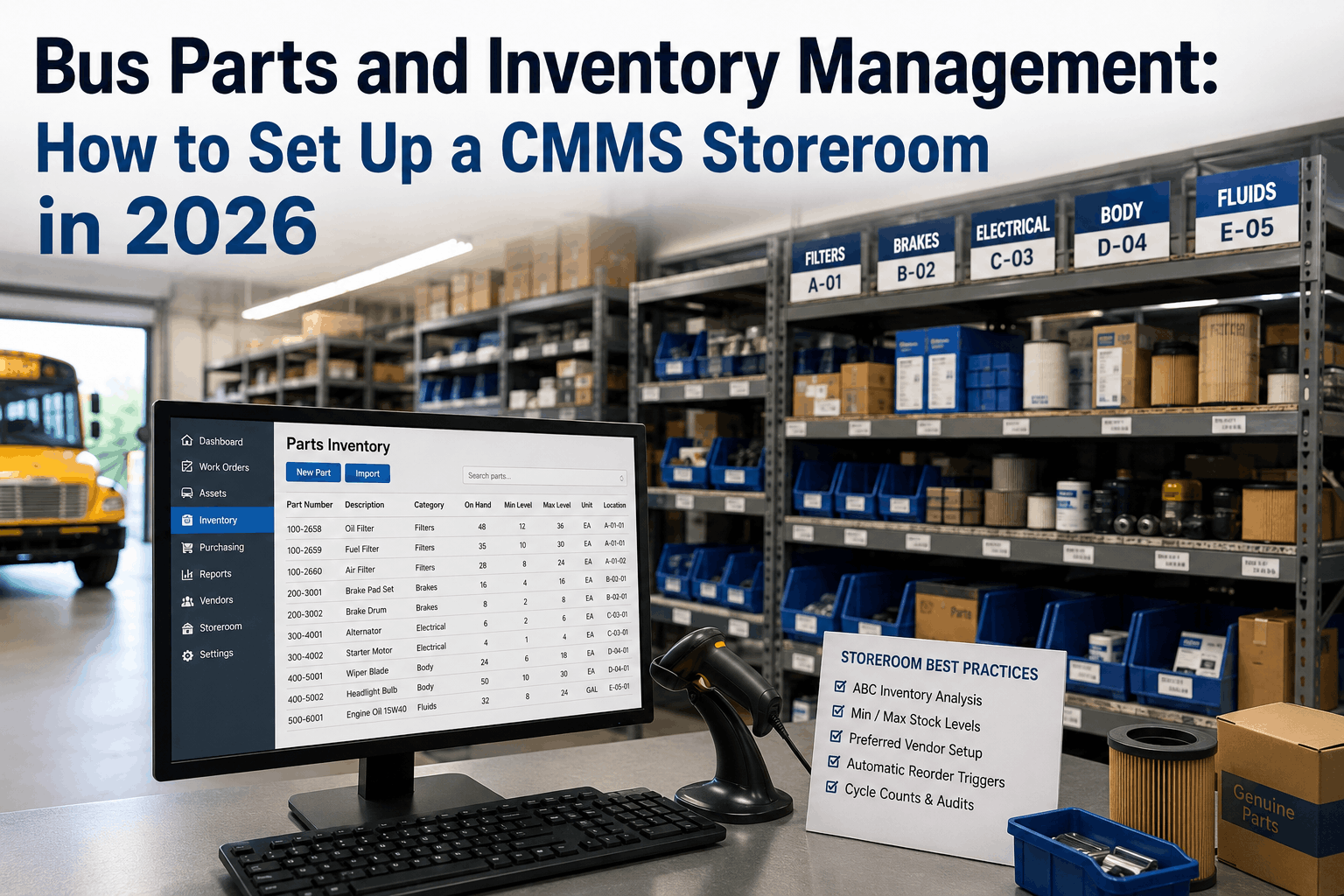
Every part stored in your storeroom must be cataloged in your CMMS with the following information: part number, description, supplier, current stock level (quantity on hand), reorder point (the level at which you automatically order more), reorder quantity (how many units you order when you reorder), par level (the target inventory level), and unit cost. The database must be synchronized with your actual physical inventory at least quarterly through a physical count or perpetual inventory process. Without an accurate database, you cannot forecast demand, you cannot optimize stock levels, and you cannot prove to auditors or budget committees what assets you are holding.
Your storeroom must be organized by functional category (brakes, transmission, engine, cooling, electrical, suspension, general hardware) with logical bin placement driven by frequency of use. High-use items (oil, filters, brake pads, hoses) occupy the most accessible, fastest-to-reach locations. Slow-moving items go to higher shelves or back storage. Each bin must be labeled with the part number, description, reorder point, and current stock level. Technicians should be able to locate and pull any part in under two minutes. A poorly organized storeroom with identical-looking bins buried behind other inventory creates the exact opposite effect: technicians give up searching, interrupt supervisors, and lose 20 to 30 minutes per missing part.
When a technician pulls the last unit of a critical part from the storeroom, the CMMS should automatically trigger a purchase order to your preferred vendor and alert the supervisor that a reorder has been issued. The vendor should have a standard delivery window (next business day for emergency parts, 2 to 3 days for standard stock) and a preferred vendor agreement that locks in pricing and delivery terms. Without automation, you rely on supervisors to manually monitor stock levels and place orders, which is reactive and creates the frequent stockouts that shut down maintenance bays.
ABC Inventory Classification: How to Identify Which Parts to Stock, Which to Order On-Demand, and Which to Keep Extra Quantities Of
Every bus fleet maintenance shop has about 800 to 1,500 unique parts in inventory, but only about 80 to 100 of those parts account for 80 percent of maintenance activity and parts spending. ABC inventory analysis is a simple classification system that divides your parts into three categories based on annual usage frequency and cost impact, then assigns different inventory strategies to each category. A-items (your most critical, highest-value parts) are always in stock with generous par levels. B-items are kept at moderate stock levels based on demand patterns. C-items are ordered on-demand from vendors. This classification system ensures you never run out of critical parts while avoiding the excessive inventory costs of stocking low-demand, high-cost components that might sit on the shelf for two years.
Parts that represent the top 20 percent of annual maintenance activity and top 80 percent of parts spending. Examples: brake pads, air filters, engine oil, transmission fluid, alternators, water pumps, fuel filters, starter motors. These parts are ordered and used frequently enough that stockouts create immediate maintenance shutdown. Strategy: Always stock at par level, maintain 1.5 to 2 months of supply, set reorder points at 25 percent of par level, establish next-day or same-day delivery agreements with vendors.
Parts that represent the next 30 percent of maintenance activity and 15 percent of parts spending. Examples: hoses, clamps, belts, gaskets, connectors, seals, moderate-cost electrical components, fasteners. These parts are ordered occasionally, and stockouts are inconvenient but not catastrophic. Strategy: Maintain 30 to 45 days of supply, set reorder points at 50 percent of par level, order from standard suppliers with 2 to 3 day lead times, review stock levels monthly.
Parts that represent 50 percent of your parts catalog but only 5 percent of annual activity. Examples: specialty fasteners, low-cost hardware, obscure connectors, one-time-use components, parts for aging vehicles that may be retired soon. These parts are ordered infrequently and often cost less than the storeroom labor required to track and store them. Strategy: Order on-demand from vendors, do not maintain standing inventory except for general fasteners and hardware, do not assign storeroom space, maintain a vendor catalog reference.
Building Your CMMS Storeroom in 6 Steps: From Parts Catalog to Automated Reorder Triggers
Pull every part from your storeroom, count it, photograph it, and create a master spreadsheet with: part number, description, quantity on hand, vendor/supplier, unit cost, and last purchase date. This inventory count is the baseline truth. Do not estimate quantities—actually count them. This process typically takes 2 to 4 days for a medium-sized fleet storeroom but is absolutely essential because you cannot manage what you do not measure.
Review your maintenance records for the previous 12 months. Identify which parts were used most frequently and which ones represent the largest cost impact. Classify each part as A, B, or C. You should end up with approximately 10 to 15 percent of your parts catalog as A-items, 25 to 35 percent as B-items, and 50 to 65 percent as C-items. Use this classification to determine stocking strategy and inventory investment.
Enter all parts with part numbers, descriptions, suppliers, unit costs, and ABC classifications into your CMMS inventory module. Link each part to the maintenance work orders and vehicle repair procedures that use that part, so the CMMS can forecast demand. The more complete your data at this stage, the more accurate your demand forecasting and reorder triggers will be.
For A-items, set par level at 45 to 60 days of average monthly usage, and reorder point at 25 percent of par (when you hit this level, you automatically order to return to par). For B-items, use 30 to 45 days par level and 50 percent reorder point. For C-items, do not set par levels—order as needed. Your CMMS should automatically calculate these based on monthly usage data, and you should manually review and adjust quarterly as usage patterns change.
Establish preferred vendor relationships for A-items (typically one or two suppliers that can guarantee next-day delivery), B-item suppliers (2 to 3 day lead times), and C-item catalog sources. Document minimum order quantities, bulk discounts, lead times, and delivery reliability for each vendor. Configure your CMMS to automatically generate purchase orders to your preferred vendor when stock levels hit the reorder point, reducing manual work and ensuring consistent supplier relationships.
Institute a process where technicians check out and check in parts from the storeroom using the CMMS mobile app (ideally with barcode scanning to eliminate manual entry errors). Conduct quarterly cycle counts on A-items to ensure accuracy. A-items should have 95 to 99 percent inventory accuracy. B-items should have 85 to 95 percent accuracy. Large discrepancies indicate theft, damage, or miscounting and should trigger investigation. Annual physical count of entire inventory serves as the ultimate verification and reconciliation.
Strategic Vendor and Service Partner Management: Building Supplier Relationships That Guarantee Parts Availability
Most bus fleet maintenance shops approach parts vendors as interchangeable commodities: lowest price wins, and vendor relationships are transactional. This approach costs you time, creates frequent stockouts, and leaves you scrambling when an emergency part is needed at 2 PM on a Friday. A professional bus fleet parts operation establishes preferred vendor partnerships with scorecards that measure reliability, delivery performance, pricing, and service quality. Your top vendors become part of your maintenance strategy, and in return, they prioritize your orders, guarantee delivery windows, and sometimes stock high-value emergency parts on consignment.
Select one or two vendors for brake components, engine parts, and transmission items. These vendors should be able to guarantee next-business-day delivery of 95 percent of orders, maintain consignment inventory of your highest-use items, provide technical support, and commit to volume discounts on A-items. Relationship focus: reliability and speed. Meet quarterly to review stock levels, delivery performance, and opportunity to adjust par levels based on actual usage trends. Expect to pay 5 to 8 percent premium for guaranteed delivery compared to standard suppliers, but the cost is justified by elimination of production delays.
Maintain relationships with 2 to 3 mid-size parts suppliers capable of 2 to 3 day delivery on standard hoses, belts, gaskets, and electrical components. These vendors should offer competitive pricing (within 3 to 5 percent of online retailers), accept purchase orders via electronic catalog, and provide occasional volume discounts. You are not locked into these vendors (unlike A-item vendors), but switching should be evaluated quarterly based on delivery performance and pricing. Relationship focus: cost and service balance.
For rare, low-value parts, use online parts catalogs and just-in-time ordering. Do not negotiate volume discounts or special terms for C-items because the transaction cost of negotiation exceeds the benefit. Use standard internet-based suppliers (Grainger, Amazon Business, industry-specific catalogs) that offer 3 to 5 day delivery at reasonable pricing. Save storeroom space and capital by not stocking items you use once per year or less.
Case Study: 38-Bus Fleet Implemented CMMS Parts Management and Eliminated 45-Minute Stockout Delays Within 60 Days
A charter bus operator in North Carolina with 38 coaches, a four-technician shop, and a parts room that resembled an archaeological dig site inherited from previous management found that technicians were spending an average of 28 minutes per work order waiting for or hunting for parts. Stockouts of critical items (brake pads, filters, hoses) occurred 3 to 4 times per week, forcing technicians to idle or move to different jobs and lose task context. The operator implemented a complete CMMS parts management system: physical inventory count of all parts, ABC classification, par level configuration, and automated reorder triggers for A-items. Within 30 days, A-item inventory accuracy reached 98 percent and stockouts dropped from multiple per week to zero. Within 60 days, technician wrench time improved from 58 percent to 67 percent due to parts availability, and maintenance labor productivity improved by 15 percent. The operator calculated that parts management improvements recovered approximately $22,000 per year in technician labor productivity with zero change in parts spending. The parts operation went from a productivity sink to a competitive advantage.
Bus Fleet Parts and Inventory Management: Frequently Asked Questions
Start with a complete physical count: pull every part, count it, and list it in a spreadsheet. Then organize by functional category (brakes, transmission, engine, etc.) with ABC classification. Place high-use A-items in the most accessible locations. This one-time effort (2-4 days) eliminates chaos and creates the foundation for ongoing inventory management.
Par level is your target inventory quantity (how much you want to have in stock). Reorder point is the trigger level (when you order more to return to par). Example: if par level is 30 units and reorder point is 8 units, you order more when inventory drops to 8 units to replenish back to 30 units.
Yes, for the most critical A-items (brake pads, oil, filters), consider holding safety stock 15 to 25 percent above par level to protect against demand spikes or supplier delays. Calculate the cost of carrying extra inventory against the cost of a one-day maintenance shutdown and make informed decisions.
Conduct quarterly cycle counts on A-items (high-value, high-turnover) and semi-annual counts on B-items. Do a complete physical inventory annually. This verification schedule maintains inventory accuracy above 95 percent and identifies shrinkage or system errors before they cascade.
Yes, barcode scanning integrated with your CMMS eliminates entry errors and provides real-time visibility of parts movement. When a technician scans a part, the CMMS records the removal, flags when stock reaches reorder points, and auto-generates purchase orders. This automation is the gold standard for parts management in professional fleets.
Implement check-out and check-in procedures where every part removal is recorded in the CMMS by the technician or storeroom attendant. Lock high-value items in a separate secure cabinet. Conduct regular cycle counts to identify discrepancies and investigate large variances immediately. This accountability deters casual theft and creates audit trails.
Budget 15 to 22 percent of total parts spending for inventory capital (the parts you are holding in storeroom) plus carrying costs (storage space, inventory management labor). If your inventory is holding 40 percent or more of annual parts spending, you are overstocked and tying up capital that could be deployed elsewhere.
Bus Fleet Parts and Inventory Management System Ready to Deploy. ABC Analysis, CMMS Integration, Automated Reorder Triggers, Vendor Management.
Eliminate parts hunting delays, eliminate stockouts, eliminate inventory carrying costs. Transform parts management from a productivity sink into a competitive advantage for your fleet.