Two buses are parked out front. Dispatch grabs the first one for the long cross-county run — and it's the unit with a minor coolant weep the shop flagged yesterday and a PM that's nearly due. The pristine bus goes on the three-mile shuttle instead. By afternoon the wrong bus is on the shoulder. Smart bus route assignment flips that: match the route to the vehicle's actual condition, and the strongest bus takes the hardest route while the compromised one stays close to home.
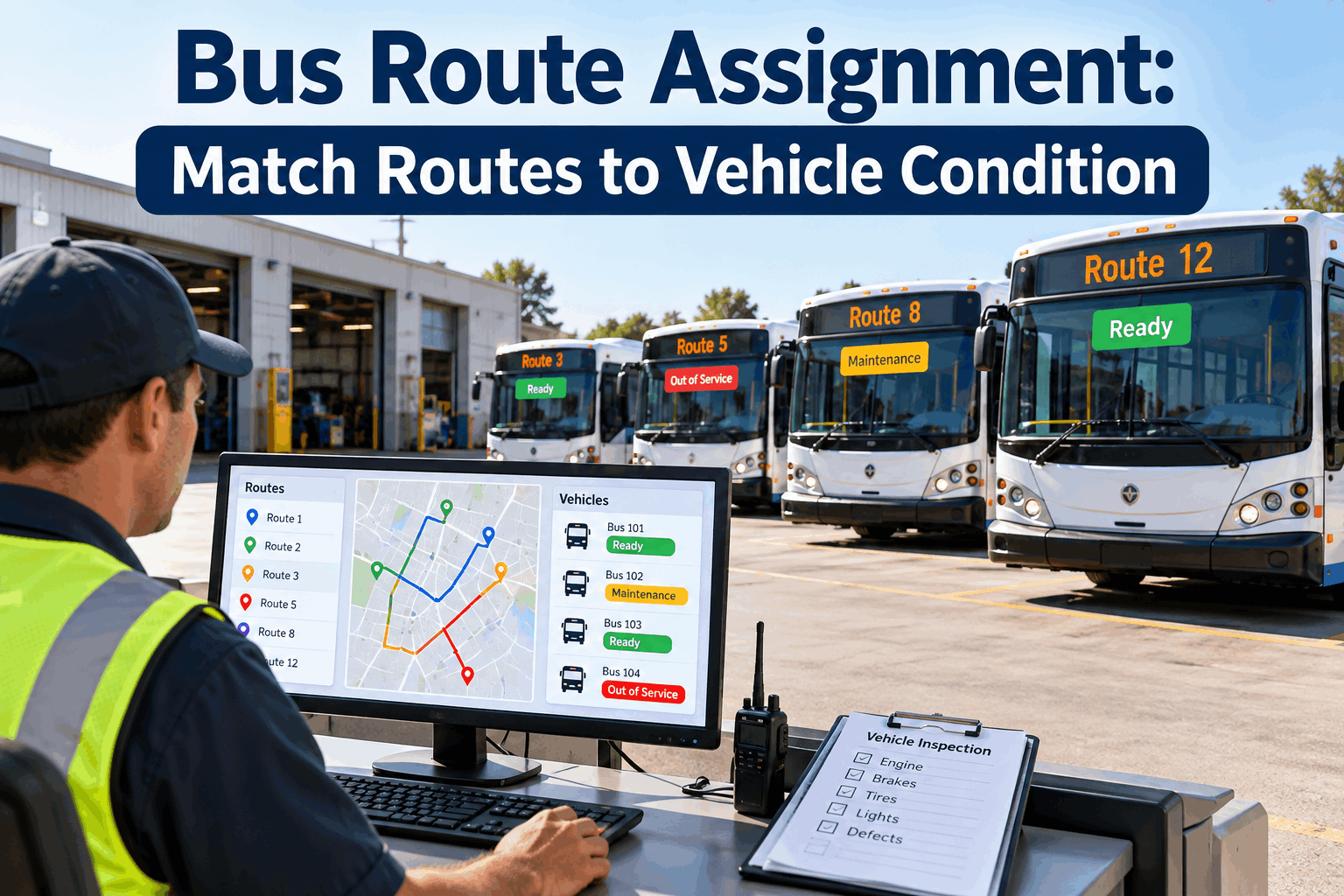
Bus Route Assignment: Match Routes to Vehicle Condition
Assigning buses by whoever's parked in front wastes the one thing you already know — each bus's condition. Match the strongest bus to the hardest route and stop putting compromised buses where they'll fail.
The Cost of Assigning Buses Blind
Most daily bus route assignment happens on autopilot — the bus that's parked in front, the one a driver likes, or whatever the yard sheet lists first. None of that accounts for the single most useful thing a fleet already knows: what condition each bus is actually in. When assignment ignores condition, the fleet effectively assigns at random against the thing that matters most, and the results show up on the road.
Compromised Bus, Hardest Route
A bus with an open defect or overdue PM lands on the long, demanding run — the exact conditions that turn a minor issue into a mid-route breakdown.
Uneven Wear
The same few buses always draw the hard routes while others coast, so part of the fleet ages fast and the rest sits underused — lopsided wear nobody planned.
Avoidable Road Calls
A breakdown that condition data could have predicted becomes a stranded route, a tow, and a scramble — the expensive version of a problem you already knew about.
Wasted Good Condition
The freshest, defect-free bus spends the day on a three-mile shuttle while a tired one grinds out the highway route — capability left on the table.
The frustrating part is that the information to prevent all of this already exists — it's in the inspection reports, the PM schedule, and the open work orders. It just isn't in front of the person making the assignment. Dispatch assigns from a yard sheet; the condition data lives in the maintenance system; and the two never meet at the moment of decision. Closing that gap is what condition-based assignment is about. It builds directly on having a live readiness view in the first place, which our piece on bus dispatch and fleet software touches on. Book a demo to see bus condition next to route demand at assignment time.
The Condition Signals That Should Drive Assignment
Condition-based bus route assignment runs on a handful of signals the fleet already captures. Put these four in front of dispatch and the assignment decision stops being a guess and becomes a match.
Open Defects
Any active write-ups from the latest DVIR or inspection. A safety defect means the bus doesn't run at all; a minor non-safety item means keep it close and easy, not on the long haul.
PM Status
How close the bus is to its next service. A bus a few hundred miles from a PM shouldn't take the route that will blow past the interval mid-day — put it on a short run and service it on schedule.
Readiness State
Ready, in maintenance, or needs a pre-trip check. Only assign from the genuinely ready pool — and never pull a bus onto a route straight out of the shop without its check cleared.
Age & Recent Duty
A newer bus, or one that's had lighter recent duty, can absorb a hard route better than an older unit that just ran three severe days straight. Spread the hard miles instead of piling them on the same few.
None of these require new data collection — they're the byproducts of running inspections and a PM program you're already doing. The shift isn't gathering more; it's surfacing what you have at the one moment it matters, the assignment. The most actionable pair is open defects and PM status: together they tell you instantly whether a bus should be on the hardest route, a routine one, or parked close to home for a short run until it's serviced. The condition data that feeds this is the same live status a readiness view provides, which our guide to giving dispatch live bus status covers as the foundation. Sign up free and put condition signals in front of your dispatch.
The Matching Logic: Condition to Route Demand
Once you can see each bus's condition, assignment becomes a match against what the route actually demands. Not every route is equal — a long, hilly, all-day run asks far more of a bus than a short flat loop — so you pair the demand of the route with the condition of the bus.
The bottom row is the guardrail that overrides everything above it: a safety-critical defect isn't a "put it on an easy route" situation, it's an out-of-service situation, and no route demand changes that. Above that line, the logic is about fit — keeping a compromised-but-safe bus on a short, close-in route means if something does go wrong, it's a two-mile tow and a quick swap, not a route stranded forty minutes out. And putting the best bus on the hardest route isn't just protective; it's the assignment most likely to finish the day without a call. It also quietly evens out wear, because the hard miles stop landing on the same tired unit every day. Book a walkthrough to see condition-to-route matching in action.
What Condition-Based Assignment Actually Prevents
Matching condition to route isn't a nice-to-have — it heads off specific, costly problems that random assignment creates. Here's what changes when the assignment finally accounts for condition.
The theme across all three is that condition-based assignment converts information you already have into breakdowns that don't happen. A road call you prevented doesn't show up as a win on any report — which is exactly why blind assignment persists, because its costs are invisible until a bus is on the shoulder. But a fleet that assigns by condition simply has fewer bad afternoons: fewer stranded routes, more even wear, and PMs that actually land on schedule instead of getting blown through by a poorly-matched route. It's the same fleet and the same routes — just paired on purpose. Sign up free and start matching buses to routes by condition.
How BusCMMS Powers Condition-Based Assignment
Condition-based assignment only works if the condition data is visible at the moment of the decision. Because BusCMMS runs the inspections, PM schedule, and fleet status in one system, that data is already there to surface next to the assignment — not buried in a maintenance module dispatch never opens. The features below make the match possible.
-
Open-Defect Visibility
Each bus's active DVIR write-ups and open work orders show at assignment time — so a flagged bus is never accidentally sent onto the hardest route.
-
PM Status at a Glance
See how close each bus is to its next service, so a near-due bus draws a short run and hits its PM on time instead of blowing past it mid-route.
-
Live Readiness Pool
Assign only from the genuinely ready buses, with in-maintenance and needs-check units clearly separated — the assignable pool, always current.
-
Duty & Mileage History
See recent duty and accumulated miles per bus, so hard routes get spread across the fleet instead of piling on the same few units.
-
Safety-Defect Lockout
A safety-critical defect keeps a bus out of the assignable pool entirely — the guardrail that no route demand can override.
-
One Shared View
Dispatch and maintenance read the same condition data, so the assignment decision uses the shop's real findings, not a stale yard sheet.
The whole thing works because the data lives together. In a fleet where inspections are on paper and the PM schedule is a separate spreadsheet, dispatch simply can't see condition at assignment time — the information exists but not where the decision is made. When it's one system, each bus's real state travels with it into the assignment, and the match becomes something dispatch can do in seconds without opening four screens or calling the shop. That's the difference between condition-based assignment as a nice idea and as a daily habit. Book a demo to see condition data surfaced right at the assignment.
The Fleet Manager's View
That's the shift in one voice: from "whatever's first in the row" to a simple, condition-aware rule — strong buses on the hard routes, flagged buses close to home. Same fleet, same routes, far fewer bad afternoons. Sign up free and make condition part of every assignment.
The Bottom Line on Bus Route Assignment
Smart bus route assignment means matching the route to the vehicle's condition instead of grabbing whatever's parked in front. The information to do it — open defects, PM status, readiness, and recent duty — already exists in your inspections and PM program; it just has to reach the person making the assignment. Put the best-condition bus on the hardest route, keep a minor-defect or near-due bus on a short close-in run, and never assign a safety-critical defect to any route at all. Do that, and you convert data you already have into breakdowns that never happen, wear that spreads evenly, and PMs that land on schedule. It's the same fleet and the same routes — paired on purpose instead of by accident, which is the whole difference between a good afternoon and a stranded one. Book a walkthrough to see condition-based route assignment on a fleet like yours.