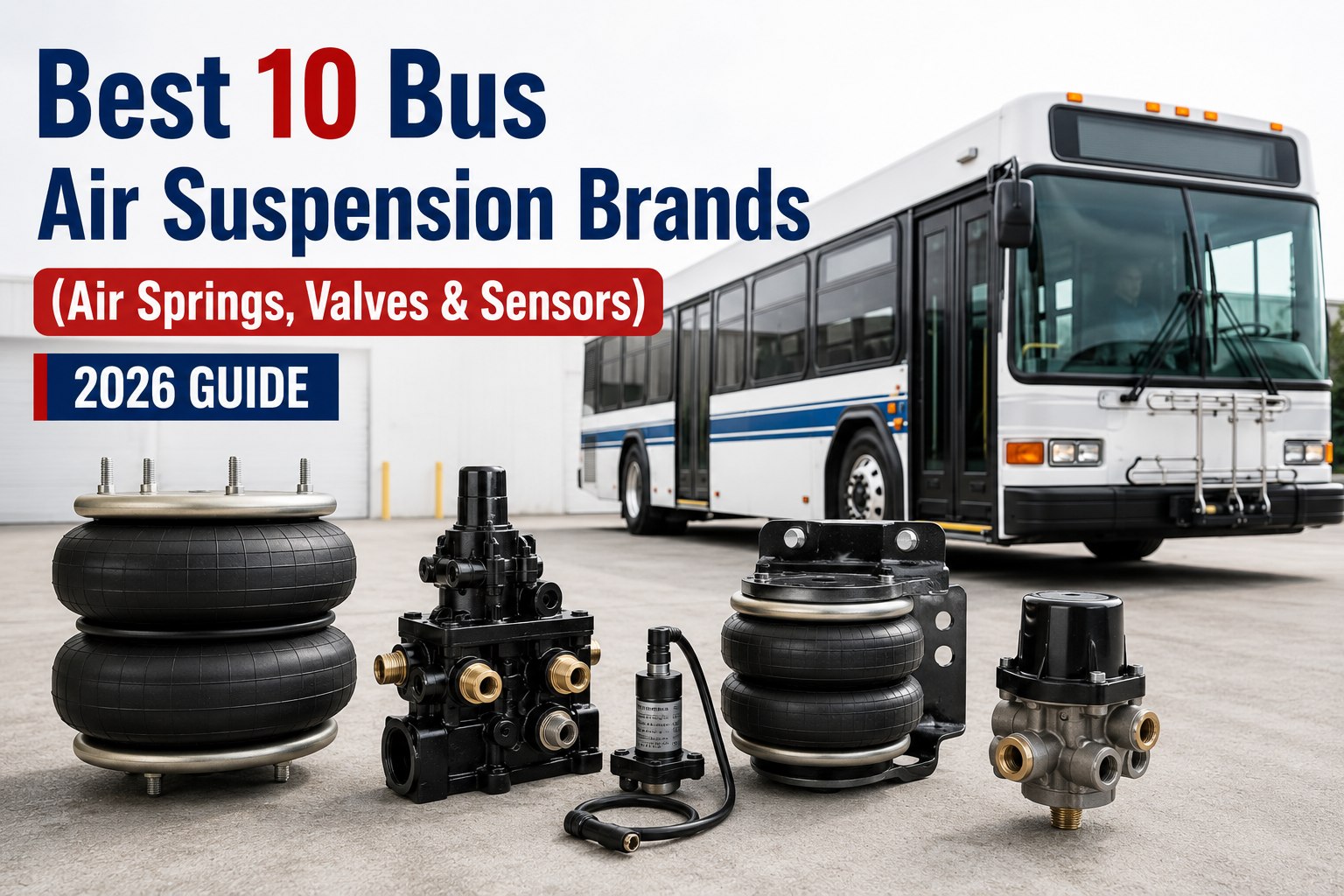
Bus #47 kneels down at the curb to load a wheelchair passenger, and this time it does not stand back up. The right rear air spring blew out somewhere on the last route -- the driver did not notice because the electronic leveling valves compensated until the reservoir ran dry. Now the bus is dead in service, the passenger is transferred, and the shop foreman is on the parts line asking which brand of air spring gets there fastest. That question -- which brand -- is where fleets either recover in four hours or lose the whole afternoon. This 2026 ranking compares the ten bus air suspension brands that actually matter when a bus is on the ground.
Best 10 Bus Air Suspension Brands: Air Springs, Valves & Sensors
The honest comparison of the leading air suspension manufacturers for school district, transit, and motorcoach fleets -- ranked on durability, aftermarket availability, OEM compatibility, and total-cost-of-ownership.
- Air spring quality
- Valve & sensor fit
- Parts availability
Why the Air Suspension Brand You Buy Actually Matters
On modern buses, the air suspension is not a convenience feature -- it is the primary load-carrying, ride-quality, and kneel-mechanism system. A cheap air spring lasts 18-24 months and blows out on route. A quality OEM-grade replacement lasts 5-7 years and holds pressure through 40 below. The delta on that one part decision, multiplied across every axle on every bus, is a five-figure line item on a mid-sized fleet's annual maintenance budget.
- 5-7 yrs Service life of a quality OEM-grade bus air spring under normal duty
- 18-24 mo Typical life of a low-tier aftermarket unit before failure
- 1938 Year Firestone patented the first commercial air spring
- $400-$1.2K Typical installed cost per air spring, replacement
Add up the labor, the tow, the missed route, and the passenger-service impact and a single wrong air spring choice easily hits $2,500 all-in. Getting the brand right upfront is one of the highest-leverage parts decisions a fleet manager makes. Book a demo to see suspension part tracking automated in BusCMMS.
The 3 Component Types Every Bus Air Suspension Uses
Every bus air suspension breaks down into three core component families. Different brands are strongest in different families. Understanding which is which is how you avoid buying a Meritor air spring and a WABCO valve that do not talk to each other.
-
Category A
Air Springs (Bellows)
Rubber-and-cord bellows that carry the entire bus weight. Rolling lobe, convoluted, and reversible sleeve styles.
Leaders Firestone, ContiTech, Goodyear -
Category B
Height Control Valves
Mechanical or electronic valves that maintain ride height by inflating and deflating air springs as load changes.
Leaders WABCO/ZF, Haldex, Hendrickson -
Category C
Sensors & Controls
Position sensors, pressure sensors, ECAS modules. The intelligence that manages kneel, lift, and load-based leveling.
Leaders WABCO/ZF, Bendix, Meritor
The Top 10 Bus Air Suspension Brands (2026)
Tap any brand to expand full details on component focus, best-fit fleet, and typical pricing. Sign up free to track suspension parts by brand across your fleet.
1
Best overallFirestone Airide
Air springs specialist · 80+ years · U.S.
The company that patented the commercial air spring in 1938 and has been the OEM baseline ever since. Used by more suspension builders than any other brand. The W01-358 series is effectively the industry cross-reference standard -- when a shop looks up an air spring, they look up the Firestone part number and everything else cross-references against it.
StrengthAir springs (rolling lobe, convoluted, sleeve)Best fitAll bus fleets -- OEM replacement baselineAvailabilityWidest distribution in North AmericaWarrantyStandard OEM (typically 1-2 yr)2
Best premiumContiTech (Continental)
Global premium · German engineering
Continental's ContiTech line is the go-to premium alternative to Firestone. Superior ride comfort, direct cross-reference to virtually every Firestone part number, and a reputation for excellent quality control. Common OEM on European motorcoaches and higher-end North American transit fleets.
StrengthPremium air springs, sensors on Continental busesBest fitMotorcoach, transit, premium replacementAvailabilityStrong; slightly longer lead times than FirestoneWarranty1-3 yr depending on distributor3
Best complete systemHendrickson
Complete systems · VANTRAAX · PRIMAAX
Where Firestone and ContiTech sell components, Hendrickson sells complete suspension systems. The VANTRAAX platform is the dominant transit bus air suspension in North America. PRIMAAX handles motorcoach applications. Also owns Neway. When the OEM spec sheet says "Hendrickson," you almost always want Hendrickson parts back.
StrengthComplete systems, valves, arms, springsBest fitTransit agencies, motorcoach with Hendrickson OEMAvailabilityDirect dealer + OEM distributionWarranty1-3 yr per component4
Best valueMeritor
Drivetrain + suspension · MTA series
Full-line commercial supplier of axles, drivetrains, and suspension. MTA-series air suspensions show up on a wide range of school buses and transit units. Not the highest-durability option in the top 3, but a legitimate step above no-name aftermarket and consistently priced well against Firestone and Hendrickson.
StrengthMTA air suspensions, brake-suspension bundlesBest fitSchool districts, value-focused fleetsAvailabilityStrong through commercial parts networkWarrantyStandard commercial (1-2 yr)5
Best availabilityGoodyear
Air springs · Global distribution
Goodyear's air spring line (1R-series) is one of the most cross-referenced part numbers in the aftermarket -- if a shop cannot find a Firestone in stock, the Goodyear equivalent is usually the next call. Reliable general-purpose OEM replacement, wide distribution through commercial parts channels, no surprises.
StrengthAir springs (1R-series is the standard aftermarket)Best fitAny fleet needing fast in-stock replacementAvailabilityWidest same-day availabilityWarranty1 yr standard6
Best electronicsWABCO (ZF Commercial Vehicle Solutions)
Electronic Controlled Air Suspension · ECAS
Now a ZF brand, WABCO's Electronic Controlled Air Suspension (ECAS) system is the industry standard for kneel control, load-based leveling, and precise ride height management on modern transit buses. Where mechanical valves start to feel dated, WABCO/ZF is what the OEM specifies.
StrengthECAS controllers, height sensors, solenoid valvesBest fitModern low-floor transit buses, kneel-equipped fleetsAvailabilityThrough ZF and specialist bus parts channelsWarranty1-2 yr electronic components7
Best for custom buildsRidewell Suspension
Custom bus + motorcoach OEM
A U.S. specialist in custom air suspension solutions with strong bus and motorcoach presence. Ridewell is often the OEM you see on specialty coach builds and lower-volume transit configurations where a stock Hendrickson VANTRAAX would not fit. Excellent for fleets running non-standard chassis.
StrengthCustom air suspensions, air springs, armsBest fitMotorcoach OEM, specialty vehicle buildersAvailabilityDirect + through specialty distributorsWarranty1-2 yr commercial standard8
Best mid-tierNeway (Hendrickson)
Air ride suspensions · medium duty
A Hendrickson-owned brand covering air ride suspensions across trailer and medium-duty commercial applications. Common on Type C school buses and shorter transit vehicles. Not as premium as the parent Hendrickson VANTRAAX line but a solid, well-supported choice at a lower price point.
StrengthAir ride suspensions, air springsBest fitType C school buses, medium-duty routesAvailabilityExcellent through Hendrickson networkWarranty1-2 yr standard9
Best for European coachesSAF-Holland
European heritage · trailer + bus OEM
A European commercial-vehicle supplier with strong OEM presence on European motorcoach brands (MAN, Setra, Van Hool imports). North American fleets running any European coach chassis should verify SAF-Holland part fitment before defaulting to Firestone -- the mounting and stroke specs are not always interchangeable.
StrengthTrailer suspensions, European bus OEM partsBest fitEuropean motorcoach fleets in North AmericaAvailabilityThrough European bus specialist channelsWarranty1-2 yr commercial10
Best for heavy-dutyReyco Granning
Heavy-duty commercial suspensions
A U.S. specialist in heavy-duty commercial suspensions. Common on charter coaches, heavy-load service vehicles, and buses configured for extreme duty. Not the first choice for a standard urban transit fleet, but the right answer for anyone running exceptionally heavy or specialty configurations.
StrengthHeavy-duty air suspensions, custom applicationsBest fitHeavy-duty specialty configurationsAvailabilityDirect + heavy-duty parts networkWarranty1-2 yr commercial
Failure Signs: When Air Suspension Parts Need Attention
Air suspension components rarely fail without warning. Catch them at Level 1 and you replace a $400 part on a Saturday. Miss it to Level 3 and you are looking at a bus on the ground mid-route.
-
Level 1 Early · schedule replacement
Small Signs Building Up
- Slight audible air leak at cold start
- Compressor cycles more often than baseline
- Ride height sits 1/2" low overnight
- Visible cracking on air spring bellows
-
Level 2 Mid · act this week
Symptoms in Service
- Driver reports bus riding rougher than usual
- Kneel operation slower or hesitant
- One corner consistently lower than others
- Height control valve buzzing or continuous cycling
-
Level 3 Critical · ground the bus
Immediate Repair
- Air spring blown out, bus resting on bump stop
- Reservoir drains within minutes of shutdown
- ECAS fault code active, kneel disabled
- Chassis dragging on frame at full load
The fleets that never see Level 3 track compressor cycle rate per bus and log any driver report of "rides rough" or "sits low overnight" as an actionable inspection trigger. Book a demo to see driver complaint auto-routing in BusCMMS.
Match Brand to Fleet: Selection Guide
Fleet type drives most of the answer. A school district running Type C conventionals needs a fundamentally different suspension stack than a low-floor transit fleet with kneel and ADA lift equipment.
Type C / Type D Buses
- Air springs: Firestone Airide (OEM baseline)
- Alternative: Goodyear (fast in-stock)
- Systems: Neway (medium-duty Type C)
- Valves: Haldex or Hendrickson
- Budget pick: Meritor MTA
Low-Floor with Kneel
- Systems: Hendrickson VANTRAAX
- Air springs: Firestone or ContiTech
- ECAS: WABCO / ZF Commercial
- Sensors: WABCO or Bendix
- Kneel valves: WABCO ECAS-integrated
Long-Distance / Interstate
- Systems: Hendrickson PRIMAAX
- Air springs: ContiTech (premium ride)
- European chassis: SAF-Holland
- Custom builds: Ridewell
- Heavy-duty: Reyco Granning
Most mature fleets end up standardizing on two primary brands -- one for the air spring itself (usually Firestone or ContiTech) and one for the system or electronic controls (usually Hendrickson or WABCO/ZF). That two-brand stack covers 80%+ of routine replacements. Sign up free and track your suspension parts stack in minutes.
A Shop Foreman's Take on Air Suspension Brand Choice
The rule we settled on after too many bad Saturdays: Firestone or ContiTech on every air spring, no exceptions. Two years ago we tried a batch of no-name aftermarket units to save $180 a corner. Six buses came back inside eleven months with blown bellows. The math on the recall alone -- labor, tow, warranty claims -- was ten times what we thought we saved. Now the parts room does not stock anything but Firestone and ContiTech, and I sleep better on the weekends.
Which air suspension brand is best for a school bus fleet?
For most Type C and Type D school buses, Firestone Airide is the default air spring choice because it is the OEM baseline on the majority of chassis and has the widest same-day availability across the U.S. parts network. Goodyear's 1R-series is the go-to alternative when Firestone is out of stock. For the suspension system itself -- axles, mounts, arms -- Neway (a Hendrickson subsidiary) is common on Type C buses and Meritor MTA is a legitimate value choice on lower-budget fleets. Districts running low-floor Type A units or activity buses with heavy loads should verify OEM spec before defaulting to any single brand.
Can I substitute an aftermarket air spring for the OEM brand?
Yes, within limits. The industry uses cross-reference part numbers so a Firestone W01-358 spring, a ContiTech equivalent, a Goodyear 1R-series, and OEM branded parts often refer to the same physical spring built to the same spec. Reputable aftermarket suppliers (MVP, Automann, HDValue) build to OEM specs and cross-reference publicly. Where fleets get burned is with unbranded or discount aftermarket parts that do not match dimensions or bellows material -- those routinely fail inside 18 months. Rule of thumb: stick to the top 5-6 brands in this ranking, or aftermarket parts that publish full cross-reference charts and offer at least a 1-year warranty.
What is the difference between Firestone Airide and ContiTech air springs?
Both are premium OEM-grade suppliers with essentially interchangeable quality on comparable part numbers. Firestone (U.S.-based, part of Bridgestone) has the widest North American distribution and is the OEM baseline on most domestic buses. ContiTech (part of Continental, German-based) is often the OEM on European motorcoaches and higher-end North American transit units, with a reputation for slightly better ride comfort under identical loads. For most fleet replacement decisions, the choice comes down to availability and price on the specific part number -- both are excellent choices.
How often do bus air suspension parts need replacement?
A quality OEM-grade air spring under normal duty typically lasts 5-7 years or 400,000-600,000 miles. Height control valves last 8-10 years on mechanical designs, with electronic ECAS modules typically outlasting them if kept clean and dry. Position and pressure sensors trend closer to 5-7 years. Kneel-frequency-heavy transit buses see faster wear across the board -- as much as 30-40% faster on air springs -- because kneel cycles exercise the bellows twice per stop. Fleets that trend compressor cycle rate per bus catch drift months before a failure.
How does a bus CMMS help manage air suspension across multiple brands?
A bus-specific CMMS solves the multi-brand parts problem in four ways. First, it logs which brand, part number, and install date is on every corner of every bus -- no more guessing what came in when. Second, warranty expiration alerts fire before coverage lapses, so failures inside the window get covered. Third, cross-reference lookup lets a shop foreman check a Firestone part against ContiTech, Goodyear, and Hendrickson equivalents in one place instead of five browser tabs. Fourth, driver reports of "rides rough" or "sits low overnight" auto-generate a suspension inspection work order routed to the appropriate technician.