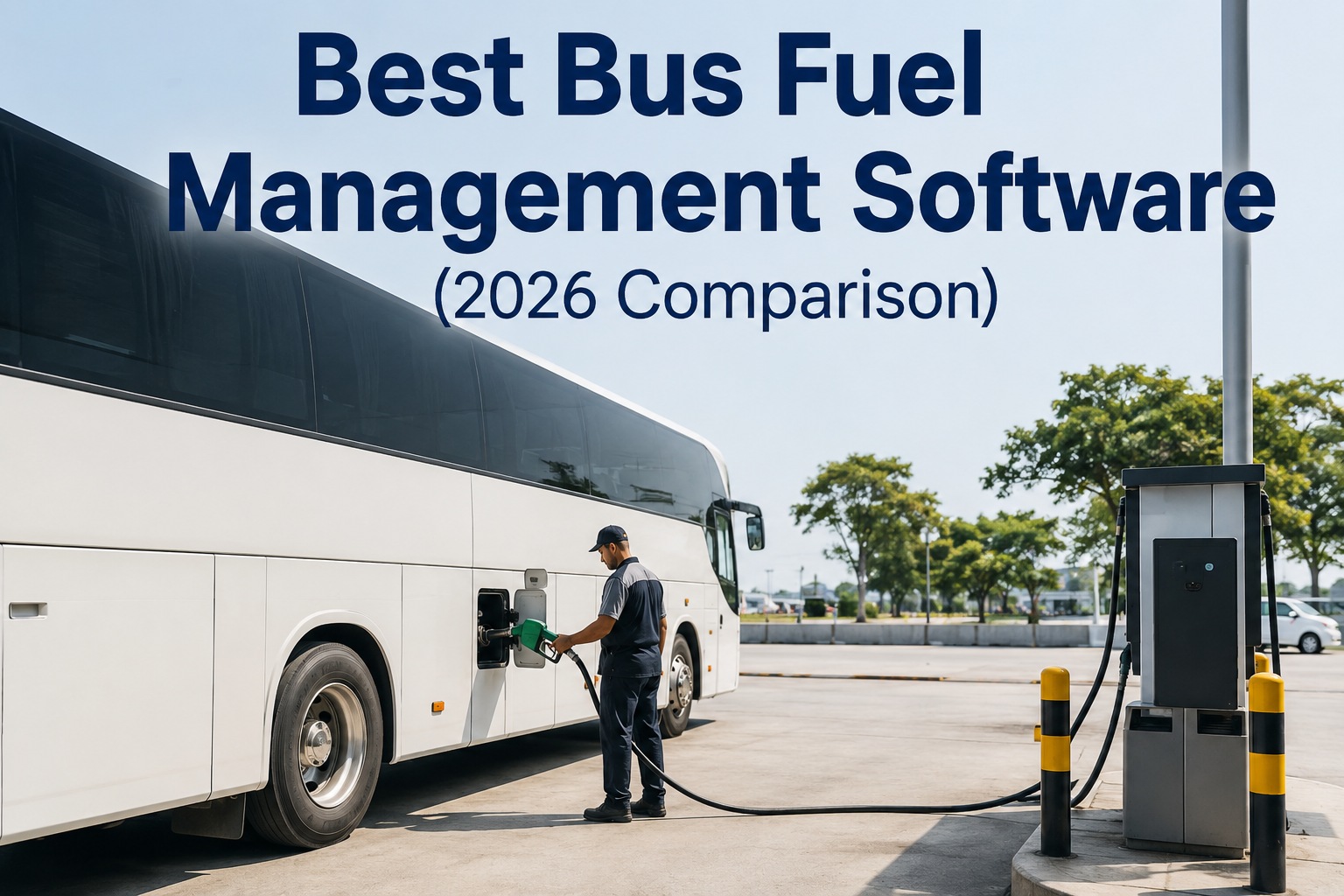
A 156-bus school district in Texas spent $2.1 million on diesel in 2024. When the finance director asked the maintenance manager to break down fuel costs by bus, he could not. The data was spread across fuel card statements, mechanic logs, driver notes, and telematics dashboards that did not talk to each other. Some buses ran 3.2 MPG. Others got 5.8 MPG on the same routes. Nobody knew which was which. Six months after implementing fuel management software, the district found Bus 407 had a dragging brake caliper wasting $4,200/year, Bus 203 had bad injectors wasting $7,800/year, and Bus 512 was idling four hours daily at $3,600/year. The software paid for itself in 60 days. This is the 2026 comparison of the six fuel management platforms bus fleets are actually evaluating -- Samsara, Geotab, Fleetio, Zonar, FuelCloud, and Motive -- covering fuel tracking accuracy, card integration, telematics depth, theft detection, and bus-specific fit.
Where a $2.1M Annual Fleet Fuel Bill Actually Goes
Numbers from that 156-bus Texas school district after fuel management software audited a year of transactions. The waste categories below are consistent across most bus fleets running 50+ buses.
- Total Annual Diesel Spend
- Fuel card fraud & duplicate transactions
- Unauthorized personal use of fuel cards
- Idling & poor MPG identified per bus
- Missing or misrecorded transactions
- Recoverable annually with software
Why Bus Fleets Need Dedicated Fuel Management Software
Six reasons buses are different from generic fleet vehicles when it comes to fuel management. These reasons drive the vendor selection below.
Fuel is the #2 operating cost
Behind only labor. For most school and transit fleets, diesel runs $8K-$12K per bus per year. A 100-bus fleet spends $1M+ annually.
MPG varies 40-60% between buses
Same routes, same fuel, different results. Without per-bus tracking, the underperformers hide inside the fleet-wide average.
Fuel cards fail without controls
Duplicate transactions, ghost fillups, personal use. Manual reconciliation costs 3-5 hours weekly per 50 buses and still misses most fraud.
Idle time is invisible without telematics
A bus idling four hours a day burns $3,600/year. Multiply by fleet size. Without integrated telematics, this waste is undetectable.
Fuel data drives PM triggers
Sudden MPG drop signals injector failure, dragging brake, or bad turbo. Fuel software tied to maintenance CMMS catches issues weeks earlier.
ROI payback in 3-8 months
Well-run fleets recover 8-15% of fuel spend annually. On a $1.5M fuel budget, that is $120K+ per year in verified savings.
The 6 Fuel Management Platforms Bus Fleets Evaluate
Scan-first matrix. Deep-dives follow.
| Platform | Core Strength | Fuel Data Source | Bus-Fleet Fit |
|---|---|---|---|
| Samsara | AI + IoT telematics + fuel gateway sensors | Real-time tank + fuel cards + telematics | Excellent |
| Geotab | Open telematics, deep MPG analytics | Telematics engine data + fuel cards | Excellent |
| Fleetio | Fleet management + fuel tracking + maintenance | Fuel cards (WEX/Fuelman/Voyager) | Excellent |
| Zonar | School-bus-native platform, DVIR integrated | Telematics + driver entry + fuel logs | Strong |
| FuelCloud | On-site tank monitoring + dispensing control | Bulk tank sensors + RFID dispensing | Strong |
| Motive | ELD + AI dashcams + fuel usage | Telematics + fuel cards | Selective |
Book a demo to see how BusCMMS integrates fuel data alongside maintenance and inspections.
6 Fuel Management Platforms in Detail
Each platform is a serious option. Fit depends on fleet size, existing tools, and whether you need on-site tank monitoring, road fuel cards, or both.
Samsara
AI telematics + Fuel Gateway sensors Telematics-Native LeaderSamsara pairs its Vehicle Gateway and dedicated Fuel Gateway hardware with cloud analytics to deliver real-time fuel level, consumption, and idling data. Integrates natively with WEX, Comdata, and other fuel cards for automated transaction reconciliation, and uses AI anomaly detection to flag fraud and unusual usage. Reported fuel savings of 10-20% for well-configured deployments.
Pick Samsara When
- Mid-to-large fleet (50+ buses)
- You want real-time fuel level via IoT sensors
- AI-driven anomaly detection is a priority
- You will invest in hardware install
Look Elsewhere If
- Small fleet under 25 buses
- Budget cannot absorb Vehicle Gateway install cost
- You do not want to standardize on one telematics vendor
Geotab
Open telematics + advanced MPG analytics Analytics LeaderGeotab is the go-to for fleets that value data depth and open ecosystems. Pulls engine data directly (via OBD-II or J1939), calculates precise fuel consumption and MPG, benchmarks buses against fleet peers, and offers Marketplace add-ons for specialized fuel workflows. Strong choice for districts wanting a data-forward platform rather than a locked ecosystem.
Pick Geotab When
- You want engine-level precision (not just card data)
- Open Marketplace integrations matter
- MPG benchmarking is a priority
- You have technical resources to configure
Look Elsewhere If
- You want out-of-the-box simplicity
- Your team lacks capacity to configure open telematics
- You prefer a school-bus-specific vendor
Fleetio
Fleet management + fuel + maintenance in one All-in-One Fleet PlatformFleetio is a cloud fleet-management platform where fuel tracking sits alongside maintenance, inspections, and expense management. Integrates with WEX, Fuelman, Voyager, Comdata, and other card providers for automatic transaction imports. Fuel data feeds directly into meter-based PM triggers, so an MPG drop can auto-generate an inspection work order. Popular with small-to-mid district fleets.
Pick Fleetio When
- You want one platform for fleet + fuel + maintenance
- Fuel card reconciliation is a top priority
- You want fuel data driving PM triggers
- Mobile-first driver fuel logging matters
Look Elsewhere If
- You need on-site bulk tank monitoring
- You want deep AI analytics (Samsara/Geotab go deeper)
- Advanced fuel features may require higher tier
Zonar
School-bus-native platform with fuel School Bus SpecialistZonar has long specialized in school bus telematics, EVIR pre-trip inspections, and student transportation workflows. Fuel monitoring is integrated with DVIR data and route logs, giving school districts one platform for compliance + fuel + inspection. Partnership with BusPatrol adds stop-arm safety at no cost to authorized districts. Strong fit for pure school bus operations.
Pick Zonar When
- Pure school bus fleet (no transit or coach)
- DVIR + fuel + telematics in one is a priority
- You want school-bus-native workflows
- You want the BusPatrol partnership option
Look Elsewhere If
- Mixed fleet (school + transit + coach)
- You need the deepest fuel analytics available
- Enterprise-grade fuel dashboards are essential
FuelCloud
On-site tank monitoring + dispensing control Tank & Dispensing SpecialistFuelCloud focuses on bulk tank environments. Wireless tank sensors track inventory in real time; RFID or PIN-based dispensing authorization controls who fills up and when. Prevents unauthorized fuel siphoning and delivers per-transaction accountability at the pump. Best paired with a broader fleet management platform for full workflow coverage.
Pick FuelCloud When
- District has on-site fuel storage tanks
- Bulk fuel theft is a known concern
- RFID/PIN dispensing controls are required
- You need automated inventory reporting
Look Elsewhere If
- No on-site fuel storage (retail cards only)
- You need a full fleet management platform
- You want telematics-native fuel data
Motive
ELD + AI dashcams + fuel tracking Safety-First Fleet PlatformMotive (formerly KeepTruckin) is primarily an ELD + AI dashcam platform with integrated fuel usage tracking. Strong fit for districts already using Motive for driver safety and compliance. Fuel data comes from telematics + fuel card integrations. Not a fuel-first platform, but a solid choice if the safety features are the primary driver and fuel management is a secondary requirement.
Pick Motive When
- You already run Motive for ELD or AI dashcams
- Driver safety is the primary use case
- Fuel tracking as a secondary feature is enough
- You want one vendor for safety + fuel
Look Elsewhere If
- Fuel management is the primary business case
- You need on-site tank monitoring
- Deep fuel analytics is critical
Why Generic Fleet Fuel Software Falls Short for Buses
Every vendor above is a real platform. What most miss is that bus fleets are not just "fleets" -- they carry passengers, follow fixed routes, run mixed fuel types, and answer to different regulators than commercial trucking.
- Vehicle-centric: Each unit is "a truck" or "a vehicle"
- Fuel type: Diesel by default; CNG/electric are afterthoughts
- Route awareness: Trip-based, not route-based
- MPG benchmarks: Class 8 truck norms, not bus norms
- Driver context: CDL Class A trucker profile
- Compliance: IFTA/FMCSA focused
- Integration: Generic maintenance CMMS
- Bus-centric: Route, driver, students loaded, fuel type per bus
- Fuel type: Diesel + CNG + propane + electric in one dashboard
- Route awareness: Fuel-per-route + per-district benchmarking
- MPG benchmarks: Blue Bird / Thomas / IC bus specific
- Driver context: CDL Class B/S with student endorsement
- Compliance: FMCSA + FTA + NTD + state DOT reporting
- Integration: BusCMMS with DVIR + PM + inspections
If your district runs 30+ buses with mixed fuel types and route-based operations, a generic fleet tool may leave 30-40% of the fuel management value on the table. Book a demo to see bus-specific fuel tracking in action.
The 6 Data Streams Your Fuel Software Must Ingest
A fuel management platform is only as good as the data flowing in. If any of these six sources is missing, you are optimizing with incomplete data.
- 01
Fuel Card Transactions
WEX, Fuelman, Voyager, Comdata, regional cards. Daily transaction import: driver ID, vehicle, gallons, cost, location, time.
- 02
On-Site Tank Sensors
If your district has bulk fuel storage. Continuous inventory monitoring, dispensing authorization, delivery reconciliation.
- 03
Telematics + GPS
Odometer readings at time of fueling, engine hours, idle time, actual MPG per route. Auto-populates fuel calculations.
- 04
Driver Fuel Logs
Manual entry at pump when telematics is offline. Odometer + gallons at minimum. Mobile app is the modern standard.
- 05
Maintenance CMMS
Work orders that affect MPG (dragging brake, bad turbo, injector failure). Ties fuel drops to root cause.
- 06
Fuel Supplier Feeds
Bulk delivery invoices, spot pricing. Enables per-gallon cost variance analysis and supplier renegotiation data.
Book a demo to see which data sources BusCMMS ingests and integrates for your fleet.
The 60-Day Payback Math on a Typical District
Real numbers. Walk through the calculation your business office will run before signing off on the software purchase.
Numbers scale linearly. A 200-bus fleet on $2M annual spend recovers $160K-$300K. That is a full-time transportation staff position worth of savings, per year, in perpetuity. Book a demo to see the calculation on your actual fleet numbers.
What is the difference between fuel management software and a fleet fuel card?
Fuel cards (WEX, Fuelman, Voyager, Comdata) handle the payment layer -- driver swipes card, fuel is dispensed, invoice hits the district. Fuel management software sits on top of the card data plus telematics plus maintenance context. It reconciles every transaction against odometer + GPS + expected MPG, flags anomalies (duplicate charges, personal-use suspicion, mid-route fillups that do not match location), and connects fuel drops to maintenance root causes. Fuel cards alone give you what you spent. Fuel management software tells you why you spent it and where you can spend less.
How quickly does fuel management software pay for itself?
Most bus fleets see full payback in 3-8 months. Well-configured deployments recover 8-15% of annual fuel spend. On a $500,000 fuel budget, that is $40,000-$75,000 in year-one savings against a $8,000-$15,000 software cost -- net $25,000-$60,000 in year one, and it compounds annually because the software keeps finding new inefficiencies as fleet composition changes. The 156-bus Texas district referenced in the intro hit 60-day payback because the software surfaced three specific mechanical issues (dragging brake, bad injectors, chronic idling) that together were burning roughly $15,600/year in wasted fuel.
Does the software work with mixed-fuel fleets (diesel + CNG + electric)?
The best platforms do. Samsara, Geotab, and Fleetio handle diesel, CNG, propane, and electric in one dashboard -- tracking gallons, cubic feet, and kilowatt-hours in fuel-type-appropriate units. The comparison is normalized to cost-per-mile so a diesel bus and an electric bus are visible side-by-side. Zonar handles diesel + CNG well; electric is newer. If your fleet is transitioning to EV, verify how each vendor handles kWh tracking, charging session data, and cost allocation before signing.
What data integration is required to make fuel software actually work?
At minimum: fuel card transaction import (daily), odometer capture at time of fueling (either telematics or driver entry), and a link to the bus asset in your maintenance system. Optional but strongly recommended: telematics for engine hours + idle time + actual MPG, on-site tank sensors if you have bulk storage, and maintenance CMMS integration so MPG drops trigger inspection work orders. Districts that skip the maintenance CMMS integration typically leave 20-30% of the software's value on the table because they cannot connect fuel waste to mechanical causes.
How does BusCMMS fit alongside a fuel management platform?
BusCMMS is not a replacement for Samsara, Geotab, Fleetio, or the other fuel platforms above. It is the bus-specific maintenance layer that consumes fuel data (from any of those vendors) and translates MPG drops into inspection work orders on the right bus, assigned to the right technician. When Bus 407 shows an 18% MPG drop over two weeks, BusCMMS auto-generates a brake and driveline inspection work order tied to that bus asset, with the fuel data attached as evidence. Districts running BusCMMS alongside their fuel platform typically capture an additional 3-5% fuel savings on top of what the fuel platform alone delivers, by catching mechanical issues weeks earlier. Book a 20-minute demo to see the integration live, or start a 30-day free trial.