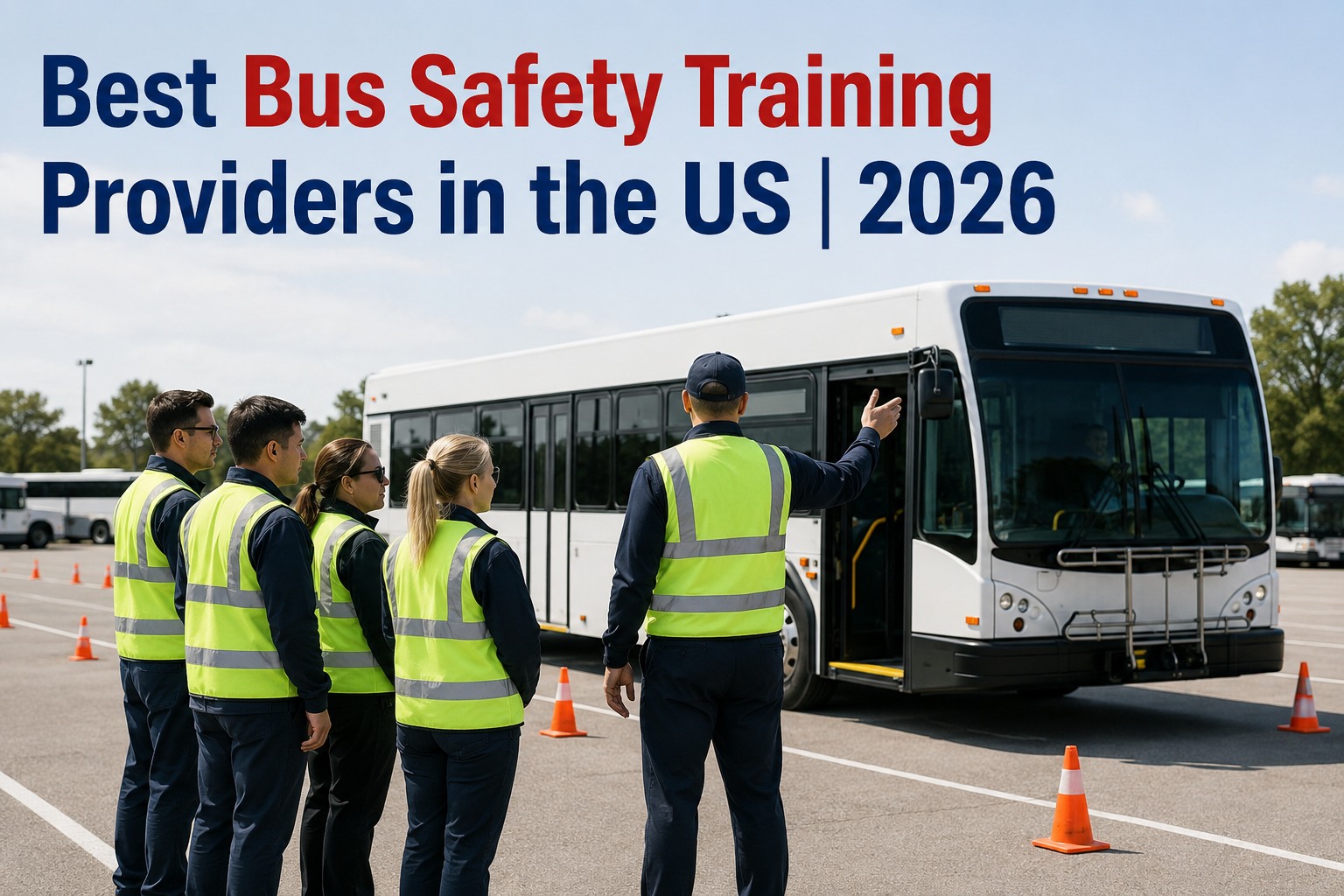
Your transportation director just got promoted from a 90-bus district to a 340-bus consortium. First question from the board: "Which training program are we standardizing on for the next three years?" Wrong answer costs the district a $2M+ safety contract. Right answer requires actually knowing what the top bus safety training providers in the US do differently -- and which one fits a school, transit, or motorcoach operation. This 2026 ranking cuts through the marketing to compare the seven providers that actually run the industry, on the eight criteria that matter to a fleet safety program.
Top 7 Bus Safety Training Providers in the US
An honest comparison of the leading providers for school district, public transit, and motorcoach fleets -- ranked on curriculum, ELDT compliance, online delivery, pricing, and fleet-scale support.
- 8 evaluation criteria
- ELDT + CDL coverage
- Fleet-fit guide
Why Bus Safety Training Is a Direct Line to Fleet Risk
The bus is statistically the safest way to move a student or transit rider, but that record is built on training discipline, not luck. A driver who has done a certified defensive driving program is dramatically less likely to end up in an at-fault crash. And on the compliance side, ELDT requirements under FMCSA have raised the floor for every new bus driver in the country since 2022. The training provider you pick is not just a curriculum decision -- it is the shape of your insurance premium, your CSA score, and your legal exposure.
- ~50% Accident reduction reported for fleets using structured behavior-based training
- Feb 2022 ELDT rule effective; mandatory for new CDL P and S endorsements
- 25+ hrs Typical classroom instruction for new school bus drivers
- Annual Refresher training expected in every state for pupil transportation
Picking a training provider is the easy part. Actually tracking which driver has which cert, which one is due to expire and which ones lapsed while a driver was on medical leave -- that is where fleets lose points on their CSA score. Book a demo to see driver certification tracking automated in BusCMMS.
How We Ranked: The 8 Evaluation Criteria
Every provider on this list was evaluated against the same eight criteria. The rankings prioritize what a real transportation director asks when comparing options -- not brochure claims.
-
Curriculum Depth
Number of modules, topic coverage, adult-learning design.
-
ELDT Compliance
Meets FMCSA Entry Level Driver Training for P and S endorsements.
-
Defensive Driving
Behavior-change focus, real-world scenarios, safety habit formation.
-
Online Delivery
LMS integration, mobile-friendly, self-paced options.
-
Certifications
Recognized credentials, CEU eligibility, trainer-the-trainer paths.
-
Pricing Model
Per-seat, subscription, or bundle. Multi-year discounts, fleet tiers.
-
Fleet Scalability
Support for 10-driver ops through 1,000+ driver enterprises.
-
Customer Support
Dedicated account rep, response times, training-the-trainer help.
Weighting these criteria differently for a school district vs a transit agency vs a motorcoach operator changes the top of the ranking. That is why Section 04 breaks the recommendations down by fleet type. Book a demo to see how BusCMMS tracks providers against these criteria in one place.
The Top 7 Bus Safety Training Providers (2026)
Tap any provider to expand full details on curriculum, best-fit fleet, and pricing structure. Sign up free to track certifications from any of these providers in BusCMMS.
1
Best overallSmith System
Defensive driving · All fleets · 70+ years
The industry's original behavior-based defensive driving system, built around the "5 Keys to Space Cushion Driving." Used across the largest commercial fleets in North America. Deep bench of certified trainers, strong behind-the-wheel component, and one of the most measurable programs on the market when it comes to accident-rate reduction.
Programs5 Keys, DriverDirect, trainer certificationDeliveryClassroom, in-vehicle, blended onlineBest fitMotorcoach, transit, mixed commercial fleetsPricingFleet contract, per-driver seat2
Best for K-12School Bus Safety Company (SBSC)
K-12 specialist · 25+ years · Hudson, OH
The most complete K-12-specific curriculum on the market. The flagship Driver Training Course contains 27 integrated modules covering everything from mirror adjustment and danger zones to student management and adverse conditions. Delivered as high-quality video with trainer's guides, quizzes, and reinforcement posters. Widely reported to reduce accidents by around 50% when implemented fully.
Programs27-course driver training, special needs, ELDTDeliveryVideo-driven, trainer-led + online via VectorBest fitSchool districts of any sizePricingCourse license + annual reinforcement3
Best for complianceNational Safety Council (NSC)
Nonprofit · DDC · Nationally recognized
The Defensive Driving Course (DDC) is the most widely recognized defensive driving credential in the country -- accepted by many state DMVs, courts, and insurance carriers for premium reductions. NSC also runs the Child Passenger Safety on School Buses National Training program, one of the few certifications specifically covering restraint systems for preschoolers and children with disabilities on school buses.
ProgramsDDC, CPS on School Buses, First Aid/CPRDeliveryIn-person, online, hybridBest fitFleets seeking insurance/DMV creditPricingPer-course, CEU eligible4
Best online deliveryVector Solutions (Vector LMS)
LMS platform · Partnered with SBSC
Not a training author in the strictest sense -- Vector is the delivery platform. Their K-12 partnership with School Bus Safety Company makes them the online distribution channel for the SBSC courses, plus their own catalog of 25 additional integrated safety courses. Strong assignment tracking, reporting, and district-wide administration make this a natural fit for K-12 systems that already use Vector for other staff training.
ProgramsSBSC library, CDL prep, ELDT, special needsDelivery100% online LMS, mobile-friendlyBest fitDistricts already using Vector K-12 platformPricingAnnual per-seat subscription5
Best for compliance-heavy fleetsJ. J. Keller & Associates
DOT compliance specialist · 70+ years
The gold standard for FMCSA compliance training. J. J. Keller's ELDT curriculum is one of the most widely adopted registered programs on the FMCSA Training Provider Registry, and their broader library covers everything from hours-of-service to hazmat. Not the most engaging defensive driving content, but nobody covers regulatory rule-changes faster or more accurately.
ProgramsELDT (P + S endorsement), CDL prep, HOS, DOT audit prepDeliveryOnline, in-person, printBest fitTransit agencies, motorcoach, mixed commercialPricingPer-course, enterprise bundles6
Best for ELDT + consultingPupil Transportation Safety Institute (PTSI)
Nonprofit · 25+ years · ELDT focus
A pupil-transportation-focused nonprofit with a strong ELDT program for CDL P and S endorsements. Beyond core curriculum, PTSI offers consultation and evaluative studies that help school districts identify at-risk conditions, minimize liability, and increase operational efficiency. Deep bench of pupil-transportation subject matter experts.
ProgramsELDT, on-site consulting, DVDs, printed workbooksDeliveryBlended: in-person + onlineBest fitSmall-to-mid districts needing ELDT + audit supportPricingCourse + consulting hourly7
Best for leadership trainingNAPT (National Association for Pupil Transportation)
Industry association · Professional development
NAPT is the industry association, not a mass-market driver training vendor. Where they earn a spot on this list is their Certified Director of Pupil Transportation program and other leadership-level credentials that develop the transportation directors, supervisors, and dispatchers who ultimately run driver training programs. Also the strongest source of industry benchmarking data for pupil transportation.
ProgramsCertified Director, Certified Instructor, Certified Safety SupervisorDeliveryConference, cohort, online modulesBest fitTransportation directors + supervisorsPricingMember rates, program enrollment
Choose by Fleet Type: Which Provider Fits You
Fleet type drives most of the answer. A school district running 40 Type C buses needs a fundamentally different training stack than a 200-vehicle transit agency or a 12-coach charter operator.
K-12 Pupil Transport
- Primary: School Bus Safety Company
- Online delivery: Vector Solutions
- ELDT: PTSI or J. J. Keller
- Special needs: NSC + SBSC
- Leadership: NAPT Director program
Fixed Route / Paratransit
- Primary: Smith System defensive driving
- Compliance: J. J. Keller FMCSA
- Refresher: NSC Defensive Driving
- ADA / accessibility: Vendor-specific + APTA
- Leadership: Transit-specific consortiums
Long-Distance Passenger
- Primary: Smith System (mountain / interstate)
- Compliance: J. J. Keller ELDT + HOS
- Refresher: NSC DDC (insurance credit)
- Trainer prep: Smith System certification
- Leadership: ABA / UMA industry events
The right stack is usually two providers, not one -- a primary curriculum plus a compliance-focused overlay. That combination is where most mature fleets land after their first review cycle. Book a demo to see how BusCMMS tracks multi-provider training on one dashboard.
Make Training Actually Stick: The Missing Layer
Here is what most transportation directors learn the hard way: picking the best provider only solves half the problem. The other half is the operational layer -- who has completed what, when it expires, which route each certified driver is authorized for, and whether a lapsed cert is riding around on Bus 22 right now.
Curriculum & Certification
- Course delivery
- Behavior change
- Credential issuance
Tracking & Compliance
- Cert expiration alerts
- Driver-vehicle authorization
- Audit-ready records
Complete Fleet Safety Program
A driver's completion at Smith System, SBSC, or NSC lands in BusCMMS automatically -- refreshers get scheduled, expirations get flagged 60 days out, and every FMCSA or state audit produces a signed export in under a minute.
This is the piece that turns a training program into a real safety culture. And it is where BusCMMS actually earns its keep on a fleet: not by replacing the training, but by making sure every dollar spent on training shows up on the audit trail. Sign up free and connect your training records in minutes.
A Transportation Director's Take
We ran SBSC for eight years and it made a real difference on our accident rate. The problem was never the training -- it was tracking who had done what refresher and when. Two years ago we got hit on a state audit for four drivers whose annual refresher had lapsed 30-90 days. Nobody had done the training wrong; the tracking had. Once we started logging every completion the same day it happened, the audit issue disappeared. Training + tracking is one job, not two.
Which bus safety training provider is best for a school district?
For pupil transportation, School Bus Safety Company (SBSC) is the market-leading specialist. Their 27-module Driver Training Course covers every core K-12 topic -- danger zones, pre/post-trip inspections, mirror adjustment, student management, special needs, adverse conditions -- and is reported to reduce accident rates by around 50% when implemented fully. Most K-12 districts pair SBSC with Vector Solutions for online delivery, plus PTSI or J. J. Keller for ELDT compliance on new hires. NSC's Defensive Driving Course is a popular annual refresher because many state DMVs and insurance carriers give credit for it.
What is ELDT and which providers meet the requirement?
Entry Level Driver Training is the FMCSA rule effective February 2022 that requires every new applicant for a CDL Class A or B (including Passenger and School Bus endorsements) to complete standardized training from a provider registered on the FMCSA Training Provider Registry before taking the state CDL skills test. Multiple providers meet the requirement -- most commonly J. J. Keller and PTSI in this list, plus Vector Solutions (delivering the SBSC ELDT curriculum) and School Bus Safety Company directly. The trainer choice matters less than the registry-registered curriculum choice, but fleets should verify TPR status before enrollment.
How much does bus safety training cost per driver?
Pricing varies widely by provider and delivery format. Online course subscriptions typically run $100-$400 per driver per year for a comprehensive library. Instructor-led classroom training with behind-the-wheel typically runs $500-$1,500 per driver for initial certification. ELDT registered programs often run $150-$600 per driver depending on delivery. Fleet contracts and multi-year agreements bring per-seat costs down significantly, and NSC courses in particular often pay back through insurance premium reductions. The most expensive line item is almost always driver time -- not the course fee.
Does Smith System work for school bus drivers or only transit and trucking?
Yes, Smith System curriculum applies to school bus drivers -- the 5 Keys to Space Cushion Driving are physics-based and universal to any large commercial vehicle. That said, most K-12 districts choose SBSC as their primary because it covers the pupil-transportation-specific content that Smith System does not: student management, danger zones, loading and unloading procedures, and student-with-disabilities protocols. The common pattern is SBSC as primary + Smith System certification for the district's driver trainers so their instruction methodology matches an industry standard.
How does BusCMMS work with these training providers?
BusCMMS is not a training provider -- it is the operational tracking layer that sits beneath whichever provider (or providers) your fleet uses. Driver certifications get logged with completion date, expiration date, and issuing provider. Refresher due-dates auto-flag 60 days before expiration. Driver-vehicle authorization rules ensure a bus with wheelchair lifts only gets assigned to drivers whose lift-training cert is current. Every audit -- FMCSA, state DOT, FTA triennial, insurance -- gets an audit-ready export of every driver's cert status in seconds. The training is the safety investment; BusCMMS is what makes it visible on the compliance side.