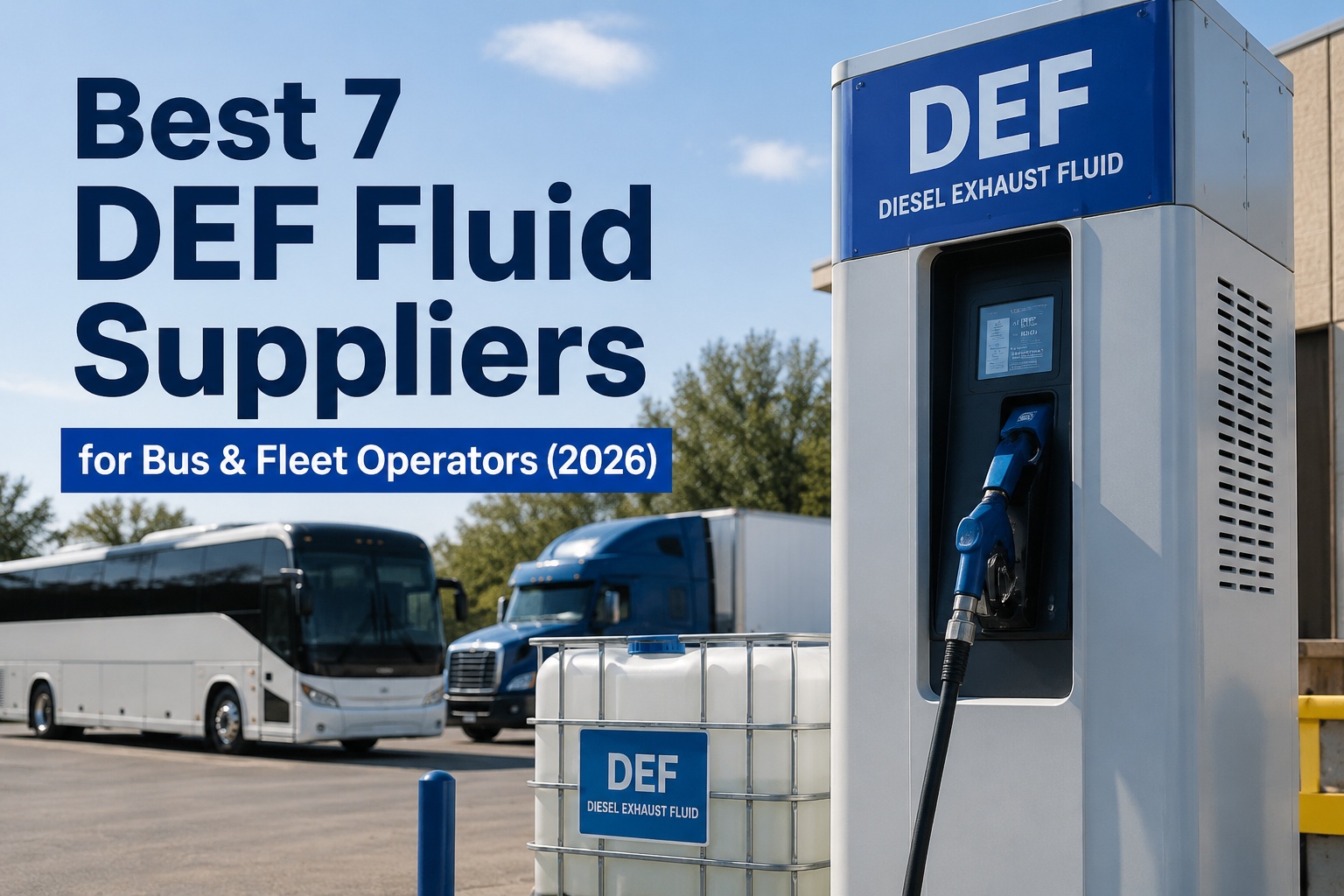
Your SCR system just threw a DEF quality fault code, the bus is limp-moded at 65% power, and the tanker delivery from the low-bid supplier last week is now suspect. Bad DEF costs $8,000-$15,000 per SCR catalyst replacement, voids engine warranty, and takes the bus out of service for days. This 2026 guide ranks the seven DEF fluid suppliers that bus and truck fleet operators are actually buying from -- Yara Air1, BlueDEF, PEAK BlueDEF PLATINUM, Valvoline Premium Blue, Prestone DEF, Cummins Fleetguard, and the Mansfield Energy delivery network -- with API certification, ISO 22241 compliance, bulk delivery capability, and fleet-friendly pricing broken down for each.
Best 7 DEF Fluid Suppliers for Bus & Fleet Operators (2026)
Seven leading suppliers ranked head-to-head on API certification, ISO 22241 compliance, bulk delivery, storage support, fleet pricing, and true bus-fleet fit -- with the storage rules and contamination pitfalls that every fleet manager needs before signing a supply contract.
Composition
- Urea content32.5% ± 0.7
- Water base67.5% deionized
- Density (20°C)1.087-1.093 g/cm³
- pH9.0
Storage Parameters
- Safe temp range23°F -- 86°F
- Freeze point12°F
- Shelf life12 months
- ContainerHDPE, stainless
Why It Matters for Your Fleet
- Sub-spec DEF damages SCR catalyst ($8K-$15K repair)
- Contaminated fluid voids engine manufacturer warranty
- Off-spec urea triggers derate + limp mode
- Expired DEF causes progressive SCR fouling
The Real Cost of Buying Bad DEF
Every DEF supplier claims to meet ISO 22241. Not every supplier proves it. When sub-spec fluid hits your fleet's SCR systems, the damage compounds fast -- and traces back to the supplier contract in the audit trail.
-
$8K-$15K
SCR catalyst replacement
Sub-spec urea, hard water impurities, or biological contamination poison the catalyst substrate. Once damaged, the catalyst cannot be cleaned -- only replaced. Per bus.
-
3-7 days
Vehicle out of service
Diagnosis, parts sourcing, catalyst installation, calibration, emissions recheck. A missed AM route because of contaminated DEF hits parent confidence and driver overtime budget.
-
Warranty void
Engine manufacturer coverage
Cummins, Detroit, PACCAR, Volvo, and Navistar warranties require certified DEF. Bulk purchase records from an uncertified supplier are grounds for warranty denial.
-
Derate + limp
Progressive engine derate
SCR quality fault codes trigger staged derate: first 25%, then 65%, then 5-mph limp. The bus becomes undriveable within days if the fault is not cleared. Regen cycles do not fix it.
The way you avoid these costs is not by finding the cheapest per-gallon DEF price. It is by verifying that every supplier delivers API-certified, ISO 22241-compliant fluid every time, with a supply chain audit trail. That is what separates the seven suppliers below from the long list of low-cost distributors. Book a demo to see how BusCMMS tracks DEF purchase records for warranty defense.
The 7 DEF Suppliers at a Glance
Ranked on quality certification, delivery options, fleet-scale support, and true bus-fleet fit. Deep-dives follow.
| Supplier | Primary Strength | Bulk Delivery | Fleet Fit |
|---|---|---|---|
| Yara Air1 | Global purity leader, telemetry ordering | Yes · Nationwide | Excellent |
| BlueDEF (Old World) | US market leader, widest distribution | Yes · Nationwide | Excellent |
| PEAK BlueDEF PLATINUM | Synthetic urea, deposit prevention | Regional | Strong |
| Valvoline Premium Blue | OEM specification match, retail availability | Regional | Strong |
| Prestone DEF | Price-performance balance, wide compatibility | Regional | Selective |
| Cummins Fleetguard | OEM-endorsed, warranty leverage | Regional | Strong |
| Mansfield Energy | Bulk delivery + fuel integration | Yes · Nationwide | Excellent |
7 DEF Suppliers in Detail
Each supplier's Supply Format Row shows which package options are available. Gold pill = supported. Outlined pill = limited or third-party.
Yara Air1
Global purity leader · ISO 22241 pioneer Best OverallYara pioneered DEF production in Europe in 2005 and brought it to North America in 2010 under the Air1 brand. Manufactures Air1 in 5 plants worldwide -- the largest DEF production capacity globally. Distributed via the Mansfield DeliveryONE Network across the US. API certified, fully audited production chain, ISO 22241-1/2/3 compliant. Offers telemetry-based JIT bulk delivery -- when your tank hits a preset level, Air1 gets an alarm and dispatches automatically. Fuel-card enabled for over-the-road refills.
Mid-to-large bus and transit fleets prioritizing supply-chain audit trail, JIT delivery, and never-runs-out uptime. Highest confidence choice when fleet OEMs are strict on warranty documentation.
BlueDEF (Old World Industries)
US market share leader Best US AvailabilityBlueDEF is the industry-standard US DEF brand, manufactured by Old World Industries. API certified, ISO 22241 compliant, meets or exceeds all OEM specifications. Formulated with high-purity synthetic urea and deionized water with triple-filtration to prevent urea crystal formation. Available in every US region through fuel distributors, truckstops, retail, and direct bulk. Manufacturer claims up to 5% fuel economy improvement over sub-spec alternatives. Widely accepted at truckstop DEF pumps.
Bus and truck fleets running national routes where over-the-road DEF top-off availability matters. Broadest truckstop network coverage of any brand.
PEAK BlueDEF PLATINUM
Deposit prevention formulation Best Anti-DepositAlso from Old World Industries, PEAK BlueDEF PLATINUM is a step above standard BlueDEF with advanced additives and 100% synthetic urea. Designed to maintain superior fuel economy and prevent urea crystal deposits from forming within the SCR system -- a common failure mode in high-idle bus operations. API certified, meets or exceeds ISO 22241 and OEM specifications. Slightly higher per-gallon cost, but reduces SCR maintenance frequency.
School bus fleets with high-idle routes (long stops, cold-weather warmups) where urea crystal deposits shorten SCR service life. The upgrade formulation earns back its price premium in reduced SCR maintenance.
Valvoline Premium Blue DEF
OEM specification match Best OEM MatchValvoline Premium Blue DEF has a long history in engine oil supply to fleet OEMs, which extends to DEF. ISO 22241 certified, API certified with the certification mark, matches OEM specifications across major diesel platforms including Cummins, Detroit, Volvo, and Navistar. Wide retailer availability. Not the deepest bulk-delivery network but strong through fuel distributor channels.
Fleets already sourcing Valvoline engine oil who want to consolidate the fluid supply relationship. Strong choice when warranty documentation requires OEM-endorsed brand names.
Prestone DEF
Price-performance balance Best Value BalancePrestone brings automotive fluid heritage to DEF with high-grade urea content and wide SCR compatibility across major diesel platforms. API certified, meets ISO 22241 and OEM standards. Available in multiple quantities from retail jugs to industrial totes. Odorless formulation. Not the deepest bulk network but consistent quality and pricing that fleets appreciate for budget planning.
Small-to-mid bus fleets prioritizing predictable pricing and consistent product availability over a specific brand relationship. Solid mid-tier choice.
Cummins Fleetguard DEF
OEM-endorsed for Cummins engines Best for Cummins FleetsCummins Filtration branded DEF, formulated specifically to match Cummins engine SCR system requirements. API certified, ISO 22241 compliant. Strongest warranty leverage when the fleet runs Cummins-powered buses (which is most US school and transit bus fleets). Available through Cummins Onan distributor network and Fleetguard channels. Higher per-gallon cost than generic-label brands, but simplifies warranty conversations.
Cummins-powered bus fleets where SCR warranty disputes could hit large dollar amounts. Premium pricing pays for itself if it prevents a single warranty denial.
Mansfield Energy DeliveryONE
Bulk delivery specialist + fuel integration Best for Bulk DeliveryMansfield Energy is one of the largest fuel and DEF delivery networks in the US, and operates as Yara's official Air1 distributor. Combines DEF bulk delivery with diesel fuel supply -- one contract, one invoice, one delivery relationship. Ideal for bus depots that already receive bulk diesel and want to consolidate DEF procurement. Offers on-site DEF tank installation, telemetry, and JIT scheduling.
Mid-to-large bus fleets and transit agencies with on-site fuel infrastructure who want fuel + DEF consolidated under one supplier contract, one delivery cadence, and one AR relationship.
DEF Storage Rules Every Fleet Depot Must Follow
The best DEF from the best supplier still degrades if stored wrong. These rules are what separates a fleet whose DEF meets spec at the SCR inlet from a fleet whose DEF quality certificate is irrelevant by the time it hits the bus.
Store at 23°F -- 86°F
Temperature above 86°F accelerates urea decomposition. Below 12°F, DEF freezes (does not damage the fluid, but interrupts dispensing). Insulated bulk tanks + climate control is standard for northern depots.
Use HDPE or stainless containers
DEF corrodes brass, copper, aluminum, zinc, and unlined mild steel. HDPE (high-density polyethylene) plastic and 304-grade stainless steel are the only approved storage materials.
Rotate stock FIFO
12-month shelf life from manufacture date, tracked by batch number. Log receipt date on every drum, tote, and bulk fill. Use oldest first. Anything older than 12 months goes out for testing, not into a bus.
Reuse fuel containers
Diesel fuel residue is the #1 DEF contaminant on fleet lots. Never use a container that previously held diesel, oil, coolant, hydraulic fluid, or any petroleum product. Dedicated DEF-only equipment.
Mix batches or brands
Do not top off with a different brand or an older batch. Do not mix at the SCR tank. If mixing is unavoidable, document it and reduce the shelf life clock to the older batch's date.
Store outdoors uncovered
UV exposure accelerates urea breakdown. Direct sun on a plastic drum in July can push tank temperature past 100°F. Covered storage or shaded IBC placement is standard practice.
Annual DEF Cost Calculator for Bus Fleets
DEF consumption runs 2-3% of diesel fuel volume. For a typical 25,000-mile/year transit or school bus consuming 5,000 gallons of diesel, that means 100-150 gallons of DEF per bus per year. Below is the annual DEF spend for four fleet sizes at bulk-tier pricing.
What Bus Fleets Actually Report on DEF Management
Aggregated data from bus and truck fleets that switched from ad-hoc DEF purchasing to structured supply agreements with API-certified suppliers.
What is API certification for DEF and why does it matter?
API (American Petroleum Institute) certification for DEF verifies that the product meets ISO 22241 quality standards for composition, purity, and consistency. API-certified DEF carries a distinct certification mark on the package. This certification is what engine OEMs (Cummins, Detroit, Volvo, PACCAR, Navistar) require for warranty coverage on SCR components. Buying uncertified DEF, even at lower per-gallon cost, exposes the fleet to warranty denial if an SCR catalyst fails within warranty period. Every one of the seven suppliers above carries API certification.
Is bulk DEF delivery worth it for our fleet size?
Bulk DEF delivery becomes ROI-positive around 60 buses / 7,500+ gallons of annual DEF consumption. Below that threshold, the storage tank cost, telemetry, and delivery minimum quantities do not pay back within 12-18 months. At 30-60 buses, a 330-gallon IBC tote setup with regular deliveries is the sweet spot -- lower infrastructure cost than a bulk tank, better per-gallon pricing than jugs or drums. Below 30 buses, jug and drum purchases from a fuel distributor are typically most cost-effective. Verify current bulk pricing with your target supplier before committing to on-site infrastructure.
How long can we store DEF before it goes bad?
12 months from manufacture date when stored properly (23F to 86F, out of direct sunlight, in HDPE or 304-grade stainless containers, sealed). Higher temperatures shorten shelf life significantly -- DEF stored at 95F+ can degrade within 6 months. Freezing does not damage DEF (it re-liquefies at 12F+ with no quality loss), but interrupts dispensing. Best practice: log receipt date on every container, rotate FIFO, and test any DEF older than 12 months before use rather than assuming it is still in-spec.
What happens if we use uncertified or contaminated DEF?
Progressive failure sequence: (1) SCR quality fault codes appear within days, (2) engine derate to 65% power, (3) engine derate to 25%, (4) 5-mph limp mode, (5) SCR catalyst poisoning becomes permanent. Catalyst replacement runs $8,000-$15,000 per bus. Engine OEM warranty denial is likely if bulk purchase records cannot document API certification. The math is clear: saving $0.25/gallon on 150 gallons of DEF ($37.50/year) is not worth the risk of an $8,000 uncovered catalyst replacement.
How does BusCMMS help manage DEF supplier relationships?
BusCMMS captures the DEF purchase and quality documentation trail that fleet operations typically neglect until warranty disputes arise. Every purchase logged with supplier name, batch number, API certification, delivery date, and quantity. Bulk tank levels tracked with FIFO rotation. Storage temperature and shelf-life countdowns per container. Cross-referenced against each bus's SCR service history and fault code events. When an OEM warranty question comes up 3 years later, the evidence trail is complete and defensible. Book a 20-minute demo to see the DEF management workflow live, or start a 30-day free trial.