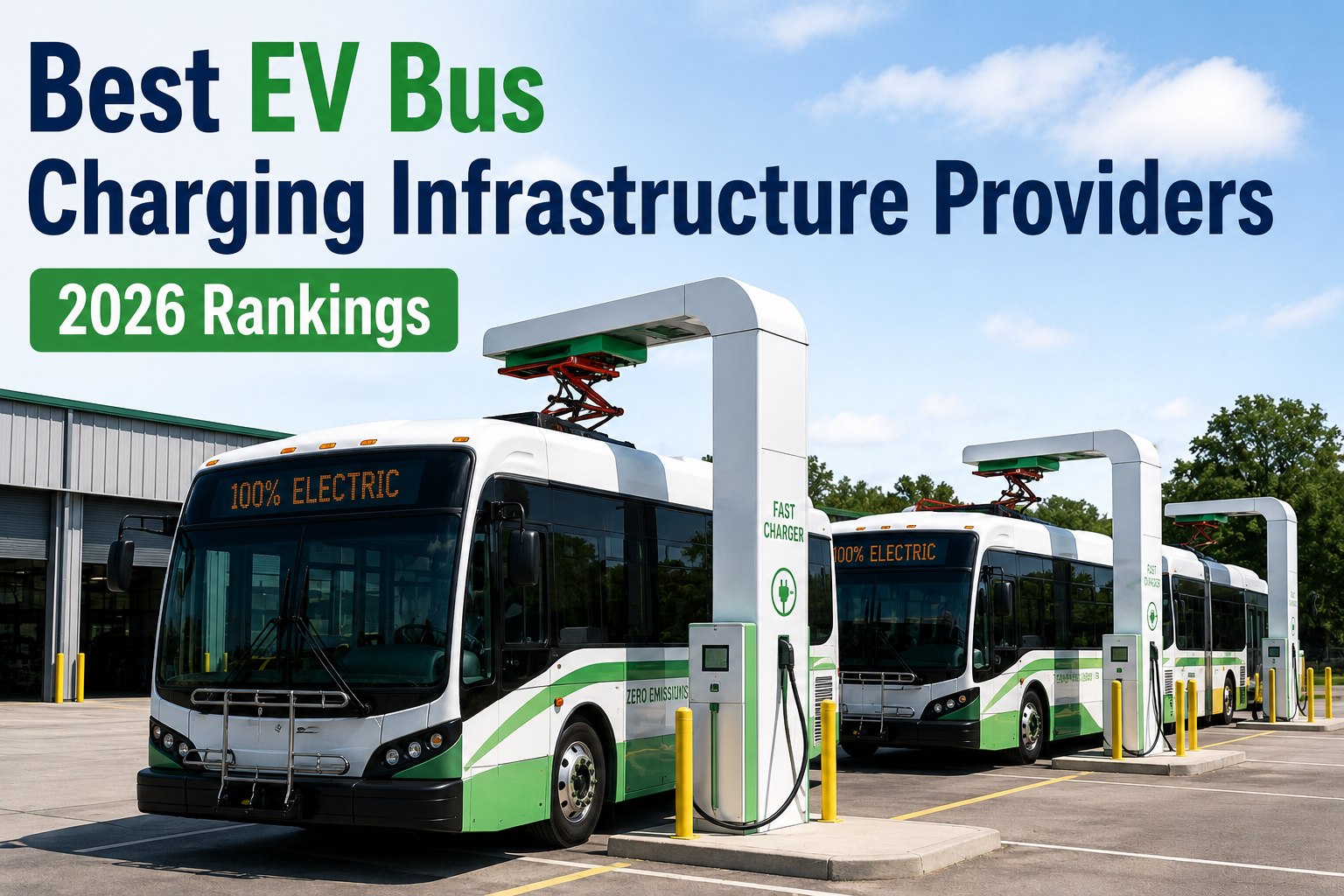
Your transit board just approved a $14M grant for 40 electric buses. Great news, except the buses will not move without depot chargers, a utility service upgrade, dispatch software that understands state-of-charge, and a maintenance program that catches a bad connector before Bus 22 comes in with an empty pack. The vehicles are only 60% of the electrification budget. The charging infrastructure is the other 40%, and the partner you pick for it will either accelerate the transition or gate it for the next three years. This 2026 ranking compares the nine EV bus charging infrastructure providers actually running large-scale deployments in North America and Europe today.
Best 9 EV Bus Charging Infrastructure Providers
The honest comparison of the leading charging infrastructure partners for school district, transit, airport shuttle, and motorcoach fleets -- ranked on depot power, pantograph and DC fast capability, software, and total-cost-of-ownership.
- Depot & opportunity
- Up to 1.5 MW MCS
- V2G ready
Why the Charging Infrastructure Partner Matters More Than the Bus
Everyone focuses on the buses. But the bus manufacturers have converged -- the differences between Proterra, New Flyer, GILLIG, BYD, and Lion pale next to the differences between charging partners. A depot laid out with the wrong software cannot load-manage 40 chargers on a single utility feed. A pantograph vendor whose service radius stops at the state line means a 48-hour repair on a $600K charger. And an installer who does not coordinate with the local utility six months in advance ends up with 20 buses waiting for a transformer that has not arrived yet.
- 54.2% Share of EV bus market held by depot charging (2025)
- $3.5B Global EV bus charging market, 2025
- 20.2% CAGR through 2035, per market research
- 1.5 MW Peak MCS charging power available in 2026
The market is doubling every three years and the technology is not standing still. Picking a partner today means picking a partner for the fleet you will have in 2030, not the one you have on the lot right now. Book a demo to see how BusCMMS tracks charger uptime and utilization by bus.
The 4 EV Bus Charging Technologies (And Where Each Fits)
Nobody uses just one. A typical transit deployment blends depot overnight for the base load, DC fast for turnaround, and pantograph for high-frequency routes. Understanding what each technology does is the first step toward picking the right provider stack.
-
01 50-150 kW
Depot Overnight Charging
The workhorse. Plugged in at the depot at end of shift, charged before morning pull-out. Lowest cost per kWh, gentlest on the battery.
Best for: School buses, single-shift transit, airport shuttles -
02 150-400 kW
DC Fast (Opportunity)
Mid-day top-ups during driver breaks or at layover points. Enables longer duty cycles without oversizing the battery pack.
Best for: Extended-hour transit, motorcoach layover, high-mileage routes -
03 300-600 kW
Pantograph (Route)
Automated overhead connection at bus stops or terminals. Bus arrives, mast raises, charges in minutes, continues route. Zero driver effort.
Best for: High-frequency BRT, fixed-terminal transit lines -
04 1.0-1.5 MW
Megawatt Charging (MCS)
The emerging heavy-duty standard. Enables sub-30-minute full recharges on the largest packs. Rolling out on select routes in 2026.
Best for: Long-haul coach, high-utilization transit, future-proofing
Nine times out of ten, the wrong purchase is depot-only for a fleet that will need pantograph in three years, or MCS-ready hardware for a fleet that will never leave 150 kW. Matching technology to duty cycle is what the good providers do best. Book a demo to see BusCMMS report utilization by charger technology tier.
The Top 9 EV Bus Charging Infrastructure Providers (2026)
Tap any provider to expand details on power range, best-fit fleet, and delivery model. Sign up free to track charger uptime and utilization across every provider.
1
ABB E-mobility
Swiss-Swedish · Global scale · Terra + OM X
Best overall up to 600 kWThe industry heavyweight. Terra 360 delivers up to 360 kW for depot and opportunity charging, pantograph systems reach 600 kW, and the OM X-Series distributed platform launched in May 2026 targets the largest and highest-power sites. ABB is not the operator -- they build hardware that fleet operators and utilities integrate. Global service network, strong reliability record, premium pricing.
Power50 kW depot → 600 kW pantographBest fitLarge transit, high-power sites, mixed portfoliosDeliveryHardware + integrator networkGlobal reachYes -- deployed in 85+ countries2
Siemens eMobility
Integrated portfolio · SICHARGE FLEX + MCS
Best portfolio up to 1.5 MWSiemens's SICHARGE FLEX platform (introduced late 2025) delivers up to 1,500 A through its MCS dispenser -- one of the first commercially available megawatt-class solutions for heavy-duty buses and trucks. Deep integration with building energy management, transit signaling, and utility-scale infrastructure. The 2024 Heliox acquisition added dedicated bus depot expertise.
PowerDepot to 1.5 MW MCSBest fitLarge mixed heavy-duty fleets, MCS-ready projectsDeliveryHardware + software + integration servicesNotableOwns Heliox (bus-specific brand)3
ChargePoint
Fleet-first · Express Plus · 16+ yr experience
Best fleet mgmt up to 500 kWThe most bus-fleet-friendly commercial deployment story on the list. Express Plus platform uses modular Power Blocks that scale as the fleet grows -- no rip-and-replace when going from 10 buses to 40. Optional pantograph connector, ChargePoint Assure Pro program with 24/7 monitoring, guaranteed one-day resolution, and a 10-year warranty. Thousands of buses charged since 2007.
Power62.5 kW Blocks scaling to 500 kWBest fitGrowing transit fleets, mixed depot + on-routeDeliveryHardware + cloud SW + managed serviceWarranty10 yr with Assure Pro program4
Heliox (Siemens)
Dutch heritage · Transit specialist
Best transit heritage up to 600 kWA Dutch bus-charging pioneer, now the transit-focused brand within Siemens eMobility. Deep depot deployment experience across Europe, especially with articulated and BRT fleets. Retains its own product line and installation network but benefits from Siemens's utility and financing scale. A safe pick for anyone specifying "European transit-grade" infrastructure.
Power50 kW depot to 600 kW pantographBest fitEuropean-style transit, articulated buses, BRTDeliveryTurnkey design + build + monitorNotableBacked by Siemens capital + service5
Kempower
Finnish · Modular DC · Dynamic distribution
Best modular up to 4.5 MW siteThe modular story done best. Central power cabinets feed satellite dispensers, dynamic power sharing routes kilowatts to whichever bus needs them most, and depots can scale to 4.5 MW aggregate. Compact footprint, advanced cable management, strong software layer. Growing US presence after strong European rollout.
Power50-400 kW per dispenser, 4.5 MW site maxBest fitGrowing fleets, multi-bus simultaneous chargingDeliveryHardware + software, US partner networkNotableDynamic load management standard6
InCharge Energy
US fleet electrification · Full service
Best US turnkey up to 350 kWNot a hardware manufacturer -- a full-service fleet electrification integrator. InCharge handles the utility conversations, permits, site design, installation, and long-term operations. They resell hardware from multiple OEMs (including ABB, ChargePoint, Kempower) and let the fleet stay hardware-agnostic. Best pick for districts and agencies that want a single throat to choke.
PowerDepot 50-150 kW to 350 kW DC fastBest fitUS school districts, transit doing first EV rolloutDeliveryDesign + install + ops + softwareNotableUtility-coordination expertise7
Nuvve
V2G specialist · School bus focus
Best V2G up to 60 kWThe vehicle-to-grid pioneer. Nuvve's platform lets electric school buses sell energy back to the grid when parked during summer or off-hours -- turning a depreciating vehicle into an active revenue asset. Not the highest power on this list, but the only serious V2G play with real school-district deployments. Strong pick for districts with time-of-use utility rates.
PowerBidirectional up to 60 kW per busBest fitSchool districts, Type C/D e-buses, V2G revenueDeliveryHardware + V2G software + utility partnershipsNotableGrants + V2G revenue offset TCO8
BTC Power
US-manufactured · DC fast focus
Best US-made up to 400 kWDomestic-manufactured DC fast chargers, which matters for Buy America Act procurement on federally funded transit deployments. Solid mid-power depot and DC fast lineup, growing bus presence, and easier long-term parts availability than European-only alternatives. Not the flashiest but the right answer for federal-grant-funded projects.
Power50-400 kW DC fastBest fitFTA-funded transit, Buy America procurementDeliveryHardware + third-party integratorsNotableUS manufacturing origin9
Tritium
Global DC fast · Award-winning design
Best DCFC design up to 350 kWAustralian-origin, global DC fast charger manufacturer with a strong reputation for compact, weather-hardened designs. Not the largest player in bus specifically but a legitimate DCFC option for depot and layover charging. Popular with municipal transit projects looking for a lower-footprint alternative to the biggest cabinets.
Power50-350 kWBest fitMunicipal transit, layover chargers, mixed EV sitesDeliveryHardware + partner integrationNotableCompact footprint, IP65 weather rating
Match Provider to Fleet: 2026 Selection Guide
Fleet type and duty cycle drive most of the answer. A school district running Type C buses on two-shift service has fundamentally different needs than a transit agency with 18-hour block routes.
Type C / Type D Buses
- Primary: InCharge Energy (turnkey)
- V2G option: Nuvve (summer revenue)
- Hardware: ChargePoint or ABB
- Buy America: BTC Power
- Best pattern: Depot 50-100 kW overnight
Fixed Route + BRT
- Primary: ABB or Siemens (scale)
- Depot: ChargePoint Express Plus modular
- Pantograph: ABB or Heliox
- Modular: Kempower
- Best pattern: Depot + on-route pantograph
Long-distance + Continuous
- Primary: Siemens (MCS-ready)
- DC fast: ABB Terra or Tritium
- Layover: BTC Power or Kempower
- Future-proof: MCS 1-1.5 MW capable
- Best pattern: Depot + high-power turnaround
Most large deployments end up with two hardware brands and one integrator -- the integrator handles utility, permits, and long-term ops, while the hardware brands compete on power tier. That structure is where most mature fleets land. Book a demo to see multi-brand charger tracking in BusCMMS.
7 Questions to Ask Before You Sign With Any Provider
These seven questions surface every issue that shows up on year-two of an EV deployment. Ask them upfront and the honest providers will give straight answers.
-
Q1
What is your guaranteed uptime and how do you measure it?
Look for 97%+ hardware uptime with a documented monitoring service. "Best effort" is not an answer.
-
Q2
Where is your nearest field service tech to our depot?
A 4-hour response from 200 miles away is very different from a 48-hour response from 800 miles away.
-
Q3
Is your software OCPP-compliant and vendor-neutral?
Open Charge Point Protocol is table-stakes. Avoid partners who require their walled-garden platform.
-
Q4
Can your hardware scale from 10 chargers to 50 without a rip-and-replace?
Modular Power Blocks or shared central cabinets say yes. Stand-alone units usually say no.
-
Q5
Who coordinates with the utility, and how early?
Service upgrades routinely take 12-18 months. If nobody at the provider owns this, it becomes your job.
-
Q6
What is your Buy America Act status for federally funded projects?
Critical for FTA-funded transit. Domestic content requirements apply to hardware, not just installation.
-
Q7
How does your platform integrate with our maintenance software?
Charger fault data should flow to work orders automatically. If it does not, the CMMS becomes an island.
The best answers to Q7 come from providers with published API documentation and existing CMMS integrations. Sign up free and see how BusCMMS pulls charger fault data into work orders automatically.
A Transit Fleet Director's Take
Our first mistake was picking the flashiest hardware brand and no integrator. We spent six months arguing with the utility about a transformer nobody had ordered. The second deployment we hired InCharge as the integrator and let them handle the ABB order, the utility conversation, and the permits. That project came online eight months faster. The buses matter, but the partner who owns the whole stack matters more.
What is the difference between depot charging and pantograph charging?
Depot charging is what happens overnight -- buses plug in at the end of the day and charge at 50-150 kW using a cable connector, typically finishing before the morning pull-out. It is the lowest cost per kWh and the gentlest on the battery. Pantograph charging is automated on-route or at-terminal charging where an overhead mast connects to a roof-mounted bus receiver and delivers 300-600 kW in short bursts. Depot charging is the standard for school districts and single-shift transit; pantograph is where high-frequency BRT and continuous-duty transit deploy for opportunity top-ups. Most large transit deployments use both.
Which provider is best for a US school district electrifying its bus fleet?
For most US school districts, InCharge Energy is the strongest turnkey partner because they handle the utility conversations, permits, and installation coordination that districts do not have internal capacity for. On hardware, ChargePoint is the most district-friendly with modular Power Blocks that scale as the fleet grows. Districts with V2G-friendly utility rates should evaluate Nuvve for the potential revenue offset from selling summer power back to the grid. Any district using EPA Clean School Bus Program funding should confirm the hardware they specify meets Buy America Act requirements -- BTC Power is a strong domestic option there.
How much does EV bus charging infrastructure cost per bus?
Fully installed charging infrastructure costs vary widely by power level and site conditions. Overnight depot chargers typically run $30,000-$60,000 per port for hardware, with total installed cost (including transformer, service upgrade, trenching, and switchgear) often reaching $80,000-$150,000 per bus. Pantograph systems can run $500,000-$800,000 per unit but serve multiple buses on a route. DC fast chargers for opportunity charging fall between at $80,000-$250,000 installed. The utility service upgrade is often the largest and least predictable line item -- fleets should budget 12-18 months lead time and involve the utility from day one.
What is Megawatt Charging (MCS) and does my fleet need it?
Megawatt Charging System (MCS) is the emerging heavy-duty fast-charge standard delivering 1.0-1.5 MW of power -- enough to fully recharge the largest bus battery packs in under 30 minutes. Siemens SICHARGE FLEX (2025) was one of the first commercially available MCS solutions. For most transit and school bus deployments, MCS is overkill in 2026 -- depot overnight charging plus DC fast at layover covers 90%+ of duty cycles. MCS becomes relevant for continuous-duty coach service, high-utilization interstate transit, and future-proofing major depot builds. If your 2030 plan includes long-haul electric coaches, specify MCS-ready infrastructure now.
How does a bus CMMS integrate with EV charging infrastructure?
A bus-specific CMMS integrates with charging infrastructure through OCPP or vendor APIs to pull charger uptime, session data, fault codes, and utilization per bus. That data becomes actionable in four ways. First, charger faults auto-generate work orders routed to the appropriate technician. Second, per-bus utilization data feeds cost-per-mile calculations that separate energy costs from maintenance costs. Third, session errors flag chargers that need attention before a bus is dispatched to one. Fourth, integration with fleet scheduling ensures a bus is not assigned to a route it cannot complete on its current state of charge. BusCMMS supports OCPP-compliant chargers from every major provider in this ranking.