Your first electric buses just arrived, and diesel-era CMMS software wasn't built for battery packs, DC fast chargers, or high-voltage work orders. Generic fleet tools leave 30-40% of EV lifecycle value on the shop floor -- missed warranty windows, uncertified tech dispatch, and battery health drift that goes unreported for months. This 2026 head-to-head compares Samsara, Geotab, ChargePoint Fleet, Fleetio, Motive, and Ampcontrol on the six criteria that actually matter: battery SOH monitoring, charger PM, range prediction, HV technician routing, mixed-fleet support, and true bus-fleet fit.
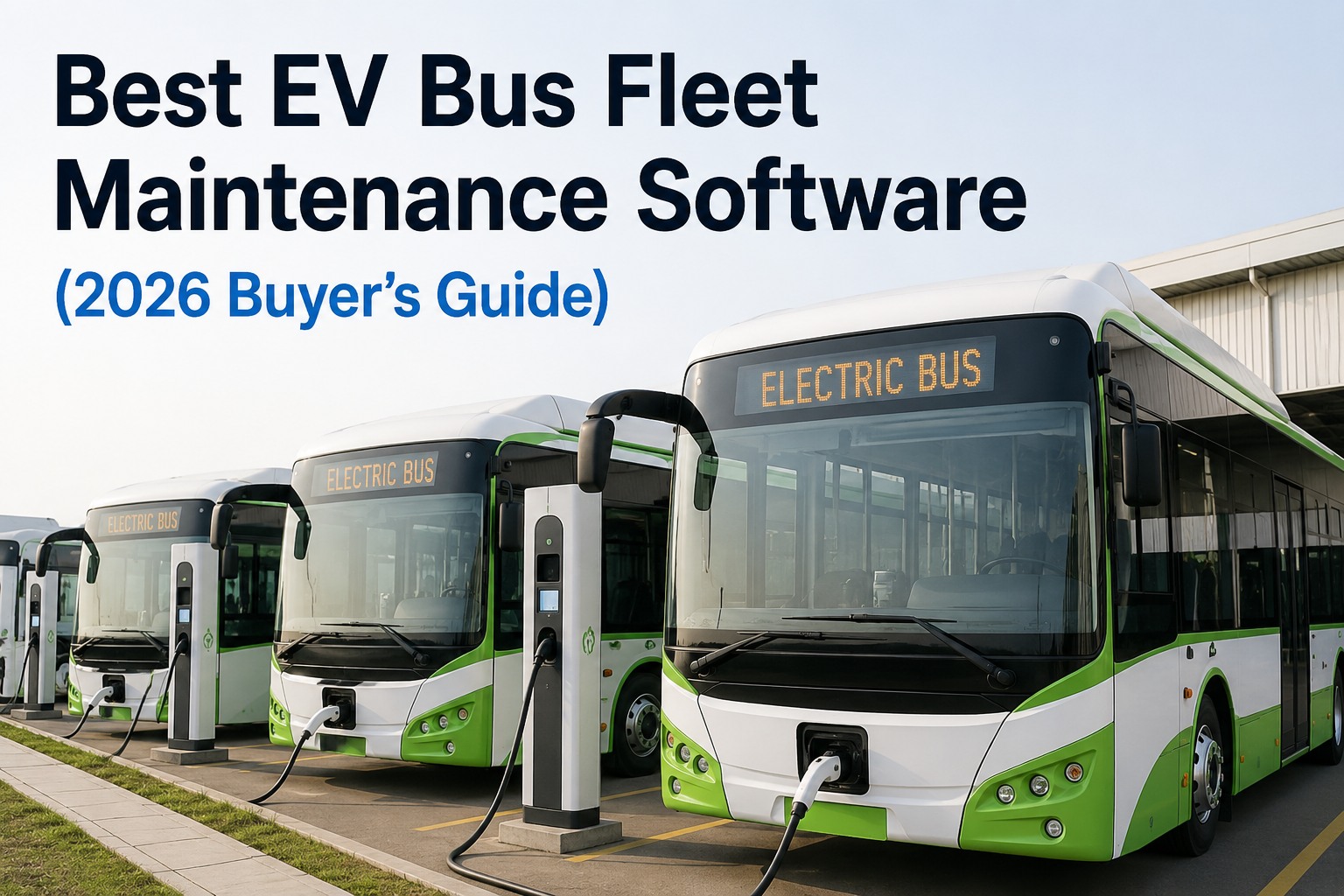
Best EV Bus Fleet Maintenance Software (2026 Buyer's Guide)
Six leading platforms ranked head-to-head on battery State-of-Health monitoring, DC fast charger PM, range prediction, HV technician certification tracking, mixed-fleet support, and total cost of ownership for electric bus fleets.
- E-047SOH 96%
- E-051SOH 92%
- E-053SOH 88%
- E-062SOH 82%
- DC-0178 kW
- DC-0262 kW
- DC-03Fault
- DC-0445 kW
- Route AM6 buses
- Route Midday2 buses
- Route PM4 buses
- Reserve0 buses
- E-062Battery SOHYr 7
- DC-03EVSE 5yr30 days
- E-051MotorYr 5
- E-047BMS FWUpdate
6 Fundamental Shifts When a Bus Fleet Goes Electric
Every one of these shifts breaks a diesel-era assumption about how bus fleets are maintained. Software that treats an EV bus like a diesel bus with a battery misses the entire operational reality.
-
01
The powertrain is the software now
Diesel had injectors, turbos, DEF systems. EV has a Battery Management System (BMS), inverter, motor controllers -- all software-defined. Firmware versions drive performance. Every OTA update is a maintenance event that must be tracked and rolled back if issues surface.
High Impact -
02
Battery State of Health (SOH) is the new odometer
Miles matter for warranty. But SOH -- battery capacity retention as a percentage of original -- determines when a $120K battery pack must be replaced or reconditioned. Tracking SOH per bus per week is not optional; it drives lifecycle decisions and warranty leverage.
High Impact -
03
Chargers are fleet assets now
DC fast chargers cost $50K-$100K each and fail in their own patterns: cable damage, connector wear, communication faults, firmware issues. Every EVSE needs its own PM schedule, uptime tracking, and warranty file. A dead charger is a fleet unavailable in the morning.
High Impact -
04
HV technicians are certified specialists
High-voltage work (400V-800V systems) requires certified technicians with PPE, training, and lockout-tagout protocols. The CMMS must know which techs are certified, which certifications expire when, and route HV work orders only to qualified staff. Diesel-era CMMS platforms do not know this exists.
High Impact -
05
Range prediction determines route assignment
A diesel bus takes any route. An EV bus with 88% SOH and cold-weather HVAC draw may not complete the same route it ran last week. The CMMS must feed real-time SOH + weather + expected HVAC load into route assignment or the dispatcher makes a bad decision at 5 AM.
Medium Impact -
06
Fewer PM items, but new consumables
No oil changes, no injectors, no DEF, no exhaust aftertreatment. But now: coolant loops for battery + inverter, cabin air filters (unique to EV), and 12V auxiliary batteries that still fail. The PM schedule is shorter but different, and generic fleet software often defaults to diesel schedules unless configured.
Medium Impact
Book a demo to see how BusCMMS handles all 6 shifts in one bus-specific platform.
The 6 EV Bus Fleet Software Platforms at a Glance
Ranked on the combination of EV-specific data depth, charging infrastructure support, and bus-fleet fit. Deep-dives follow.
| Platform | Primary Strength | EV Readiness | Bus Fleet Fit |
|---|---|---|---|
| Samsara | Mixed fleet + AI-driven insights | Excellent | Strong |
| Geotab | Deepest EV analytics + battery SOH | Excellent | Strong |
| ChargePoint Fleet | Charging infrastructure specialist | Excellent | Selective |
| Fleetio | Maintenance-forward + kWh tracking | Strong | Excellent |
| Motive | Safety-first + ELD + EV telematics | Strong | Strong |
| Ampcontrol | Depot charging orchestration | Excellent | Selective |
Book a demo to see how BusCMMS integrates with any EV fleet platform for bus-specific maintenance.
6 EV Bus Fleet Platforms in Detail
Each vendor's EV Capability Grid shows which of the 6 core EV bus fleet capabilities are natively supported. Gold pill = supported. Outlined pill = limited or partner-integrated.
Samsara
AI-powered mixed fleet management Mixed Fleet LeaderSamsara delivers real-time telematics, safety monitoring, and EV-specific tools including battery State-of-Charge tracking, charging session management, energy efficiency analytics, and AI-optimized routing that factors in charging infrastructure. Rated 99 on G2 with a 75.6 NPS score, Samsara is consistently ranked #1 for mixed diesel-to-EV fleet transitions. Charge Insights and State-of-Charge reports give dispatchers real-time visibility on which buses are ready for assignment.
Mid-to-large transit agencies transitioning from diesel to EV, wanting one platform for both fleets during the multi-year electrification period. Best-in-class for the "we still have 40 diesel buses and 8 new EVs" scenario.
Geotab
Deepest EV analytics + battery SOH Analytics LeaderGeotab offers the deepest EV data support of any general fleet platform, with 300+ EV vehicle model compatibility and the industry-leading EV Suitability Assessment (EVSA) tool. Tracks battery State of Charge and State of Health across the fleet, provides sustainability reporting, and offers custom rules + maintenance insights that automate fleet decisions based on EV-relevant signals. Open API + Marketplace add-ons enable specialized workflows for bus-specific operations.
Data-forward transit agencies + school districts that want the deepest battery-level analytics available. Higher configuration overhead than plug-and-play platforms, but rewards teams with technical capacity to leverage the data.
ChargePoint Fleet
Charging infrastructure specialist Charging LeaderChargePoint Fleet is purpose-built for EV charging management, providing access to 200,000+ chargers and 750,000+ ports across North America. Handles depot charger scheduling, driver access control, cost allocation, real-time monitoring, and OCPP 2.0.1 integration for third-party chargers. Best when the fleet standardizes on ChargePoint hardware or needs deep public charging network access. Less suited as a standalone maintenance CMMS.
EV-only or nearly-EV bus fleets prioritizing depot charging management, public-network route flexibility, and driver-facing charging apps. Pair with a maintenance CMMS for full workflow coverage.
Fleetio
Maintenance-forward + kWh tracking Maintenance LeaderFleetio is a cloud-based fleet management platform primarily focused on maintenance, compliance, and expense tracking. For EV fleets, it provides kWh consumption logging, charging session tracking, battery State-of-Charge monitoring, and EV-specific maintenance schedules. Transparent pricing starting at $4/vehicle/month with 100+ integrations including Geotab, Samsara, WEX, Fuelman, and ChargePoint. Best-in-class for mixed-fleet districts needing maintenance depth alongside telematics.
Small-to-mid districts prioritizing maintenance workflow depth, budget-friendly pricing, and mixed-fleet support. Pair with Geotab or Samsara for deeper battery analytics.
Motive
Safety-first + EV telematics Safety-FirstMotive (formerly KeepTruckin) is an AI-powered fleet operations platform combining ELD compliance, AI dashcams, and EV telematics in one stack. Strong fit for districts already using Motive for driver safety or fleets that want unified safety + EV telematics. EV features include battery monitoring, charging analytics, and predictive maintenance signals. Not a fuel/EV-first platform, but a solid choice when the safety features are the primary driver.
Fleets already standardized on Motive for ELD or safety who want to add EV features without switching platforms. Secondary EV depth vs Geotab or Samsara.
Ampcontrol
Depot charging orchestration Charging OrchestrationAmpcontrol is EV fleet charging orchestration software focused on the depot side of the operation. Optimizes charging schedules across the fleet to minimize demand charges, balance load across chargers, avoid peak-hour tariffs, and hit route-readiness windows. Critical for mid-to-large bus fleets where uncontrolled charging spikes utility bills 30-40%. Not a maintenance CMMS -- pair with Fleetio or BusCMMS for full coverage.
EV-first fleets with 15+ buses running depot-based charging where demand charges are meaningfully impacting operating cost. Adds real ROI even for fleets that already have another CMMS.
8 EV Bus Maintenance Features That Separate Serious Platforms
Every vendor markets "EV support" and "battery monitoring." These 8 features are where the real differentiation lives -- and where your evaluation should focus.
-
01
Battery SOH per bus per week
Not "battery health" as a label -- an actual State-of-Health percentage, tracked weekly, trended over months, alerting when degradation runs ahead of warranty schedule.
-
02
DC fast charger uptime tracking
Every EVSE gets its own asset record: firmware version, cable inspection dates, PM schedule, uptime SLA, warranty term. A dead charger blocks a route in the morning.
-
03
HV tech certification routing
Work orders on high-voltage systems auto-route only to certified technicians. Certification expiration alerts. Diesel-era CMMS platforms are blind to this.
-
04
Range-aware dispatch signals
Real-time SOC + SOH + weather + expected HVAC load feeds route assignment. Prevents mid-route battery depletion and unnecessary early swaps.
-
05
OCPP 2.0.1 charger integration
Open Charge Point Protocol lets your platform talk to chargers from any manufacturer. Without it, you are locked into one vendor's ecosystem and pricing power.
-
06
Battery warranty file tracking
8-12 year battery warranties are the largest single warranty on any fleet asset. The CMMS must track claim documentation, SOH data supporting claims, and expiration windows.
-
07
Regenerative brake calibration cycle
Regen brake systems drift over time and require periodic recalibration. Missed calibration reduces efficiency 3-8% and accelerates friction brake wear. Track it in the PM schedule.
-
08
Mixed diesel + EV fleet unified reporting
Most bus fleets will run mixed for 5-10 years during transition. The platform must produce unified cost-per-mile, availability, and PM compliance reports across both fleets.
Book a demo to see all 8 EV-specific features running in a live BusCMMS instance.
EV vs Diesel Bus Cost Per Mile -- The 12-Year Battle Card
EV buses cost 2.5-3x more to purchase but 40-55% less per mile to operate. The math is real, but only shows up when the CMMS captures both purchase-side and operating-side data accurately. Below is the sample comparison for a 40-foot transit bus running 30,000 miles/year over a 12-year service life.
- Fuel (diesel)$0.45
- Maintenance labor$0.20
- Parts + fluids$0.10
- Electricity (charging)$0.15
- Maintenance labor$0.15
- Parts + battery reserve$0.12
These savings only materialize when the CMMS captures actual per-vehicle energy consumption, maintenance labor, and parts cost accurately. Fleets using diesel-era CMMS on EV buses routinely underreport savings by 15-25%. Book a demo to see per-vehicle EV cost tracking in BusCMMS.
What Districts Actually Report from EV Bus Deployments
Real numbers from published transit agency and school district EV bus results, aggregated across US deployments through 2026. The math is real -- but only when the CMMS captures the data.
What is battery State of Health (SOH) and why does it matter for EV bus fleets?
State of Health is the current capacity of an EV battery pack as a percentage of its original rated capacity. A new EV bus battery is 100% SOH; after 5 years of typical service it may drop to 85-90%; at 70-75% most manufacturers recommend replacement or reconditioning. Because a replacement battery pack costs $80,000-$150,000, SOH tracking is the single most important data point on an EV bus. Fleets that do not track SOH per bus per week lose warranty leverage (manufacturer says "you did not report the degradation in time") and get surprised by mid-life battery costs. Every serious EV fleet platform surfaces SOH; BusCMMS additionally ties SOH data to route assignment, warranty claims, and next-procurement decisions.
Do we need a separate platform to manage our DC fast chargers?
Depends on scale and complexity. Small deployments (1-4 chargers) can be managed inside the vendor's own portal (ChargePoint app, ABB portal, etc.). Mid-scale deployments (5-15 chargers) benefit from a charging orchestration platform like Ampcontrol to optimize load balancing and minimize demand charges. Large deployments (15+ chargers across multiple depots) typically need both charger management (ChargePoint Fleet, Driivz) and orchestration (Ampcontrol). In all cases, the chargers themselves are fleet assets that need PM tracking, warranty files, and uptime SLAs -- this is where a bus-specific maintenance CMMS complements the charging platform rather than replacing it.
How much does EV bus fleet maintenance software cost?
Wide range depending on platform and fleet size. Fleetio starts at $4/vehicle/month for basic maintenance features, up to $8+/vehicle/month for the Pro tier. Samsara typically runs $27+/vehicle/month for the full IoT + AI stack. Geotab starts at $10/vehicle/month with modular pricing. Enterprise platforms (Trapeze, Optibus) use custom quotes starting in the tens of thousands annually. Charging platforms (ChargePoint Fleet, Ampcontrol) typically price per charger + per session or as an enterprise contract. For a 10-EV-bus school district, budget $15K-$40K annually across the full software stack. Cost is recovered many times over through better warranty capture, SOH tracking, and route optimization.
What is OCPP and why does it matter?
OCPP (Open Charge Point Protocol) is the industry standard for communication between charging software and hardware from different manufacturers. OCPP 2.0.1 supports advanced features including "Plug and Charge" authentication. Without OCPP compliance, your fleet is locked into a single vendor's charging hardware ecosystem -- if that vendor raises prices, discontinues products, or gets acquired, you have no leverage. Every serious EV fleet platform (Samsara, Geotab, ChargePoint, Ampcontrol) supports OCPP. Every serious charger manufacturer (ABB, ChargePoint, Delta, Kempower, Wallbox) supports OCPP. Verify OCPP 2.0.1 support in every vendor evaluation.
How does BusCMMS work alongside these EV fleet platforms?
BusCMMS is not a replacement for Samsara, Geotab, ChargePoint, or Ampcontrol. It is the bus-specific maintenance layer that consumes EV data from any of those platforms and translates it into bus-shop workflow. When Bus E-062 shows SOH dropping ahead of the warranty curve, BusCMMS auto-generates a warranty claim file with the supporting SOH history. When DC-03 charger goes offline, BusCMMS creates a work order routed to the certified HV technician. When regen brake calibration is due at 100K miles, BusCMMS schedules it. Districts running BusCMMS alongside an EV telematics platform capture an additional 15-25% of EV lifecycle value that pure-telematics platforms leave on the table. Book a 20-minute demo to see the integration live, or start a 30-day free trial.