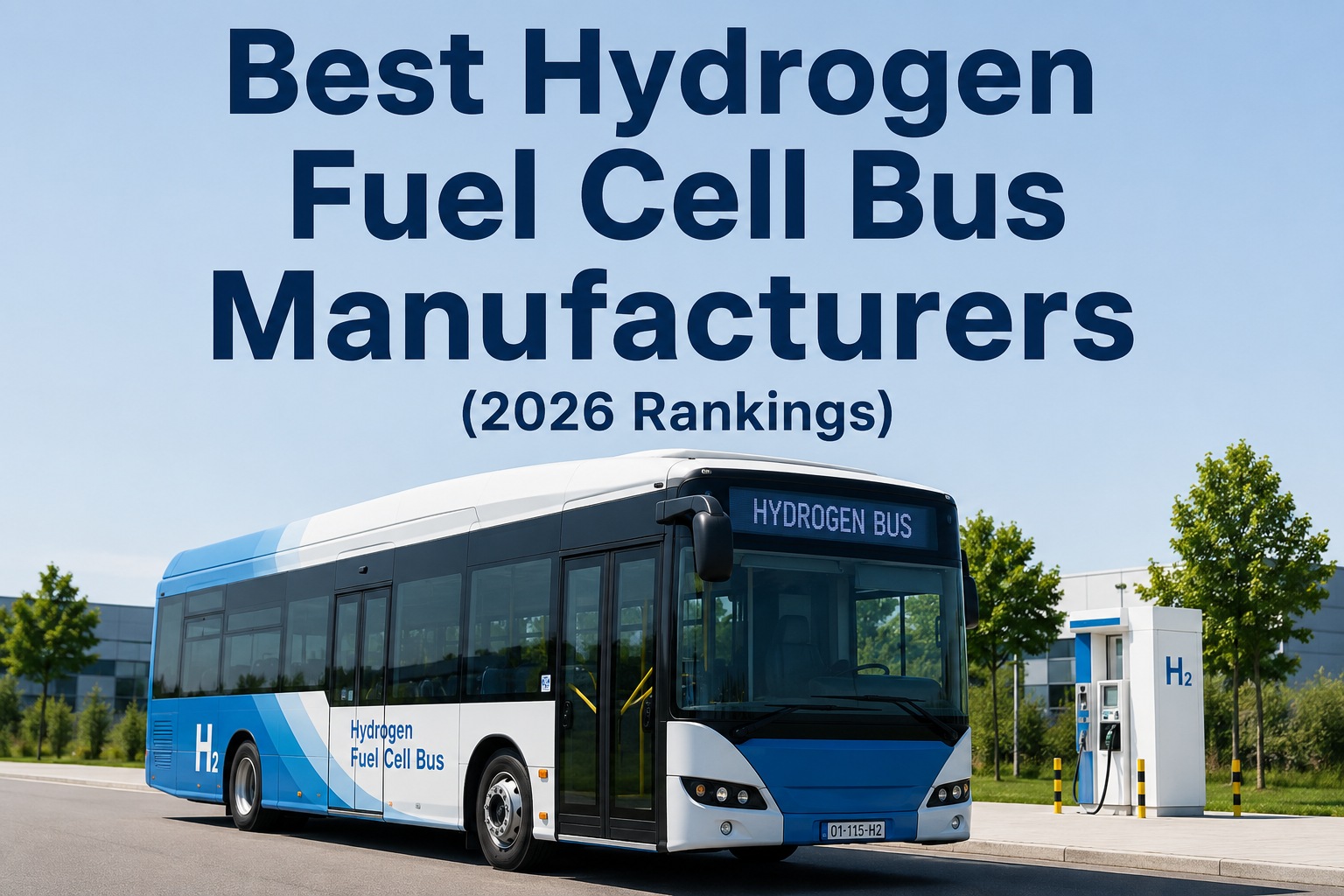
Your transit board just signed off on a zero-emission fleet transition. The battery-electric buses you piloted last winter did great inside 150-mile route loops and abysmal on the 220-mile inter-city runs where drivers had to swap vehicles mid-shift. That range-and-refuel gap is exactly why hydrogen fuel cell buses are back on the table in 2026 -- 400-960 km per fill, 8-minute refueling, and a like-for-like operational profile to diesel. This ranking compares the eight hydrogen fuel cell bus manufacturers actually shipping vehicles for transit, coach, and municipal fleets in 2026.
Best 8 Hydrogen Fuel Cell Bus Manufacturers
The honest comparison of leading FCEV bus manufacturers for transit, coach, and municipal fleets -- ranked on range, refueling time, passenger capacity, fleet support, and long-term total cost of ownership.
- 300-960 km range
- 6-10 min refuel
- Zero tailpipe emissions
Why Hydrogen Buses Are Winning the Long-Range Zero-Emission Fight
Battery-electric buses solved the urban problem. They did not solve the inter-city, hilly-route, or cold-climate problem. Fully loaded BEVs on the hills of Santa Cruz failed the operational test -- which is why in October 2023 Santa Cruz Metro ordered 57 hydrogen fuel cell buses at $87M. Cold-climate operators in Hebei Province, China chose hydrogen for the same reason. When you need diesel-equivalent range with zero tailpipe emissions and cannot double your fleet size to compensate for BEV limitations, hydrogen wins the math.
- $3.25BGlobal hydrogen bus market in 2025 (per Fortune)
- 426%H1 2025 European registration growth YoY
- 30%Maintenance cost drop vs prior H2 generation
- 29-35%Projected CAGR through 2033-2034
Hydrogen bus economics are still tougher than diesel or BEV -- vehicle cost runs $1.0-1.3M before incentives, roughly 2x a diesel and 40% above BEV. But refueling stations service 50-100 buses each at $2-4M install, and operating costs are dropping fast with each generation. Book a demo to see how BusCMMS tracks total-cost-of-ownership across hydrogen, diesel, and BEV fleets on one dashboard.
Anatomy of a Hydrogen Fuel Cell Bus
Every FCEV bus on this list shares the same five core systems. What varies between manufacturers is the fuel cell supplier (Ballard, Toyota, Hyundai HTWO), the storage tank layout, and the battery-buffer sizing.
-
Component 01
H2 Storage Tanks
Roof-mounted 350 or 700 bar carbon-fiber tanks. Typical 12m bus carries 30-40 kg H2.
-
Component 02
Fuel Cell Stack
PEMFC (98.8% of market) converts H2 + O2 into electricity + water. 75-100 kW typical.
-
Component 03
Battery Buffer
30-60 kWh Li-ion pack absorbs regen braking and delivers peak-power surges.
-
Component 04
Electric Traction Motor
180-320 kW permanent-magnet motor. Direct drive, minimal mechanical wear.
-
Component 05
Thermal Management
High-capacity radiator and coolant loops handle fuel cell heat. Critical for hot-climate deployment.
Understanding these five subsystems is the difference between managing a hydrogen bus and reacting to it. Fuel cell hours, tank certification cycles, and battery buffer state-of-health each need their own maintenance schedule. Book a demo to see H2 subsystem PM scheduling in BusCMMS.
The Top 8 Hydrogen Fuel Cell Bus Manufacturers (2026)
Tap any manufacturer for full details on range, capacity, and best-fit fleet. Start a 30-day free trial to track your hydrogen fleet's fuel consumption and maintenance in one dashboard.
1
Solaris
Poland · European market leader · Urbino 12/18
Best European transitup to 600 kmThe dominant European hydrogen bus manufacturer with 58% market share in H1 2025 and 425+ hydrogen buses delivered by end of 2024. The Urbino 12 hydrogen leads the 12-meter segment; the Urbino 18 articulated version won Bus of the Year 2025. Signed a 1,000-fuel-cell LTSA with Ballard. Deployed to RVK Cologne (largest European H2 fleet at 160 units), Bologna (130 units), Barcelona TMB (38 units).
Range350-600 km (Urbino 12/18)Fuel cellBallard FCmoveSC 75 kWBest fitEuropean transit, articulated BRT routesDelivered425+ units end of 20242
Wrightbus
UK · World's first hydrogen double-decker
Best double-deckerup to 1,030 kmNorthern Ireland-based, built the world's first hydrogen double-decker. StreetDeck Hydroliner Gen 2.0 (Feb 2025) claims 20% fuel cost savings and 30% maintenance savings over Gen 1.0, 8-minute refueling, and like-for-like diesel replacement. GB Kite Hydroliner has demonstrated up to 1,030 km in testing. Committed £25M to zero-emission R&D. Deployed in London, Birmingham, Aberdeen (Europe's largest H2 double-decker fleet), Geilenkirchen Germany.
Range300+ mi (StreetDeck) to 1,030 km (Kite test)Fuel cellBallard FCmoveSC 75 kWBest fitUK double-deckers, cold-climate operationsRefueling8 minutes typical3
Hyundai
South Korea · Range leader · Universe FCEV + Elec City
Best rangeup to 960 kmRange leader in the category. The 2026 Universe FCEV claims industry-best 960 km per fill, operating at elevations up to 2,080 meters. Elec City FCEV entered service 2019, over 1,000+ units sold in Asia. Seoul ordered 1,300 Elec City units. Uses proprietary HTWO fuel cell tech (not Ballard-dependent). Trial operations in Vienna, Germany. Strong position in Asia-Pacific transit.
Range500-960 km (Elec City / Universe)Fuel cellHyundai HTWO (proprietary)Best fitLong-range routes, high-elevation serviceSold1,000+ Elec City units globally4
New Flyer (NFI Group)
Canada/US · North America transit leader
Best for North Americaup to 480 kmNorth America's largest transit bus manufacturer and dominant hydrogen player in the US and Canada. Xcelsior CHARGE FC platform. 220+ units deployed across NA. Committed to 500 fuel cell engines from Ballard (50 MW capacity). Major contracts include SamTrans (108 buses) and Santa Cruz Metro (57 buses at $87M). AC Transit runs the largest US hydrogen fleet with Van Hool and New Flyer units.
Range300-480 km typical serviceFuel cellBallard (500-engine LTSA)Best fitUS and Canadian transit agenciesDeployed220+ Xcelsior CHARGE FC in NA5
CaetanoBus
Portugal · Toyota alliance · H2.City Gold
Best compact H2400 kmPortuguese manufacturer with strategic Toyota alliance since 2018. H2.City Gold uses Toyota Mirai-derived fuel cell stacks, tanks, and key components. Available in 8.5m, 10.7m, 12m, and 18m variants -- the only major H2 manufacturer offering compact buses. 400 km range, under 9-minute refueling. Ranked third in European deliveries after Solaris and Wrightbus. Partners with Iberdrola on green hydrogen supply.
Range400 km typicalFuel cellToyota Mirai-derivedBest fitCompact 8.5-10.7m routes, Iberia + ItalyRefuelingUnder 9 minutes6
Van Hool
Belgium · A330 Fuel Cell · Ballard partner
Best legacy transit350-500 kmBelgian manufacturer with one of the longest hydrogen bus track records. A330 Fuel Cell platform runs on Ballard fuel cells. Deployed at AC Transit (California), which operates the largest US hydrogen fleet with 22 buses split between Van Hool and New Flyer. Available in 12m and 18m variants. Established fleet-support network across Europe and North America.
Range350-500 km (12m and 18m)Fuel cellBallardBest fitLegacy US and European transit programsNotableAC Transit deployment (US pioneer)7
Daimler Buses
Germany · eCitaro range extender · H2 Coach
Best for coachup to 800 kmGerman heavyweight extending the eCitaro platform with a hybrid fuel cell range-extender configuration using Toyota fuel cells (400 km range). More significantly, launched the H2 Coach (Setra S 517 HD) with 800 km range for test drives -- signaling clear path to series production of hydrogen coaches for the intercity segment. Best pick for coach operators planning long-distance H2 transitions.
Range400 km (eCitaro) to 800 km (H2 Coach)Fuel cellToyota (range extender)Best fitGerman transit + intercity coach operatorsNotableH2 Coach signals series-production intent8
GILLIG
US · New H2 entrant 2026 · BAE/Ballard partnership
Best emerging US optionTBD 2026Established US transit bus manufacturer entering the hydrogen segment in 2026 via partnership with BAE Systems (powertrain) and Ballard Power Systems (fuel cells). Not yet a proven H2 deployment story, but strong existing US transit relationships give it a fast path to fleet trials. Worth including in RFP shortlists for US agencies wanting a domestic-manufactured H2 option alongside New Flyer.
RangeTo be announced 2026 launchFuel cellBallard + BAE Systems powertrainBest fitUS transit RFPs, Buy America contractsStatusMarket entry 2026
Head-to-Head: Maximum Range Per Fill
Range is the number one differentiator in the hydrogen bus category. Here is the max range each manufacturer's flagship model has demonstrated on a single fill.
- Wrightbus Kite Hydroliner1,030 km
- Hyundai Universe FCEV960 km
- Daimler H2 Coach800 km
- Solaris Urbino 18600 km
- Hyundai Elec City500 km
- Van Hool A330500 km
- New Flyer Xcelsior CHARGE FC480 km
- CaetanoBus H2.City Gold400 km
Test-track figures do not equal service reality -- cold weather, HVAC load, hills, and passenger weight cut real-world range 15-25%. Match the manufacturer's demonstrated range to your worst-case duty cycle plus a 20% safety buffer. Book a demo to see per-bus H2 consumption and range tracking in BusCMMS.
Hydrogen or Battery-Electric? The Decision Guide
The honest answer for most transit agencies in 2026 is both. Battery-electric for predictable urban loops with depot overnight charging. Hydrogen for the routes where BEVs cannot deliver. Here is the framework that mature fleets use.
When Range or Refuel Time Wins
- Route length: 300+ km daily duty cycle
- Refueling window: Cannot afford 2-4 hr charge downtime
- Climate: Extreme cold or hot compromises BEV range
- Terrain: Hilly routes drain BEV batteries faster
- Fleet count: Need diesel-equivalent unit count, not 2x
- Infrastructure: H2 supply or on-site electrolyzer viable
When Cost and Simplicity Win
- Route length: Under 200 km daily duty cycle
- Refueling window: Overnight depot charge available
- Climate: Mild seasonal range predictable
- Terrain: Flat urban routes
- Fleet count: Can size fleet around charging blocks
- Infrastructure: Grid capacity and charger install ready
Most large transit agencies land on 70-80% BEV, 20-30% hydrogen for the longest and most demanding routes. That mixed-fleet reality is why a fuel-type-aware maintenance platform matters. Start a 30-day free trial and track diesel, BEV, and H2 buses on one dashboard.
A Transit Fleet Manager's Take
We piloted eight battery-electric buses and eight hydrogen fuel cell buses side by side for eighteen months. The BEVs won on cost per mile inside the city grid. The hydrogen buses won on any route where the driver could not swap the bus mid-shift. Once you accept that answer, you stop arguing about which technology is better and start planning a mixed fleet. What you need is one maintenance system that understands both.
How much does a hydrogen fuel cell bus cost in 2026?
Hydrogen fuel cell buses typically cost $1.0-1.3 million before incentives -- roughly 2x a diesel bus ($280K) and 40% more than a battery-electric equivalent ($400-475K). Refueling station infrastructure adds $2-4 million per station, but a single station services 50-100 buses. Grants, low-emission vehicle credits, and cross-manufacturer procurement partnerships can offset 30-70% of vehicle cost depending on region. Operating cost per mile is dropping fast -- Wrightbus's StreetDeck Hydroliner Gen 2.0 claims 20% fuel and 30% maintenance savings vs its own prior generation.
What is the range of hydrogen fuel cell buses in 2026?
Range varies significantly by manufacturer and model. Wrightbus's GB Kite Hydroliner has demonstrated up to 1,030 km in testing. Hyundai's 2026 Universe FCEV claims 960 km per fill. Daimler's H2 Coach reaches 800 km. Solaris Urbino 18 achieves approximately 600 km. Most standard 12m transit buses (New Flyer Xcelsior CHARGE FC, Van Hool A330, Solaris Urbino 12) deliver 350-500 km in service. CaetanoBus H2.City Gold delivers 400 km. Real-world service range typically runs 15-25% below manufacturer-quoted specifications due to HVAC load, terrain, and passenger weight.
How long does it take to refuel a hydrogen fuel cell bus?
Refueling times run 6-20 minutes depending on tank size, station capacity, and ambient conditions. Wrightbus StreetDeck Hydroliner Gen 2.0 and Solaris Urbino 12 both target 8-minute refueling. CaetanoBus H2.City Gold refuels in under 9 minutes. Compared to 2-4 hours for battery-electric depot charging or 30-45 minutes for BEV DC fast charging, hydrogen refueling is directly comparable to diesel -- which is the primary reason transit agencies pick hydrogen for high-utilization routes where BEV charging windows do not fit the schedule.
Which hydrogen bus manufacturer is best for a US transit agency?
New Flyer leads the North American hydrogen bus market with 220+ Xcelsior CHARGE FC units deployed and major contracts including SamTrans (108 buses) and Santa Cruz Metro (57 buses at $87M). Van Hool retains a legacy US position through AC Transit deployments. GILLIG is entering the market in 2026 with BAE Systems + Ballard partnership, giving US agencies a second domestic option. For Buy America Act compliance, New Flyer and GILLIG are the strongest domestic manufacturing choices. Van Hool provides a Belgian-imported alternative with proven US operational experience.
How does a bus CMMS help manage a hydrogen fuel cell fleet?
A bus-specific CMMS handles hydrogen fleet management through five capabilities. First, fuel-type-specific PM schedules replace diesel oil-change intervals with fuel cell inspection cadences, hydrogen tank certification checks (typically 3-5 year cycles), and BOP (balance-of-plant) component tracking. Second, H2 consumption logging per bus captures kg-per-mile trends and identifies fuel cell degradation early. Third, fuel cell hours tracking supports warranty claims (Ballard FCmoveSC targets 25,000+ hours lifetime). Fourth, cost-per-mile comparisons across diesel, BEV, and H2 vehicles inform capital planning. Fifth, integration with hydrogen refueling telemetry captures fill session data automatically. BusCMMS is purpose-built for these mixed-fuel bus workflows.