Forty-three-and-a-half million. That is the National Association of State Directors of Pupil Transportation Services' most recent annual count of illegal stop-arm passings on U.S. school buses -- up from 17 million just a few years earlier. Twenty-six states now authorize school districts to enforce those violations with cameras (Nevada became the 26th in July 2025; Kentucky, Oregon, and Massachusetts have joined in the years since). If your district is one of them, or expects to be soon, this is the 2026 comparison of the six stop-arm camera platforms you will actually be evaluating -- BusPatrol, Verra Mobility Stop Guard, AngelTrax IntelliGuard, RedSpeed CrossingShield, Safety Vision, and Seon -- ranked on AI detection accuracy, evidence quality, citation workflow, deployment model, and district fit.
- 43.5M Annual stop-arm violations (NASDPTS 2023)
- 26+ States authorized (mid-2025, growing)
- 98% First-offenders never reoffend
- 560K U.S. school buses · 4M miles daily
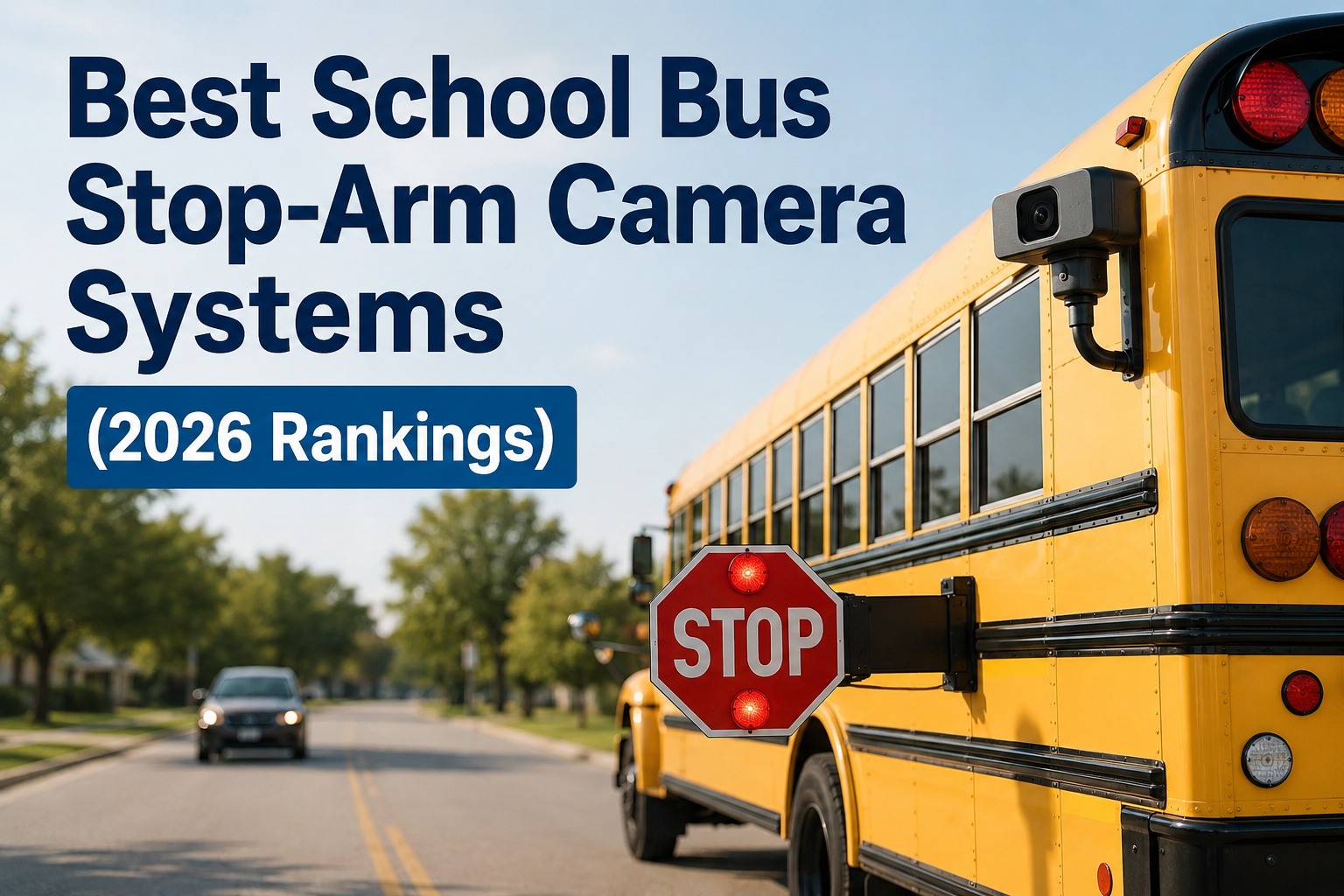
Best School Bus Stop-Arm Camera Systems in 2026
Six leading platforms ranked head-to-head on AI detection, evidence quality, citation workflow, and deployment model -- so your district picks the right partner and gets to enforcement fast.
-
2
Verra Mobility Stop Guard
Courtroom-tested adjudication · 30+ years enforcement
See details ↓ -
Editor's Pick
1
BusPatrol
AVA AI · Up to 8 lanes · Most deployed nationwide
See details ↓ -
3
AngelTrax IntelliGuard
Modular Vulcan platform · 5-year warranty
See details ↓
Is Automated Stop-Arm Enforcement Legal in Your State?
All 50 states prohibit illegally passing a stopped school bus. Only about half currently authorize automated camera enforcement. Check this first -- everything else on this page assumes your state is authorized.
States Authorized
As of mid-2025, 26 states explicitly authorize automated stop-arm enforcement per NCSL. Vendor sources cite up to 30 as of 2026.
Recent Additions
Oregon (2024), Nevada (July 2025), Kentucky (HB 7, April 2026), Massachusetts (2026) all authorized in the last 24 months.
Typical Fine Range
New York: $250 first / $1,000 for three in three years. Kentucky: $300 first. Fines scale for repeat offenders.
State Prohibitions
All 50 states prohibit the violation itself. Only authorized states permit camera-based citations without an officer present.
Skip to the vendor comparison below. Your evaluation focuses on AI detection, evidence quality, deployment model, and support fit.
Contact your state legislator, state DOT, or state pupil transportation director. NASDPTS publishes updated advocacy resources. Many states pass enabling legislation after documented incidents in-state.
Book a demo to see how BusCMMS tracks multi-state district maintenance and compliance.
The 6 Platforms at a Glance
Scan this before the deep-dives. Ranking reflects deployment scale, tech maturity, and district fit.
| # | Vendor | Best For | AI / Detection | Lane Coverage | Model |
|---|---|---|---|---|---|
| 1 | BusPatrol | Large districts, multi-state programs | AVA AI engine | Up to 8 lanes | Violator-funded |
| 2 | Verra Mobility Stop Guard | End-to-end programs with adjudication | AI + human review | 4-6 lanes | Violator-funded |
| 3 | AngelTrax IntelliGuard | Districts wanting hardware ownership | Vulcan V1284HC MDVR | 3-4 lanes | Capital / hybrid |
| 4 | RedSpeed CrossingShield | Lidar-specific evidence, HD video | Lidar + HD video | 4 lanes | Violator-funded |
| 5 | Safety Vision | Mixed-camera flexibility | Rules-based + AI | 2-4 lanes | Capital |
| 6 | Seon | School-bus-specific ecosystem | Rules-based | 2-3 lanes | Capital |
Book a demo to see how BusCMMS integrates health data from any of these camera platforms.
Ranked: 6 Stop-Arm Camera Platforms for 2026
Every vendor listed is a serious platform. Your best fit depends on district size, state law, and how you want the program funded.
BusPatrol
AVA-powered stop-arm enforcementBest for: Large districts and multi-district county programs. The most deployed stop-arm safety platform in North America, powering programs in Suffolk, Monroe, Oneida, and Orange counties in New York; Prince George's and Montgomery in Maryland; and a growing footprint in Kentucky, Pennsylvania, and elsewhere as more states pass legislation.
Key Technology
- AVA (Automated Violation Analysis) AI engine
- Reported 30% more accurate than human review
- Captures violations from up to 8 lanes away
- 4G LTE relay for real-time data + video
- AlertBus platform for live internal-camera view
- Partnership with Zonar for telematics integration
Deployment & Support
- Violator-funded · zero cost to district or taxpayer
- BusPatrol handles procurement, install, service
- Community education + warning-period rollout
- Multi-state citation processing infrastructure
- Documented 90-98% no-reoffense rate
Verra Mobility Stop Guard
End-to-end enforcement with human reviewBest for: Districts that want a battle-tested adjudication workflow and courtroom-ready evidence. Verra Mobility runs approximately 70% of U.S. speed and red-light camera programs and has processed more than 50 million enforcement events globally, giving them deep experience defending citations at scale.
Key Technology
- AI detection + rigorous human review pipeline
- High-resolution vehicle + license plate imaging
- Infrared illumination for nighttime enforcement
- Radar and motion detection layers
- DMV integration for owner registration lookup
- Court-scheduling and payment facilitation built in
Deployment & Support
- Violator-funded end-to-end model
- 30+ years automated enforcement experience
- Data security + PII handling protocols
- Community education infrastructure
- 98% first-offender no-reoffense rate reported
AngelTrax IntelliGuard
Vulcan MDVR + SAV5MP camera stackBest for: Districts that want to own the hardware and integrate stop-arm enforcement into an existing AngelTrax interior/exterior camera fleet. AngelTrax is a hardware-first manufacturer with a modular design that lets shops swap or upgrade recorder components in minutes, not days.
Key Technology
- SAV5MP camera unit · 3 built-in cameras (detection + dual 5MP for plate)
- Separate overview camera for extended stop-arm view
- Vulcan Series V1284HC 12-channel MDVR
- Approximately one year of video on one hard drive
- Patented Hybrid Component modular design
- BEV360 bird's-eye visibility system
Deployment & Support
- Capital purchase model (or hybrid)
- Five-year limited warranty
- A-to-Z Child Safety Program add-on for adjudication
- Cellular + Wi-Fi automated downloads
- Strong fit for districts already running AngelTrax
RedSpeed CrossingShield
Lidar + HD motion-picture enforcementBest for: Districts that want the strongest technical evidence package. RedSpeed is one of the few enforcement vendors using Lidar (police-grade laser detection) and is the only vendor known to publicly cite fully high-definition, lane-specific motion-picture-based enforcement rather than single still frames.
Key Technology
- Lidar speed and vehicle detection
- HD video capturing hundreds of frames per violation
- Ultrasonic detection sensor
- Two HD cameras (front and rear offside mount)
- Bi-directional violation capture · 4 lanes on driver side
- IR illumination for low-light conditions
Deployment & Support
- Violator-funded model
- Remote login + daily certification diagnostics
- ALPR integration (Rekor, Vigilant, Flock, Insight)
- Cabinet / pole / vehicle-mounted deployment options
- Wireless upload at depot
Safety Vision
Mixed-camera video management for student transportationBest for: Districts that want a broader student-transportation video platform and are willing to build stop-arm as one channel within a larger camera ecosystem. Safety Vision is a long-standing mobile video specialist known for real-time video and tracking across school bus, transit, and rail fleets.
Key Technology
- Real-time video and tracking
- Mixed-camera platform (interior, exterior, stop-arm)
- Video management software with playback + review
- Cloud-connected video storage
- Wireless data offload options
Deployment & Support
- Capital purchase model
- Broader student transportation platform
- Support for mixed transit + school bus fleets
- Established mobile video vendor
Seon
School-bus-specific video and recording systemsBest for: Small-to-mid districts that want a pure school-bus-focused vendor. Seon has long specialized in school bus video and is a common recommendation for districts that want a native school bus system rather than a general-purpose transit vendor adapting to school buses.
Key Technology
- School-bus-designed recording units
- Interior + exterior + stop-arm camera options
- Video management software
- Route-review and event-based recording
Deployment & Support
- Capital purchase model
- School-bus-native product design
- Established school transportation vendor
Real Districts. Real Results.
Three deployment stories with actual numbers -- program scale, violations captured, first-offender no-reoffense rates.
Two BusPatrol-equipped buses captured 205 stop-arm violations across 47 school days -- 2.18 violations per bus per day. Compared to 667 tickets issued by traditional enforcement across 30,000 Pennsylvania buses over an entire year, two AI-equipped buses matched roughly one-third of statewide traditional enforcement in under two months.
Oneida County partnered with Verra Mobility to deploy CrossingGuard across 191 school buses in 8 participating districts. The Sheriff's Office issued 852 citations during the 2023-2024 school year. Roughly 32,000 students in the county board buses daily. Program continues to expand to remaining districts.
Monroe County launched the BusPatrol AlertBus program under NY 2019 legislation, with a public warning period before fines. Program data shows 94-95% of first-time offenders never receive a second citation and 95% of drivers do not contest their ticket after seeing the video evidence.
Book a demo to see how BusCMMS tracks camera-system health across deployments this large.
The 8 Things That Actually Separate These Platforms
Every vendor claims "AI-powered evidence." Score each platform on the criteria that determine citation success and program sustainability.
- 1
AI Detection Accuracy
How well does the system distinguish real violations from cars turning, cars parked, bikes, or pedestrians?
- 2
Lane Coverage
How many lanes can one bus capture at once? Rural roads need 2; urban arterials need 4-8.
- 3
Evidence Quality
Video resolution, plate readability at night, contextual angles that survive legal challenge.
- 4
Citation Workflow
Who reviews the evidence? Does law enforcement approve every ticket? Court-ready packages?
- 5
Deployment Model
Violator-funded (zero district cost) vs capital purchase vs hybrid. Only one of these needs a board vote.
- 6
Cloud Portal + Reporting
Real-time dashboards, live view of internal cameras, incident retrieval, chain of custody.
- 7
Fleet Integration
Does the system integrate with telematics, GPS, ELD, and your maintenance CMMS?
- 8
Support & Adjudication
Community education, warning period, court testimony support, repeat offender tracking.
4 Questions That Narrow the Field to 1 or 2 Vendors
Most districts do not need to evaluate all six. These four questions eliminate 3-4 vendors in under 10 minutes.
-
Q1
Does the district want zero capital outlay?
If yes: BusPatrol, Verra Mobility Stop Guard, or RedSpeed CrossingShield (all violator-funded). If capital purchase is on the table: AngelTrax IntelliGuard, Safety Vision, and Seon become viable.
-
Q2
What is the lane environment?
Rural 2-lane roads: any of the six work. Urban arterials with 4-8 lanes: BusPatrol AVA (up to 8 lanes) or Verra Mobility (4-6 lanes) become clear leaders.
-
Q3
Do we need adjudication and court testimony support?
If the district wants the vendor to handle the entire citation lifecycle including court appearances: BusPatrol or Verra Mobility. If law enforcement handles adjudication in-house: any vendor works.
-
Q4
Do we already run interior/exterior cameras from a specific vendor?
If yes and it is AngelTrax or Safety Vision: adding stop-arm to the existing platform reduces coordination cost. If the interior cameras are Samsara, Motive, or Seon: a violator-funded stop-arm program from a specialist vendor can run in parallel without conflict.
What Happens After the Camera Fails? The BusCMMS Workflow.
Camera vendors capture violations. Maintenance CMMS catches failures. Here is the exact 5-step workflow that keeps cameras online.
-
1
Camera goes offline
Stop-arm camera on Bus #47 loses power or connectivity. Silent failure -- no dashboard alert on the bus itself.
-
2
Vendor portal flags it
BusPatrol / Verra / AngelTrax cloud portal registers "channel offline" or similar signal within a few hours.
-
3
BusCMMS ingests the signal
Vendor-agnostic integration pulls camera-health status per bus per hour. Offline >24h auto-flagged.
-
4
Work order auto-generated
Assigned to the right shop technician. Priority based on how long offline. Includes bus asset + last-known state.
-
5
Repair logged · asset history built
Fix applied, camera back online, entry logged against bus asset. Available in DOT and insurance audits.
Without this layer: Camera vendor emails an alert. It gets missed. Two weeks later the incident happens and the camera was offline the whole time.
With this layer: Camera vendor flags the fault. Work order fires the same day. Camera repaired within the 24-hour window. Every incident during route has evidence.
Book a demo to see the 5-step workflow live on your fleet dataWhat does violator-funded actually mean for the district?
Violator-funded means the stop-arm camera vendor installs, operates, and maintains the equipment at zero direct cost to the district. Revenue from citations issued to motorists who illegally pass the bus covers the program cost, and the vendor typically shares a portion of net revenue with the district and law enforcement per a revenue-share contract. BusPatrol, Verra Mobility Stop Guard, and RedSpeed CrossingShield all operate on this model. The upside: no board vote for capital purchase, no maintenance labor cost. The trade-off: the vendor sets equipment specs and the district has less ownership over the hardware itself. Ask the vendor for a redacted sample revenue-share contract during evaluation.
How accurate is AI-based stop-arm detection compared to human review?
Modern stop-arm AI systems focus on distinguishing real violations from cars turning, cars parked, cyclists, pedestrians, and bus mirror artifacts. BusPatrol reports its AVA engine is roughly 30% more accurate than human eye review in field testing. Verra Mobility takes a hybrid approach with AI pre-screening followed by rigorous human review before any citation goes out. All serious platforms have moved past simple motion-detection to AI-based classification. The failure mode to watch for is false positives -- older systems generated citation volume that overwhelmed law enforcement review, damaged program credibility, and caused political backlash. Ask any vendor for their false-positive rate and their citation-approval rate at law enforcement review.
Does automated stop-arm enforcement actually change driver behavior?
The most consistent industry statistic across BusPatrol and Verra Mobility is that 90-98% of drivers who receive one stop-arm citation never receive a second. Monroe County (NY) reported 94-95% first-offense-only rates from its program. This is the strongest deterrence signal in traffic enforcement -- higher than red-light or speed camera programs. The mechanism is straightforward: distracted drivers usually do not realize how dangerous their behavior is until a citation and photo evidence in the mail makes it concrete. Districts should still combine cameras with community education, warning-period rollout, and public signage for maximum behavior change.
Can we run stop-arm cameras from Vendor A alongside interior cameras from Vendor B?
Yes, and this is common. Many districts run a violator-funded stop-arm program from BusPatrol or Verra Mobility on top of an existing interior/exterior camera system from AngelTrax, Safety Vision, Seon, Samsara, or Motive. The stop-arm vendor installs its own dedicated hardware on the outside of the bus. Coordination points to watch: (1) roof-space and wiring conflicts during install, (2) power draw on the bus electrical system, (3) how each vendor's portal reports camera health so you do not have to check two dashboards. This is where a bus-specific CMMS like BusCMMS becomes useful -- pulling camera-health signals from both vendors into one work-order queue instead of asking staff to monitor two portals.
How do we track stop-arm camera maintenance alongside the rest of the fleet?
Every stop-arm platform still has physical hardware that needs monthly inspection -- lens cleanliness, mount torque, wiring integrity, IR function, aim verification. And every platform generates offline-channel signals that need to route to the right technician. Paper checklists and spreadsheets lose these signals inside a week. The audit-safe workflow is a bus-specific CMMS that files each inspection against the bus asset, tracks camera-vendor telemetry, and auto-generates work orders on health degradation. BusCMMS is purpose-built for bus fleets and integrates with the leading camera vendors. Book a 20-minute demo to see camera-health tracking live, or start a 30-day free trial and log your first inspection today.