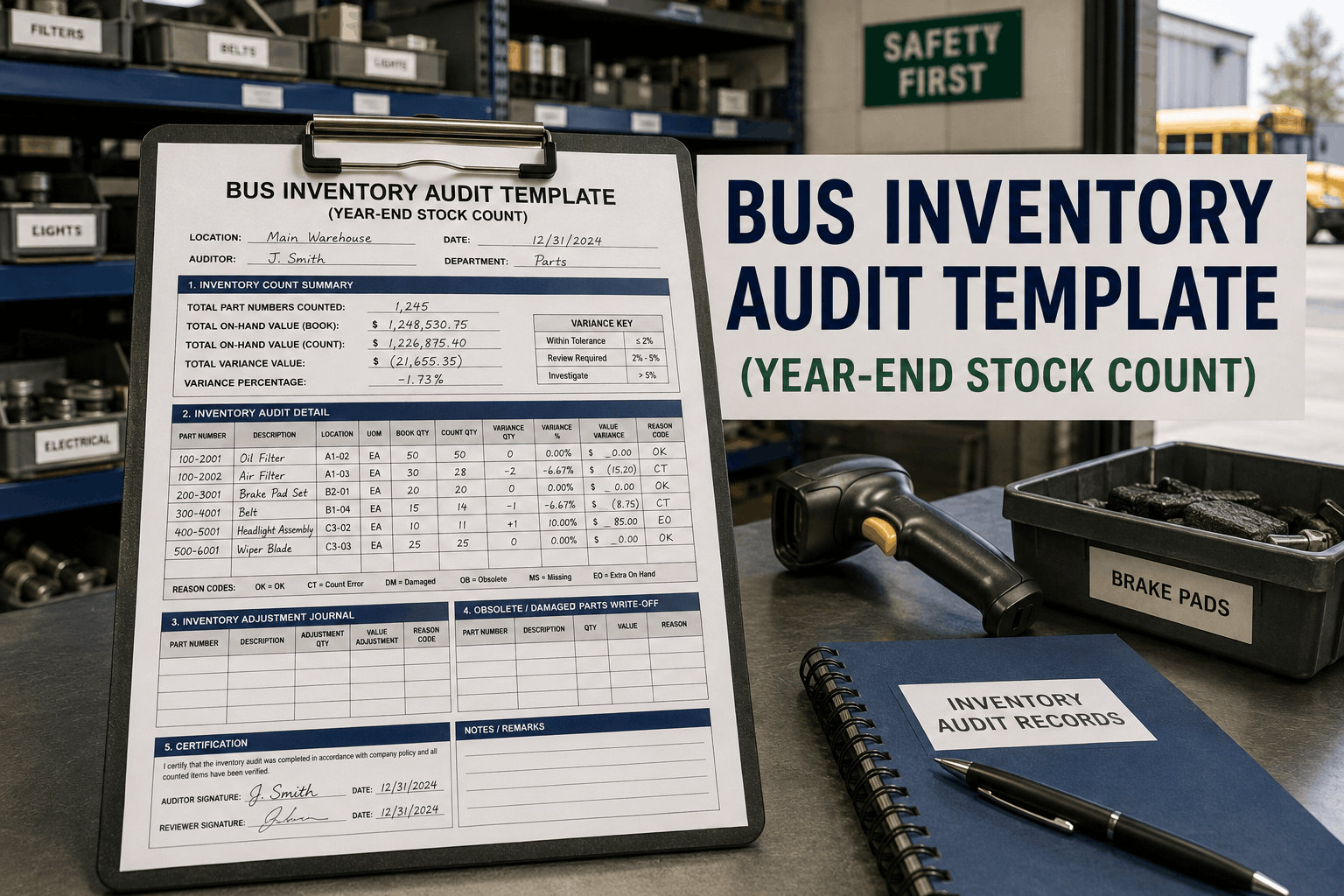
A mid-sized transit fleet with 134 buses and a parts stockroom holding over 3,200 unique part numbers faced a year-end inventory audit that exposed significant discrepancies. The annual physical count, performed by three mechanics over two weeks, revealed a 12% variance between book inventory and actual stock. High-value items like transmission filters and brake rotors were under-counted, while obsolete parts worth over $18,000 had accumulated without being written off. The finance team struggled to adjust the general ledger, and the audit committee required a detailed explanation of each variance. The root cause was not theft or mismanagement, but a lack of a structured cycle-count process—the fleet relied on an annual "big bang" count with no reconciliation procedures. After implementing a year-end inventory audit template that included cycle counting, variance analysis, adjustment journals, and obsolete-part write-off workflows, the fleet reduced counting time by 60%, eliminated inventory write-offs through proactive management, and achieved 99.5% inventory accuracy. A structured audit template transforms year-end stock count from a frantic scramble into a predictable, financial-close-ready process.
Bus Parts Inventory Audit Template: Year-End Stock Count
Streamline your year-end physical count, reconcile variances, write off obsolete parts, and close the books with confidence.
Inventory Audit Impact — 134‑Bus Fleet
Physical Count Duration (Manual)
10–14 days
Inventory Variance (Book vs Actual)
12% average discrepancy
Obsolete Parts Write‑Off
$18,000+ annually
Structured Template Count Time
4 days or less
Inventory Accuracy Rate
99.5% verified
Audit Preparation Time
2 hours (reports ready)
A structured audit template turns year-end inventory reconciliation into a smooth, defensible process.
The Inventory Audit Challenge: Annual Panic vs. Structured Cycle Counting
Many fleet operations treat inventory counting as a once-a-year event, shutting down the parts room for days while staff scramble to count every item. This approach leads to fatigue, errors, and incomplete reconciliation. A structured year-end audit template moves away from the "big bang" count by integrating cycle counting throughout the year, then using a focused final count to validate key items and adjust the books. The template includes: Cycle Count Schedules—high-value parts counted monthly, medium quarterly, low-value annually. Variance Reconciliation—tracking discrepancies between system and physical counts, investigating root causes. Adjustment Journal—formalizing necessary changes to the general ledger. Obsolete Parts Write-Off—identifying parts with no usage for 18+ months and approving write-offs before year-end. By adopting this framework, fleets reduce year-end stress and improve financial accuracy.
Annual "Big Bang" Physical Count
Counting Approach
Full stockroom shut down for 10+ days
Error Rate
High due to staff fatigue and rush
Variance Analysis
Minimal; adjustments made without investigation
Obsolete Identification
Often missed or deferred
Financial Close Integration
Manual entries, risk of errors
Structured Year-End Audit Template
Counting Approach
Cycle counts year-round, final focused count
Error Rate
Low; systematic verification
Variance Analysis
Root cause investigation and documentation
Obsolete Identification
Automated aging reports and write-off workflow
Financial Close Integration
Auto-generated adjustment journal entries
Critical Inventory Audit Metrics to Track
A robust year-end audit template should capture five essential data areas. First: Cycle Count History—count dates, counts performed, and any previous adjustments for each part. Second: Physical Count Results—actual quantities counted, with space for multiple counters and recount verification. Third: System Quantity vs. Actual—difference calculation, variance percentage, and monetary value. Fourth: Variance Reason Codes—categorize discrepancies (e.g., receiving errors, misplaced stock, theft, data entry) to identify systemic issues. Fifth: Adjustment Journal and Write-Offs—formal record of approved adjustments, including obsolete parts with dates of last use. By organizing these metrics, you can not only close the books accurately but also identify process improvements for the coming year.
Inventory Audit Performance Benchmarks
Structured Template Target
Annual "Big Bang" Method
Variance Investigation Rate
Obsolete Parts Write-Off Timeliness
A structured audit process ensures accurate financial reporting and identifies operational improvements.
Audit Framework in Action: Real‑World Inventory Reconciliation Success
A school bus contractor with 210 buses and a 5,000‑square‑foot warehouse struggled with year-end inventory audits. Their previous annual count took two weeks, required overtime pay, and still produced a 15% variance that triggered an external audit. After implementing a structured year-end audit template, they switched to cycle counting for A‑items (monthly), B‑items (quarterly), and C‑items (annually). For the year-end close, they performed a final focused count on high‑value items and used the template to generate variance reports and adjustment journals. The result: count time dropped to 4 days, variance fell below 2%, and the finance team closed the books two weeks earlier. The template also identified $22,000 in obsolete parts that were written off, improving inventory turnover.
Disorganized Year‑End Count
Two‑week shutdown; staff overtime and fatigue.
High error rates; no cycle count discipline.
Variances unexplained; adjustments made blindly.
Obsolete parts ignored; financial close delayed.
Result: Audit findings, financial restatements, and wasted labor.
Structured Audit Template
Cycle counts year‑round; final count focused on exceptions.
Systematic verification; low error rate.
Variance reason codes and root‑cause analysis.
Proactive obsolete part write‑off workflow.
Result: Accurate financial close, reduced audit risk, and leaner inventory.
Strategic Rollout: 90‑Day Audit Template Integration
Implementing a structured year-end inventory audit process can be completed in three phases. Month one: Cycle Count Setup—categorize parts by ABC analysis, define counting frequencies, and assign staff responsibilities. Establish count sheets and verification procedures. Month two: Pilot Cycle Counts—run cycle counts for each category, record results, and begin analyzing variances. Develop reason code templates and adjustment workflows. Month three: Year‑End Preparation—schedule the final focused count, train staff on the template, and generate preliminary variance reports. Run a mock close to validate the process before the actual year-end. After implementation, you'll have a repeatable, defensible audit process.
Audit Template Rollout Timeline
Days 1–30
Days 31–60
Days 61–90
Year‑End Ready
The Bottom Line
Annual inventory counting doesn't have to be a chaotic, error-prone marathon. A structured year-end audit template that incorporates cycle counting, variance analysis, and obsolete-part write-off workflows turns financial close into a predictable, accurate process. By moving from a once-a-year "big bang" count to a disciplined, year-round approach, you can achieve near-perfect inventory accuracy, reduce labor costs, and provide your finance team with clean adjustment data. BusCMMS provides the tools to build and maintain a comprehensive inventory audit template, track cycle counts, investigate variances, and generate adjustment journals that stand up to external scrutiny.
Streamline Your Year‑End Inventory Audit. Eliminate Variance Surprises.
Capture cycle counts, reconcile variances, and close the books with confidence. Free 14‑day trial.
Frequently Asked Questions
What is the difference between a cycle count and a year-end physical count?
A cycle count is a continuous, rolling count of select items throughout the year, while the year-end physical count is a complete verification of all stock to support financial reporting. A good audit template combines both, reducing the burden at year-end.
How do I determine which parts to cycle count and how often?
Use ABC analysis: A‑items (high value/usage) are counted monthly, B‑items quarterly, and C‑items annually. This focuses effort on the most impactful parts.
What should I do when I find a variance during the count?
Record the variance with a reason code (e.g., shipping error, misplacement, theft). Investigate root causes, and if the variance is confirmed, document an adjustment journal entry for the finance team.
How do I handle obsolete parts during the audit?
The template identifies parts with no usage over a defined period (e.g., 18 months). You can then seek management approval to write them off, reducing stock and improving turnover metrics.
Can the template generate the adjustment journal entries automatically?
Yes. Once variances are verified and reason codes assigned, the template can generate a detailed journal entry report with account codes and amounts, ready for your finance system.
How does the template help with external audit preparation?
It provides a complete audit trail: count sheets, variance reports, reason codes, approval workflows, and adjustment journals—all organized and accessible, saving significant time during external reviews.
Bring Your Inventory Audit Into a Structured, Repeatable, and Defensible Process.
Standardize cycle counts, reconcile variances, and close your books with confidence. Free 14‑day trial.