A propane vendor shows you a fuel-cost slide that looks unbeatable. An EV rep hands you a cents-per-mile figure that makes diesel look foolish. Both numbers are real — and both were calculated on a fleet that is not yours, on routes you do not run, in a climate you do not operate in. Choosing bus fuel type on the brochure is how districts end up with buses that do not fit their operation. The fix is to decide on your own numbers, and you can see your real cost per mile by bus in a demo before you sign a purchase order.
Choosing Bus Fuel Type: Decide on Your Data, Not the Brochure
Diesel, propane, CNG, or electric — the right answer is not the one with the best vendor slide, but the one that fits how your fleet actually runs. Here is how to decide with real operating data.
Why the Brochure Is the Wrong Place to Choose a Fuel
Vendor economics are not dishonest — just not yours. Every fuel-cost claim rests on assumptions that shift the moment the bus hits your routes. Three gaps do the most damage.
Ideal conditions, not yours
Claimed figures assume flat routes, mild weather, and steady speeds. Hills, stop-and-go, and a hard winter move electric range and diesel economy in ways no slide shows you.
Your duty cycle is ignored
A fuel that shines on long steady runs can struggle on short high-idle urban routes. The claim never knows how your buses spend their day.
Infrastructure left off the bill
Chargers, a CNG station, or a propane tank are real capital with real lead times. A per-mile figure that omits them is half the decision.
The only cost figures you can trust in a purchase decision are the ones measured on your own fleet — the rest is a starting hypothesis.
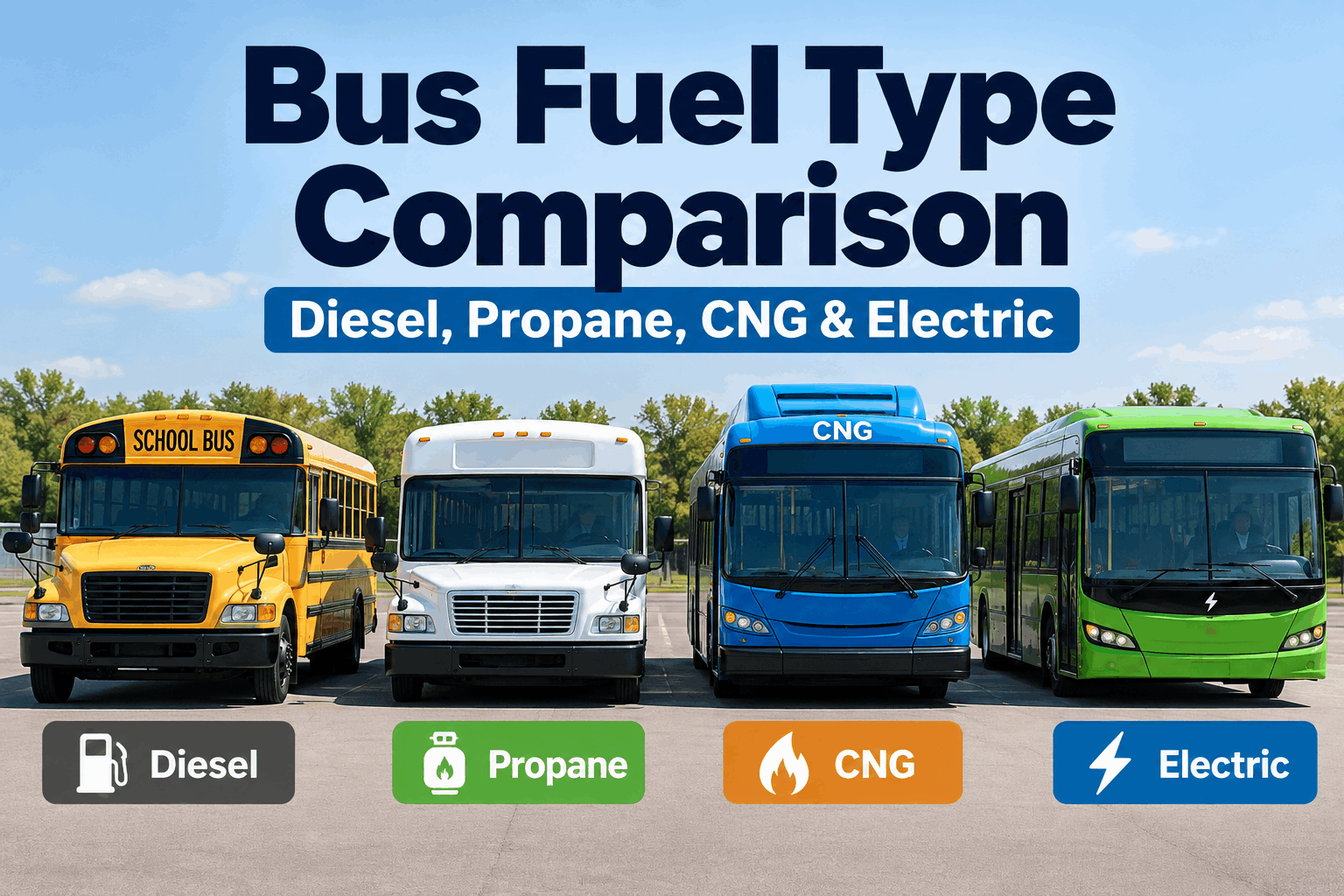
The Four Bus Fuel Types, by Operating Fit
Forget the rankings. Each fuel is strong for one operation and weak for another. The question is not which is best, but which fits how your buses run — and what to verify in your own data before you commit.
Highest range and energy density, fuels anywhere, mature parts-and-service network. Trade-off: complex emissions aftertreatment and fuel-price volatility.
Fits: long rural routes, mixed duty, no new infrastructureVerify in your data: real MPG by route, aftertreatment repair spendModest price bump over diesel, cheaper and simpler fuel, easy onsite tank, fewer cold-start headaches. Range and energy density sit below diesel.
Fits: predictable mid-length routes, cold climates, tight capitalVerify in your data: route lengths vs range, cold-start downtimeLow, stable fuel cost and clean burn, but a significant fueling-station investment and fuel-storage weight that trims range and payload. Best at scale.
Fits: large fleets, central depot, high annual mileageVerify in your data: annual miles to amortize the station, range needsLowest fuel and routine-maintenance cost per mile and zero tailpipe emissions, offset by the highest purchase price, charging infrastructure, and range that shrinks in cold and on hills.
Fits: short predictable routes, depot charging, grant support, mild climateVerify in your data: route miles vs winter range, depot dwell time to chargeFor the full dollar-by-dollar numbers, our team breaks down the lifecycle math in the diesel vs electric vs propane total cost comparison. This page is about matching a fuel to your operation.
Match the Fuel to How Your Buses Actually Run
Narrow the field by starting from your operating profile, not the fuel. Find the row that sounds like your fleet — it points to the fuels worth costing out in detail.
- Short, predictable routes, depot overnightDwell time to charge and known daily mileage make this the strongest case for electric, with propane as a lower-capital fallback.ELECTRIC / PROPANE
- Long rural routes, high daily milesRange rules here. Diesel stays the safe workhorse; propane fits if routes sit inside its range.DIESEL / PROPANE
- Large fleet, central depot, high mileageVolume amortizes a CNG station. At scale with high annual miles, CNG's cheap stable fuel pays back the infrastructure.CNG / DIESEL
- Cold climate, heavy winter startsPropane handles cold starts well; electric range drops in winter, so it needs margin. Check your coldest-day numbers, not the average.PROPANE / DIESEL
- Tight capital, no grant in handWhen upfront dollars are the constraint, propane's low premium beats a large EV or CNG outlay — diesel if nothing else changes.PROPANE / DIESEL
Notice propane shows up a lot — not because it always wins, but because it is the low-risk middle for fleets that cannot yet justify EV or CNG infrastructure. Your own route and cost data tells you where the real line sits. You can sign up free and map your routes against each fuel's fit.
A Four-Step Data-Driven Way to Choose Bus Fuel Type
Turn the decision into a short, repeatable process that ends in a number you can defend to the board. If you want it walked through on your fleet, book a demo and bring your route list.
Pull your real baseline
Start with your current fleet's actual cost per mile, MPG by route, and maintenance spend by unit. That is the benchmark every alternative fuel has to beat on your data.
Profile your routes
Map daily miles, duty cycle, climate, and depot dwell time. These decide whether a fuel's range and refueling needs even fit before cost matters.
Stress-test the vendor claim
Re-run each fuel's claimed numbers against your routes and winters, and add the infrastructure capital the brochure left off. Keep only what survives.
Decide per route group, not fleet-wide
The answer is often a mix — electric on short depot routes, diesel or propane on long ones. Choose by route group and your fleet ends up optimized, not uniform.
Done this way, the fuel decision stops being a leap of faith and becomes a calculation you can show. You can sign up free and build your baseline before your next purchase cycle.
How BusCMMS Makes the Fuel Decision a Data Decision
Every step above needs numbers from your own operation — precisely what a bus-built CMMS produces as a byproduct of running the shop. BusCMMS turns daily work into the baseline a fuel decision stands on, and keeps measuring once mixed fuels are on the lot.
Real cost per mile, by bus and fuel
Your true operating baseline from work orders and fuel data — the number every vendor claim has to beat.
Route & mileage data to profile fit
Daily miles and usage per unit from telematics, so you can test whether a fuel's range and charging window actually fit.
One dashboard across mixed fuels
Diesel, propane, CNG, and electric side by side, so after you buy you can prove which fuel delivered.
A fuel decision is a hypothesis until the buses run, and BusCMMS is how you confirm the one you chose was right. Book a demo to see it on your own fleet.
A Procurement Director's Take
Key Takeaways on Choosing Bus Fuel Type
Choosing bus fuel type is a data decision in a vendor-comparison costume. Four things for your next procurement cycle.
The brochure is a hypothesis
Vendor costs assume a fleet that is not yours.
Fit beats ranking
Each fuel wins a profile; match it to how you run.
Count the infrastructure
A per-mile figure without the station or charger is half a number.
Decide by route group
A mixed fleet, matched to routes, usually beats one fuel everywhere.
Start from your own cost-per-mile and route data, stress-test every vendor claim against it, and choosing bus fuel type becomes a decision you can defend with numbers rather than a bet on someone else's slide — and you buy buses that fit your operation instead of fighting it for twelve years.