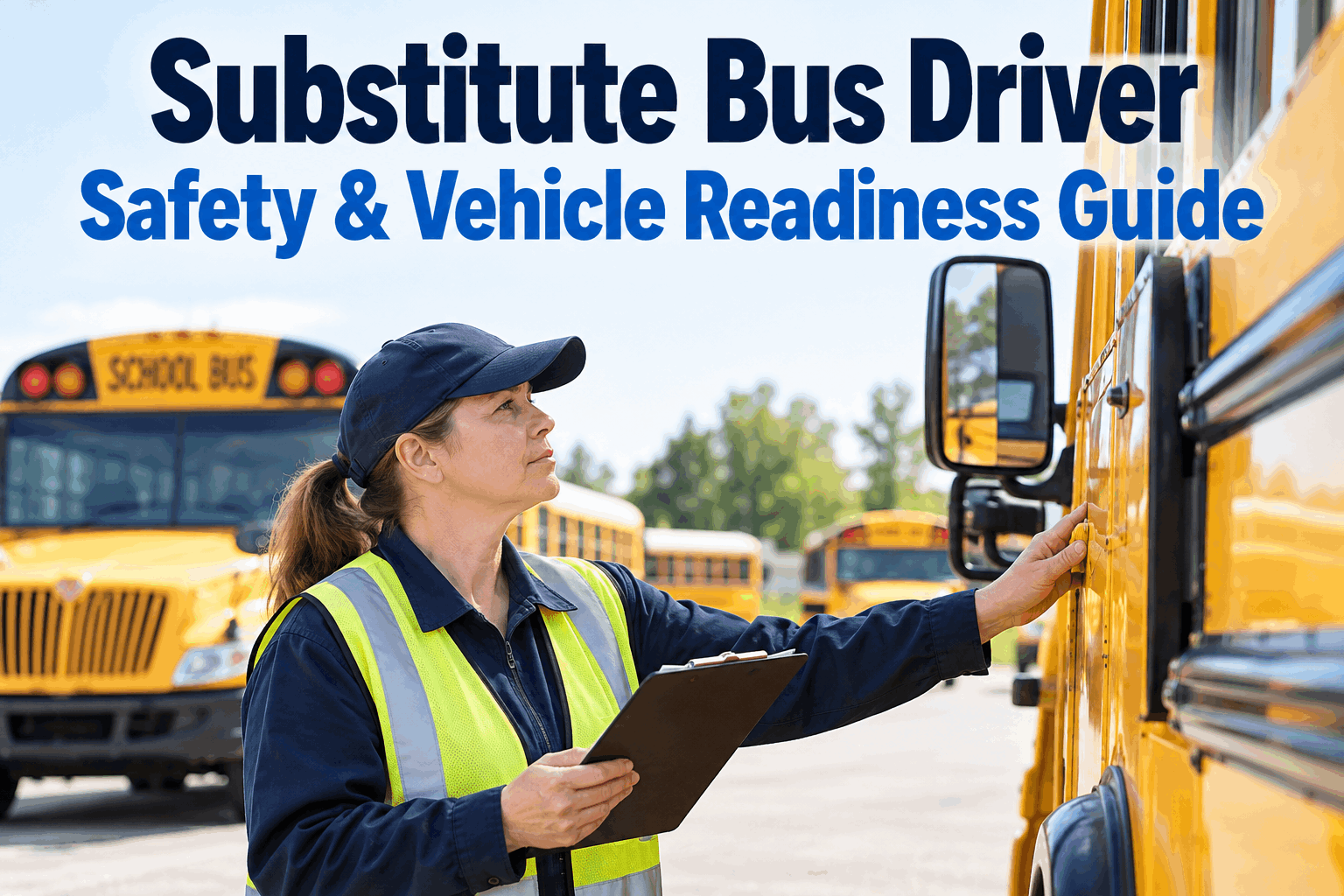
A sub driver gets handed the keys to bus 47 at 6:40, a bus she has never driven, on a route she has never run. What she does not know: the regular driver wrote up a soft brake pedal last week, and the right-side student mirror is loose. That is the quiet risk in substitute bus driver safety — not bad drivers, but good ones put on unfamiliar buses with no line of sight into what is already wrong with them.
Substitute Bus Driver Safety: Safe Handoffs on Unfamiliar Buses
A relief driver inherits a bus with a history they cannot see. Open defects, last week's inspection findings, the quirks the regular driver works around — none of it rides along unless your handoff makes it visible. Here is how to close that gap.
- The brake pedal has felt soft all week
- The right student mirror drifts
- Door sticks in the cold
- Which stops are the tight ones
- A key and a bus number
- No idea the brake feels soft
- No idea the mirror drifts
- Nothing about this bus's history
The whole safety gap is that second column. Make the bus's history visible at handoff and the sub starts the route knowing what the regular driver knows.
What a substitute bus driver doesn't know about the bus
A relief driver can be fully certified and still be operating half-blind, because everything that makes a specific bus safe to drive lives with the person who drives it every day. Four blind spots do the most harm.
Open defects
A write-up that is logged but not yet repaired — a soft brake, a bad marker light, a sticking door. The regular driver knows to watch it; the sub has no idea it exists unless the handoff tells her.
Last inspection findings
The most recent DVIR is the bus's short-term memory. Without reading it, the sub cannot know what the last driver flagged, what passed with a note, or what is trending toward a failure.
Vehicle-specific quirks
The mirror that drifts, the wheelchair lift that needs a second cycle, the gauge that reads a little high. None of it is a defect exactly — but all of it is knowledge the sub does not have.
Where everything is
Fire extinguisher, first-aid kit, cut-off switch, the feel of the service brake — all slightly different bus to bus. In an emergency, "I wasn't sure where it was" is the gap that costs seconds.
The common thread is that none of this is written down where the substitute can reach it. It lives in one person's head — and on the day you need a sub, that person is exactly who is not there. You can book a walkthrough of how that history reaches a relief driver before it stays stuck with one person. Leaning on relief drivers is often a symptom of a wider driver shortage straining the fleet, which makes safe handoffs matter more, not less.
A safe handoff checklist for substitute and relief drivers
A safe handoff is not a longer pre-trip — it is a pre-trip that starts with the bus's history instead of a blank slate. Five steps, before the wheels move — and you can see this handoff flow on a live account to picture it in your own yard.
Review open defects first
Before touching the bus, pull up what is already written up and unrepaired. This is the single most important thing a sub can know, and it takes thirty seconds when the defect list is on a screen instead of a clipboard in the shop.
Read the last DVIR
The previous driver's inspection tells the sub what to pay attention to — the items noted, the things passing with a comment. It turns a generic pre-trip into one aimed at this specific bus.
Do the full pre-trip, not a glance
On an unfamiliar bus, the pre-trip is the sub's only hands-on introduction. Stop arms, crossing gate, mirrors, brakes, lift, warning lights — every item, because nothing about this bus is yet familiar enough to skip.
Flag anything new on the spot
If the sub finds something the history did not show, it goes into the same record right away — so it is there for the next driver and routed to the shop, not lost because a relief driver did not know the paper process.
Confirm go or no-go
A clear rule on what is safe to roll with and what grounds the bus, so the decision does not fall on a driver guessing about a bus she just met. Known-good, or it does not pull out.
Never hand over a bus blind again
BusCMMS digital inspections put every bus's open defects and last DVIR in the driver's hand before pull-out — so a substitute starts the route knowing exactly what the regular driver knows.
How BusCMMS digital inspection makes substitute driver safety real
The whole gap comes down to visibility — and visibility is exactly what a digital inspection system delivers that a paper clipboard in the shop cannot. Three capabilities carry it, and you can see them on a live demo.
Open defects visible to any driver
Whoever climbs into the bus sees what is already written up and unrepaired — the defect history rides with the vehicle, not with one driver, so no sub starts blind.
Bus-specific pre-trip DVIRs
Pre-loaded inspection forms covering stop arms, crossing gates, student mirrors, lifts, and warning lights guide a relief driver item by item — no guessing what a proper pre-trip on this bus includes.
New findings captured in one tap
If the sub finds something, it goes straight into the record and auto-routes to the shop — so a relief driver never has to know the paper process, and nothing a sub catches gets lost.
Because BusCMMS was built for buses, these are not generic inspection forms — they carry the exact student-safety items a school or transit bus needs. You can start a free account and set up your handoff flow for your own fleet.
The thing that used to keep me up was a sub pulling out on a bus with an open write-up nobody told her about. Our defects lived on paper in the shop, so unless the regular driver happened to mention it, the relief driver never knew. Now the open items are right there on the tablet when she does her pre-trip — she sees the soft brake before she is on a road with forty kids. I am not relying on one driver's memory to keep the next one safe anymore.
Key takeaways on substitute bus driver safety
The risk is not bad relief drivers — it is good ones on unfamiliar buses with no visibility into open defects, last findings, or vehicle quirks.
Everything that makes a specific bus safe lives with its regular driver — and on the day you need a sub, that person is the one who is out.
A safe handoff starts the pre-trip with the bus's history: review open defects, read the last DVIR, do the full inspection, flag new findings, confirm go or no-go.
Digital inspection makes it work by attaching defect history to the bus, not the driver — so visibility rides along no matter who is behind the wheel.
Every relief driver you put on an unfamiliar bus is only as safe as what you let her see before she pulls out. Make the bus's history visible at handoff, and substitute bus driver safety stops depending on whether the right person remembered to say something. You can set it up free and make that visibility standard on every handoff.
Keep every driver safe on every bus
Set up BusCMMS digital inspections so open defects and inspection history travel with each bus — and any driver, regular or relief, pulls out knowing what they are driving. Rollout typically takes two to four weeks.
Substitute bus driver safety: frequently asked questions
What is the biggest safety risk with substitute bus drivers?
Not the driver — the visibility gap. A substitute is often fully certified but operating a bus whose open defects, recent inspection findings, and specific quirks they have never seen. The risk is pulling out blind to a known issue like a soft brake or a loose student mirror, because that knowledge lived with the regular driver who is out that day.
What should a substitute driver check before driving an unfamiliar bus?
Start with the bus's history, then the hands-on pre-trip. Review any open defects, read the last DVIR to see what the previous driver noted, then do the full pre-trip inspection — stop arms, crossing gate, mirrors, brakes, lift, warning lights — without skipping items, since nothing on the bus is yet familiar. Flag anything new and confirm it is safe to roll before pulling out.
How do you make open defects visible to relief drivers?
Attach the defect record to the bus instead of to a driver or a shop clipboard. With digital inspections, any driver who climbs in sees the open write-ups for that vehicle on the spot, so the history rides with the bus. On paper, that information usually stays in the shop and only reaches the sub if someone remembers to mention it.
Do substitute drivers still need to do a full pre-trip inspection?
Yes — even more so. For a regular driver the pre-trip confirms a bus they know; for a sub it is their only hands-on introduction to the vehicle. Skipping or rushing it on an unfamiliar bus removes the one chance to catch a problem before the route. A guided digital DVIR helps by walking a relief driver through every required item.
How does BusCMMS improve substitute driver safety?
BusCMMS makes each bus's open defects and last inspection visible to whoever is driving it, provides bus-specific pre-trip DVIRs that guide a relief driver item by item, and captures any new finding in one tap routed straight to the shop. The defect history stays with the vehicle, so a substitute never has to rely on the regular driver's memory to drive safely.