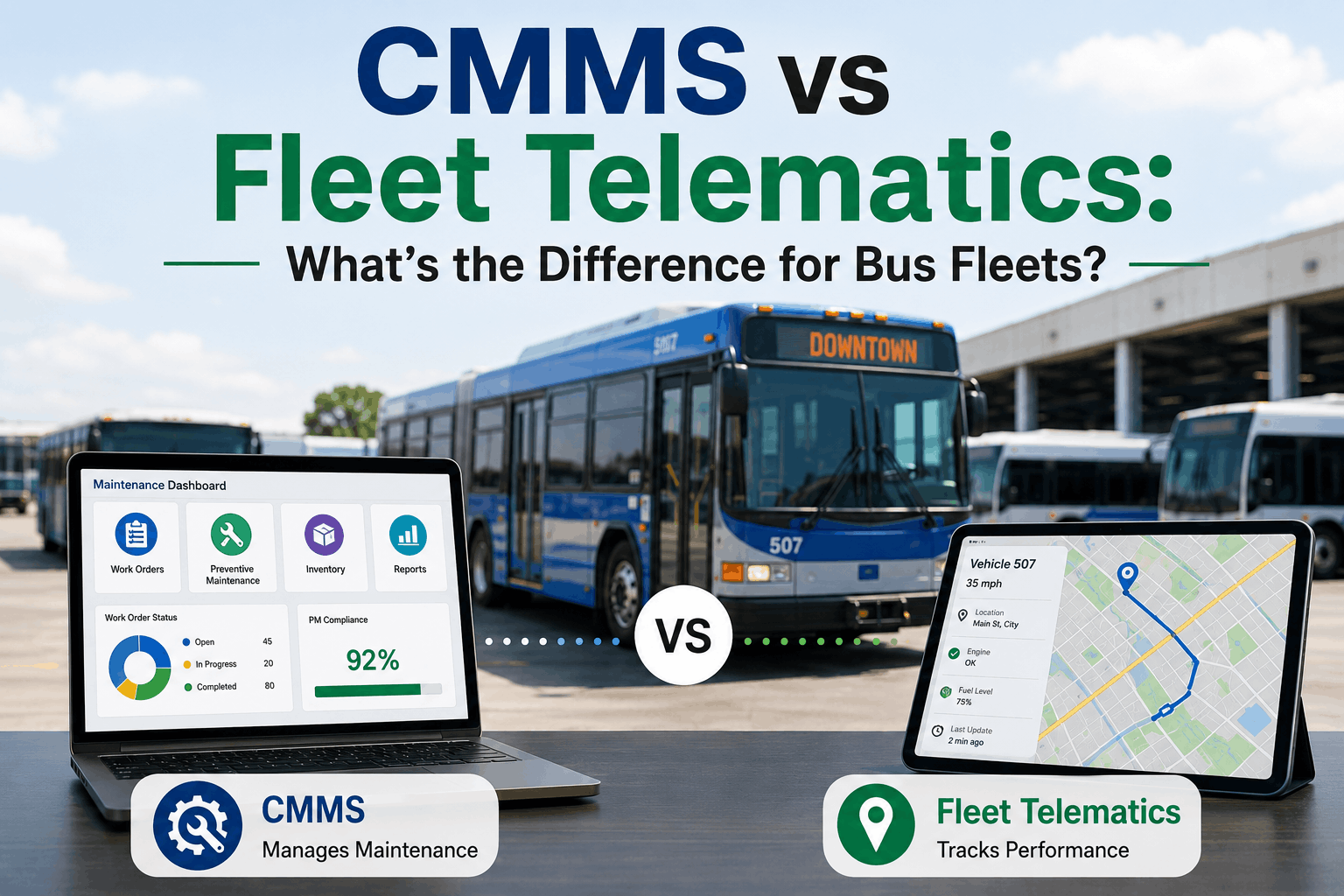
CMMS vs Fleet Telematics: What's the Difference for Bus Fleets?
Fleet managers often confuse CMMS and telematics as competing solutions. They're not. CMMS (Computerized Maintenance Management System) and telematics solve different problems and work best together. CMMS schedules and tracks maintenance. Telematics monitors real-time vehicle diagnostics, location, fuel consumption, and driver behavior. Understanding the difference—and how to integrate them—is critical for running a modern, cost-effective bus fleet.
SOFTWARE & CMMS · COMPARISON · 2026
CMMS vs Fleet Telematics: What's the Difference for Bus Fleets?
Learn how maintenance software and GPS telematics work together to prevent breakdowns, optimize routes, and extend fleet lifespan.
Both systems collect data from your buses. They use it differently. Think of CMMS as your fleet's maintenance calendar and record-keeper. Think of telematics as your fleet's real-time health monitor and performance tracker.
CMMS: Maintenance Planning
Primary Goal
Scheduled Maintenance
Prevents breakdowns by scheduling services before problems occur. Works on mileage-based or time-based intervals. Focus: "When should this bus get serviced?"
Data It Collects
Historical & Scheduled
Maintenance history (what was done, when, by whom, cost), parts inventory, technician labor hours, PM schedules, DVIR defects, compliance records.
Time Horizon
Days to Months Ahead
Plans maintenance work weeks or months in advance. Generates work orders based on PM intervals. Proactive scheduling prevents surprises.
Key Users
Fleet Management
Maintenance supervisors, technicians, fleet managers. Drivers submit defects via DVIR mobile app. Used primarily by back-office teams.
Example Use Case
Preventive Planning
"Bus #42 has 14,950 miles and is due for oil change at 15,000 miles. Automatically create work order. Assign technician. Schedule for Monday morning before bus departs."
Telematics: Real-Time Monitoring
Primary Goal
Real-Time Diagnostics
Monitors vehicle health and performance continuously. Alerts to problems as they occur. Focus: "What is the bus experiencing right now?"
Alerts trigger immediately. "Bus #15 has engine code P0101 detected. Air intake filter likely clogged. Alert maintenance team now."
Key Users
Operations & Drivers
Fleet dispatchers, drivers, route planners. Safety and operations teams use data for real-time decisions. More forward-facing than CMMS.
Example Use Case
Live Alerts
"Bus #22 is losing air pressure (tire leak). Real-time alert to driver and dispatcher. Reroute passengers to backup bus immediately. Dispatch maintenance to home depot to patch tire."
How CMMS and Telematics Work Together
The most effective fleets integrate CMMS and telematics. They feed each other. Telematics detects problems early. CMMS schedules repairs before emergencies. Together, they reduce breakdowns 40–60% and extend vehicle lifespan 2–3 years.
Predictive Maintenance Triggers
Telematics detects early warning signs (fuel consumption rising = injector fouling, idle time increasing = transmission slip). CMMS automatically creates work order before failure occurs. Prevents $8K emergency repair with $300 preventive service.
Data-Driven PM Interval Optimization
Telematics shows actual duty cycles. If a bus idles 40% of the time, it accumulates engine wear faster than mileage suggests. CMMS adjusts PM intervals based on telematics data. Catches problems sooner, avoids premature service.
Faster Diagnostics & Repair
When telematics reads a diagnostic code (check engine light), technician knows the exact fault before opening the hood. No guesswork. Repair time cuts 30–40%. CMMS logs the diagnosis, links it to telematics, prevents repeat issues.
Emergency Dispatch & Routing
Telematics alerts instantly to serious issues (brake failure, engine overheat). CMMS immediately schedules emergency repair. Dispatcher reroutes routes using GPS data. Minimizes passenger impact and secondary damage.
Compliance Proof & Audits
Telematics creates audit trail (when codes occurred, vehicle state). CMMS logs repair response. Together, they provide regulators complete documentation: problem detected, action taken, issue resolved. Satisfies DOT and emissions compliance.
Trend Analysis & Prevention
Telematics aggregates data across fleet (which routes are hardest, which drivers cause most wear). CMMS correlates maintenance needs with telematics trends. Identifies problem buses early, preventively overhauls before catastrophic failure.
"Before integration, we relied on drivers reporting problems. By then, damage was done. Now telematics catches issues early. Our maintenance team uses the data to schedule repairs before buses fail. Roadside breakdowns dropped 65% in one year. That alone saved $180K in emergency repairs and charter costs."
Best-case integration: Telematics platform (Samsara, Geotab, Verizon) feeds diagnostic data via API to CMMS. CMMS receives engine codes, alert events, fuel/idle metrics. Triggers automatic work order creation when thresholds are crossed. Technician completes repair in CMMS. CMMS updates telematics to clear alerts and reset monitoring baselines.
Real-world workflow: Bus #47 shows rising fuel consumption (inefficiency up 15%). Telematics alerts maintenance team. Maintenance supervisor reviews history in CMMS—last air filter service was 45,000 miles ago. Creates work order for air filter inspection. Technician finds filter heavily clogged, replaces it, logs in CMMS. Fuel consumption normalizes. Problem prevented before engine damage occurred.
Integration Checklist: CMMS + Telematics
Key technical and operational requirements for seamless integration.
API CONNECTIVITY
CMMS and telematics must exchange data via API. Native integrations reduce setup time. Custom integrations possible but require developer involvement.
ALERT RULES
Define which telematics signals trigger CMMS work orders. Example: Check engine code P0101 = create air filter replacement work order automatically.
DATA MAPPING
Vehicle IDs, bus numbers, component names must match across systems. Misaligned data leads to wrong repairs and audit failures.
USER TRAINING
Maintenance teams must understand how telematics alerts map to CMMS actions. Dispatchers need access to both systems for emergency response.
Real-World Integration Examples
Scenario 1: Predictive Brake Service Telematics detects brake wear (system pressure rising to compensate for pad wear). Threshold: pressure 12% above baseline. Alert triggers CMMS work order for brake pad inspection. Technician inspects, confirms 4mm pad thickness remaining (1mm before minimum). Schedules pad replacement for next scheduled maintenance window. Prevents brake failure during hill descent in passenger-heavy route.
Scenario 2: Engine Overheat Prevention Bus running on hot day, route has repeated short stops. Telematics shows coolant temp 205°F (high but not critical yet). CMMS shows cooling system overdue for flush. Integration rule: Coolant temp >200°F + flush overdue = create emergency inspection work order. Technician checks coolant level (low), radiator condition (partially clogged). Flushes system, adds 4 gallons. Prevents overheat that would have stranded 60 passengers mid-route.
Scenario 3: Transmission Health Monitoring Telematics shows rising idle time on specific route (drivers sitting in traffic, transmission in constant slipping state). Over 3 weeks, fluid temp edges up 15°F. Integration: Rising idle time + fluid temp trend = create transmission fluid analysis work order. Technician extracts sample, third-party lab analyzes. Results show early oxidation and friction wear. Transmission fluid changed before shearing leads to slipping and $6K overhaul.
Choosing a Platform: CMMS-Only vs Integrated Telematics
CMMS-Only Platform
Good For: Maintenance-Focused
When it makes sense: Fleets with 5–30 buses, in-house maintenance, no existing telematics investment. Lower cost ($100–200/bus/month). Simpler implementation. Trade-off: Manual work order creation, slower problem detection, less predictive capability.
Telematics-Only Platform
Good For: Operations-Focused
When it makes sense: Fleets prioritizing real-time monitoring, driver safety, route optimization, fuel efficiency. Lower cost than integrated solutions ($80–150/bus/month). Trade-off: Poor maintenance planning. Manual CMMS workarounds create compliance gaps.
Integrated CMMS + Telematics
Good For: Full Optimization
When it makes sense: Fleets 40+ buses, complex routes, high compliance requirements. Higher cost ($200–350/bus/month). Eliminates manual workarounds. Predictive maintenance reduces breakdowns 40–60%. ROI visible in 6–12 months through avoided emergency repairs.
See How CMMS + Telematics Integration Works
Watch a live demo showing real-time alerts, automatic work order creation, and maintenance planning powered by integrated data.
Depends on API availability. Modern platforms (Samsara, Geotab, Verizon Connect) have APIs. Older systems may not. Ask your telematics vendor: "Does your platform expose an API for third-party integrations?" If yes, most CMMS platforms can integrate. If no, you'll need manual data entry or a custom integration (expensive).
Does integration require custom development?
Not always. Purpose-built platforms like Samsara-BusCMMS or Geotab-compatible solutions have pre-built integrations. Setup takes 2–4 weeks. Generic integrations between non-standard platforms require custom API development (4–8 weeks, $15K–25K). Check if your vendors have an existing partnership before committing.
What's the ROI timeline for integrated CMMS + telematics?
6–12 months typically. First 3 months show adoption and baseline data. Months 4–6, preventive work orders prevent first major failures, saving $20K–50K. Year 2, ROI compounding: avoided breakdowns, extended vehicle lifespan, reduced fuel waste. Fleets see 40–60% reduction in emergency repairs after integration matures.
Does CMMS replace telematics or vice versa?
No. They serve different functions. CMMS is back-office maintenance planning. Telematics is real-time operational monitoring. You need both for complete fleet optimization. CMMS without telematics = reactive maintenance. Telematics without CMMS = poor maintenance planning, compliance gaps.
What if I already have a telematics platform?
Excellent. You have 50% of the integration equation. Now add CMMS. Choose a CMMS that integrates with your telematics platform (ask vendors for compatibility). This avoids rip-and-replace costs. Most modern CMMS platforms support leading telematics vendors through native integrations or APIs.
Integrate CMMS & Telematics to Cut Breakdowns 40–60%
Stop choosing between maintenance planning and real-time monitoring. Get both with a fully integrated fleet optimization platform.