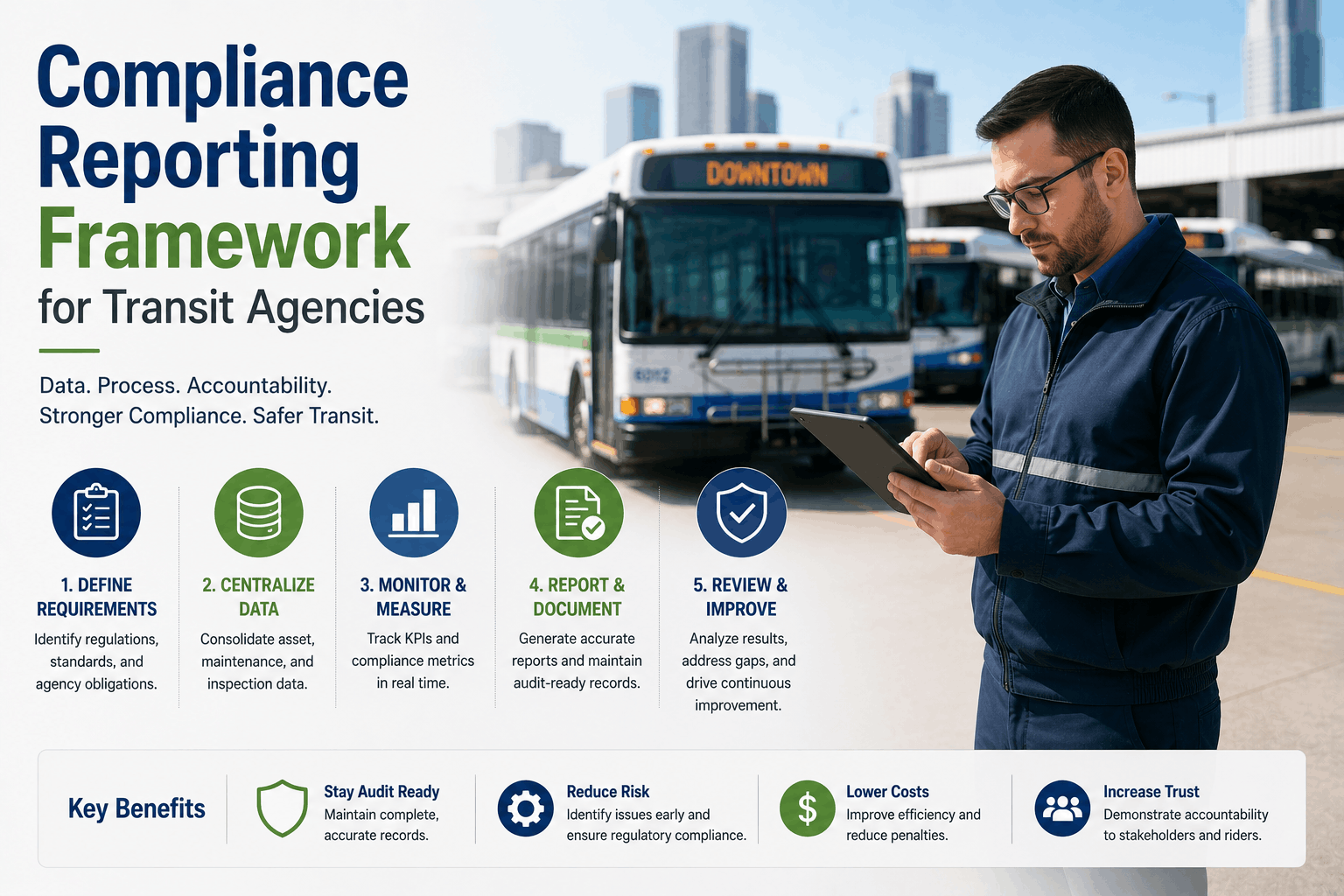
Transit agencies operate under overlapping compliance requirements: federal (FTA, FMCSA, EPA), state (DOT inspections, environmental), local (air quality, noise), and internal (safety, maintenance, procurement). Without a structured reporting framework, agencies struggle to produce accurate, timely compliance documentation. Reports are late. Data is inconsistent. Auditors find gaps. Leading transit agencies have moved from reactive audit preparation to proactive compliance reporting frameworks that integrate with their CMMS. These frameworks generate reports on demand, track compliance status in real time, and provide audit trails for every record. This guide explains the technology, processes, and reporting metrics required for effective compliance reporting across bus operations.
Understand the technology, processes, and reporting metrics required for effective compliance reporting across bus operations.
A compliance reporting framework is the structured combination of technology, processes, data standards, and reporting templates that enable an agency to produce accurate compliance documentation on demand. It answers three questions: What needs to be tracked? How is it tracked? How is it reported? The framework must cover vehicle maintenance (inspections, DVIRs, repairs, PM compliance), driver qualifications (CDL, medical cards, training records, hours of service), safety (accident reports, incident investigations, corrective actions), environmental (emissions, fuel storage, hazardous materials), and procurement (parts sourcing, vendor compliance, warranty claims). A mature framework integrates these data sources into a single CMMS, automates report generation, and provides real-time compliance dashboards. Agencies without a framework rely on siloed spreadsheets, paper records, and manual compilation — a recipe for audit findings.
Inspections, DVIRs, repairs, PM compliance, 90-day exit checks, annual inspections, record retention.
CDL, medical cards, endorsements, employment applications, prior employer inquiries, annual MVR reviews.
ELD compliance, 15-hour limit, 10-hour driving limit, 60/70-hour rule, supporting documents.
Clearinghouse queries, random test tracking, pre-employment tests, return-to-duty documentation.
Compliance reporting maturity progresses through four stages: reactive (paper records, manual compilation), organized (spreadsheets, some digital records), integrated (CMMS with basic reporting), and automated (real-time dashboards, on-demand reports, proactive alerts). Most transit agencies start at reactive or organized. The goal is automated. The trend below shows how audit findings decrease as maturity increases.
Effective compliance reporting requires a CMMS designed for transit agencies. The system must support: automated data capture (fuel cards, telematics, ELDs, inspections), configurable compliance rules (expiration alerts, due date calculations, escalation workflows), role-based access (mechanics see work orders, supervisors see dashboards, auditors see reports), audit trails (who created, modified, or viewed each record, with timestamps), and on-demand reporting (any report in under 60 seconds). Without these capabilities, compliance reporting remains manual and error-prone. The CMMS should also support mobile access so inspections, DVIRs, and work orders are captured at the point of work, not transcribed later.
Fuel cards, telematics, ELDs, and mobile inspections feed data directly into the CMMS — no manual entry, no transcription errors.
Set expiration alerts, due date calculations, and escalation workflows. The system enforces compliance automatically.
Every record includes creation timestamp, modification history, and user attribution. Critical for audit defense.
Driver qualification file report — complete file for any driver, including all required documents, expiration dates, and review history.
Vehicle maintenance history report — complete inspection, repair, and PM history for any bus, with timestamps and technician attribution.
PM compliance report — percentage of PMs completed on time by bus, by shop, by month. Shows compliance trends over time.
DVIR compliance report — DVIR completion rate by driver, defect repair time, open defects aging, and repair certification status.
Clearinghouse query report — pre-employment and annual limited query dates, results, and retention status per driver.
Annual inspection report — inspection due dates, completion dates, expiration dates, and inspector certification for every bus.
Parts inventory compliance report — parts usage, reorder points, stock levels, vendor compliance, and warranty claim status.
Audit trail report — complete history of any record, including who created, modified, viewed, or deleted it, with timestamps.
Technology alone doesn't ensure compliance. Processes must create a daily, weekly, and monthly rhythm. Daily: review open DVIR defects, confirm buses dispatched with valid inspections, address any driver qualification expirations in the next 30 days. Weekly: review PM compliance, open work orders, parts shortages, and repeat defects. Monthly: review complete driver qualification files for any upcoming expirations (medical cards, CDL, endorsements), generate compliance reports for leadership, and review audit trail reports for anomalies. This rhythm transforms compliance from an annual audit panic to routine operations. Each review should take 30-60 minutes and produce a clear action list.
Open defects, dispatch status, upcoming expirations (30 days). Actions assigned to specific owners.
PM compliance, work order backlog, parts availability, repeat defects. Adjust schedules as needed.
Complete file reviews, compliance reports for leadership, audit trail review. Identify systemic issues.
Full compliance assessment, risk review, process improvement planning, training needs identification.
What is a compliance reporting framework?
How long does it take to implement a compliance reporting framework?
What technology is required for compliance reporting?
How much can a compliance reporting framework reduce audit preparation time?
What reports should every transit agency be able to generate on demand?
How does a CMMS support compliance reporting?
A compliance reporting framework transforms transit agency compliance from reactive audit panic to proactive routine management. The framework requires technology (CMMS with automation), processes (daily, weekly, monthly reviews), data standards (consistent formats, complete records), and reporting templates (on-demand generation). Agencies that implement a mature framework reduce audit preparation time by 85-95%, cut audit findings by 60-80%, and improve data accuracy from 85% to 98%. The investment in a CMMS and process design typically pays for itself in the first audit cycle. Start with technology selection. Add process design. Build the daily/weekly/monthly rhythm. The result is a lower-risk, more defensible compliance program.