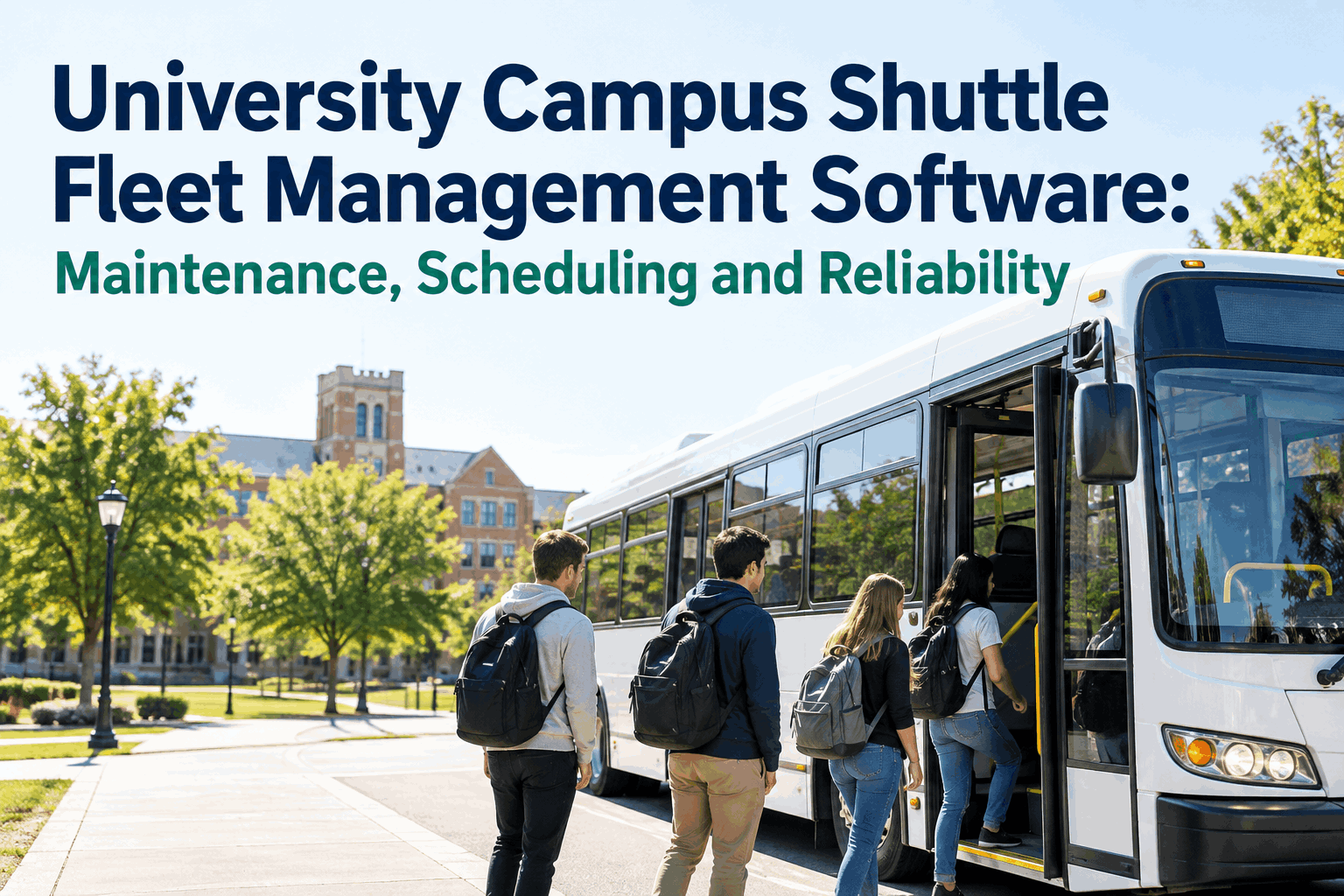
First Monday of the fall semester, the shuttles are packed at every class change, and the cutaway you meant to service over the summer is back in the shop. On a campus, a bus down is a stop full of students watching an empty schedule. Keeping a small, mixed fleet ready through the academic year is its own kind of hard. You can see how campus shuttle fleet software keeps every route covered.
University Campus Shuttle Fleet Management Software: Maintenance, Scheduling and Reliability
Campus shuttle fleet management software exists for one reason: a university shuttle fleet runs on the academic calendar, not a steady year-round line. Demand surges at class changes, game days and finals, then drops to near zero over breaks — and a small, mixed fleet of cutaways, transit buses and electric shuttles has to be ready for every one of those peaks. The right software plans maintenance around that rhythm instead of fighting it.
Why Campus Shuttle Fleet Maintenance Is Uniquely Hard
A university fleet is not a scaled-down transit agency. It is small, it is mixed, and it answers to an academic calendar and a parking-and-transit budget at the same time. Those three facts shape every maintenance decision you make.
A representative campus mix — your exact split varies, but the pattern holds: four vehicle types, three fuel systems and two very different maintenance rhythms, all run by one small shop on one dashboard.
Small fleet, no spare
A campus might run twenty vehicles, not two hundred. There is no deep bench — one shuttle down in peak week is a route that simply does not run, so availability matters more here than raw fleet size ever suggests.
Mixed fuels, mixed schedules
Gas cutaways, diesel transit buses and electric shuttles each need their own preventive-maintenance logic. Running them off one generic checklist means the EV gets diesel intervals and something important gets missed.
Budget tied to the institution
A parking-and-transit office has to justify every repair and replacement to the university, so cost-per-mile and a clean maintenance history are not nice-to-haves — they are how next year's budget gets approved.
The through-line is that a campus fleet needs transit-grade discipline at a fraction of the scale — which is exactly what purpose-built software provides. You can start managing a mixed campus fleet free and see the whole shop on one screen.
Scheduling Campus Shuttle Maintenance Around the Calendar
The secret to campus fleet reliability is not more maintenance — it is maintenance timed to the calendar. Heavy work belongs in the breaks, when demand collapses; the academic year is for light, non-disruptive checks that keep every shuttle on the road. Good software makes that split automatic, as you can see in a quick demo.
That is the difference between a fleet that limps into finals week and one that rolls into every semester at full strength. It is worth a look at how PM schedules flex with the academic year.
What Campus Shuttle Fleet Management Software Should Do
A campus transportation office does not need an enterprise transit suite — it needs the right features, sized for a small shop and a mixed fleet. Four capabilities do most of the work.
Fuel-type-specific PM scheduling
Separate preventive-maintenance logic for gas, diesel and electric shuttles, triggered by mileage, engine hours or calendar date — so each vehicle gets the service it actually needs, not a one-size checklist.
Mobile inspections and work orders
Pre-trip DVIRs on a phone, and a failed inspection that becomes a work order on the spot — so a driver's note turns into a tracked repair instead of a verbal handoff that gets lost between shifts.
Availability and cost-per-mile dashboards
Real-time fleet availability and cost per vehicle, so you can prove to the institution exactly what the fleet costs and justify the next repair or replacement with numbers, not guesses.
Parts and fuel tracking
Auto-reorder alerts keep the shelf stocked for a shop that cannot wait on parts, and fuel tracking per vehicle flags the shuttle whose economy is slipping before it becomes a breakdown.
Fast to roll out and sized for a campus shop, it turns a binder-and-spreadsheet operation into a tracked one. If compliance is also on your plate, the guide to university campus fleet compliance covers the FMCSA, FTA and university-risk side; this is the maintenance and reliability half.
We run eighteen vehicles for a campus of forty thousand, and for years it was all whiteboards and memory. The problem was never the summer — it was October, when everything is running and one breakdown blows up the whole schedule. Once we put our cutaways, our transit buses and our two electric shuttles on one system with the heavy PM scheduled into breaks, our availability during term stopped being a gamble. I can finally tell the university what the fleet costs and why.
Campus Shuttle Fleet Management: Key Takeaways
The calendar runs the fleet
Ridership peaks at class changes, game days and finals, then falls off at breaks. Maintenance has to be timed to that rhythm, not run on a flat year-round schedule.
Small and mixed is the hard part
A handful of vehicles across three fuel types with no spare means availability matters more than scale, and each vehicle needs its own PM logic.
Breaks are the shop window
Heavy preventive maintenance belongs in winter and summer breaks, so the fleet rolls into every semester at full strength instead of limping through it.
The numbers justify the budget
Availability and cost-per-mile dashboards are how a transit office proves the fleet's value and gets the next repair or replacement approved by the institution.
Campus shuttle fleet management software is really about one promise — that the shuttle shows up when the student needs it, semester after semester. Plan maintenance around the calendar, run the mixed fleet on one screen, and reliability stops being a scramble. You can set up your campus fleet free and be ready before the next term starts.
Campus Shuttle Fleet Management Software: Frequently Asked Questions
What is campus shuttle fleet management software?
It is maintenance and operations software built for a university shuttle fleet rather than a large transit agency or a trucking company. It schedules preventive maintenance for a small, mixed fleet of cutaways, transit buses and electric shuttles, handles digital inspections and work orders, and tracks availability and cost per vehicle on one dashboard. The point is to keep a campus fleet reliable through the academic calendar — ready for the class-change and game-day peaks, and serviced during the breaks — without the overhead of an enterprise transit system.
How is a campus shuttle fleet different from a city transit fleet?
Mostly in scale and rhythm. A campus fleet is small — often a dozen or two vehicles rather than hundreds — so there is no spare to fall back on when one shuttle is down. It is also tied to the academic calendar, with demand surging during terms and collapsing over breaks, instead of a steady year-round line. And it is typically mixed, running gas cutaways, diesel transit buses and electric shuttles side by side. That combination means availability and calendar-aware scheduling matter far more on a campus than raw fleet size would suggest.
When should campus shuttles get preventive maintenance?
Time the heavy work to the breaks and keep term-time service light. Winter and summer breaks, when ridership drops to near zero, are the window for major preventive maintenance and repairs, so the fleet comes back at full strength for the next semester. During the academic year, stick to pre-trip inspections and quick fixes that keep shuttles on the road without pulling them from service. Software that triggers PM by mileage, engine hours or calendar date, with seasonal activation, makes that split automatic instead of something a shop has to remember to plan.
Can one system handle gas, diesel and electric campus shuttles?
Yes, and it should — that is one of the main reasons campus fleets need purpose-built software. A mixed fleet means three different preventive-maintenance rhythms: gas and diesel vehicles need oil, filter and emissions service, while electric shuttles need battery, high-voltage and different brake intervals. A system like BusCMMS runs fuel-type-specific PM for each vehicle on one dashboard, so the electric shuttles are not forced onto diesel intervals and nothing gets missed. Managing all of them in one place is what lets a small shop keep a varied fleet straight.
How does fleet software improve campus shuttle reliability?
By turning maintenance from reactive to planned and keeping it on the calendar. Scheduled preventive maintenance catches problems before they strand a route, mobile inspections surface issues at the pre-trip, and availability dashboards show which vehicles are ready right now. Because the heavy work is pushed into breaks, the fleet starts each term at full strength, and because every repair is tracked per vehicle, the shuttle that keeps coming back gets flagged for a real fix. The result is fewer peak-week breakdowns and a fleet the campus can count on when students need it most.