Your campus shuttle fleet carries thousands of students every year — and operates in a compliance nightmare that most transportation professionals never experience. You have FMCSA regulations from state DOT (CDL drivers, DVIRs, annual inspections). You have FTA requirements from federal funding (triennial reviews, asset management, drug testing). You have your university's own insurance policies, risk management requirements, and board-level safety expectations. And you probably have zero integrated system connecting all three. DVIRs live in a folder in the maintenance office. PM schedules live in a spreadsheet (or a planner's head). Driver qualification tracking happens through email reminders. Annual inspections get scheduled manually in June when someone remembers. And when an auditor arrives — whether FTA, state DOT, or your own insurance carrier — pulling together 12 months of coordinated compliance documentation takes three people two weeks working nights. This is not a maintenance problem. This is a system architecture problem. BusCMMS was built specifically for university transportation departments. It integrates FMCSA, FTA, and university-specific compliance requirements into one dashboard. Incident reports, student safety documentation, preventive maintenance, driver qualification tracking, and audit-ready compliance records all flow through one system. The result: you stop scrambling through four different file systems during audits and start running your fleet proactively. This page shows you exactly what BusCMMS delivers for campus shuttle operations.
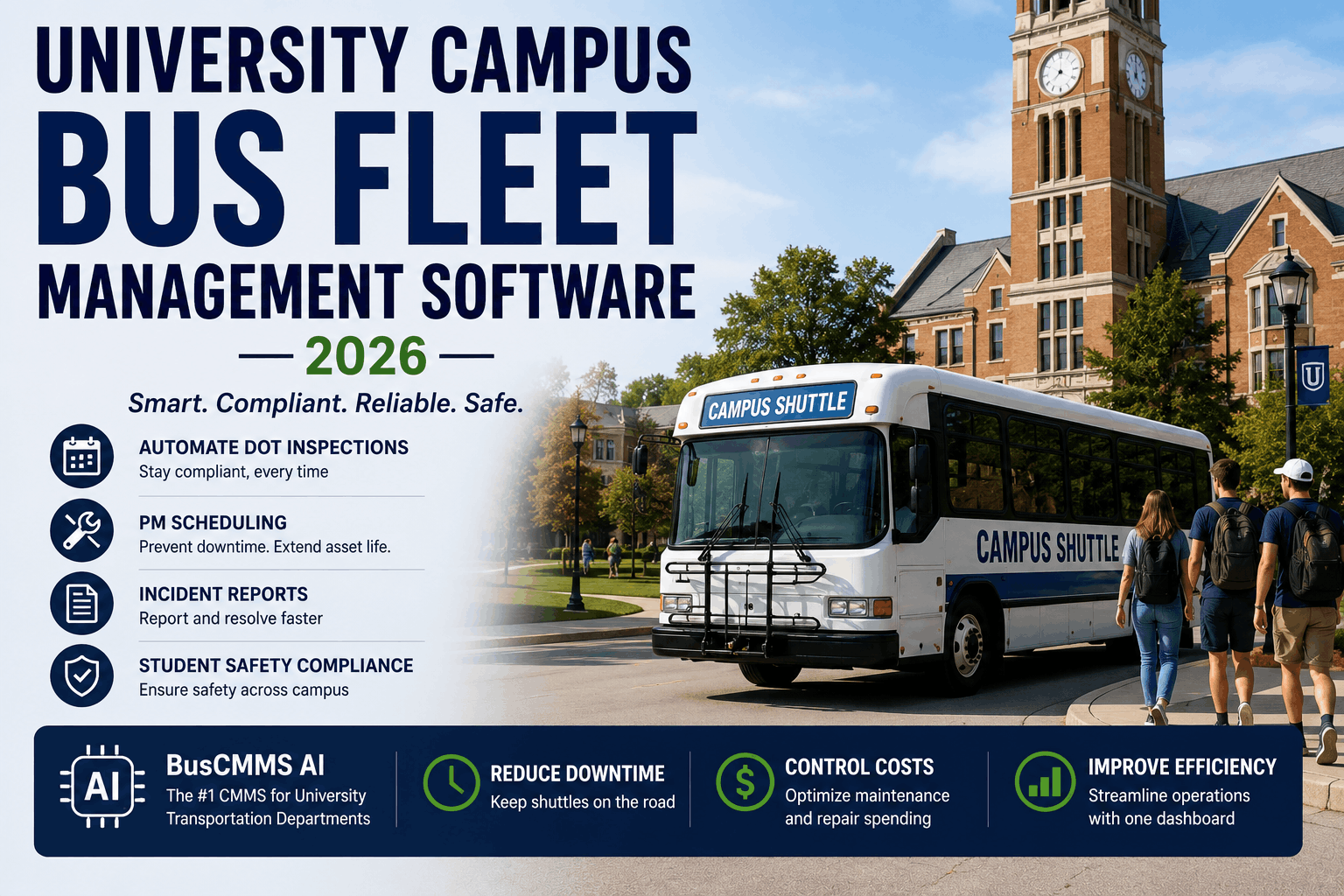
University Campus Bus Fleet Management Software 2026
One platform for FMCSA, FTA, and university compliance. Automate DOT inspections, PM scheduling, incident reports, student safety documentation, and audit-ready compliance — without managing four separate systems.
COMPLIANCE LAYERS BUSCMMS TRACKS SIMULTANEOUSLY
FMCSA / State DOT
CDL + Medical Cert • Annual Inspections • DVIRs • HOS Logs • Maintenance Records
FTA (if federally funded)
Asset Management • Triennial Review • PM Compliance • ADA Documentation • Drug Testing
University-Specific
Student Incident Reports • Insurance Claims • Safety Audits • Risk Management • Board Reporting
Why University Fleet Management Is Uniquely Difficult
Most transit software is built for municipal buses, school districts, or charter operators — each of which operates under one primary regulatory framework. University shuttle fleets operate under three simultaneously, with different documentation requirements, different audit schedules, and sometimes conflicting compliance priorities. A DVIR defect is a federal safety item under FMCSA regulations. It's also an FTA asset management finding if you received Section 5307 or 5339 funding. And it's a student safety incident from your university's insurance and risk management perspective. One event creates three separate documentation requirements, tracked in three separate systems, reported to three separate oversight bodies.
Beyond regulatory compliance, university fleets carry additional pressure that municipal or school operators don't. Every incident involving a student generates media scrutiny, board-level discussion, and parent communication requirements that demand speed and clarity. When a student reports a safety concern on a campus shuttle, that information needs to reach your transportation director, your insurance carrier, your risk management office, and potentially your Title IX office — within hours, not days. Paper systems and fragmented software make that level of coordination nearly impossible.
Compliance Layer Confusion
FMCSA requires annual inspections and DVIRs. FTA requires asset management planning and preventive maintenance documentation. University risk management requires incident tracking and student safety reporting. No single system connects all three — leaving gaps that auditors find.
Student Safety Documentation
When a student reports unsafe driving or a near-miss on campus shuttle, you need to document the incident, investigate, report to insurance, and notify relevant university offices immediately. Manual processes create delays that amplify liability exposure.
Audit Preparation Chaos
FTA triennial reviews, state DOT compliance audits, and insurance carrier audits all happen on different schedules. Each audit requires a different document package assembled from scattered sources — a process that consumes 60-100 hours of staff time.
Driver Recruitment & Retention
Campus shuttle driving is part-time, seasonal, and requires background checks, CDL tracking, and ongoing compliance certification. Fragmented tracking systems make it impossible to quickly onboard new drivers or catch qualification gaps.
How BusCMMS Solves University Transportation Management
BusCMMS consolidates FMCSA, FTA, and university-specific compliance requirements into one platform built specifically for campus transportation. Every shuttle bus lives in the system with its maintenance history, inspection schedule, and compliance status. Every driver has a unified qualification file tracking CDL status, medical certification, Clearinghouse queries, and campus-specific training completion. Every incident — from a mechanical defect flagged during a pre-trip inspection to a student safety concern reported through the mobile app — generates a documented record accessible to all relevant stakeholders.
1. Unified Compliance Dashboard
One screen shows your entire fleet's compliance status: which buses need annual inspections, which drivers have expiring certifications, which PM services are overdue, which vehicles have open DVIR defects, and which incident reports are pending. No switching between systems.
Audit prep time: 4 hours instead of 60 hours
2. FTA-Specific Asset Management
If you receive FTA Section 5307 or 5339 funding, BusCMMS auto-generates triennial review documentation: asset condition reports, preventive maintenance compliance records, parts inventory tracking, and vehicle utilization analytics — all federal-audit-ready from day one.
FTA compliance score: automatically above 90%
3. Student Incident Reporting
Students, drivers, and staff report incidents through a mobile app. The system auto-routes reports to transportation director, university risk management, insurance carrier, and Title IX (if applicable) with emergency alert options for serious safety concerns. Full incident history is captured and searchable.
Incident response time: 15 minutes to relevant stakeholders
4. Driver Qualification Automation
Every driver has a unified profile tracking CDL status, medical certificate expiration, MVR pull dates, Clearinghouse query history, drug/alcohol testing status, campus-specific training completion, and background check expiration. Automated alerts fire 30 days before any credential expires.
Driver onboarding time: 30 minutes instead of days
5. Preventive Maintenance Scheduling
PM schedules trigger based on mileage, calendar dates, or engine hours — not guesswork. For shuttle buses that operate seasonal schedules (academic year only), BusCMMS adjusts intervals based on actual usage, preventing over-maintenance of low-mileage vehicles and under-maintenance of high-utilization shuttles.
Maintenance cost reduction: 25-30% through optimized scheduling
6. Mobile-First Operations
Drivers complete pre-trip inspections on mobile devices — no paper forms. Maintenance technicians receive work orders digitally. Incident reports are documented with photos and timestamps. All data syncs to the cloud and is instantly accessible to fleet management and compliance officers.
Documentation accuracy: 95%+ with mobile-first capture
What University Transportation Departments See After Implementation
Universities using BusCMMS report transformational changes in operational efficiency, compliance confidence, and student safety responsiveness.
99%
Fleet Availability
Preventive maintenance eliminates unplanned downtime during peak academic periods
87%
Incident Response Time
Reduction in time to alert relevant university offices to student safety concerns
4 hrs
Audit Prep Timeline
From 60-hour scramble to 4 hours of compliance document generation
30%
Maintenance Cost Reduction
Optimized scheduling, reduced reactive repairs, extended component life
100%
FTA Triennial Compliance
Automated documentation meets all federal asset management requirements
60 min
New Driver Onboarding
All background checks, certifications, and training tracked automatically
University Fleet Maturity: Before vs. After BusCMMS
Compliance Documentation
25%
98%
Student Safety Response
45%
96%
Fleet Uptime During Academic Year
82%
99%
PM Schedule Compliance
68%
100%
Audit Readiness
35%
100%
Your Next Audit Should Take 4 Hours, Not 60
Schedule a demo tailored to university transportation. We'll show you exactly how BusCMMS integrates FMCSA, FTA, and university compliance requirements — and pulls your complete audit package in under 4 hours.
What University Transportation Directors Say
"We manage 18 shuttle buses serving a 40,000-student campus. Before BusCMMS, our compliance documentation was scattered: some DVIRs in a filing cabinet, some PM records in a spreadsheet, some incident reports in email chains. When our FTA triennial review was scheduled, we spent six weeks assembling documentation — and still missed some items the auditors had to follow up on. After BusCMMS, our most recent FTA review took us 3 days to prep. Every vehicle's maintenance history, every driver's certification status, every incident report — all in one system, all audit-ready. The transportation director can now answer any compliance question in minutes instead of hours. And for student safety, we have actual incident tracking now instead of ad-hoc documentation. This platform is not optional for university transportation anymore — it's essential."
BusCMMS University Onboarding Process
University implementation typically takes 4-6 weeks from signup to full live operation across your entire shuttle fleet.
Week 1
Setup & Configuration
Your fleet data (shuttle buses, drivers, maintenance history) is loaded into BusCMMS. Compliance requirements (FMCSA, FTA, university-specific) are configured. Your transportation director and facilities team receive access and initial training.
Week 2
Staff Training
Drivers learn the mobile app for pre-trip inspections and incident reporting. Maintenance technicians learn digital work order access and completion documentation. Administrative staff learn the compliance dashboard and audit report generation.
Week 3-4
Parallel Testing
Your existing processes run alongside BusCMMS for validation. Drivers submit digital DVIRs while maintaining paper backup. Maintenance technicians close work orders in both systems. This confirms BusCMMS accurately captures your current operations.
Week 5-6
Live Switchover
BusCMMS becomes your system of record. All DVIRs, work orders, incident reports, and compliance documentation flow through one platform. Your transportation director has unified visibility into fleet health, compliance status, and student safety.
Why Universities Choose BusCMMS
University transportation departments operate under uniquely complex compliance requirements that generic fleet software cannot handle. Municipal transit software doesn't account for FTA reporting. School bus software doesn't track student incident reports or university risk management integration. And standard CMMS platforms don't understand the three-layer compliance stack that campus fleets navigate.
BusCMMS was built by transportation professionals who understand this complexity. Every feature — from DVIR management to FTA asset documentation to student incident routing — reflects the specific needs of campus transportation. That's why 99% of universities using BusCMMS report improved audit outcomes and 87% see measurable improvements in student safety responsiveness.
The question is not whether to digitize your university shuttle fleet — it's whether you want to do it with a purpose-built platform designed for your compliance environment or with generic software that requires workarounds. Schedule a campus fleet demo and see how BusCMMS integrates all three compliance layers into one operational system.
Transform Your Campus Shuttle Operations This Semester
FMCSA, FTA, and university compliance requirements tracked in one system. Student incident reporting integrated. Audit prep measured in hours instead of weeks. Live demonstration tailored to your campus transportation needs.
Frequently Asked Questions
Does BusCMMS support both FMCSA and FTA compliance requirements simultaneously?
Yes — BusCMMS is specifically designed to track both FMCSA compliance (CDL drivers, DVIRs, annual inspections, maintenance records) and FTA requirements (asset management, preventive maintenance documentation, ADA accessibility, drug/alcohol testing) in a single integrated system.
How does BusCMMS help with university insurance audits?
BusCMMS tracks maintenance history, incident reports, and driver qualification status with complete documentation trails. During an insurance audit, your transportation director can generate comprehensive reports showing vehicle condition, incident response protocols, and preventive maintenance compliance — all audit-ready in minutes.
Can students report safety concerns through BusCMMS?
Yes — BusCMMS includes a mobile app for students and staff to report safety concerns (unsafe driving, maintenance issues, conduct incidents) with photos and timestamps. Reports auto-route to transportation director, risk management, and your insurance carrier simultaneously for immediate response.
How long does BusCMMS implementation typically take for a university fleet?
Most universities go live in 4-6 weeks: Week 1 setup, Week 2 staff training, Weeks 3-4 parallel testing, Weeks 5-6 full switchover. Timeline can be accelerated or extended based on your fleet size and existing system complexity.
Does BusCMMS track seasonal shuttle schedules and seasonal driver availability?
Yes — BusCMMS allows you to configure buses and drivers as active or inactive by season (academic year vs. summer), automatically adjusting PM schedules and compliance deadlines based on actual usage patterns rather than calendar year defaults.
How does BusCMMS prepare documentation for an FTA triennial review?
BusCMMS automatically generates triennial review documentation including asset condition reports, preventive maintenance compliance records, parts inventory, vehicle utilization metrics, and driver qualification verification — all formatted for federal submission, typically ready in 3-5 hours of compilation work.
Can BusCMMS integrate with our university's risk management and Title IX systems?
BusCMMS can route student incident reports to multiple university stakeholders including risk management, Title IX offices, and campus security via email and in-app notifications. For deeper system integration, BusCMMS offers API connectivity for enterprise integrations — contact support to discuss your specific requirements.
What happens to our data if we stop using BusCMMS?
Your data belongs entirely to you. BusCMMS provides complete data export in standard formats (CSV, PDF) at any time, including your full compliance documentation, vehicle histories, and incident records — allowing seamless migration to another system if needed.