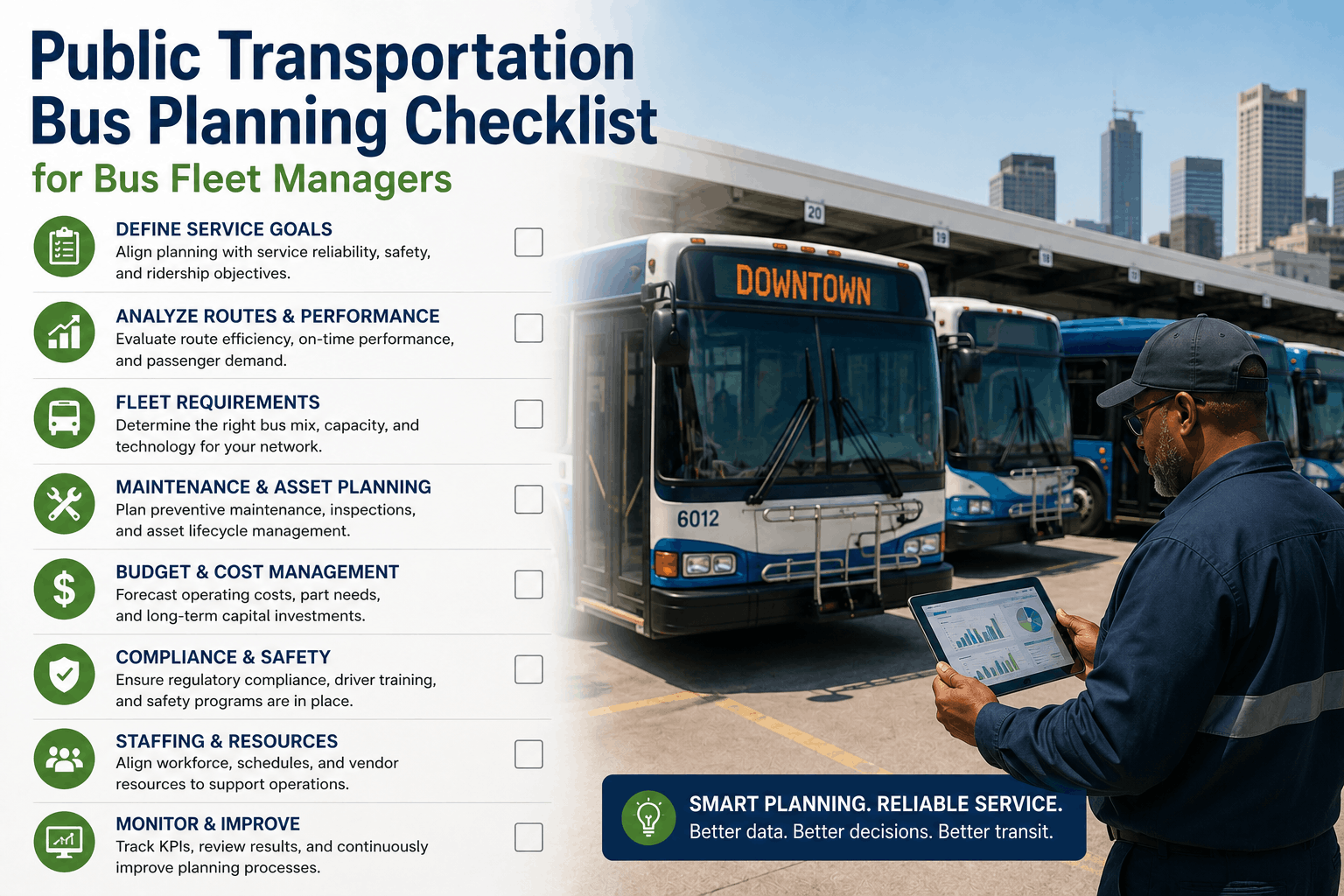
Public transportation bus planning is more complex than managing individual vehicle repairs. Transit fleets balance preventive maintenance schedules, asset replacement cycles, parts inventory, technician capacity, regulatory compliance, service reliability, and long-term fleet composition. Without a structured planning checklist, maintenance becomes reactive, asset replacement is delayed, parts shortages cause downtime, and service reliability declines. Leading transit agencies use a repeatable planning checklist that connects daily operations to annual budgets, vehicle lifecycle decisions, and performance improvement. This guide provides a public transportation bus planning checklist that fleet managers can use to improve maintenance, compliance, and asset lifecycle outcomes.
Use this checklist to improve maintenance, compliance, asset lifecycle outcomes, and service reliability with data-driven fleet planning.
The most successful transit fleets plan bus replacement 3-5 years in advance. Reactive replacement leads to budget spikes, service disruption, and higher operating costs. Asset lifecycle planning requires knowing current fleet age distribution, projected maintenance costs by year, replacement cost estimates, and funding availability. Maintain a lifecycle dashboard showing each bus's age, maintenance cost trend, projected replacement year, and current condition rating. Set replacement triggers: maintenance cost exceeds $12,000 annually (or 50% of replacement cost), cumulative downtime exceeds 15 days in 12 months, or safety defects become chronic. Review lifecycle status quarterly and adjust replacement timing based on actual maintenance data, not fixed age limits.
Target under 10 years for transit fleets. Older fleets require more maintenance and have lower reliability.
Replacing 8-10% of fleet annually keeps average age under 12 years and avoids replacement spikes.
Compare actual maintenance cost per bus to budget. Steep upward trends indicate aging fleet or poor PM compliance.
Identify shortfall between projected replacement cost and available capital funding. Adjust fleet plan annually.
Understanding how maintenance cost changes as buses age helps managers plan replacement timing and defend budget requests. In the example below, maintenance cost per bus rises slowly through year 8, then accelerates after year 10. The crossover point occurs between year 12 and 13, where annual maintenance cost exceeds 50% of replacement cost. Transit fleets that replace before this crossover point reduce total lifecycle cost.
Transit buses have less flexibility than school buses because they operate continuous service. Planning preventive maintenance requires scheduling PMs during off-service hours, layovers, and planned maintenance windows. Build a rolling 12-month PM schedule that identifies every bus's next PM due date and available service window. Prioritize PMs for buses with high mileage first. Use PM compliance trends to detect scheduling problems before buses become overdue. The most effective transit fleets maintain PM compliance above 90% by planning maintenance windows 4-6 weeks in advance and communicating schedules to operations.
Schedule PMs 4-6 weeks out based on projected mileage. Reserve service windows during off-peak hours and weekends. Coordinate with operations to avoid service gaps.
Use component life data to anticipate major repairs (engine, transmission, HVAC, brakes) and schedule them during planned windows instead of emergency repairs.
Match mechanic capacity to PM schedule. Identify peaks that exceed capacity and level-load work by adjusting PM dates or adding off-shift coverage.
Review fleet age distribution quarterly and confirm replacement timing aligns with maintenance cost projections and capital budget.
Build a rolling 12-month PM schedule that assigns every bus to a planned maintenance window based on mileage and component life.
Identify repeat defects and component-level failure trends to adjust PM intervals, technician training, or parts stocking levels.
Project parts demand 6-12 months forward based on PM schedule, component failure history, and planned major repairs.
Review technician capacity against planned work. Add overtime, temporary staff, or adjust schedules before work becomes overdue.
Schedule annual and major inspections at least 30 days before expiration to avoid last-minute compliance gaps.
Track unplanned downtime causes and adjust planning rules to reduce recurrence of the same failure modes.
Public transportation bus fleets cannot defer regulatory compliance. Missed annual inspections, out-of-date DVIRs, and incomplete training records create enforcement risk. Planning compliance means scheduling annual inspections 60 days before expiration, assigning specific technicians to complete them, and tracking status until the sticker is on the bus. It means integrating DVIR compliance into driver and maintenance workflows so defects are repaired before the bus returns to service. It means tracking mechanic certifications and training renewal dates to avoid gaps. The planning checklist must include compliance status for every bus and every mechanic, reviewed weekly, not only during audit preparation.
Schedule annual inspections 60 days before expiration. Track status weekly. A single expired inspection creates out-of-service risk.
Monitor certification expiration dates. Plan training 90 days before expiration to avoid gaps in qualified technician coverage.
Require DVIR before bus dispatch. Escalate any missing DVIR to operations and maintenance within 30 minutes of pullout time.
Plan repair capacity to close safety defects within 24 hours. Chronic repair delays indicate capacity or parts planning gaps.
How far ahead should transit fleets plan bus replacements?
What is the ideal fleet age for a transit bus fleet?
How can I reduce unplanned downtime in my transit fleet?
How does CMMS improve transit fleet planning?
What is a good PM compliance target for transit fleets?
How often should I review my fleet's maintenance plan?
Public transportation bus planning requires structured processes across asset lifecycle, preventive maintenance, parts, technician capacity, and compliance. Transit fleets that use a repeatable planning checklist reduce unplanned downtime, lower lifecycle costs, and improve service reliability. Use this checklist to build your planning rhythm: review lifecycle quarterly, schedule PMs 4-6 weeks ahead, forecast parts demand, track compliance weekly, and adjust plans based on actual performance data. A CMMS makes this possible by connecting every planning element in one platform.