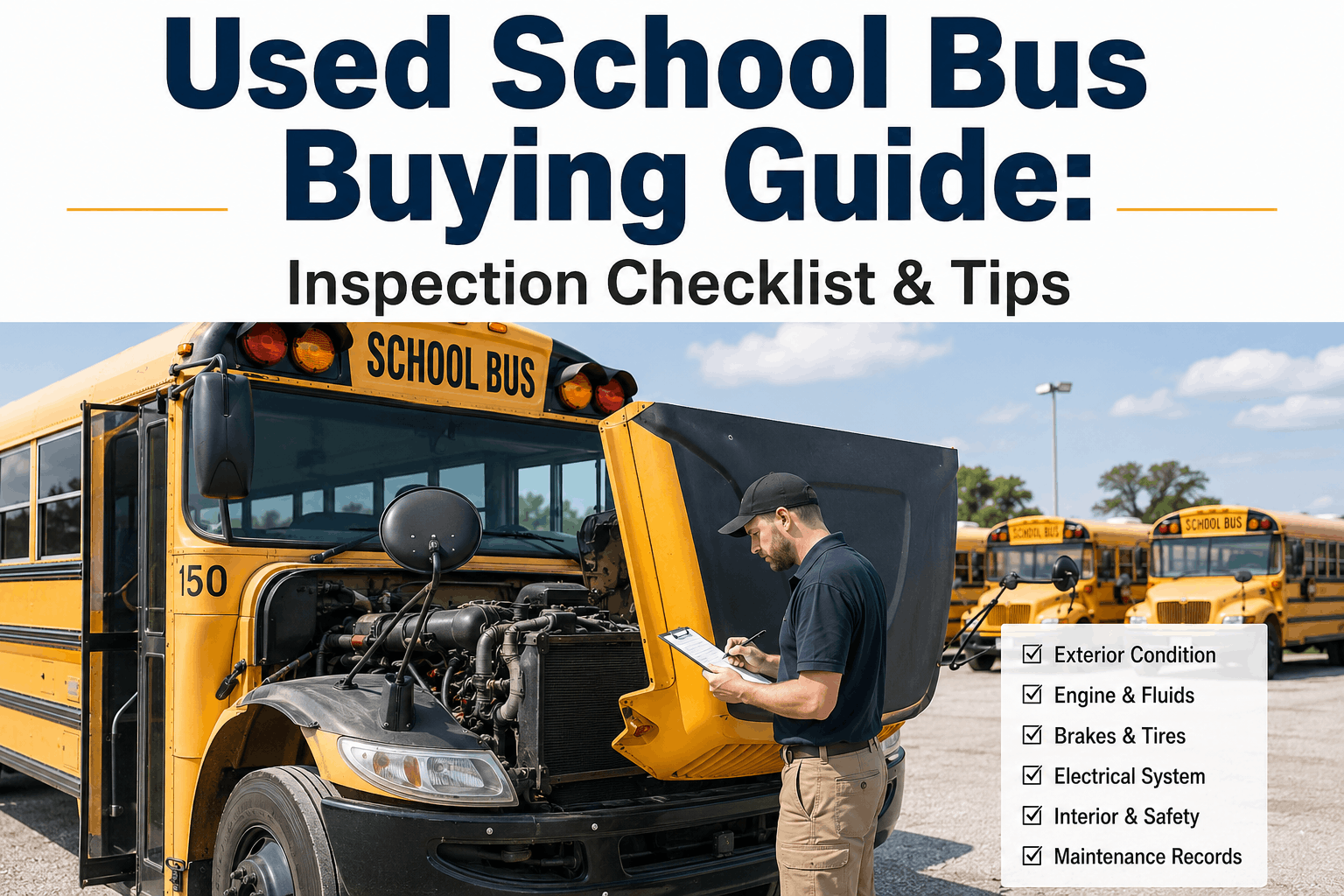
Used School Bus Buying Guide: Inspection Checklist & Tips
The used school bus market is fragmented across government surplus auctions, private dealers, and fleet liquidations—each with vastly different pricing, condition standards, and disclosure requirements. Yet fleet operators, nonprofits, and independent buyers often lack a systematic framework for evaluating mechanical condition, structural integrity, and remaining service life. This guide provides a complete inspection checklist, pricing benchmarks, negotiation strategies, and post-purchase due diligence to help you avoid costly hidden defects and overpaying for buses with limited remaining utility.
USED VEHICLE PROCUREMENT · BUYING GUIDE · 2026
Used School Bus Buying Guide: Inspection & Valuation
Complete checklist for inspecting used school and transit buses, understanding fair market pricing, and calculating remaining service life before making a purchase.
Used School Bus Market Overview — Where to Buy & What Buses Cost
Used school buses are sold through four primary channels: government surplus auctions (40% of market), fleet dealer networks (35%), private sellers (20%), and international imports (5%). Each channel has different pricing, quality standards, and regulatory compliance requirements.
Government Auctions (40%)
Price Range: Most Affordable
High Value
2010–2015 model buses: $8,000–$18,000. 2015–2018 models: $18,000–$28,000. Newer models (2018+): $28,000–$42,000. Significantly cheaper than private dealers (15–25% discount) due to bulk liquidation.
Condition Variability
High Risk
School district buses often 200K–300K miles with sporadic maintenance records. Inspection windows are brief (24–48 hours before auction). Sold "as-is" with no warranty or recourse.
No Warranty or Recourse
High Risk
Government surplus sales explicitly disclaim liability. If you buy a bus and the engine fails the next day, you own the repair cost. No cooling-off period or return options.
Advantages
Medium Value
Title is clear and government-backed. Buses typically delivered to the same location for bulk inspection. Bulk buyer discounts available (5+ buses = additional 10–15% reduction).
Fleet Dealers & Private Sales (55%)
Price Range: Mid-Market
High Value
2010–2015: $16,000–$32,000. 2015–2018: $32,000–$52,000. 2018+: $48,000–$68,000. Dealer markup 20–35% above auction prices, but includes pre-purchase inspections and limited warranty (30–90 days typical).
Condition Transparency
High Value
Reputable dealers provide maintenance history, accident reports, and pre-purchase mechanical inspections. Many offer extended warranty (6–12 months) for peace of mind. Typically sell fleet-maintained vehicles.
Limited Warranty Coverage
Medium Value
Engine, transmission, and structural defects typically covered for 30–60 days. Electrical, interior, and cosmetic issues are "as-is." Warranty limitations vary significantly by dealer.
Advantages
Medium Value
Vehicles professionally detailed, safety-inspected, and mechanically certified. Dealers handle title transfer and registration. Better customer service and recourse if mechanical issues arise within warranty period.
School Bus Pricing by Model Year & Mileage
Fair market value depends on model year, total mileage, engine type, transmission, and regional demand. The table below is based on 2024–2025 market data for Type C and Type D full-size school buses.
180K–250K miles: $10,000–$16,500 auction, $16,500–$24,000 dealer. 250K–300K miles: $7,000–$12,000 auction, $12,000–$18,000 dealer. Sweet spot for value: newer enough for modern emissions compliance, old enough for budget-friendly pricing.
2015–2017 Models (7–9 years old)
200K–280K miles: $16,500–$28,000 auction, $28,000–$38,000 dealer. 280K–320K miles: $12,000–$20,000 auction, $20,000–$30,000 dealer. Popular with nonprofits and shuttle services; good condition examples command premium.
2018+ Models (5–6 years old)
120K–180K miles: $28,000–$42,000 auction, $42,000–$58,000 dealer. Modern emissions, integrated telematics, low-mileage interiors. Similar price to 5-year-old used commercial vehicles.
A comprehensive inspection takes 90–120 minutes and requires basic mechanical knowledge. Budget $300–500 for a professional pre-purchase inspection if you're not confident assessing mechanical condition yourself.
40-Point Pre-Purchase Bus Inspection Checklist
Use this systematic approach to evaluate mechanical condition, safety, and remaining service life before committing to purchase.
TITLE & REGISTRATION
Clear title, no liens, odometer disclosure accurate, salvage/branded status verification
FRAME & EXTERIOR
Frame straightness (laser check if possible), rust/corrosion beneath door sills, windows seal properly, mirrors intact
INTERIOR & SEATS
Seat condition (bolts secure, fabric/padding sound), flooring integrity (no soft spots = rot), driver's cabin controls function
SAFETY SYSTEMS
Brakes (pedal feel, stopping distance test drive), lights (emergency, warning, backup), door mechanism (latches fully, opens manually), fire extinguisher present
"I bought a 2014 Type C bus from a government auction for $14,000 thinking I got a deal. After 3 weeks, the transmission failed—$8,500 repair cost. I should have hired a $400 pre-purchase inspection. That one decision cost me 60% of my purchase price in repairs."
— Nonprofit Director, School Shuttle Program, 2025
Critical Mechanical Systems — Red Flags & Deal-Breakers
Not all mechanical issues are equal. Some are inexpensive fixes; others signal deep structural problems that make the bus uneconomical to operate.
Check for: Delayed engagement, grinding sounds, hard shifts. Deal-breakers: Slipping (transmission failure = $6K–8K overhaul), loss of reverse. Minor issues: Shifter stiffness ($100–200 adjustment). Test drive is essential.
Brake System
SAFETY-CRITICAL
Check for: Soft pedal (bleed air), long stopping distance, uneven braking (pulled to side). Deal-breakers: Air leak in brake lines, failed ABS module. Cost estimate: Pad replacement ($400), brake fluid service ($250), air leak repair ($500–2K).
Estimating Remaining Service Life — Is This Bus Worth It?
A 2014 bus with 220K miles isn't necessarily worse than a 2016 bus with 260K miles. Remaining service life depends on maintenance history, mileage, and specific component condition. Use this framework to calculate expected years before major overhaul is required.
Cummins ISL Engine: Rated for 500K miles before overhaul. Cost to overhaul: $18K–24K. If a bus has 300K miles and runs strong, expect 4–5 years (200K miles) of additional service = $18K overhaul deferred 4–5 years = acceptable purchase if priced accordingly.
Detroit Diesel DD13: Rated for 350K–400K miles before overhaul. If a bus is at 280K miles, expect 2–3 years remaining = higher risk of imminent major repair. Price discount of $8–12K should reflect this shorter remaining life.
Transmission Life: Allison automatic transmissions: 400K–450K miles typical. Manual transmissions: 450K–500K miles. Each 50K miles = $1,500–2,500 remaining value. A transmission at 280K miles on a 450K-rated system = 170K miles remaining = $5K–6K residual value.
Frame & Structural: School buses built to last 500K–600K miles structurally. Rust and corrosion speed degradation. A bus with clean frame at 250K miles can run 8–10 more years. A bus with frame rot at 200K miles may fail emissions inspection in 2–3 years = much shorter remaining service life.
Negotiation Strategy — Getting Fair Market Price
At Government Auctions: Bidding is all-in competitive. No negotiation. Success depends on identifying undervalued buses others overlook (mechanical issues the average buyer fears) that you can fix affordably. 10–15% discount to dealer pricing if you buy smartly.
With Fleet Dealers: Always negotiate. Starting offer: 10–15% below asking price. Justification: "inspection found $2,500 deferred maintenance" (brake pads, tire replacement, suspension wear). Realistic outcome: 5–8% discount. Warranty extension (to 6 months from 30 days) often easier to negotiate than price cuts.
With Private Sellers: Maximum negotiation leverage. Sellers often unrealistic about pricing. Offer 15–20% below asking. Justification: "no warranty, as-is sale, title transfer costs me $500 + inspection $400." Realistic outcome: 8–12% discount + seller pays transfer fees.
Post-Inspection Renegotiation: If professional inspection reveals deferred maintenance (bad brakes = $1.2K, tires = $1.8K, suspension work = $2K = $5K total), demand price reduction equal to 60–75% of repair cost. Negotiation fallback: seller funds repair before delivery, you pay reduced purchase price.
Financing & Total Cost of Ownership — Should You Buy at This Price?
Don't evaluate bus price in isolation. Total ownership cost includes purchase, financing, repairs, fuel, insurance, registration, and end-of-life value.
Example: 2014 Type C Bus, 240K miles, $16,500 asking price
Purchase price: $16,500. Financing (5-year loan @ 7%): $315/month. Insurance: $100/month. Fuel (6 MPG, 40K miles/year): $2,300/year ($192/month). Maintenance: $1,200/year ($100/month). Expected repairs (wear items, coolant, belts): $400/year ($33/month). Estimated remaining life: 5 years (until 440K miles, transmission overhaul threshold). Residual value at end: $3,500 (20% of purchase price). Total ownership cost: $16,500 + (36 months × $640/month) = $39,540. Cost per mile: $0.66/mile (assuming 200K miles over 5 years).
Compare to new bus lease: New full-size bus lease: $1,200–1,500/month including maintenance and roadside assistance. Over 5 years = $72,000–90,000. Used bus costs $39.5K. Savings: $32–50K.
Decision rule: Buy used if total ownership cost is less than 50% of new equivalent. If total cost exceeds 60% of new, consider newer model or lease instead.
What is fair price for a 2015 school bus with 250K miles?
Fair market: $18,500–$24,000 depending on condition. Auction price: $14,000–$19,000 (as-is, no warranty). Dealer price: $24,000–$32,000 (warranty, inspected). If seller asks $28,000, offer $22,000 (18% discount) and justify with inspection costs + warranty comparison. Negotiate final price to $24,000–$25,000.
Is a bus with 280K+ miles still safe to operate?
Yes, if mechanically sound and maintenance is current. School buses built to 500K+ miles safely. However, components approach end-of-life: transmission (270K–330K range), engine (280K–350K depending on type). Budget $1,500/month repair reserve if mileage exceeds 280K. Higher risk of unplanned downtime.
What is the best model year to buy used?
Sweet spot: 2013–2015 models. Old enough for 25–30% price discount vs. new, young enough for modern emissions compliance (2010 Tier 2 EPA standard), widespread parts availability, and technician familiarity. 2016–2018 models cost 30–50% more but offer only marginal added reliability.
Should I buy from a dealer or government auction?
Auction if you have mechanical expertise and time to inspect dozens of buses. Dealer if you value warranty, condition assurance, and peace of mind. Dealers cost 20–35% more but eliminate risk of catastrophic failures in first 30 days. Budget your time and risk tolerance into the decision.
How do I finance a used school bus?
Options: (1) Bank loan (5–7 years, 6–8% APR typical). Requires clear title and passing safety inspection. (2) Equipment financing (commercial loan, lower rates, shorter terms). (3) Lease-to-own (higher cost but flexible exit). For nonprofits: SBA loans available at 5–6% rates with tax-exempt status.
Buy Your Next Used School Bus with Confidence
Use our complete inspection checklist, pricing benchmarks, and negotiation strategies to avoid costly mistakes and get fair market value.