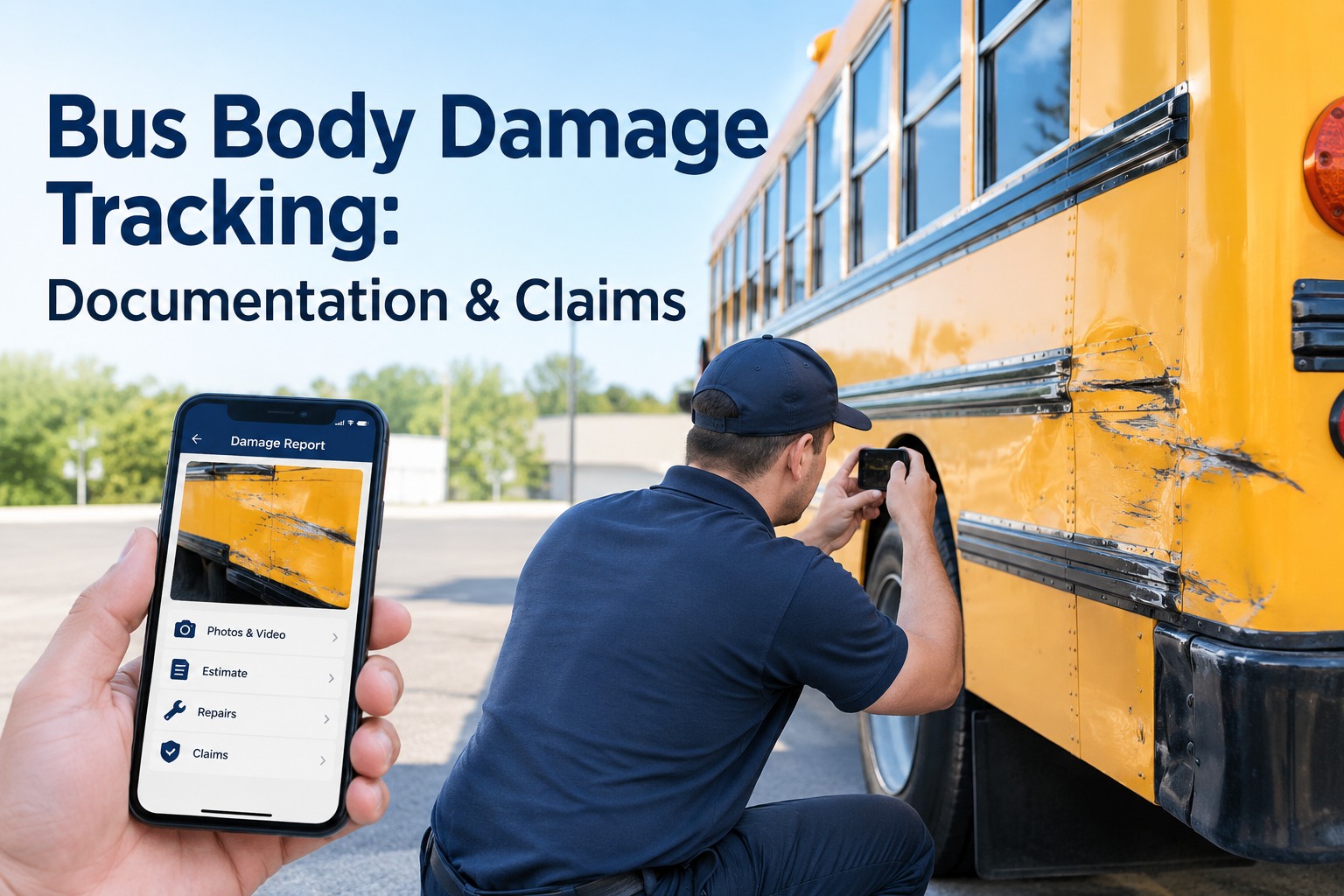
Bus body damage tracking is the practice of documenting exterior damage from the moment it is first observed — recording the bus and location, capturing photos or relevant video, assessing the repair, opening a work order, and retaining the records that support any claim. Done as one connected workflow, it lets a fleet establish when the damage appeared, prove it was repaired, and back a claim or third-party recovery with evidence instead of guesswork.
Bus Body Damage Tracking: Documentation and Claims
A dented panel is a small thing — until you need to prove when it happened, that it was fixed, and who should pay. Track it end to end and the claim writes itself.
Updated September 2026 · Not legal or insurance advice; requirements vary by district, state, and insurer.Body damage is expensive in a quiet way: a scrape here, a cracked mirror there, each handled as a loose repair and rarely tied to a claim. The cost adds up, and when a third party or an insurer should have covered it, the fleet often eats it simply because the documentation was not there when it mattered. A connected tracking workflow fixes that, and it starts the moment the damage is seen.
The damage lifecycle, from first look to closed claim
Every piece of body damage should travel the same path, whether it is a minor scrape or a major panel hit. Follow the steps and nothing falls through — the damage is documented, repaired, and backed by records a claim can rest on.
Observe
Damage is spotted on a pre-trip, a yard check, or flagged by a camera event.
Record bus & location
Tag it to the exact bus and where on the body — rear panel, mirror, door.
Capture evidence
Photos from a few angles, and a relevant clip where footage adds context.
Document the incident
When, where, and what is known — recorded factually, without over-claiming cause.
Estimate
Assess the repair and its cost, so the financial picture is clear from the start.
Work order
A repair work order opens against the bus, with the evidence and estimate attached.
Repair
The fix is completed and signed off, with parts, labor, and cost logged.
Retain
Records and evidence are kept per policy, ready to support a claim or recovery.
The power is in the connection: because every step attaches to the same bus record, you can answer the three questions a claim always comes down to — when was it observed, was it repaired, and what documentation supports it. Book a demo to see the full damage lifecycle on one record
Photos and video: capture context, not conclusions
Good evidence is specific and honest. Photos and video make a claim credible — but only when they are captured properly and described for what they actually show, not stretched into claims they cannot support.
Camera footage is valuable for the context it provides — showing that damage was present at a point in time, for instance — but a fleet should stop short of asserting that video automatically identifies or proves driver responsibility. Record what the evidence shows; let the claim process determine cause. Start free and keep evidence tied to the incident
Let AI surface the damage that matters
A busy fleet generates more camera events and inspection flags than anyone can review by hand. AI-assisted detection helps by surfacing the events that look like significant damage and routing them into the maintenance workflow — so a real panel hit does not sit unnoticed while staff wade through routine footage.
AI flags events and inspection findings that appear to involve significant body damage, from the systems you already run.
The likely-significant items rise to the top, so maintenance attention goes to real damage first, not the noise.
A flagged event becomes an issue tied to the bus, ready to move into the documentation-to-repair workflow.
The point is not to replace human judgment — a person still confirms and assesses the damage. It is to make sure the significant events are seen and acted on quickly, instead of being lost in the volume. Book a demo to see AI-assisted damage detection in the workflow
A worked example: from a scrape to a documented claim
Here is the lifecycle made concrete. A driver returns bus 14 with fresh damage on the rear left panel. Follow it through to a claim backed by evidence.
Nothing here required stitching four systems together at claim time. Because the whole lifecycle lived on one bus record, the claim package was a retrieval, not a reconstruction — and the fleet could show exactly when the damage was seen and that it was repaired. Start free and turn damage into a claim-ready record
Why claims fall apart: the evidence is scattered
The recurring failure is the same across damage cases: camera footage lives in one vendor portal, while damage reports, estimates, and maintenance records sit in separate systems. So when a claim needs to show when the damage was observed, that it was repaired, and what documentation supports it, staff have to reconcile several sources by hand — and often cannot produce a clean, connected story.
BusCMMS is an AI-native, hardware-agnostic bus fleet operations platform that closes that gap. It connects relevant events from the MDVR or AI camera systems you already run — no rip-and-replace — to bus asset records, incidents, and maintenance work orders, and uses AI-assisted detection to route significant damage into the workflow. A damage event links to the bus, evidence and the estimate attach to the incident, a work order tracks the repair, and everything is retained on one record — so cost estimation, third-party recovery, and insurer documentation all draw from the same connected history. Book a demo to connect your cameras, estimates, and repairs
What the regulations do and do not cover
It is worth being clear about the legal backdrop, because there is less prescription here than people assume. No single federal mandate dictates how a fleet must document body damage or structure a claim.
Part 396 establishes federal inspection, repair, and maintenance requirements and the associated recordkeeping obligations — keeping vehicles in safe operating condition and documenting maintenance. Good body-damage records support those obligations, but Part 396 does not prescribe a universal body-damage claim or photo workflow. How you document damage, estimate cost, and pursue a claim is shaped by your district policies, state requirements, and insurer or contract terms — not by a single federal rule.
So the honest framing: maintain and document to the federal standard because you must, and build your damage-and-claim documentation to satisfy your insurer, district, and contracts — which is exactly what a connected record makes easy. This page is a practical guide, not legal or insurance advice, and documentation and retention requirements can vary by district, state, insurer, and contract. Start free and keep damage records complete and retrievable
See how a video event becomes a closed work order in BusCMMS
Watch a camera event link to the right bus, capture the damage, open a work order with the estimate attached, and close as a repaired, claim-ready record — all on one bus record, using your existing MDVR or AI cameras. Hardware-agnostic, no rip-and-replace.
Hardware-agnostic · Works with your existing cameras · One record per bus
Frequently asked questions
What is bus body damage tracking?
Bus body damage tracking is the process of documenting exterior damage to a bus from the moment it is first observed through to repair and any claim. It means recording the specific bus and where on the body the damage is, capturing photos and relevant video, documenting the incident factually, estimating and completing the repair, and retaining the supporting records. Handled as one connected workflow rather than a series of loose repairs, it lets a fleet establish when the damage appeared, prove it was repaired, and support an insurer or third-party recovery claim with organized evidence instead of scattered notes.
Does camera video prove who caused body damage?
Not automatically. Camera and MDVR footage is valuable for the context it provides — for example, showing that damage was present at a certain point in time, or capturing an event for review — but a fleet should be careful not to assert that video automatically identifies or proves driver responsibility. The right approach is to record what the evidence actually shows, described factually, and let the claim or investigation process determine cause. Over-claiming what a clip proves can undermine credibility; documenting it accurately and tying it to the incident is what makes it useful.
What documentation supports a bus body damage claim?
Typically the elements a connected workflow captures: when and where the damage was observed, the specific bus and location on the body, photos from several angles and any relevant video, a factual incident description, a repair estimate, the completed repair with parts and cost, and the retained records tying it all together. The exact requirements depend on your insurer, district policy, state rules, and any contracts — they are not set by a single federal mandate. The practical goal is a complete, connected record that answers when the damage was seen, that it was repaired, and what evidence supports the claim, retrievable without reconciling several systems by hand.
Do federal regulations require a specific damage or photo workflow?
No. 49 CFR Part 396 establishes federal inspection, repair, and maintenance requirements and recordkeeping obligations, which keeping good body-damage records helps support, but it does not prescribe a universal body-damage claim or photo workflow. How you document damage, estimate cost, capture photos or video, and pursue third-party recovery or insurer claims is shaped by district policies, state requirements, and insurer or contract terms rather than a single federal rule. This article is a practical guide and does not provide legal or insurance advice; documentation and retention requirements can vary by district, state, insurer, and contract, so confirm your specific obligations.
Do we need to replace our cameras to track body damage this way?
No. BusCMMS is hardware-agnostic and is designed to connect relevant events from the MDVR or AI camera systems you already operate to bus asset records, incidents, and maintenance work orders, without a rip-and-replace deployment. A camera event links to the correct bus, evidence and the estimate attach to the incident, a work order tracks the repair, and AI-assisted detection helps route significant damage into the workflow. The aim is one connected record per bus — from first observation through the completed repair and claim documentation — using your current camera hardware rather than a new system.