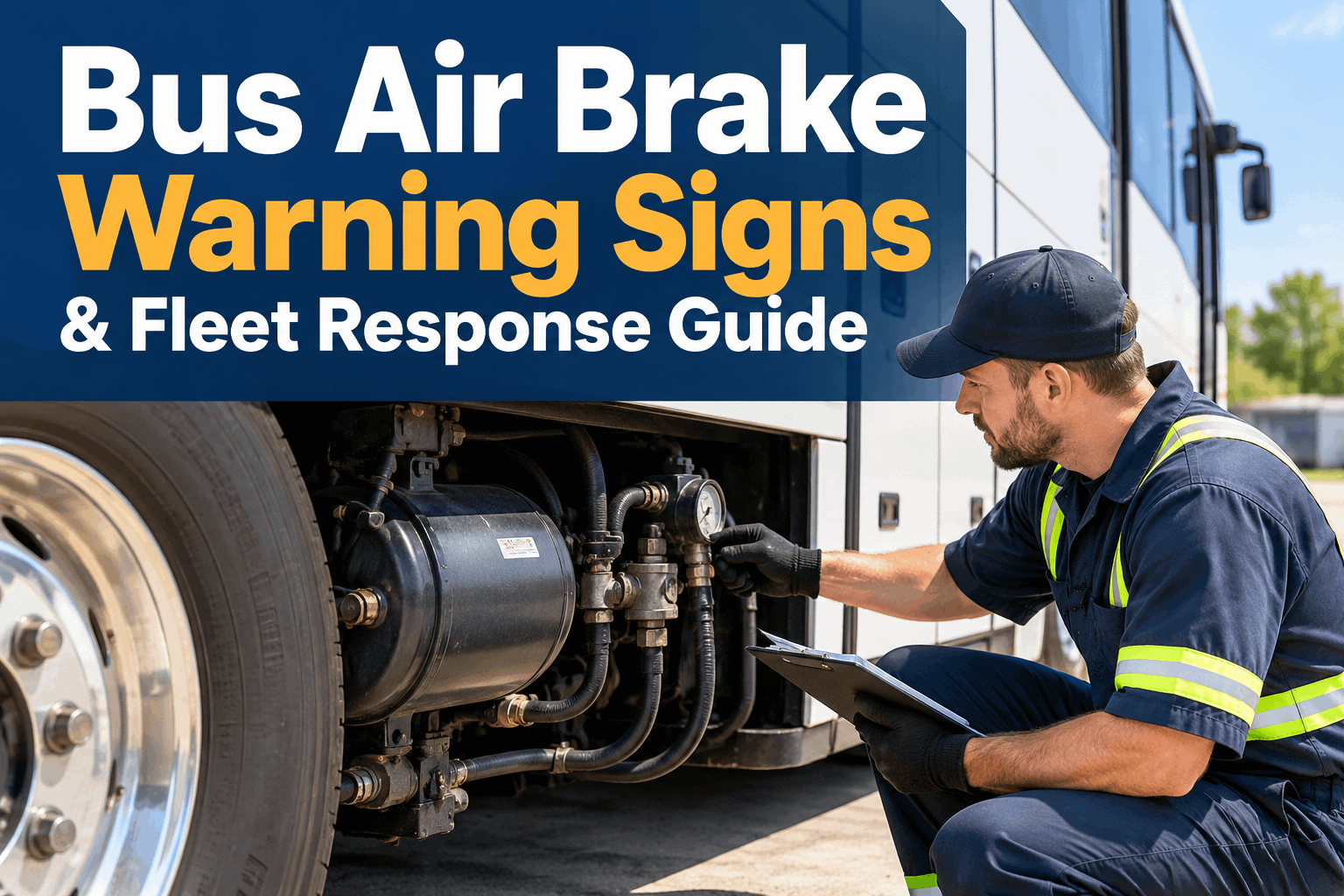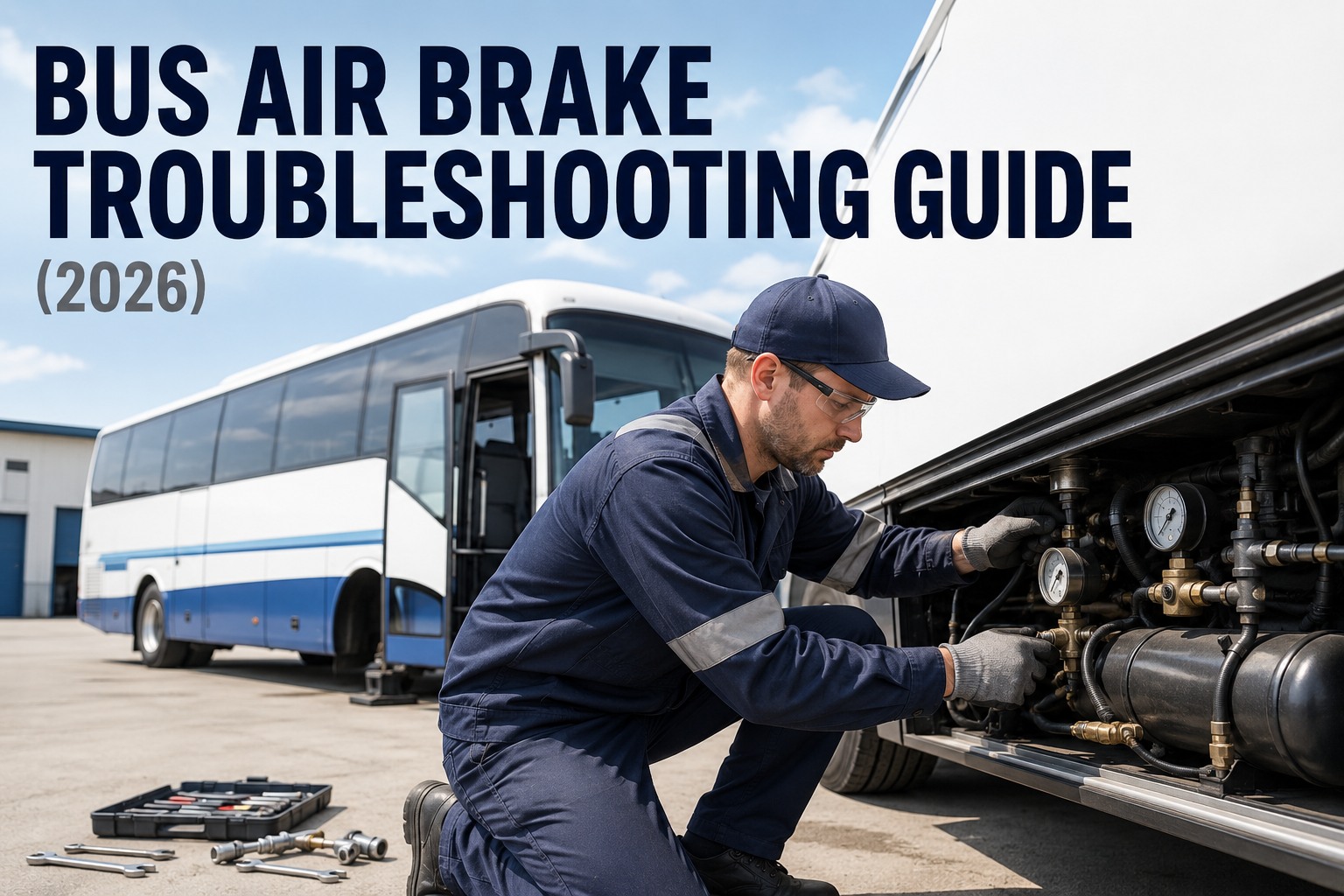
Bus 14 leaves the yard at 6 AM with 71 kids on board and the air pressure warning light comes on at the second stop. That is not a slow leak somewhere -- that is a real safety event with a real timeline. The driver has minutes before the spring brakes apply and the bus is stuck in the middle of a route. Air brake systems are unforgiving; the difference between a normal shop repair and a $16,000 civil penalty often lives in a $12 valve. If you troubleshoot bus air brakes weekly, book a 20-minute demo to see how BusCMMS logs pressure history per bus and surfaces drift patterns before they turn into road calls.
Bus Air Brake Troubleshooting Guide (2026): Flowchart, Common Faults & Repairs
Every pressure target, leak-rate limit, and fault path a bus tech needs to isolate air brake problems in under 30 minutes
The Air Brake Diagnostic Flowchart -- Driver Symptom to Root Cause
Four complaints cover 95% of bus air brake troubleshooting tickets. Read the driver report, follow the branch, and the fault path narrows immediately.
- 01
"Air Won't Build" / "Slow Build"
Test: Time 85 → 100 psi build. Over 45 sec = fail.
Look at: Compressor drive, governor, air dryer bypass valve, major supply leak.
- 02
"Air Won't Hold" / "Pressure Drops Fast"
Test: Full brake application, engine off, watch gauge 2 min. Over 5 psi drop = fail.
Look at: Chamber diaphragms, foot valve, treadle valve seals, air line fittings.
- 03
"Brakes Drag" / "Won't Release"
Test: Release pedal, listen for quick release valve exhaust. Check pushrod full return.
Look at: Foot valve exhaust port, quick release valve, over-adjusted slack adjuster, iced air lines.
- 04
"Spring Brakes Won't Apply / Release"
Test: Pull park valve, listen for spring chamber exhaust. Push in, chambers should release audibly.
Look at: Spring brake chamber diaphragm, park control valve, caging bolt left in from prior repair.
The reason this flowchart works is that every branch has a distinct diagnostic test that isolates the fault path within 5 minutes. A tech who tries to jump straight to component-swapping without matching the symptom to a branch typically spends 3x longer on the ticket. Sections 02 through 05 walk each branch in detail. Book a demo to see how BusCMMS tags every brake work order with its symptom branch for shop-level pattern tracking.
Slow Build or No Build -- The Compressor Circuit
If the bus can't reach cut-out pressure, or takes over 45 seconds to build from 85 to 100 psi, the fault lives in the supply side. Four culprits cover most cases.
- Cause 01
Compressor Drive Failure
Symptom: No build at all, or extreme slow build. Engine RPM has no effect on gauge climb rate. Fix: Inspect belt tension, coupling wear, compressor mount. Confirm compressor shaft turns with engine.
- Cause 02
Governor Stuck Open
Symptom: Compressor never loads. Air supply line to governor stays vented. Fix: Confirm governor cut-in setting per manufacturer spec. Test with air line disconnect. Replace if stuck.
- Cause 03
Air Dryer Bypass or Purge Valve Failure
Symptom: Compressor loading but pressure builds slowly. Continuous air exhaust from dryer. Fix: Check purge valve for stuck-open condition. Inspect dryer cartridge -- if beyond 12-month PM interval, replace.
- Cause 04
Major Supply-Side Leak
Symptom: Audible leak downstream of compressor. Build climbs then plateaus below cut-out. Fix: Soap-test fittings from compressor outlet through wet tank, dryer, and check valves. Torque or replace leaking joint.
Excessive Leak-Down -- The 2-Minute Test That Isolates It
Apply full service brakes, engine off, key on, watch the gauge for 2 minutes. Over 5 psi total drop is an FMCSA leak-rate failure. The leak is downstream of the check valves.
- Cause 01
Ruptured Brake Chamber Diaphragm
Symptom: Loud continuous leak from one specific brake chamber. Uneven brake application on that wheel. Fix: Replace chamber. Inspect for cracked chamber body from overpressure or corrosion.
- Cause 02
Foot Valve (Treadle) Seal Failure
Symptom: Leak audible at treadle valve when brake pedal applied. Cab-floor air loss. Fix: Rebuild or replace treadle valve. Confirm brake pedal returns to full up-position.
- Cause 03
Air Line Fittings and Hoses
Symptom: Small hissing at fittings, especially at frame joints and pivot points. Common on aging fleets. Fix: Soap-test every fitting, chase leak progressively. Replace cracked hoses. Torque fittings to spec.
- Cause 04
Relay Valve or Quick Release Valve Failure
Symptom: Slow leak audible from exhaust port of valve. Rear brake application timing off. Fix: Test valve exhaust port for continuous leak. Replace if faulty (rebuild rarely economical).
Leak-down failures are the #1 cause of unplanned bus air brake road calls. Fleet-wide pressure trending catches the slow-drift version -- fittings weeping half a psi more per week -- weeks before the low-air warning fires on a route. Book a demo to see how BusCMMS tracks leak-rate baselines per bus and flags drift automatically.
Won't Release Fully -- The Downstream Circuit
Brakes that stay partially applied after pedal release burn linings, overheat drums, and cost 2-3x normal PM material. The cause is downstream of the foot valve and usually cheap to fix.
- Cause 01
Foot Valve Won't Fully Exhaust
Symptom: Brake chambers hold 5-15 psi even with pedal fully released. Pedal returns fine mechanically. Fix: Rebuild or replace treadle valve. Inspect pedal linkage for binding or wear at pivot points.
- Cause 02
Quick Release Valve Plugged
Symptom: Slow release audible at wheel end. Front brakes drag first (quick release usually front-axle circuit). Fix: Inspect QR valve exhaust port for debris. Replace valve if exhaust restricted.
- Cause 03
Over-Adjusted Slack Adjuster
Symptom: Excessive pushrod travel or brake stays applied even at low pressure. Confirm with pushrod stroke measurement. Fix: Verify automatic slack adjuster function -- most modern buses use auto slacks. Replace if seized. Manual re-adjustment illegal on most commercial vehicles per FMCSA.
- Cause 04
Ice or Moisture in Air Lines
Symptom: Cold-weather-only dragging. Clears once bus warms up. Common on aging fleets with tired air dryers. Fix: Drain wet tank. Replace air dryer cartridge. Root cause is a failed air dryer 90% of the time.
Dragging brakes are one of the top three causes of premature bus brake lining wear and overheated drums. Fleets that catch dragging early save thousands per year in brake material and drum machining costs. Book a demo to see how BusCMMS flags brake stroke drift trends before drums overheat.
Won't Apply or Won't Release -- The Emergency Circuit
Spring brakes are the failsafe. When they misbehave -- won't set, won't release, or apply on their own -- the risk profile changes fast. This is the branch you close in the shop, not the driveway.
- Cause 01
Spring Brake Chamber Diaphragm Rupture
Symptom: Continuous loud air leak from spring brake side (rear chamber). Spring brake may apply on its own at highway speed. Fix: Replace spring brake chamber. Do NOT attempt to disassemble -- the coiled spring is a decapitation hazard.
- Cause 02
Park Control Valve Stuck
Symptom: Pull park valve, spring brakes don't apply. Or push in, spring brakes don't fully release. Fix: Confirm valve linkage travel. Replace park valve. Common on aging school buses with corroded dash-mount valves.
- Cause 03
Caging Bolt Left Installed
Symptom: Spring brakes never apply on that chamber even when air pressure drops. Bus rolls with park brake set. Fix: Inspect caging bolt hole on spring chamber. Remove bolt if still installed from prior brake job. Document in maintenance log.
- Cause 04
Check Valve Between Circuits Failed
Symptom: Loss of pressure in one circuit affects spring brake side. Both service and park pressure drop together on single-side leak. Fix: Test one-way check valves between reservoirs. Replace any that allow backflow.
Spring brake events are one of the highest-consequence faults in bus fleet operations -- unlike a service brake leak, a spring brake malfunction can either strand the bus mid-route or fail to hold on a hill. Every event should be logged with photos, resolution, and cause. Book a demo to see how BusCMMS captures spring brake incident history per VIN for warranty and safety documentation.
The Regulatory Anchor -- and How Fleet Tracking Changes the Math
Every air brake defect you catch in the shop is a roadside penalty you didn't pay. Fleet-wide brake pressure history is the difference between reactive repair and predictive maintenance.
Out-of-Service Criteria
Pushrod stroke exceeding chamber limit (Type 30 = 2.25", Type 20 = 2.0", Type 24 = 2.25") is an automatic OOS violation. Same for missing terminators, cracked chambers, and audible leaks at fittings.
Leak Rate Standards
FMCSA 49 CFR 570.57: static leak ≤ 2 psi/min single vehicle, applied ≤ 3 psi/min. State inspections often apply 3 psi/min released, 4 psi/min applied. FMCSA 2-min test: ≤ 5 psi total loss.
Build Time Standard
85 to 100 psi in 45 seconds or less at max regulated engine RPM. Failing build time is a shop-fix, not a road-side violation, but it foreshadows a compressor or dryer failure within weeks.
Full DTC History Per Bus
BusCMMS captures every brake-related SPN and freeze-frame from J1939. Six months in, drift patterns emerge that no scan-tool session would catch on its own.
Pressure Trend Alerts
Fleets with pressure telemetry integrated into BusCMMS receive automatic alerts when a specific bus starts losing air faster than baseline -- weeks before the driver notices.
PM & Recall Anchor
Air dryer cartridges on a 12-month schedule, chamber inspections on quarterly, slack adjuster checks at every PM. BusCMMS ships with bus-specific brake PM templates on day one.
Whether you run 20 school buses on a rural district route or 200 transit coaches through a metro system, the diagnostic gap is not the multimeter or the scan tool -- it is whether every air brake event your fleet generates ends up on someone's dashboard, tied to a work order, with a trend behind it. That's exactly what BusCMMS was built to close. Sign up free and load your first fleet's brake history in under an hour.
What are normal bus air brake pressures?
A properly functioning bus air brake system maintains pressure between 100 and 125 psi during operation. The governor cuts out (stops the compressor) at 120-125 psi and cuts in (resumes) at approximately 100-115 psi -- typically about 20 psi below cut-out. The low-air warning must activate before pressure drops below 60 psi. Spring brakes automatically apply between 20 and 45 psi. FMCSA requires that a bus never operate with system pressure below 90 psi.
Why won't my bus air brakes build pressure?
Four causes cover most cases. First, compressor drive failure -- check belt tension, coupling wear, and mount. Second, governor stuck open, which prevents the compressor from loading. Third, air dryer purge valve stuck open, which continuously vents supply air (audible exhaust from the dryer). Fourth, a major supply-side leak between the compressor and check valves. Time the build from 85 to 100 psi -- if it exceeds 45 seconds at max regulated engine RPM, you have an FMCSA build-time failure.
What causes bus brakes to drag or not fully release?
Dragging brakes are downstream faults, meaning the fault is between the foot valve and the wheel. The four most common causes are: foot valve not fully exhausting (rebuild treadle valve), quick release valve plugged (check exhaust port for debris), over-adjusted or seized slack adjuster (verify auto-slack function -- manual re-adjustment is illegal on most commercial vehicles under FMCSA), and ice or moisture in air lines during cold weather (usually indicates a failed air dryer cartridge). Dragging brakes accelerate lining wear and can overheat drums -- catching them early saves significant PM budget.
How often should bus air brakes be inspected?
Daily pre-trip inspections are required by FMCSA before every trip -- including the full air brake test sequence (build-up, leak-down, low-pressure warning, service brake test). Additionally, air dryer cartridges should be replaced on a 12-month PM interval, spring brake chambers inspected quarterly, slack adjusters and pushrod stroke measured at every PM service, and full system inspection at annual FMCSA inspection (or state DOT inspection where required). BusCMMS ships with bus-specific brake PM templates pre-loaded.
What is the FMCSA leak rate limit for bus air brakes?
Under 49 CFR 570.57, air pressure should not drop more than 2 psi in one minute for single vehicles with brakes released, or 3 psi in one minute with brakes fully applied. Some state inspections use 3 psi released / 4 psi applied. FMCSA also specifies a 2-minute test for motorcoaches: with brakes applied and engine off, total leakage over 2 minutes must be 5 psi or less. Any leakage exceeding these limits indicates a fault requiring immediate repair -- and is an automatic out-of-service violation at roadside inspection.