A camera doesn't need to be broken to be useless — a thin film of winter road salt over the lens, or interior fogging on a humid morning, produces the exact same blank result as a dead unit. Bus camera maintenance is mostly about adding two small, recurring tasks to routines that already exist: a lens check folded into existing PM intervals, and a two-minute driver check added to the pre-trip. Book a walkthrough of the unified camera and maintenance record.
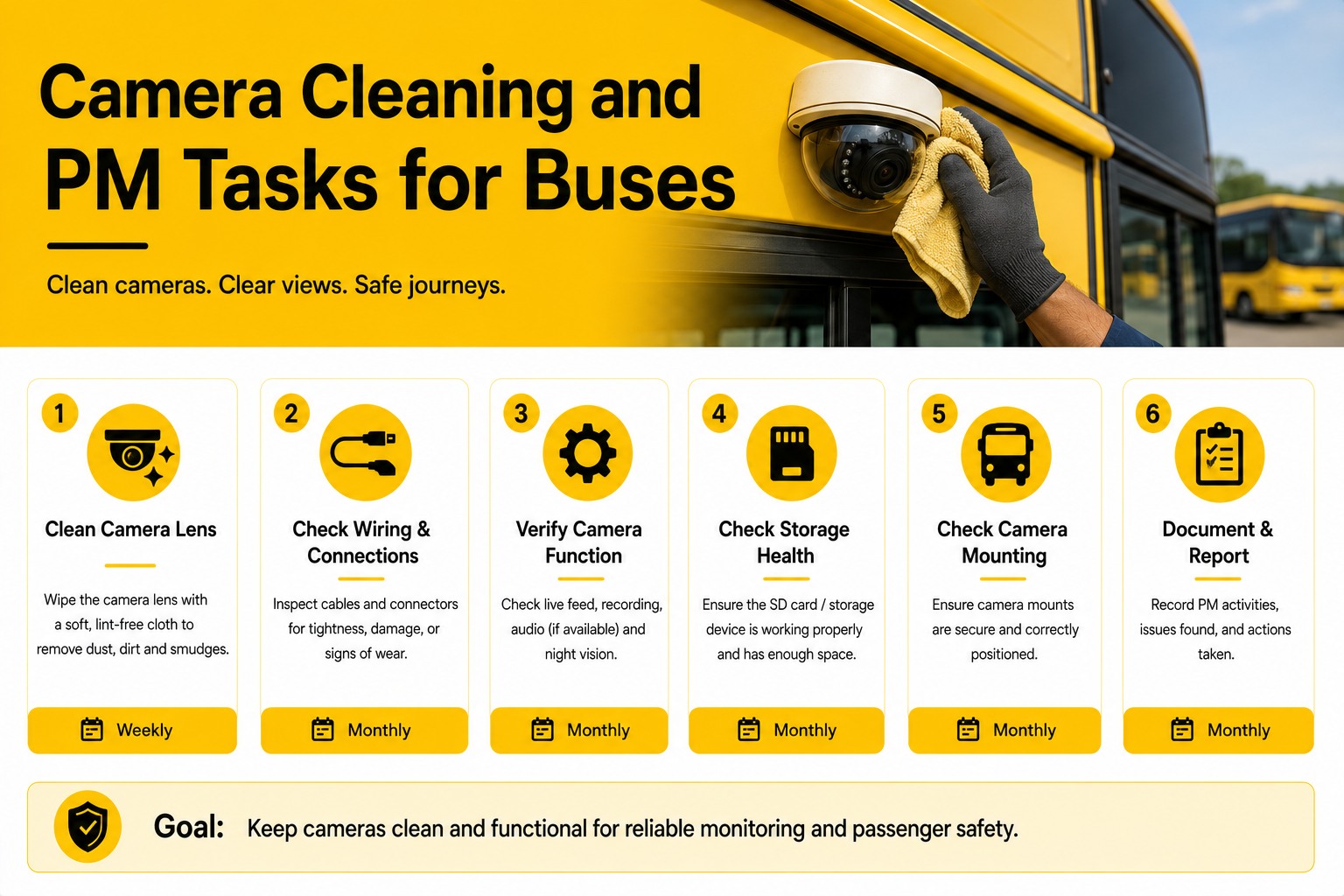
Camera Cleaning and PM Tasks for Buses
Folding lens cleaning into existing PM intervals, handling winter salt film and interior fogging, and the two-minute driver check that belongs on every pre-trip.
Wipe forward lens by hand if road film, frost, or salt residue is visible
Confirm interior monitor shows a live, non-fogged image on start-up
Check side/loading-door camera view for obstruction before first stop
Note any visible camera issue on the same DVIR used for mechanical defects
Adding Camera Checks to Existing PM Intervals
Not a new maintenance program — a few extra line items on the inspection you're already doing.
49 CFR 396.11 and 396.13 already require documented driver vehicle inspections and pre-trip checks, and the FMCSA eDVIR final rule, under Docket FMCSA-2025-0115, became effective March 23, 2026, moving the expectation toward electronic inspection records. Camera lens condition and monitor function fit naturally as additional line items on the same PM schedule already covering lights, brakes, and mirrors — there's no need for a separate camera-specific maintenance program running on its own calendar. A quarterly PM interval, for example, can add "clean exterior lens housings" and "verify all channels display a clear image" as two extra checklist items technicians confirm during the same visit they're already performing other scheduled work.
Winter Salt Film: The Seasonal Task Most PM Schedules Miss
A camera that's fine in October can be functionally blind by January without a seasonal adjustment.
Road salt and de-icing chemicals build up as a fine film on exterior lens housings during winter months, gradually degrading image clarity in a way that's easy to miss because it happens slowly rather than all at once. A standard quarterly PM cycle may not catch this fast enough during peak winter, since salt film can accumulate meaningfully within just a week or two of active winter road treatment. Fleets operating in regions with heavy winter road salt use should add a more frequent — weekly or biweekly — exterior lens wipe specifically during winter months, separate from the standard quarterly deep clean, rather than assuming the regular PM interval alone is sufficient during the season when it matters most.
Interior Lens Fogging: A Humidity Problem, Not a Hardware Failure
Condensation on an interior camera lens looks like a broken camera but usually isn't.
Interior cameras can fog on humid mornings the same way a windshield does, when warm, moist air inside the bus meets a cold camera housing that hasn't equalized to interior temperature yet. This produces a blurred or hazy image that resolves on its own within a few minutes as temperatures equalize, and it's easy for a driver or technician to mistake for a genuine hardware fault if they're not aware it's a known, temporary condition. Training drivers to recognize this specific pattern — a brief foggy start that clears within the first few minutes of the route — prevents unnecessary service calls for a non-issue, while still keeping the door open to flag it if the fogging doesn't clear or recurs unusually often, which could indicate a genuine seal failure worth a technician's attention.
The Spec Mistake That Cleaning Alone Can't Fix
A perfectly clean lens on inadequate hardware still produces poor footage.
Here's the objection worth naming directly: a camera specified around resolution alone, without adequate low-light performance, vibration rating, or retention window, will underperform regardless of how diligently it's cleaned and maintained. Cleaning and PM tasks address dirt, obstruction, and seasonal buildup — they don't compensate for a camera that was under-specified from the start. A fleet frustrated with persistently poor footage quality despite a disciplined cleaning routine should check the underlying hardware spec before assuming the maintenance program itself is failing.
A Scenario From a Real Bus Operation
Where a right-side incident and a simple lens film problem intersected.
More than 90% of illegal school bus passes happen on the left side, but right-side passes — the ones that cross directly in front of the loading door — rose from a 2.15% pre-pandemic average to 3.02% afterward (School Bus Fleet analysis of NASDPTS data, September 2025). A district running 40 buses received a complaint about a possible right-side pass during a February morning route, but the side camera's footage from that day was too degraded by winter road salt film to identify the vehicle clearly. The district's quarterly PM interval hadn't yet reached that bus, and no seasonal weekly wipe schedule existed. Following the incident, the district added a winter-specific weekly lens wipe for all exterior cameras from December through March, closing the seasonal gap the standard quarterly schedule had missed.
We had a right-side complaint in February and the footage was there, technically — just useless, coated in road film we hadn't cleaned since our last quarterly PM in November. Three months of winter salt buildup on a lens is a completely different problem than three months of regular road dust. Now winter gets its own weekly wipe schedule, separate from the normal quarterly cycle.
Heading into winter without a seasonal lens-cleaning schedule? That's worth adding before the first road salt hits. Talk to the team about seasonal PM planning →
Quick Spec Reference
Scannable on a phone during a PM planning meeting.
| Task | Recommended frequency |
|---|---|
| Exterior lens wipe (standard) | Folded into existing quarterly PM interval |
| Exterior lens wipe (winter) | Weekly to biweekly during active road-salt season |
| Interior monitor check | Confirm clear image on start-up, part of pre-trip |
| Driver pre-trip camera check | Daily, two minutes, logged on the same DVIR as mechanical items |
| Fogging vs. fault assessment | Flag only if condensation doesn't clear within first few minutes |
| Underlying hardware spec review | If poor footage persists despite cleaning, check spec before assuming a maintenance failure |
Frequently Asked Questions
Should camera cleaning be a separate maintenance program from existing PM?
No — camera lens condition and monitor function fit naturally as additional line items on the PM schedule already covering lights, brakes, and mirrors. There's no need for a standalone camera-specific maintenance program; a quarterly PM interval can simply add lens cleaning and channel verification as extra checklist items during the same visit.
Why does winter require a different lens-cleaning schedule than the rest of the year?
Road salt and de-icing chemicals build up as a film on exterior lens housings during winter, degrading image clarity gradually enough that a standard quarterly PM cycle may not catch it in time. Salt film can accumulate meaningfully within just one to two weeks of active winter road treatment, which is why fleets in heavy-salt regions should add a weekly or biweekly wipe specifically during winter months.
Is interior camera fogging a sign the camera is broken?
Usually not. Interior cameras can fog on humid mornings when warm interior air meets a cold camera housing, similar to a windshield fogging. This typically clears within a few minutes as temperatures equalize. It's only worth flagging for technician attention if the fogging doesn't clear or recurs unusually often, which could indicate a genuine seal failure.
What should a two-minute driver pre-trip camera check include?
A quick check should confirm the forward lens is wiped if road film or frost is visible, the interior monitor shows a clear non-fogged image on start-up, the side or loading-door camera view isn't obstructed, and any visible issue is noted on the same DVIR used for mechanical defects — consistent with the driver inspection requirements under 49 CFR 396.11 and 396.13.
Can cleaning fix poor camera footage if the underlying hardware is under-specified?
No. Cleaning and PM tasks address dirt, obstruction, and seasonal buildup, but they don't compensate for a camera originally specified around resolution alone without adequate low-light performance, vibration rating, or retention window. Persistently poor footage despite a disciplined cleaning routine is a sign to check the underlying hardware spec, not the maintenance schedule.