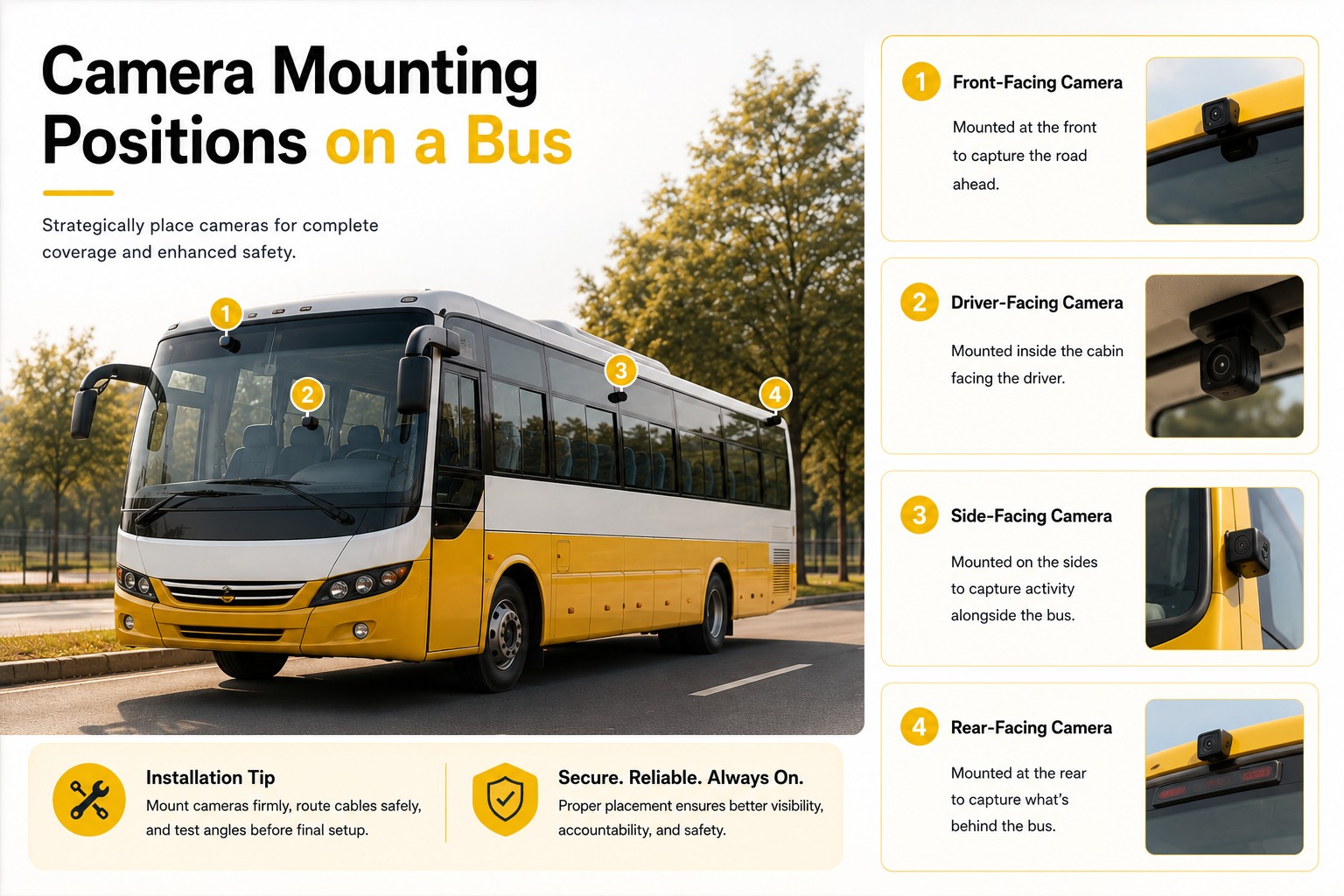
Six camera positions cover a bus — forward, cab, stairwell, aisle, rear, and side — and each one answers a different question about what happened, where, and to whom. Get any one position wrong, and that specific question goes unanswered no matter how good the other five cameras are. Talk to the BusCMMS team .
Camera Mounting Positions on a Bus
What each of the six standard camera positions is actually responsible for, where sightlines conflict with mirrors and the stop arm, and the placement mistakes that quietly ruin evidence value.
Forward
Windshield-mounted, road-facing. Covers the lane ahead and, critically, the extended stop arm zone to the front-left.
Cab
Driver-facing. Confirms driver behavior, attention, and response at the exact moment of an event captured by another channel.
Stairwell / Entry
Covers boarding and exiting specifically — a narrower, higher-incident zone than general aisle coverage.
Aisle
One or more units depending on bus length, covering seat-to-seat interaction along the vehicle's interior.
Rear
Backing maneuvers and following-vehicle context — the FMVSS 111 zone on buses under 10,000 lb GVWR.
Side / Loading Door
The single most commonly missed zone — see the mounting mistakes section below.
Sightline Conflicts With Mirrors and the Stop Arm
A camera position that overlaps a mirror's existing view wastes coverage; a position that ignores the stop arm entirely leaves a gap.
No single federal mandate governs camera mounting position specifications on buses; the compliance bar here is 49 CFR 396 maintenance record requirements and district policy. But the safety motivation connects directly to 49 CFR 673.25, which requires large urbanized area transit providers and their safety committees to consider mitigations that reduce operator visibility impairments — including where a camera should sit relative to existing mirror coverage rather than duplicating it. The forward camera specifically needs a field of view wide enough to capture the extended stop arm and the zone immediately beside it, not just the lane directly ahead, since that's the exact area a mirror-only setup already struggles to cover.
Why the Cab Camera's Position Matters as Much as Its Existence
A cab camera aimed slightly wrong captures the wrong things at the wrong moments.
The cab camera's job is confirming what the driver was doing at the exact moment another channel flags an event — a hard brake, a stop-arm violation, a following-distance alert. That only works if the cab camera's field of view actually includes the driver's face and hands, not just a general shot of the dashboard. A unit mounted too low captures the driver's torso and misses eye direction; mounted too far to one side, it catches a profile that's hard to interpret for attention or fatigue cues. This is a narrower, more precise placement requirement than most other positions on the bus.
The Placement Mistake That Ruins Evidence Value
The loading door is the highest-incident zone on the bus and the most commonly uncovered one.
Here's the objection worth naming directly: install positions get chosen for convenience — wherever a bracket fits easily — rather than for the field of view that actually matters, and the loading door zone is the most commonly missed coverage gap as a result. A side camera aimed for general right-side visibility during a turn can miss the loading door entirely, because that zone sits at a different angle and height than the general side sweep. A fleet can genuinely believe its coverage is complete based on a spec sheet listing six camera positions, while the one zone with the highest foot-traffic risk — where students board and exit — sits just outside the actual recorded frame.
Position-by-Position Placement Checklist
Confirm each of these against the actual recorded frame, not the spec sheet.
Forward camera captures the stop arm zone, not just the lane ahead
Cab camera includes the driver's face and hands, not just torso
Stairwell camera has a distinct angle from general aisle coverage
Aisle camera(s) cover full length without a blind gap near the rear
Rear camera activates automatically with reverse gear, not manually
Side/loading door camera confirmed against the actual door threshold
A Scenario From a Real Bus Operation
Six cameras on the spec sheet, five actually covering what they needed to.
A district running 48 buses had all six standard camera positions installed fleet-wide and considered the coverage complete. A shop supervisor doing a routine review, prompted by an unrelated parent complaint, discovered that the side camera on twelve buses had been mounted at an angle optimized for general right-side visibility during turns, but that angle didn't reach far enough forward to include the loading door threshold itself. All twelve buses technically had a "side camera" on the spec sheet and in the maintenance log, but none of them could have provided usable footage of an incident occurring right at the door. Remounting those twelve units two inches forward and re-angling them closed the gap — a fix that only happened because someone checked the actual recorded frame instead of trusting the position label in the inventory system.
We had "side camera installed" checked off on every bus in our fleet log, and it took an actual complaint for us to realize a dozen of them weren't actually pointed at the door. The label in the system said we had coverage. The recorded frame said otherwise. Now I don't trust the checklist until someone's physically looked at the footage from that exact position.
Not sure your side camera actually covers the loading door threshold? That's worth checking against real footage, not the inventory log. Talk to the team about a coverage audit →
Quick Spec Reference
Scannable on a phone during a vendor or technician call.
| Position | Primary job |
|---|---|
| Forward | Road view plus stop arm and front-left zone coverage |
| Cab | Driver face/hands — confirms behavior at the moment of any flagged event |
| Stairwell | Boarding and exiting, distinct angle from general aisle |
| Aisle | Seat-to-seat interaction along the bus length |
| Rear | Backing maneuvers, reverse-triggered activation |
| Side/loading door | Highest-incident zone; most commonly under-covered in practice |
Frequently Asked Questions
What are the six standard camera positions on a bus?
Forward (road-facing, covering the stop arm zone), cab (driver-facing), stairwell/entry (boarding and exiting), aisle (seat-to-seat interior coverage), rear (backing maneuvers), and side/loading door (the highest-incident, most commonly under-covered zone). Each position answers a different question about an incident, and missing any one leaves that specific question unanswered.
Why does the forward camera need to cover more than just the road ahead?
The forward camera's field of view needs to be wide enough to capture the extended stop arm and the zone immediately beside it, not just the lane directly in front of the bus. This is the area a mirror-only setup typically struggles to cover, connecting to the visibility-impairment mitigation considerations under 49 CFR 673.25.
Why is the loading door camera position so often installed incorrectly?
Side cameras are frequently mounted and angled for general right-side visibility during turns, which is a different field of view than what's needed to capture the loading door threshold specifically. A bus can show "side camera installed" on an inventory log while the actual recorded frame never includes the door zone, since nobody verified the footage against the intended coverage area.
What makes cab camera placement more precise than other positions?
The cab camera needs to capture the driver's face and hands specifically, not just a general dashboard view, since its job is confirming driver behavior at the exact moment another channel flags an event. A unit mounted too low or too far to one side can miss the eye direction or attention cues that make the footage useful for that purpose.
Is there a federal requirement for specific camera mounting positions on buses?
No single federal mandate governs specific camera mounting positions on buses. The compliance bar for bus records is set by 49 CFR 396 maintenance requirements and district policy. The safety motivation connects to 49 CFR 673.25, which requires transit safety committees to consider visibility-impairment mitigations, without mandating exact camera placement.