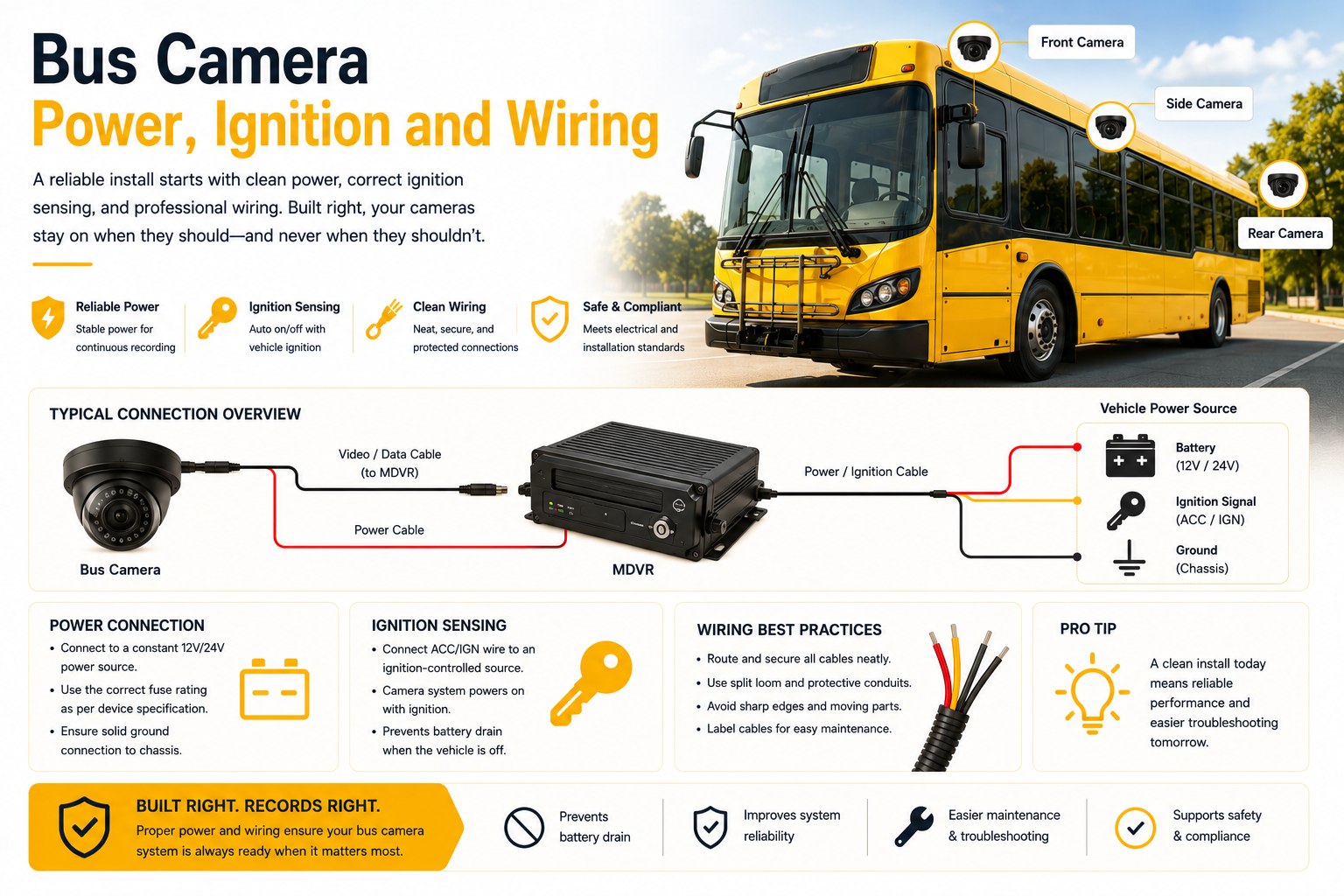
A camera rated fine for a passenger car dashboard can fail within a year mounted on a body-on-chassis bus, where constant low-frequency vibration and temperature swings from a Minnesota winter to a Texas summer are simply outside what that hardware was ever tested for. "Rugged bus camera" really means two separate specs — an IP/IK rating for physical ingress and impact, and an operating temperature range wide enough for your actual climate — and a camera can pass one while failing the other. See how BusCMMS can help manage your bus camera operations.
Vibration and Temperature Ratings for Bus Cameras
What IP and IK ratings actually mean, the operating range a bus camera needs across a full year of climate swings, and the failure modes that show up in year two, not year one.
IP and IK Ratings: What the Numbers Actually Mean
Two-digit and single-digit codes that describe very specific, testable protection levels.
An IP (Ingress Protection) rating is written as two digits — the first for solid particle protection, the second for moisture protection. A common exterior bus camera spec might show IP67, meaning full protection against dust and the ability to withstand temporary immersion in water. An IK rating is a single number describing impact resistance, measured in joules of force the housing can withstand without damage. No single federal mandate governs IP or IK rating requirements for bus cameras; the compliance bar here is 49 CFR 396 maintenance record requirements and district policy, which means these ratings are a voluntary but important part of a fleet's own purchasing standard, not something a regulator checks.
The distinction matters because a camera can carry a strong IP rating — genuinely resistant to rain and road spray — while having a weak IK rating that leaves it vulnerable to the physical shock and constant low-level vibration of daily operation on a bus chassis. Both numbers need to be checked separately; one doesn't imply the other.
Operating Temperature Range: Northern Winters and Southern Summers
The same camera model has to survive both extremes if it's sold as a fleet-wide standard.
A bus camera's specified operating temperature range needs to cover the actual conditions it will face, not just a comfortable middle range. A northern fleet running buses in sub-zero winter mornings needs a camera rated well below freezing at the low end, since a below-spec unit can fail to power on reliably, or produce distorted footage, in genuinely cold starts. A southern fleet running buses that sit in direct sun on asphalt lots through summer afternoons needs a camera rated for sustained high interior temperatures at the top end, since an underrated unit can overheat and shut down or degrade during exactly the hours students are riding home. A fleet spanning both extremes across different regions, or simply a fleet that wants one hardware standard across its full inventory, needs a camera whose rated range comfortably covers both ends, not just the seasonal average.
Vibration Standards for a Body-on-Chassis Bus
Constant low-frequency vibration is a fundamentally different stress than the occasional bump a passenger car camera is designed for.
A body-on-chassis bus transmits a specific, sustained vibration pattern through the frame and body panels that's meaningfully different from the ride of a unibody passenger vehicle — lower frequency, more constant, and present on every mile of every route rather than just the occasional pothole. A camera hardware standard genuinely built for vehicle-mounted use should reference vibration testing standards specific to commercial or heavy vehicle applications, not a general consumer electronics durability spec. Asking a vendor directly which vibration standard their hardware is tested against, and whether that testing reflects a bus-type duty cycle rather than a passenger car, is one of the more useful qualifying questions in a purchase evaluation.
The Failure Modes That Show Up in Year Two, Not Year One
A camera can pass every initial check and still fail slowly, well after the warranty conversation has moved on.
Here's the objection worth naming directly: a camera with an inadequate vibration or temperature rating rarely fails on day one. It typically performs acceptably through its first several months, then begins showing intermittent problems — a loose internal connector from accumulated vibration, a lens seal that's slowly degraded from repeated thermal expansion and contraction, a mounting bracket that's fatigued from a year of constant low-level shock. These failure modes are specifically the kind that don't show up in a quick installation check or even a first-season review, which is exactly why a rating spec sheet matters more than a short initial trial period. A fleet that only tests new camera hardware for a few weeks before a full rollout decision may never see the failure modes that a genuinely under-rated unit will eventually produce.
The Install Mistake That Compounds a Weak Rating
Even a properly rated camera can fail early if it's mounted somewhere convenient instead of somewhere appropriate.
Install positions chosen for convenience rather than field of view create a second, compounding problem beyond simply leaving the loading door uncovered — a bracket mounted in a location with worse vibration exposure or more direct sun and heat exposure than necessary shortens the effective life of even a well-rated camera. A properly IP/IK-rated and temperature-rated unit still benefits from thoughtful placement that avoids unnecessary additional stress, and conversely, a marginal-spec camera mounted in a particularly harsh location on the bus will likely fail well before its rated lifespan would otherwise suggest.
A Scenario From a Real Bus Operation
A fleet split across two climate extremes, and what happened when one camera standard was applied to both.
A multi-district transportation cooperative running 65 buses across both a northern mountain region and a southern valley region standardised on a single camera model to simplify parts inventory and technician training. Within the first eighteen months, the northern buses showed a meaningfully higher rate of camera failures during winter months specifically, traced back to the unit's rated low-temperature threshold sitting close to the actual conditions those buses regularly encountered before dawn. The southern buses showed a separate pattern of intermittent lens fogging and reduced clarity during peak summer afternoons, tied to the same unit's upper temperature rating being marginal for sustained high heat in a sun-exposed mounting position. The cooperative's next hardware standard specified a wider operating range explicitly covering both climate extremes, rather than a single model chosen primarily for cost and inventory simplicity.
We picked one camera for our whole cooperative to keep parts simple, and it took us most of two winters to realize our mountain buses were failing at a completely different rate than our valley buses. Nobody had actually checked the temperature rating against our specific coldest mornings — we just assumed a commercial-grade camera meant it would handle anything. Now temperature range is the first spec I check, before resolution, before anything else.
Not sure your current camera's temperature rating actually covers your coldest mornings? That's worth checking before next winter. Talk to the team about a hardware spec review →
Quick Spec Reference
Scannable on a phone during a vendor call.
| Spec | What to actually check |
|---|---|
| IP rating | Confirm both digits — solid particle and moisture protection separately |
| IK rating | Confirm impact resistance in joules, tested against vehicle-mounted use |
| Operating temperature | Rated range must cover your actual coldest and hottest conditions, not the average |
| Vibration standard | Ask which standard was used and whether it reflects bus-type duty cycles |
| Year-two failure modes | Confirm rating against long-term testing, not just a short initial trial |
| Mounting position | Avoid compounding a marginal rating with an especially harsh mounting location |
Frequently Asked Questions
What do IP and IK ratings mean for a bus camera?
An IP (Ingress Protection) rating is a two-digit code describing resistance to solid particles and moisture — a common exterior bus camera spec might be IP67, meaning full dust protection and resistance to temporary water immersion. An IK rating is a single number describing impact resistance in joules. Both need to be checked separately, since a camera can have a strong IP rating while having a weak IK rating that leaves it vulnerable to physical shock and vibration.
What operating temperature range does a bus camera actually need?
The rated range needs to cover the fleet's actual coldest and hottest real conditions, not a comfortable seasonal average. A northern fleet needs a camera rated well below freezing to handle sub-zero winter mornings reliably, while a southern fleet needs a camera rated for sustained high interior heat from direct sun exposure. A fleet spanning both climates, or standardizing on one hardware model, needs a range comfortably covering both extremes.
Why does a body-on-chassis bus need different vibration testing than a passenger car camera?
A body-on-chassis bus transmits sustained, lower-frequency vibration through the frame on every mile of every route, which is a different stress pattern than the occasional bump a passenger car camera is designed for. Camera hardware genuinely built for vehicle-mounted use should reference vibration testing standards specific to commercial or heavy vehicle duty cycles, not a general consumer electronics durability spec.
Why do under-rated bus cameras often fail in year two rather than immediately?
Cameras with inadequate vibration or temperature ratings typically perform acceptably for the first several months before showing intermittent problems — a loose connector from accumulated vibration, a degraded lens seal from repeated thermal cycling, or a fatigued mounting bracket. These failure modes don't show up in a short initial trial period, which is why checking the rating spec sheet matters more than relying on early performance alone.
Is there a federal requirement for vibration or temperature ratings on bus cameras?
No single federal mandate governs vibration or temperature rating requirements for bus cameras. The compliance bar for bus records is set by 49 CFR 396 maintenance requirements and district policy, meaning these ratings are a voluntary but important part of a fleet's own purchasing standard rather than something a regulator checks.