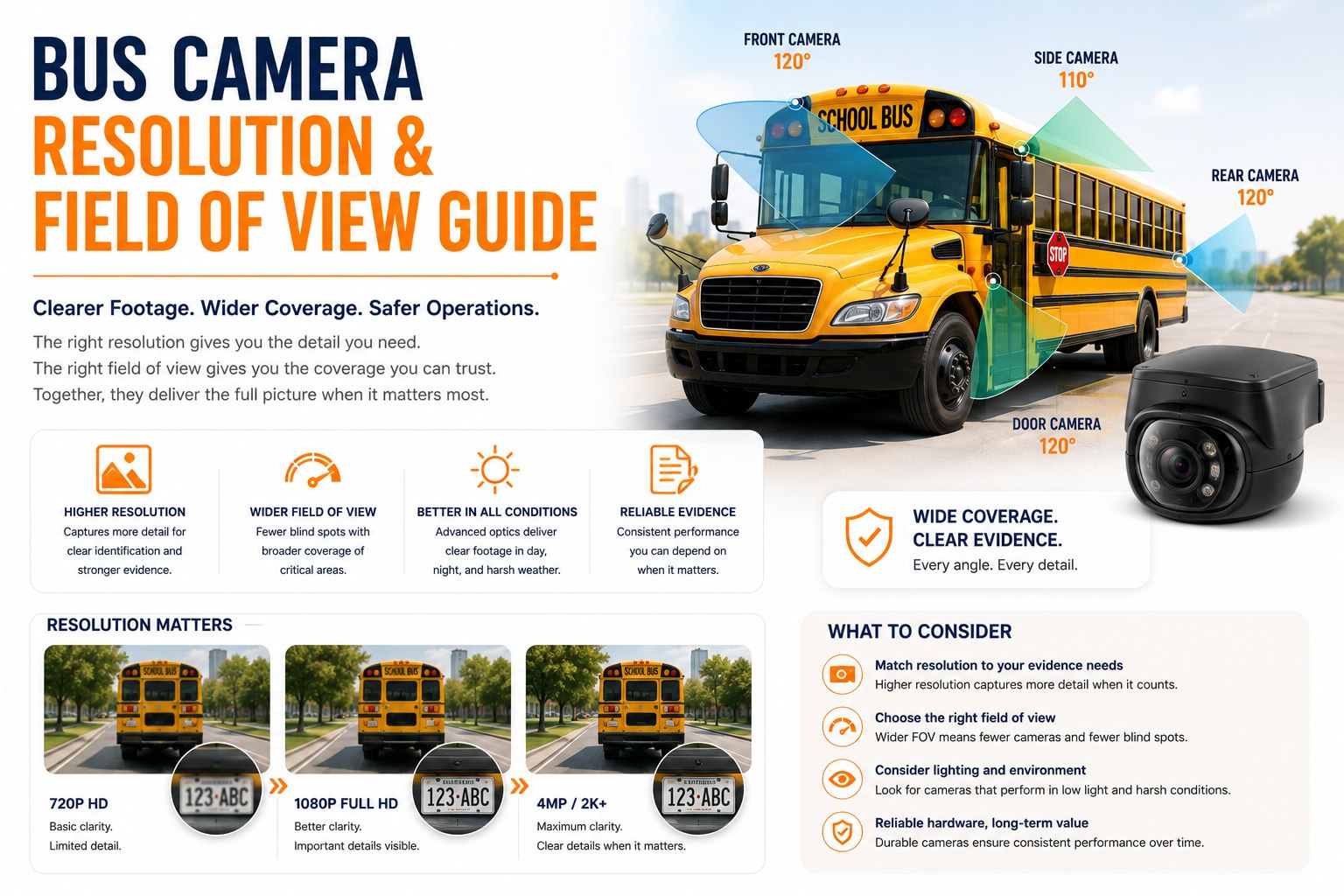
1080p is enough to identify a passing vehicle's make and color at stop-arm distance. It is usually not enough to read the plate clearly enough to hold up in an enforcement referral, and it's a different requirement entirely from what's needed to identify a specific student three rows back in a moving bus. "Bus camera resolution" isn't one number — it's at least three different answers depending on what the footage needs to prove. See resolution requirements mapped to your use cases → book a demo.
Bus Camera Resolution and Field of View Guide
What resolution actually needs to do at stop-arm distance versus inside the aisle, why megapixels alone don't decide it, and the lens distortion trade-off nobody explains upfront.
Three Different Resolution Jobs, Three Different Answers
"What resolution do I need" only has one answer once you specify what the footage needs to prove.
No single federal mandate governs bus camera resolution specifications; the compliance bar here is 49 CFR 396 maintenance record requirements and district policy, which means resolution decisions are made entirely at the fleet level based on what each camera actually needs to accomplish. That's the right framing, because "enough resolution" means something different depending on the job.
License Plate Read at Stop-Arm Distance
The highest resolution demand of the three. A plate needs to be legible at 20-40 feet, often on a moving vehicle, which requires enough pixel density at that specific distance — not just a high headline resolution number on a static test chart.
Vehicle Make/Color Identification
A meaningfully lower bar. Standard 1080p is generally adequate to confirm a passing vehicle's color, general shape, and approximate size — useful for a general incident description even when the plate itself isn't legible.
Student Identification in the Aisle
A different problem entirely — identifying a specific student and seat row from a wide-angle interior camera mounted at the front of a 35+ foot aisle, where resolution needs are driven by distance and angle, not motion.
Writing one resolution number into a purchase order and assuming it covers all three jobs is exactly how a fleet ends up with unusable footage on the one job that mattered. Get all three requirements checked against your fleet → book a demo.
Sensor Size vs Megapixels: The Spec That Actually Matters More
Two cameras with identical megapixel counts can produce very different footage.
Megapixel count gets all the marketing attention because it's a single number easy to compare between vendors, but it's only half the story. A camera's physical sensor size determines how much light each individual pixel actually captures — a higher megapixel count crammed onto a smaller sensor means each pixel is smaller and captures less light, which hurts performance specifically in low-light conditions like a dawn route or a dim bus interior. A camera with fewer megapixels on a larger sensor can meaningfully outperform a higher-megapixel camera on a smaller sensor once actual lighting conditions get difficult, even though the smaller-sensor camera "wins" on the spec sheet's headline number.
Wins the spec sheet comparison. Struggles in low light because each individual pixel captures less light — exactly the condition most bus incidents occur in (dawn routes, dim interiors).
Loses the headline number comparison but often produces clearer, more usable footage in the actual low-light conditions a fleet operates in daily.
Frame Rate: Why a Sharp Still Image Isn't Enough for a Moving Plate
Resolution and frame rate solve different problems, and both matter for a passing vehicle.
A camera can have excellent resolution and still produce a blurred, unreadable plate on a vehicle moving at even moderate speed if the frame rate is too low. Frame rate determines how many individual images the camera captures per second — a higher frame rate reduces motion blur on a fast-moving subject, which matters directly for a vehicle passing an extended stop arm, since that's rarely a slow-moving target. A camera spec'd purely around resolution while running a low frame rate can technically have a very sharp sensor and still fail at the one job — reading a moving plate — that resolution alone was supposed to solve.
Lens Distortion: The Trade-Off Between Coverage and Clarity
Wider field of view captures more of the scene, but stretches detail at the edges.
A wider-angle lens captures more of the scene in a single frame — useful for covering a wider zone with fewer cameras — but wide-angle lenses introduce distortion, particularly toward the edges of the frame, where straight lines curve and detail compresses. A plate or a student's face near the center of a wide-angle frame may be perfectly clear, while the same subject near the edge of that same frame can be meaningfully distorted. This is a real trade-off, not a solvable problem: a narrower lens with less distortion covers less physical area, while a wider lens covers more area at the cost of edge clarity. The right choice depends on whether the camera's job is broad situational coverage or precise identification within a narrower, predictable zone — like the specific area directly beside an extended stop arm.
The Install Mistake That Undermines Every Resolution Decision
The best sensor in the world can't capture a zone the camera isn't aimed at.
Here's the failure worth naming directly: install positions get chosen for convenience — wherever a bracket fits easily — rather than for the field of view that actually matters, and the loading door zone is the most commonly missed coverage gap as a result. All the resolution and frame rate optimization in the world doesn't help if the camera's mounting angle simply doesn't include the zone where an incident happens. Before finalizing any resolution spec, confirm the physical mounting position and angle actually captures the specific zones — the stop-arm area, the loading door, the full aisle — that the resolution requirements above were calculated for.
A Scenario From a Real Bus Operation
One resolution spec that looked fine on paper and failed on the one job that mattered.
A district running 46 buses selected a camera system based on a headline 4K resolution spec, assuming that number alone guaranteed usable footage for any incident. Within the first semester, a stop-arm violation was captured on video, but the vehicle was moving at normal road speed and the camera's frame rate was low enough that the plate rendered as a motion-blurred smear despite the high resolution — the incident was documented, but not in enough detail to support an enforcement referral. The district's next camera evaluation explicitly tested frame rate against a moving vehicle before purchase, rather than relying on the resolution number alone, and the replacement system produced a legible plate read on a comparable incident the following year.
We bought on the resolution number because that's what every vendor led with in their pitch. First real stop-arm incident, we had a beautifully sharp image of a blur — the plate was just gone, motion-smeared past the point of reading. Nobody had ever mentioned frame rate to us until after that happened. Now it's the second question I ask, right after resolution, not an afterthought.
Not sure your current cameras can actually read a moving plate? That's worth testing before it's tested by an incident. Talk to the team about a frame-rate audit →
Quick Spec Reference
Scannable on a phone during a vendor call.
| Spec | What to actually check |
|---|---|
| Plate-read resolution | Test legibility at actual 20-40 ft stop-arm distance, not a static chart |
| Student ID resolution | Test seat-row identification at full aisle length |
| Sensor size | Ask specifically — don't assume higher megapixels means better low-light footage |
| Frame rate | Confirm legibility on a moving vehicle, not just a stationary test subject |
| Lens distortion | Check edge-of-frame clarity, not just center-frame sharpness |
| Mounting position | Confirm the field of view actually includes the zone the resolution spec was calculated for |
Frequently Asked Questions
What resolution is needed to read a license plate at stop-arm distance?
Reading a plate legibly at typical stop-arm distances of 20-40 feet on a moving vehicle requires higher resolution and sufficient frame rate together — a high resolution number alone doesn't guarantee a legible read if motion blur from a low frame rate distorts the plate. This is a higher bar than simply identifying a vehicle's color or general shape, which standard 1080p resolution can usually handle.
Do more megapixels always mean better bus camera footage?
Not necessarily. Sensor size determines how much light each individual pixel captures, and a higher megapixel count crammed onto a smaller sensor means smaller individual pixels that perform worse in low light. A camera with a moderate megapixel count on a larger sensor can produce clearer, more usable footage in real low-light conditions than a higher-megapixel camera on a smaller sensor, even though the smaller sensor wins on the spec sheet's headline number.
Why does frame rate matter for reading a moving vehicle's plate?
Frame rate determines how many images a camera captures per second, and a low frame rate produces motion blur on a fast-moving subject like a vehicle passing an extended stop arm. A camera can have excellent resolution and still fail to produce a legible plate read if the frame rate is too low to freeze that motion clearly.
What's the trade-off between a wide-angle and narrow lens on a bus camera?
A wider-angle lens covers more physical area in a single frame but introduces more distortion toward the edges, where straight lines curve and detail compresses. A narrower lens produces less distortion but covers less area. The right choice depends on whether the camera needs broad situational coverage or precise identification within a smaller, predictable zone.
Why does camera mounting position matter as much as resolution specs?
Even a camera with ideal resolution, sensor size, and frame rate produces unusable footage if it isn't physically aimed at the zone that matters. Install positions chosen for mounting convenience rather than verified field of view commonly leave the loading door zone uncovered, which defeats the purpose of an otherwise well-specified camera.