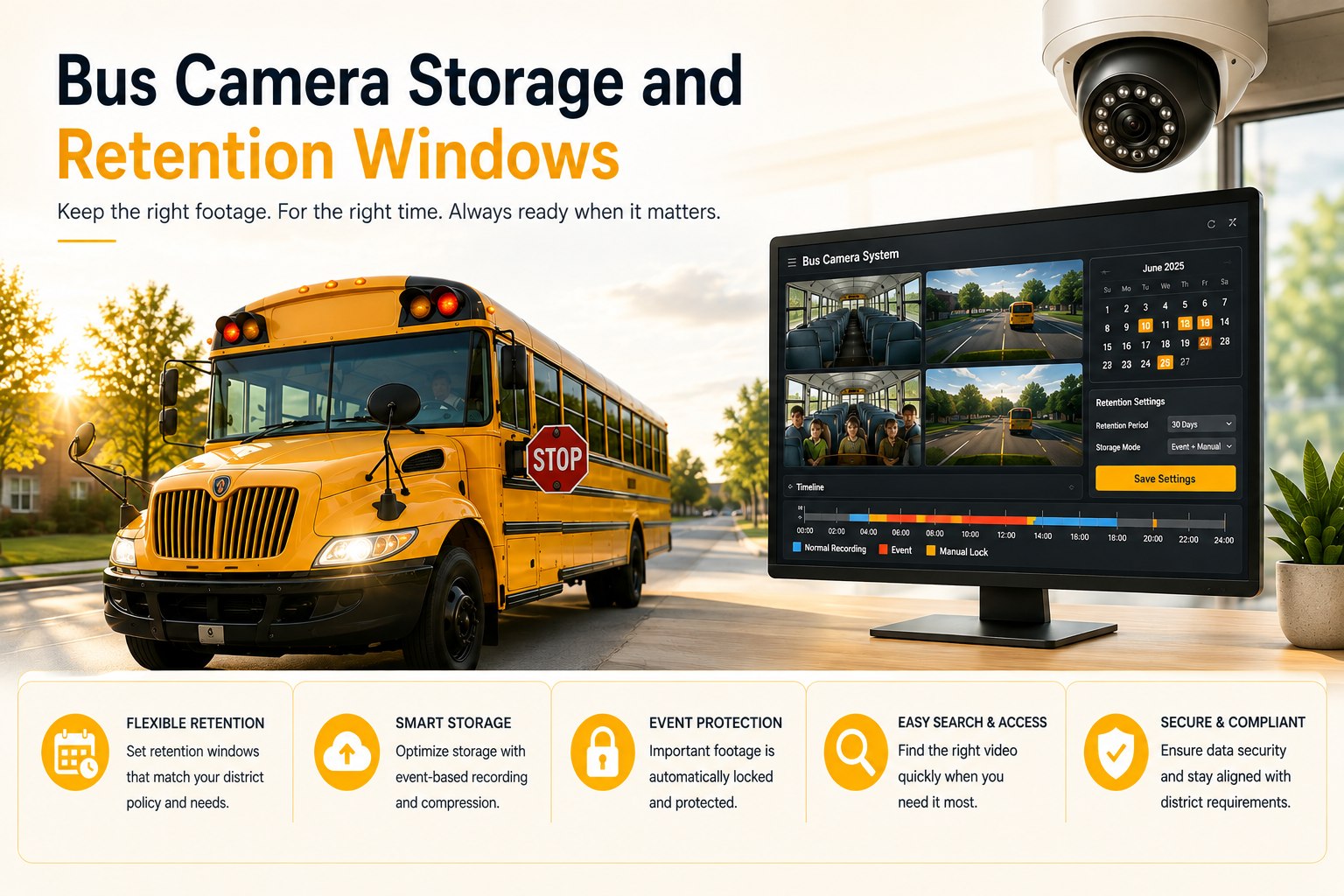
An 8-channel MDVR recording continuously at high bitrate can overwrite a full day's footage in under a week on a standard drive — which sounds fine until a complaint comes in on day nine. "Bus camera storage" is really a math problem: channel count times bitrate times drive size gives you a number of days, and that number needs to be longer than the gap between an incident and someone actually asking for the footage. Get your fleet's actual retention math checked → book a demo.
Bus Camera Storage and Retention Windows
The actual math behind how many days of footage a system holds, event-clip versus continuous storage, and matching retention to district policy instead of a vendor default.
Channel Count
More cameras recording simultaneously means more data written per hour, regardless of drive size.
Bitrate
Higher resolution and quality settings consume more storage per minute of footage recorded.
Drive Capacity
The physical ceiling — once it's full, the system starts overwriting the oldest footage first.
Event-Clip vs Continuous Retention: Two Very Different Storage Budgets
The single biggest lever for stretching or shrinking your retention window.
Continuous recording keeps a full, unbroken record of everything every camera captures for as long as storage allows — thorough, but the fastest way to fill a drive and shorten the effective retention window. Event-clip recording saves only the footage tied to a flagged event, plus a short buffer before and after, which uses a small fraction of the storage that continuous recording requires for the same time period. Most fleets that need both — a general safety net and specific incident evidence — run a hybrid: continuous recording on a shorter rolling window (say, 5-7 days) alongside event-clips retained much longer, since those are the specific pieces of footage most likely to be needed for an investigation weeks later.
The FERPA and State Law Question: How Long Should Footage Actually Be Kept?
Retention isn't just a technical spec — it's a compliance decision with real legal weight.
FERPA (20 U.S.C. 1232g), as applied to bus video, treats footage identifying individual students as potentially part of their education record, which has implications for how long it should reasonably be kept and who can access it. Layered on top of that, state public-records law and your district's own retention schedule set the specific number of days or years footage should be held before being purged — and these two frameworks need to be reconciled together, not treated as separate checkboxes. A retention window set purely by a vendor's default storage capacity, without reference to either FERPA guidance or your state's public-records requirements, is a policy gap waiting to surface during exactly the kind of records request or litigation discovery process where it matters most.
A defensible retention policy accounts for:
- Your state's specific public-records retention schedule for video
- FERPA implications for footage identifying individual students
- Realistic timelines for behavior, injury, and safety investigations
A vendor-default retention window often ignores:
- Whether the default window matches your specific state's requirements
- How long complaints or investigations realistically take to surface
- Litigation risk if footage is purged before a legal hold could apply
This is a policy decision worth documenting deliberately, not inheriting from whatever a vendor ships by default. Talk through your state's specific retention requirements → book a demo
Cloud Storage Cost Curves: Where the Budget Actually Goes
Cloud storage costs don't scale linearly with fleet size — they scale with retention policy choices.
Cloud storage cost is driven by three of the same variables as onboard retention — channel count, bitrate, and how long footage is kept — but with an ongoing monthly cost attached rather than a one-time hardware purchase. A fleet that defaults to continuous cloud upload for every channel on every bus, retained indefinitely, will see costs climb steeply as fleet size grows. A fleet that uses event-clip cloud sync as the primary cloud strategy, with continuous footage staying onboard on a shorter rolling window, keeps cloud costs proportional to actual incident volume rather than total recorded hours — a meaningfully different cost curve at fleet scale.
The Spec Mistake: Buying on Resolution, Not Retention
The same pattern that undermines exterior and interior camera specs shows up here too.
Here's the objection worth naming directly: camera purchases get specified around resolution as the headline number, and retention window gets treated as a footnote — often assumed to be "whatever the drive holds" rather than calculated deliberately against realistic investigation timelines. A higher-resolution camera consumes more storage per minute, which, without a corresponding storage upgrade, directly shortens the retention window. A fleet can genuinely believe it has strong camera coverage while actually holding only a few days of footage, because nobody ran the channel-times-bitrate-divided-by-capacity math before signing the purchase order. Low-light performance and vibration rating matter for the same underlying reason as on other camera specs — a system optimized for one number while ignoring the others produces footage that looks good on a spec sheet and fails the moment it's actually needed.
A Scenario From a Real Bus Operation
One retention gap, discovered at the worst possible moment.
A district running 50 buses purchased a camera system specified primarily around resolution, with retention treated as whatever the standard drive provided — which turned out to be roughly nine days of continuous footage at the system's default settings. When a parent reported a right-side stop-arm violation concern eleven days after the fact, the footage had already been overwritten. The district's follow-up evaluation calculated retention explicitly: with the same channel count and a modest bitrate reduction on non-critical channels, paired with a moderate drive capacity increase, the system could hold 21 days of continuous footage plus indefinite event-clip retention for flagged incidents — comfortably covering the realistic gap between an incident and a complaint being filed.
We never once asked our vendor how many days of footage we actually had until a complaint came in past our window and we found out the hard way. Turns out "however many days the drive holds" isn't a policy, it's an accident. Now retention is a number I actually know and can defend, tied to our state's records schedule, not a mystery buried in a spec sheet.
Not sure how many actual days of footage your current system holds? That's the first number worth calculating. Talk to the team about a retention audit →
Quick Spec Reference
Scannable on a phone during a vendor call.
| Spec | What to actually check |
|---|---|
| Retention math | Confirm actual days of footage: channel count × bitrate ÷ drive capacity |
| Recording model | Hybrid — shorter continuous window plus longer event-clip retention |
| State compliance | Retention window matched to your state's public-records schedule |
| FERPA alignment | Access and retention documented for footage identifying students |
| Cloud cost model | Event-clip sync as primary cloud strategy, not full continuous upload |
| Litigation risk | Retention window covers realistic gap between incident and complaint |
Frequently Asked Questions
How many days of footage does a bus camera system actually store?
Retention days depend on three factors together: channel count, recording bitrate, and drive capacity. More cameras recording simultaneously or higher-quality bitrate settings both increase how much data is written per hour, which shortens the retention window unless drive capacity increases to match. This calculation should be done explicitly for each specific system rather than assumed from a vendor's default settings.
What's the difference between event-clip and continuous camera retention?
Continuous recording keeps an unbroken record of everything captured, which fills storage quickly and shortens the effective retention window. Event-clip recording saves only footage tied to a flagged event plus a short buffer, using a fraction of the storage. Most fleets run a hybrid: a shorter continuous rolling window alongside longer-retained event clips, since those are more likely to be needed for later investigation.
Does FERPA set a specific retention period for bus camera footage?
FERPA (20 U.S.C. 1232g), as applied to bus video, treats footage identifying individual students as potentially part of their education record, which has implications for access and retention, but the specific number of days or years is typically set by state public-records law and district retention schedules working alongside FERPA rather than FERPA alone dictating an exact timeframe.
How does cloud storage cost scale with fleet size?
Cloud storage costs are driven by channel count, bitrate, and retention duration, similar to onboard storage, but with an ongoing monthly cost. A fleet defaulting to continuous cloud upload retained indefinitely sees costs climb steeply as fleet size grows, while a fleet using event-clip sync as the primary cloud strategy keeps costs proportional to actual incident volume rather than total recorded hours.
What's the risk of setting retention based on a vendor's default rather than district policy?
A vendor default may not match a specific state's public-records retention requirements, and it may not account for how long behavior, injury, or safety complaints realistically take to surface — often longer than a short default window covers. This creates a real risk that footage relevant to an investigation or legal matter is purged before anyone requests it, which is why retention should be a deliberate policy decision rather than an inherited default.