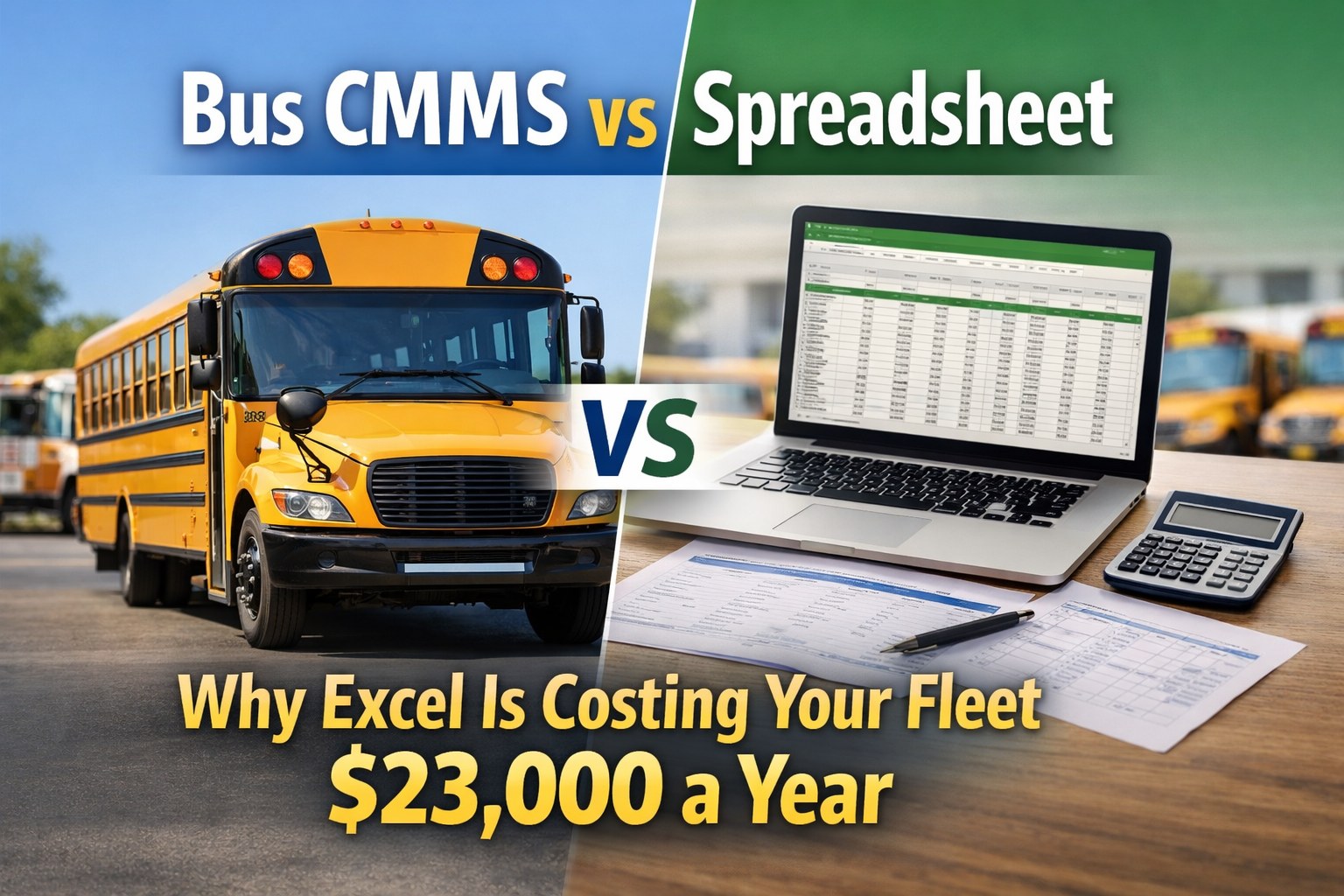
Your maintenance spreadsheet isn't free—it just hides its costs across a dozen budget lines you never connect. Missed PM intervals that become emergency repairs. Warranty claims that expire because nobody tracked them. Compliance fines from inspections that slipped through the cracks. For a typical 50-bus fleet, these hidden costs add up to $23,000 annually—money that silently drains from your operation while Excel does exactly what it's designed to do: store data without acting on it.
Where the $23,000 Goes
Every dollar of this loss is preventable. Here's exactly how spreadsheet-based maintenance bleeds money from your operation:
These aren't theoretical costs—they're documented losses from fleets that switched to CMMS and finally saw where their money was going. Book a demo to see how much your fleet could recover.
What Spreadsheets Can't Do
Excel is powerful software—for financial modeling, data analysis, and reporting. But maintenance management requires capabilities spreadsheets were never designed to provide:
The question isn't whether spreadsheets work—they do, for storing data. The question is whether storing data is enough when your operation needs automated workflows. Sign up free and see the difference automated maintenance makes.
Side-by-Side: Spreadsheet vs. CMMS
Here's what changes when you move from manual tracking to purpose-built maintenance software:
The Real ROI Timeline
Fleets implementing CMMS don't wait years to see returns. Here's what the research shows:
The data comes from industry benchmarks across thousands of fleet implementations. Your specific ROI depends on current practices—fleets with more reactive maintenance see larger improvements. Schedule a demo to calculate your fleet's potential savings.
Expert Review: When Spreadsheets Actually Work
To be fair, spreadsheets aren't always wrong. Here's an honest assessment of when each approach makes sense:
Most bus fleets crossed the threshold where CMMS makes financial sense years ago. The only question is how much longer you'll pay the hidden spreadsheet tax. Book a demo and see your actual cost recovery potential.
Frequently Asked Questions
How did you calculate the $23,000 annual cost?
The figure comes from documented losses across fleets that transitioned from spreadsheets to CMMS. It includes emergency repair premiums (reactive repairs cost 3-5× more than scheduled), missed warranty claims (industry data shows 40-60% of valid claims go unfiled without tracking), admin labor waste, compliance penalties, and rush shipping costs. For a 50-bus fleet, these categories consistently total $20,000-$28,000 annually—$23,000 is a conservative midpoint.
Our spreadsheet system works fine. Why change?
If your PM compliance exceeds 95%, you've had zero DOT findings, no emergency repairs in the past year, and you've filed every valid warranty claim, your spreadsheet system genuinely works. For most fleets, "works fine" means "we haven't connected our breakdowns to missed PM intervals." CMMS makes those connections visible—often revealing costs that were always there but never attributed to maintenance tracking failures.
How long does it take to switch from spreadsheets to CMMS?
Most fleets are operational within 1-2 weeks. Basic setup takes hours, not days. Historical data migration varies—some fleets import spreadsheet data; others start fresh and build history going forward. The biggest time investment is training, which typically requires 2-4 hours for staff to become proficient with core workflows.
What if our team isn't tech-savvy?
Modern CMMS platforms are designed for field use, not IT departments. If your team can use a smartphone, they can use fleet maintenance software. Mobile apps guide technicians through inspections with photos and checklists. Many fleets report that older technicians who resisted computers adapt quickly because the mobile interface is intuitive—often easier than the spreadsheet system they replace.
How much does Bus CMMS cost compared to spreadsheets?
Spreadsheets appear free but carry hidden costs averaging $460 per bus annually in our analysis. CMMS software typically costs $4-$15 per vehicle monthly depending on features—$48-$180 per bus annually. When a single prevented breakdown saves $2,000-$8,500, the math favors CMMS for any fleet larger than 5 vehicles. Most fleets achieve full payback within 4-8 months through reduced emergency repairs alone.