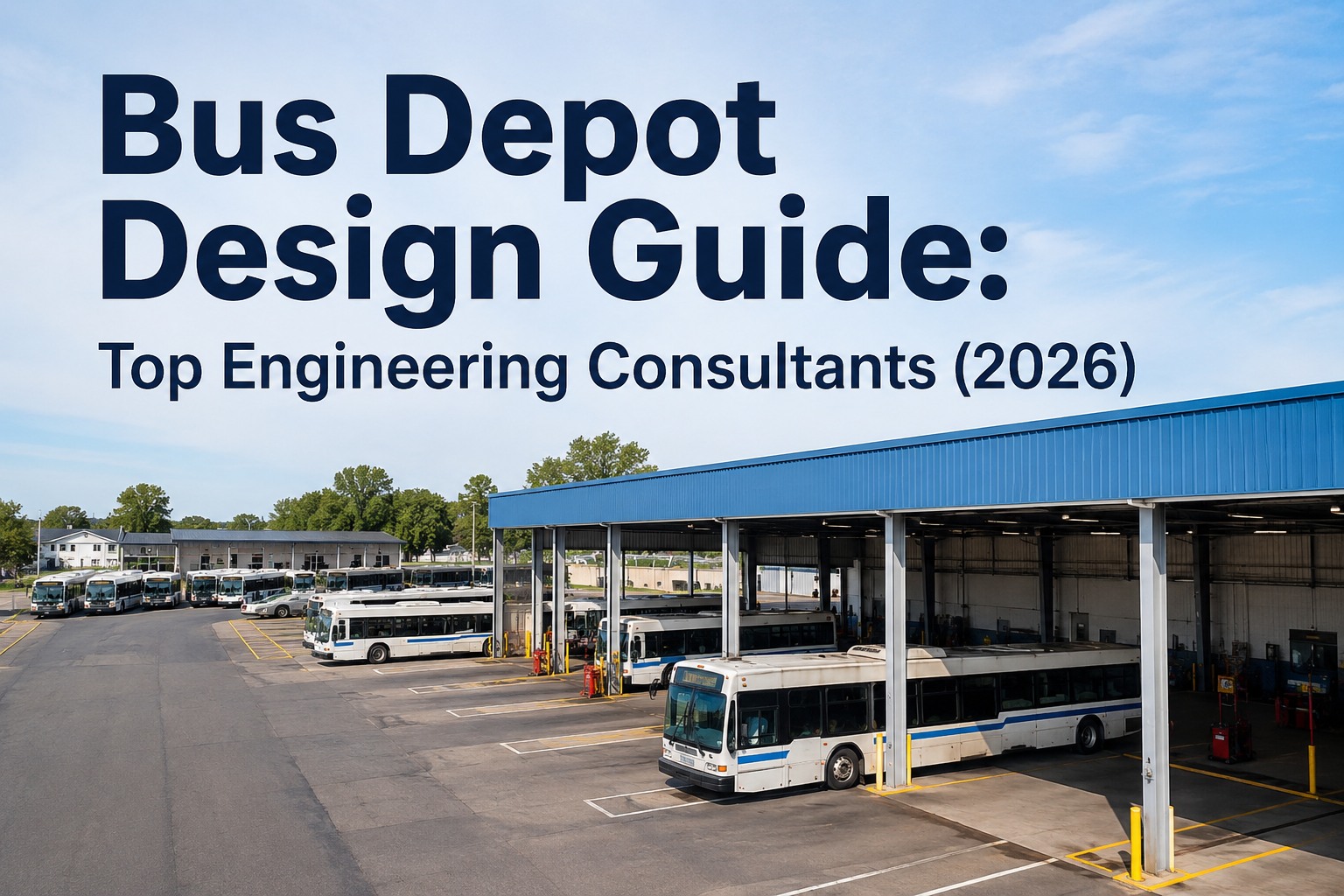
Your transit board just approved a $45M expansion depot for 80 new buses -- half diesel, half electric. The engineering firm you pick, the workshop layout you sign off on, the parts warehouse dimensions you specify, and the CMMS you set up on Day 1 all lock in your fleet operating costs for the next 25 years. This 2026 guide covers the eight engineering firms actually delivering bus depot projects across the US, plus the depot design decisions that will make or break maintenance productivity from Day 1.
Bus Depot Design Guide: Top Engineering Consultants (2026)
Eight leading engineering firms ranked on real bus depot project delivery, EV facility electrification experience, and total operational fit -- plus the workshop, parts, and CMMS design decisions that lock in fleet efficiency for the next 25 years.
6 Depot Design Priorities That Drive 25-Year Operating Cost
Every dollar you invest at design phase saves ten dollars over the depot's operating life. Focus the design conversation on these six priorities.
-
01
Site circulation & flow
One-way bus routing, staff parking separation, safe pedestrian crossings, and fueling/charging queue design. Bad circulation costs 20-30 minutes per driver shift start.
-
02
Maintenance workshop layout
Bay count, drive-through vs back-in, lift versus pit, tool distribution, and technician workflow. This is where fleet uptime is engineered or destroyed.
-
03
Parking capacity + 20-year growth
Design for actual fleet plus 30% growth headroom. Redesigning a depot 5 years in because you outgrew the lot costs 4-6x the original build.
-
04
Utilities + power infrastructure
Electric service to depot for EV charging is often the longest lead time in the whole project. Design for peak charging load plus future battery storage tie-in.
-
05
Environmental + stormwater
Fuel spill containment, DEF handling, wash water reclaim, stormwater management, and emissions permitting. Every state DOT has its own rulebook.
-
06
Future flexibility
Depot built in 2026 will operate into the 2050s. Design for fuel-type transition (diesel → CNG → EV → hydrogen). Modular power distribution. Convertible bays.
The 8 Engineering Firms Actually Delivering Bus Depots
Ranked on bus depot project delivery, EV facility experience, and transit sector focus. Deep-dives follow.
| Firm | Specialty | EV Depot Focus | Fleet Fit |
|---|---|---|---|
| STV Group | Transit maintenance facilities national leader | Exceptional | Best for EV |
| AECOM | 100+ year transit engineering practice | Excellent | Universal |
| Jacobs Engineering | Multi-sector infrastructure delivery | Excellent | Large agencies |
| WSP | Sustainability-focused transit design | Excellent | Green fleets |
| HDR | Transit + community infrastructure | Strong | Mid-size agencies |
| HNTB | Multi-modal transportation infrastructure | Strong | Multi-modal |
| Kimley-Horn | Transportation planning + engineering | Growing | Schools + mid-size |
| Arup US | Sustainable, future-ready design | Excellent | Innovation-forward |
8 Engineering Firms in Detail
Each firm's Notable Projects row shows real bus depot facilities they have designed or currently deliver.
STV Group
Bus depot electrification leaderSTV is the national practice leader for transit maintenance facility design, with the deepest bus depot electrification portfolio of any US firm. Uses proprietary PEER (Performance Evaluation of Electric Bus Routes) modeling to feed depot design with real fleet operational data. Strong at multi-fuel facility design (diesel + CNG + EV) for agencies mid-transition.
AECOM
100+ year transit engineering practiceLargest transit engineering firm globally, over 100 years of continuous transit work. Full-spectrum services from planning through construction management. Strong on complex multi-agency projects and integrations with rail. Leads BD+C 2025 Giants 400 Report ranking of transit facility firms.
Jacobs Engineering
Multi-sector infrastructure deliveryMajor infrastructure firm with deep transit portfolio. Strong at facility design for large transit agencies with complex operational requirements. Multi-disciplinary teams cover architecture, engineering, environmental, and construction management under one contract.
WSP
Sustainability-focused transit designGlobal engineering firm with strong US transit practice and industry-leading focus on sustainability and low-carbon design. Best fit for agencies pursuing LEED or Net-Zero facility certification. Strong at integrated site design with solar, battery storage, and demand-response systems.
HDR
Transit + community infrastructureHDR delivers integrated transit facility solutions for mid-size agencies and municipal transit systems. Strong on community stakeholder engagement and phased delivery for depot renovations. Good fit for districts and agencies balancing operational needs with community context.
HNTB
Multi-modal transportation infrastructureDeep multi-modal engineering with strong bus, rail, and aviation portfolios. Best fit when the depot project connects with other transit modes -- BRT stations, park-and-ride, rail transfer facilities. Emphasizes smart transportation technology integration.
Kimley-Horn
Transportation planning + engineeringStrong in transportation planning combined with facility engineering. Best fit for school districts and mid-size transit agencies where the depot is one part of a broader operations plan. Ranks in BD+C's top 5 transit facility engineering firms.
Arup US
Sustainable, future-ready designGlobally respected engineering firm with US transit practice known for sustainable, future-ready facility design. Best fit for agencies wanting cutting-edge integration of energy, digital infrastructure, and modular flexibility. Higher design fees but genuinely forward-looking outputs.
Depot Design Decisions That Drive Maintenance Productivity
The engineering firm designs the building. The decisions below determine whether the shop actually works when the buses arrive.
Maintenance Workshop Layout for Technician Productivity
Bay count is the headline number, but bay configuration drives productivity. Drive-through bays (bus enters from one end, exits the other) cut per-work-order time by 15-25% versus back-in bays. Parallel bays with shared tool cribs cut tech walk-time by 30-40 minutes per shift. In-ground lifts serve heavier work; two-post above-ground lifts handle 80% of routine work at lower cost.
- Drive-through configuration for at least 60% of bays
- Central tool crib within 15 seconds walk of every bay
- Parallel bay orientation for shared HVAC + air lines
- Mix of lift types: 2 in-ground pits, remainder 2-post/4-post lifts
Inspection Bays & PM Areas
Preventive maintenance work has different tempo than repair work. PM bays should have a dedicated area for driver DVIR handoff, a documented PM checklist workflow, and a clean flow from arrival through inspection to release. Fleets running structured PM through a CMMS see 25% higher bay throughput than fleets running PM ad-hoc.
- Dedicated PM lanes separate from repair lanes
- DVIR station at bay entry with tablet mount + charging
- Standard workflow markings on floor for PM sequence
- Digital signage integrated with CMMS work orders
Spare Parts Warehouse Layout
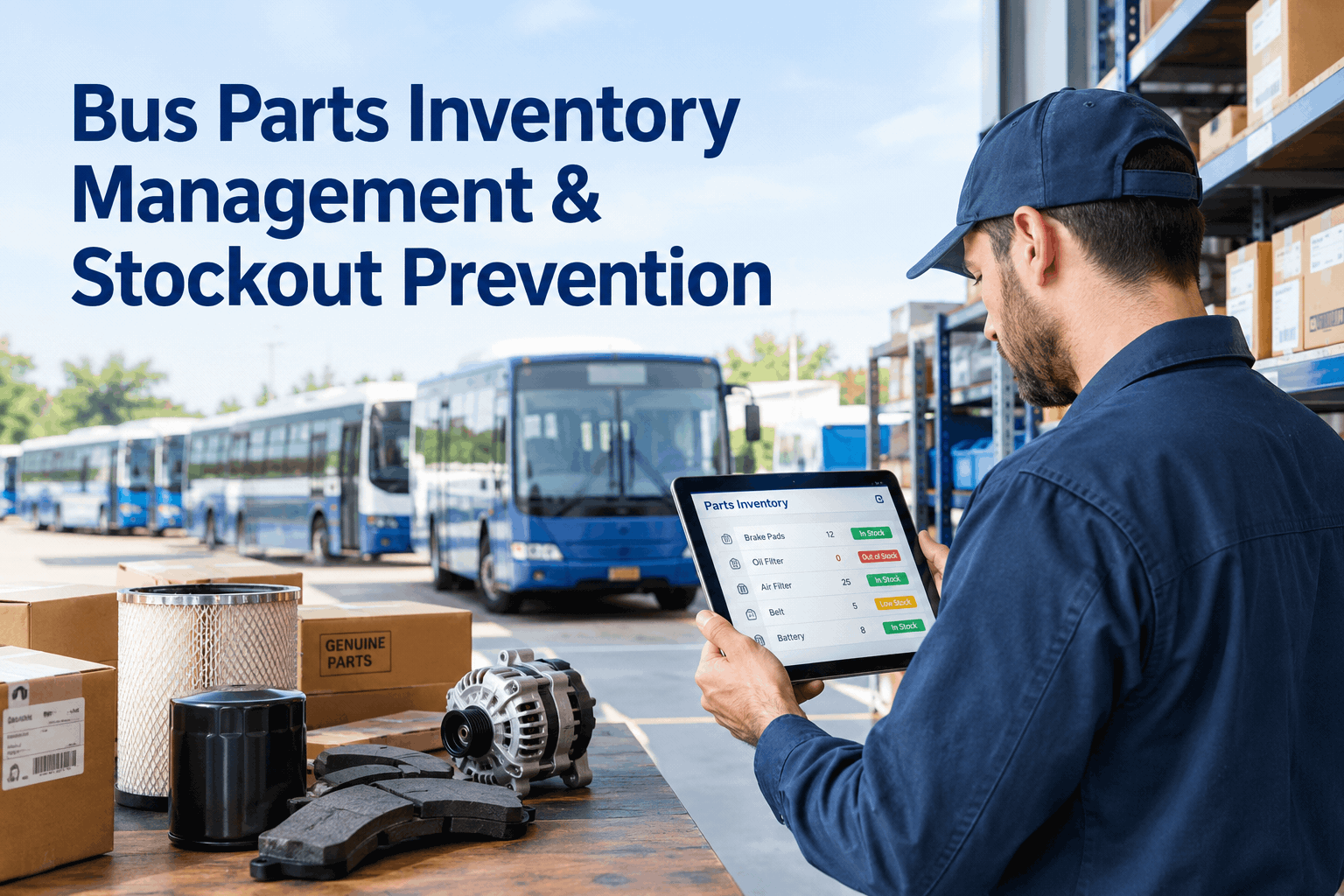
Parts warehouse layout is where 10-15% of technician time gets recovered or wasted. ABC classification (A = high-velocity, B = medium, C = slow-movers) drives shelf placement. A-parts sit within 20 feet of the shop counter; C-parts occupy the back of the warehouse. Every part gets a barcode or QR code from Day 1 for CMMS inventory tracking.
- ABC velocity zones with A-parts closest to shop counter
- Barcode / QR label standard defined during construction, not after
- Reorder point set by CMMS usage data, not vendor default
- Physical bin sizes matched to typical order quantity
Work Order Workflow Design
The physical shop layout should follow the CMMS work order flow, not fight it. Work orders enter the shop through a defined intake station, get assigned to bays by qualification (see certification tracking), move through PM or repair sequences, close out at parts return + labor sign-off, and get archived for warranty defense. Every step is a physical location in the shop.
- Intake station with tablet + scanner near bay entrance
- Assignment board (physical or digital) showing bay status live
- Sign-off station with printer for warranty documentation
- Archive process linked to CMMS work order closure
Fuel + EV Charging Infrastructure
Diesel + DEF + electric charging often share the same site zone but need different design treatment. Diesel and DEF tanks demand spill containment, vapor recovery, and safe fire distance. EV charging demands utility service capacity, thermal management, and OCPP-compliant hardware. Both need CMMS integration -- fuel transactions per bus, kWh delivered per bus, charger uptime per unit.
- Diesel + DEF: shared containment, monitoring, and DEF-only nozzles
- EV charging: utility capacity sized for peak demand plus 30% headroom
- OCPP 2.0.1 compliance required for chargers to talk to CMMS
- Fuel + charging transaction data flows directly to CMMS for cost per mile
Digital-First Depot Commissioning & CMMS Setup
The strongest engineering firms know a depot is not "done" when the building is done. It is done when the assets are tagged, the CMMS is loaded, and the shop can accept its first work order.
Asset tagging during commissioning
Every bay, lift, chargier, tool cabinet, fuel pump, and parts bin gets a QR or barcode tag before the ribbon-cutting. Tag standard defined in the design phase, applied during construction. No retrofit tagging six months in.
CMMS asset hierarchy configured
Site → Building → Zone → Bay → Equipment. Loaded into the CMMS during construction, not after. Work orders can then be created against specific assets from Day 1 -- no "which bay is that lift in?" ambiguity.
PM schedules pre-loaded
Every asset (buses, lifts, chargers, air compressors, HVAC units) gets its manufacturer PM schedule loaded into the CMMS before opening day. Alerts fire on schedule from the day the depot opens.
Technician profiles + certifications
Every technician's ASE, EPA 609, OEM, and xEV credentials logged in the CMMS. Work orders auto-route by qualification from Day 1. No unqualified work sign-offs, no missed renewals, no state-audit surprises.
Fuel + charger integration live
Diesel fuel management system + EV charger network integrated with CMMS on Day 1. Every fuel transaction and every kWh dispensed is captured against the specific bus. Cost-per-mile reporting starts immediately.
Parts inventory populated
Opening-day parts inventory loaded into CMMS with actual bin locations, cost, supplier, and reorder points. First technician who needs a part on Day 1 can look it up on a tablet and go directly to the bin.
Book a demo to see how BusCMMS handles digital commissioning + Day 1 depot operations.
How BusCMMS Supports New Depot Operations
A new depot is a rare and expensive moment. The CMMS choice made during design is the same CMMS your shop uses for the next 20 years.
-
Design phase
Data feeds engineering decisions
Fleet operational data (dwell times, PM cycles, energy consumption, seasonal peaks) exported from BusCMMS informs the engineering firm's design assumptions. Real data replaces guesswork.
-
Construction
Asset tagging standard
BusCMMS provides the tagging standard and asset hierarchy template so the construction team knows what to label and how. No last-minute retrofit tagging.
-
Commissioning
Pre-configured system ready
Asset hierarchy loaded, PM schedules configured, technicians assigned, parts inventory populated. When the depot opens, the CMMS is already running.
-
Day 1
First work order flows correctly
Driver DVIR triggers a work order that routes to the correct qualified technician in the correct bay with the correct parts staged. From opening day forward.
-
Year 2+
Data supports next depot decision
Actual per-bus cost, per-bay utilization, per-tech productivity, and per-asset warranty history become the input for the next depot expansion or replacement decision.
A new depot represents 25 years of operating decisions locked in over a 24-month design + construction window. Book a demo to see how BusCMMS supports depot design, commissioning, and Day 1 operations for your fleet.
How long does a new bus depot project take from planning to opening?
Typical timeline is 24-36 months for a new-build depot: 4-8 months for planning and engineering firm selection, 12-18 months for design (including permitting), and 12-18 months for construction and commissioning. EV-electrified depots can add 6-12 months to the utility service coordination alone. Depot renovations run 18-30 months. The engineering firm's ability to sequence utility coordination in parallel with design work often determines whether the project finishes on schedule.
What is the biggest bus depot design mistake?
Under-sizing parking capacity for future growth. Depots designed exactly to current fleet capacity are outgrown within 3-5 years, and expansion projects cost 4-6x per stall compared to the original build. Best practice is to design for current fleet + 30% growth headroom + provision for fuel-type transition (diesel bays convertible to EV over time). The engineering firm should model 20-year fleet growth and fuel mix scenarios during the design phase, not add them as change orders during construction.
How much does a new bus depot cost per bus?
All-in cost typically runs $250,000 to $650,000 per bus stall for a modern electrified depot in the US. This includes site acquisition, engineering, construction, utility work, and equipment. Diesel-only depots run at the lower end ($200K-$300K per stall). EV-electrified depots with DC fast charging, utility service upgrades, and battery storage integration hit the higher end. Engineering firm fees typically run 8-12% of construction cost.
Should we pick the engineering firm or the CMMS first?
In parallel. The engineering firm designs the physical facility; the CMMS defines how the facility operates. Best-in-class projects bring the CMMS provider into design conversations early so that asset tagging standards, work order workflows, and physical shop layouts are designed together rather than retrofitted. Fleets that pick the CMMS after the depot is built spend the first 12-18 months of operation adjusting the shop to fit the software. Fleets that align both from the start hit full productivity on Day 1.
How does BusCMMS support new depot design and Day 1 operations?
BusCMMS provides fleet operational data (dwell times, PM cycles, per-bus energy consumption, seasonal peaks) that informs engineering firm design assumptions. During construction, BusCMMS supplies the asset tagging standard so every bay, lift, charger, and part bin is labeled correctly the first time. Before commissioning, the CMMS is pre-configured with asset hierarchy, PM schedules, technician certifications, and parts inventory. On Day 1, the first driver DVIR triggers a work order that flows correctly through the system. Book a 20-minute demo to see the design-through-commissioning workflow, or start a 30-day free trial.