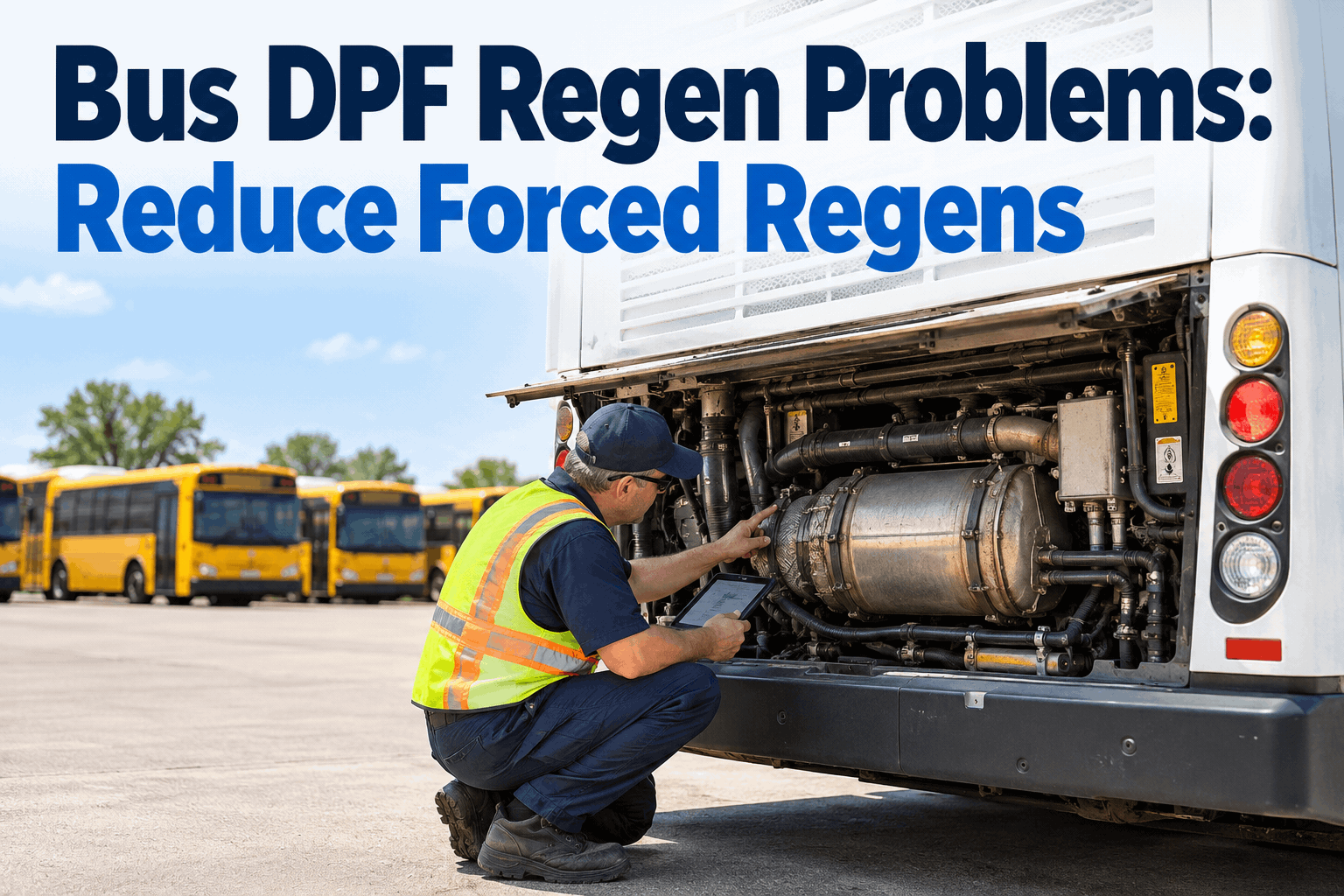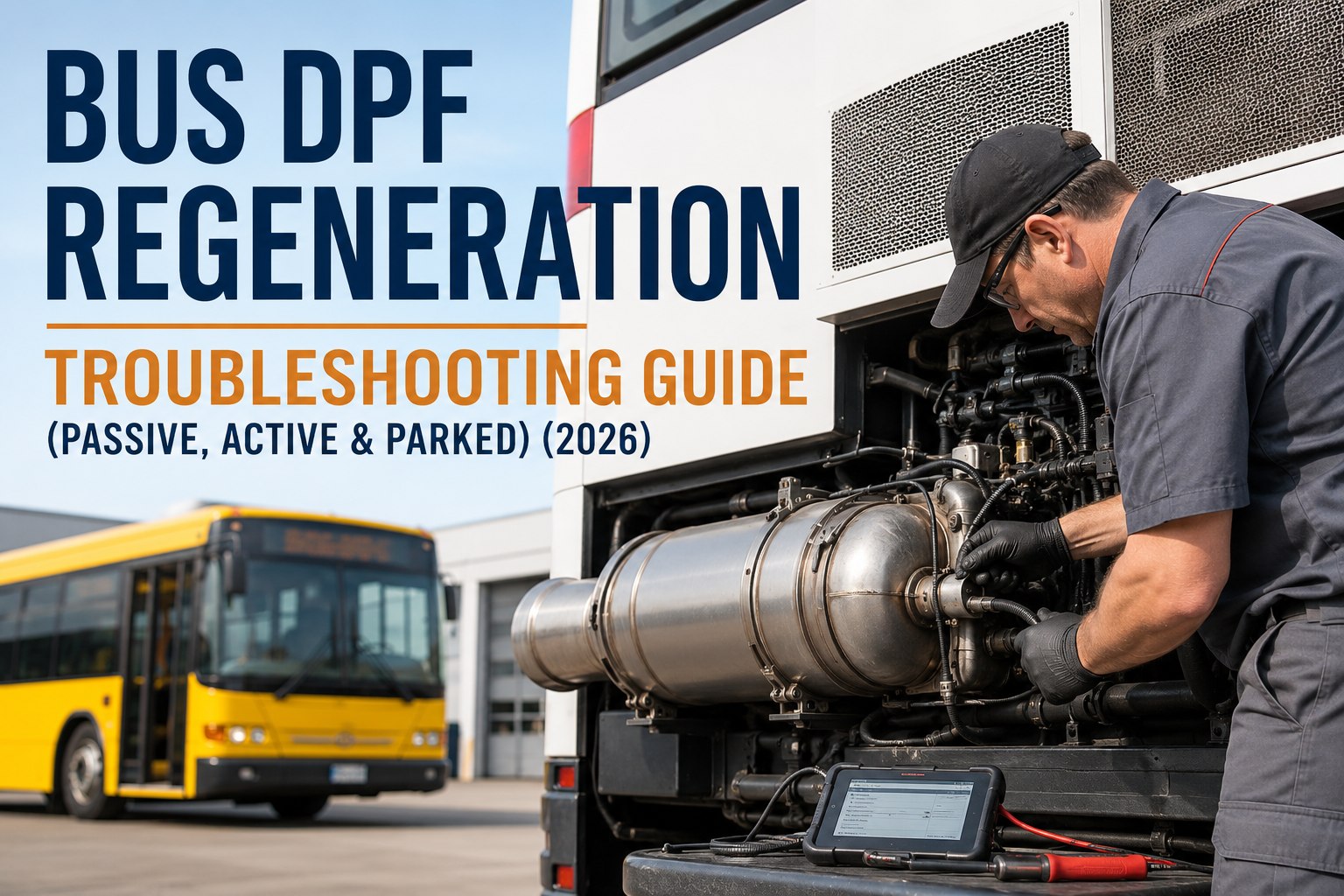
Bus 42 sits in the yard at 6:47 a.m. with a solid DPF light -- third regen call this week. If that scene sounds familiar, DPF regeneration troubleshooting is eating hours you don't have. This guide walks the 3 regen modes, 8 real root causes, fault codes that block regen, and the diagnostic sequence that saves a $2,500 filter. Book a demo to see regen tracking built for bus fleets.
Bus DPF Regeneration Troubleshooting: Passive, Active & Parked Regen Fixes
The 3 regen modes, 8 root causes, fault codes that block regen, and the sequence that saves a $2,500 DPF replacement
- 30 minAvg parked regen
- 85%Soot = forced regen
- $150vs $2,500 DPF
- 1
Passive Regen
650–750°F
Highway cruise, driver never notices
- 2
Active Regen
1,000–1,200°F
ECU injects fuel while driving
- 3
Parked / Forced
1,100°F+
Bus stationary, 20–40 min cycle
- !
Derate / Limp
SOOT > 100%
Power & speed cut, tow-in likely
The Three Regen Modes — And Where Buses Get Stuck
Every DPF regeneration troubleshooting call starts with one question: which mode failed? A modern diesel bus has three ways to burn off soot, and knowing which one the bus is stuck in tells you most of what you need before you plug in a scan tool.
Passive Regeneration
Soot burns off naturally at highway EGTs (650–750°F). No fuel injection, no driver action, no downtime. The ideal state.
Short routes, heavy idle, stop-and-go city runs. Exhaust never stays hot long enough. Classic school bus and urban transit problem.
Active Regeneration
ECU commands post-injection fuel into the exhaust to raise EGT above 1,000°F while driving. Cycle runs 20–40 minutes.
Driver shuts down mid-cycle, EGT sensor fault, boost leak, or clogged dosing injector. Partial burns load soot faster.
Parked / Forced Regen
Manual, stationary regen initiated by driver or tech. High RPM, fuel dosed into exhaust, 30 minutes average. The last chance before derate.
Active fault codes block it, safety interlock not met, or soot > 100%. Repeated attempts damage the substrate.
Thomas Built Buses has documented fleets running six to seven forced regens per day per bus at the worst -- Loudoun County (Va.) Public Schools cited that exact number before engine strategies cut it back. That's not a maintenance program; it's a full-time regen shop pretending to be one. Book a demo to log every regen event per bus, per route, in one dashboard.
The 8 Real Root Causes of Failed Regens
A DPF light is a symptom, not a diagnosis. Nine times out of ten the filter itself is fine -- something upstream is producing too much soot, blocking the burn, or lying to the ECU. Here are the eight causes behind the vast majority of regen failures, in the order you should check them.
- 01CHECK FIRST
Short-trip / heavy-idle duty cycle
EGT never sustains 650°F+. Passive regen can't run, actives stack up, forced regens go weekly. #1 cause on school bus and urban transit routes.
- 02SENSOR
Failed EGT (exhaust gas temp) sensor
If the ECU can't confirm target temp, it won't start or complete regen. Common on high-mileage buses. A $150 sensor prevents a $2,500 DPF replacement.
- 03SENSOR
Cracked DPF differential pressure tubes
Rubber hoses on the DP sensor crack from underhood heat. False high-soot readings trigger unnecessary regens. Cheapest fix on this list.
- 04DOSING
Clogged 7th injector / dosing valve
Carbon buildup on the dosing nozzle stops fuel from reaching the exhaust. Active regen fails silently. Common cause of repeat forced-regen requests.
- 05AIR PATH
Boost or exhaust leak
Cracked charge pipes, blown bellows, or turbo leaks distort MAF/MAP data. ECU runs rich, makes extra soot, can't reach regen temp. Smoke-test the charge system.
- 06EMISSIONS
DEF quality / dosing / NOx sensor faults
P20EE, P207F, P204F. Contaminated DEF or a bad NOx sensor triggers derate that blocks regen. Fix SCR side first or forced regen won't complete.
- 07EGR
Sticky or carboned EGR valve
EGR stuck open floods intake with recirculated exhaust, spiking soot production. More soot in, more regens out. Common past 150K miles.
- 08DPF
Ash-loaded DPF (end of service life)
Regen only burns soot, not ash. After 200K–300K miles the ash residue plugs the substrate. No forced regen empties ash — only pro cleaning or replacement.
The three easiest checks -- duty cycle, EGT sensor, DP pressure tubes -- solve the majority of regen problems on school bus fleets. Jumping straight to "replace the DPF" without ruling those out is spending $2,500 to fix a $150 sensor. Book a demo to see the 8-cause checklist built into your work orders.
Fault Codes That Block Regen (And How to Read Them)
Here's what most drivers and even some techs miss: the ECU refuses to run a regen if certain fault codes are active, no matter how many times you press the forced-regen button. The bus is protecting itself. If parked regen won't start, the answer is almost always in the fault code list -- not the DPF.
DPF Efficiency Below Threshold
Often sensor drift or DP tube crack, not a damaged filter. Verify soot load with a scan tool before condemning the DPF.
DPF Restriction — Ash
Ash-loaded filter at end of service life. Triggers derate. Forced regen won't fix it — needs pro cleaning or replacement.
DPF Restriction — Soot
Excessive soot load, often from interrupted regens. Diagnose root cause first — forcing another regen without fixing it makes it worse.
SCR NOx Catalyst Low
Emissions-side fault that blocks regen. Check DEF quality, NOx sensors, and dosing valve before touching the DPF.
Reductant Quality Poor
Bad DEF or a bad DEF quality sensor. Test the fluid first — the sensor throws false positives in cold weather on some engines.
Reductant Control Module
Almost never the primary problem. Usually points to other DTCs on the module — fix those first and P204F clears on its own.
The SCR/DEF codes catch most fleets off guard. P20EE and P207F don't feel like DPF codes, but they'll block a forced regen just as hard as a plugged filter. Techs spend an hour force-regenning a bus that will never start until the DEF fault is cleared. Sign up free to auto-ingest fault codes from your telematics into work orders.
The Diagnostic Sequence That Saves a $2,500 DPF
Nine out of ten "the DPF is bad" calls turn out to be something else once you follow a real diagnostic sequence. Here's the six-step order well-run shops actually follow. Every step costs less than the next, so working top to bottom keeps you out of the $2,500 hole unless it's actually needed.
- 1
Scan all fault codes — engine, aftertreatment, SCR
Any active code can block regen. Clear or resolve them before doing anything else. Solves ~30% of "won't regen" calls by itself.
Cost: $0 (scan tool) - 2
Check live data — soot load, ash load, EGT
Soot at 100% means regen; ash at 100% means service. Cross-check EGT sensors against each other — big deltas mean a bad sensor.
Cost: $0 (scan tool) - 3
Inspect DP sensor tubes and EGT wiring
Cracked rubber DP tubes and corroded EGT connectors cause more false regen requests than actual DPF failures. Five-minute visual check.
Cost: $20–$150 - 4
Smoke-test charge air & exhaust for leaks
Boost leaks, cracked bellows, or loose clamps drop EGT and prevent regen from reaching target. Pressure test from turbo to SCR inlet.
Cost: $50–$400 - 5
Test 7th injector / DEF dosing valve
Command the dosing valve open with a scan tool. No fuel or DEF flow means clogged nozzle. Clean or replace — often solves repeat regen requests.
Cost: $200–$600 - 6
DPF cleaning or replacement
Only after steps 1–5 are ruled out. Ash-loaded DPF at 200K+ miles is a real end-of-life event. Pro cleaning restores service; cracked substrate = replace.
Cost: $300 clean / $2,500+ replace
The point isn't just the fix -- it's the discipline of not skipping steps. Every fleet has a story about a bus that got a new DPF, ran fine for two weeks, then went right back into regen hell because nobody fixed the boost leak making the soot. Same problem, new $2,500 filter, same result. Book a demo to see this diagnostic sequence loaded into work order templates.
Route Design: The Root Cause Nobody Wants to Talk About
Half the DPF regeneration troubleshooting calls on a school bus fleet aren't a mechanical problem -- they're a route problem. A Type A bus running four miles round-trip in cold weather, twice a day, never gets exhaust hot enough for passive regen. The ECU falls back on actives, most get interrupted at shutdown, and by Friday the bus is in the shop asking for a forced regen.
- Short in-town school route (< 8 mi)Weekly
- Mixed suburban routeMonthly
- Rural / highway routeRarely
- Urban stop-and-go transitWeekly+
This is where a CMMS earns its keep. Pull a report showing your three worst-offender buses are all on the shortest, coldest routes, and the conversation with the routing coordinator changes overnight. Rotate them onto longer runs weekly. Assign the newest, cleanest-burning units to short routes. Or schedule a mid-day 20-minute highway loop -- an old but effective trick to force a passive regen without a shop visit.
How BusCMMS Handles Regen Data
A CMMS built for buses treats regen events as first-class data, not buried notes on a work order. BusCMMS ties every regen to the bus, route, fault code, and tech -- turning "lots of regen issues this month" into "buses 12, 34, 41 need EGT sensor check; buses 22, 27 rotate off short routes."
Auto-Ingested Fault Codes
Samsara, Geotab and other telematics fault codes flow into work orders automatically. No manual re-entry.
Regen History per Bus
Every passive, active, and forced regen logged with EGT, soot load, and duration. Trend by bus, route, month.
6-Step Diagnostic Templates
DPF diagnostic sequence built into work order templates. Techs check in order, no skipped steps.
Diesel PM Schedules
DPF inspection, DEF quality check, EGT wiring, and DP tube inspection auto-triggered by mileage.
Regen vs. Route Reports
See which routes drive the most regens. Rotate buses off short-cycle duty before the DPF becomes a problem.
Board-Ready Cost Reports
Aftertreatment cost per bus, per mile, per quarter. Justify capital replacement with real numbers.
BusCMMS reports districts using its aftertreatment tracking see fewer mid-route regen breakdowns and lower DPF replacement costs within the first year, based on customer-reported outcomes. The software makes the pattern visible before it becomes a $2,500 problem.
The Shop Foreman's Take
DPF regeneration troubleshooting is 80% pattern recognition, 20% wrench-turning. The wrench work is straightforward once you know which bus, which sensor, which route. The pattern recognition is what a bus-specific CMMS actually does -- it puts a year of scattered regen events into one view so the right pattern becomes obvious.
What is the difference between passive, active, and parked DPF regeneration on a bus?
Passive regeneration happens automatically when exhaust gas temperature reaches 650–750°F during sustained highway driving -- the driver never notices it. Active regeneration is ECU-initiated when soot load rises: extra fuel is injected into the exhaust to raise EGT above 1,000°F while the bus continues driving, lasting 20–40 minutes. Parked or forced regeneration is a manual, stationary regen initiated by the driver or technician when active regens can't keep up, running about 30 minutes with the bus safely parked. Short-route and heavy-idle school bus and urban transit fleets rely heavily on parked regens because their duty cycle prevents passive regen from ever running.
Why won't my bus complete a forced DPF regeneration?
The most common reasons: an active fault code that blocks regen (especially SCR/DEF codes like P20EE or P207F), a failed EGT sensor preventing the ECU from confirming target temperature, a clogged 7th injector or dosing valve, a boost or exhaust leak preventing the system from reaching regen temperature, or a soot load already above the safe regen threshold. Always scan for and resolve all active fault codes first -- the ECU will refuse to run regen if it detects any condition that could damage the aftertreatment system.
How often should a school bus need a forced DPF regeneration?
On a well-running diesel bus with a mixed-route duty cycle, forced parked regens should be rare -- monthly or less. Some fleets go quarters without needing one. If you're seeing weekly or daily forced regens on the same bus, the fix isn't more regens -- it's diagnosing the upstream cause: short routes, a failed EGT or DP pressure sensor, a boost leak, a clogged dosing injector, or a sticky EGR valve. Thomas Built Buses has documented fleets running six to seven forced regens a day per bus in the worst cases -- that's a diagnostic problem, not a driver problem.
Can a bad EGT sensor or DEF quality fault prevent DPF regeneration?
Yes to both. A failed EGT (exhaust gas temperature) sensor prevents the ECU from confirming the exhaust has reached target temp, so it either won't start regen or aborts it partway through. A DEF quality fault (P207F) or SCR NOx efficiency fault (P20EE) triggers a derate sequence that blocks regen entirely -- the ECU protects itself by refusing to run one system when another emissions component is faulted. This is why the diagnostic sequence starts with a full fault code scan before touching the DPF: fixing a $150 EGT sensor or a bad NOx sensor often solves the regen problem without any DPF service at all.
How does BusCMMS help troubleshoot bus DPF regeneration problems?
BusCMMS ingests fault codes and regen events from telematics platforms like Samsara and Geotab automatically, then logs each regen against the specific bus, route, tech, and mileage. Aftertreatment PM tasks -- EGT sensor inspection, DP pressure tube check, DEF quality sample, dosing valve function -- are pre-loaded and triggered by mileage. The 6-step DPF diagnostic sequence is built into work order templates so technicians work in the right order without skipping steps. Regen-vs-route reports flag buses stuck on duty cycles their DPF can't handle. And board-ready cost reports show aftertreatment spend per bus and per mile for capital planning conversations.