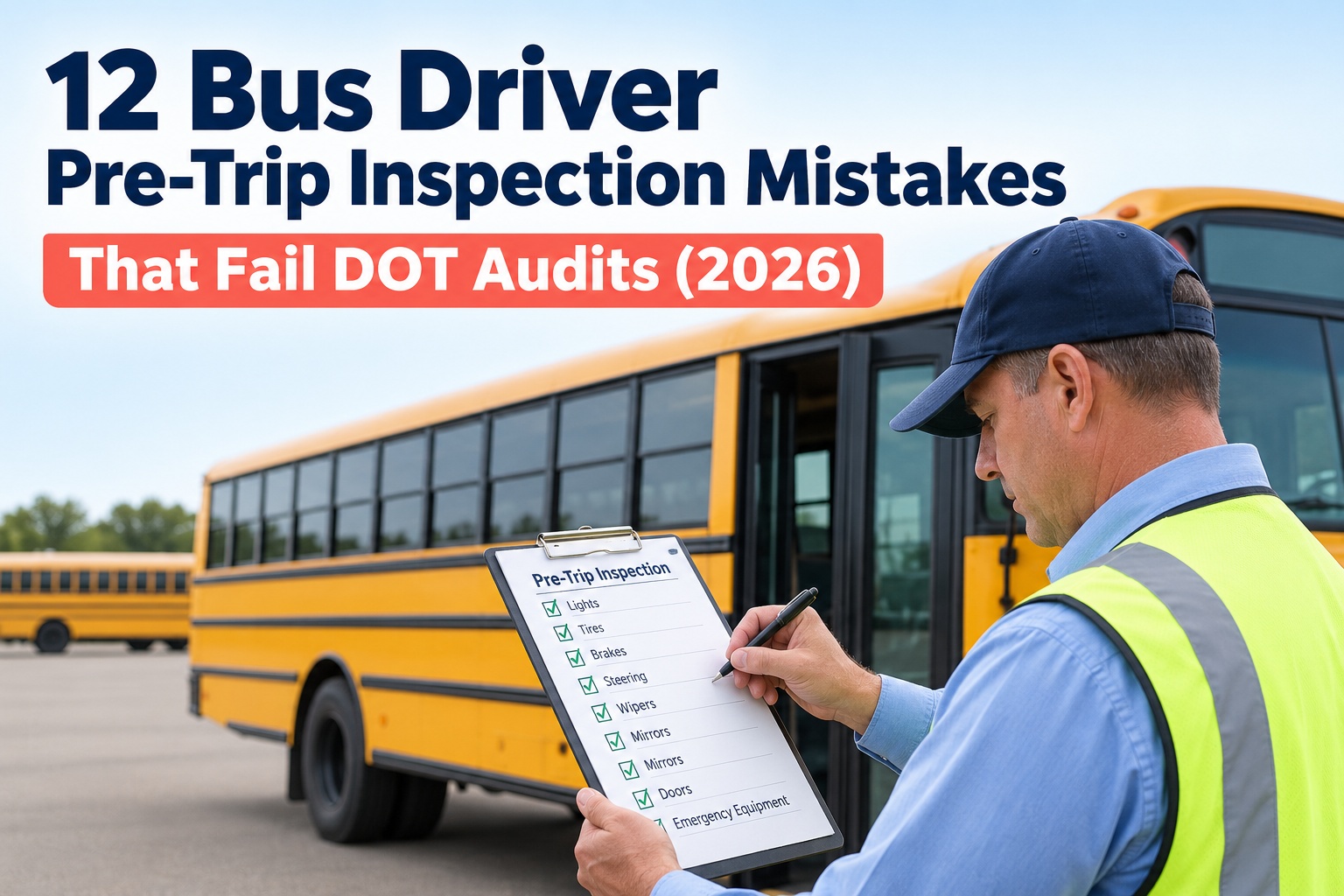
Somewhere in your fleet right now, a driver is checking "OK" on every line of a pre-trip form without actually walking around the bus. It happens under schedule pressure, in the cold, on the tenth bus of a rushed morning -- and it's invisible until a CVSA inspector pulls that same bus over and finds the brake defect the paper form said didn't exist. Bus driver pre-trip inspection mistakes are rarely dramatic. They're small skipped steps that compound into out-of-service orders, DOT audit findings, and fines that start at $1,270 a day and climb from there. We pulled together the 12 mistakes that show up most often in DOT audits and CVSA roadside data, what each one actually costs, and the specific fix that closes the gap.
12 Bus Driver Pre-Trip Inspection Mistakes That Fail DOT Audits
The most common pre-trip inspection mistakes drivers make, what they cost in DOT fines, and the fix for each one -- plus a free checklist to catch them before an auditor does.
Why Pre-Trip Inspection Mistakes Are So Expensive
A rushed or incomplete pre-trip walkaround doesn't just risk a roadside citation. Under 49 CFR 396.13, DVIR violations carry civil penalties up to $1,270 per day for a missing report, $12,700 for a falsified one, and $15,420 for failing to repair a documented defect -- and operating an out-of-service vehicle can run as high as $19,277. During the 2025 CVSA International Roadcheck, 18.1% of vehicles inspected were placed out of service, with brake defects accounting for 41% of those violations and tire issues another 21.4%. Nearly every one of those was an item a thorough pre-trip inspection would have caught before the bus ever left the yard. Book a demo to see how BusCMMS closes these gaps before an auditor finds them.
The 12 Most Common Pre-Trip Inspection Mistakes
Each of these shows up repeatedly in DOT audit findings and CVSA roadside data. None of them require new equipment to fix -- just a system that won't let them slide. Book a demo to see how BusCMMS turns each fix into a required digital step, not a suggestion drivers can skip.
Kicking Tires Instead of Gauging Them
A tire can be 20% underinflated and still look normal to the eye. Visual-only checks miss this every time.
The Fix
Require a tire gauge reading logged for every wheel position, not a visual pass. Tire issues made up 21.4% of 2025 OOS violations.
Skipping the Under-Vehicle Brake Check
Brakes, suspension, and exhaust sit under the bus -- and account for over 50% of OOS violations when skipped.
The Fix
Make the under-vehicle look a required, photo-logged step. Push rod stroke and lining wear can't be judged from the driver's seat.
"Pencil Whipping" the DVIR
Checking every box "OK" without actually performing the inspection, often from the cab before the bus even moves.
The Fix
Digital DVIRs that require interaction with each item and photo evidence make this nearly impossible to fake.
Not Reviewing the Previous DVIR
49 CFR 396.13 requires a driver to review and certify the prior report before operating. Skipping it is a separate, citable violation.
The Fix
A digital chain that won't let a driver start a new inspection until the last one is reviewed and signed off.
Rushing the Air Brake Test
Skipping build-up time and leak-rate checks. Excessive leak rates worsen through the day and are an immediate OOS condition.
The Fix
Build the full air system sequence -- governor cut-out, build-up time, leak rate, low-air warning -- into the required steps, not optional ones.
Missing Emergency Equipment Checks
Fire extinguisher charge, reflective triangles, and spare fuses get skipped as "quick" items. Missing triangles alone is an OOS violation.
The Fix
Keep emergency equipment as its own required checklist section, not folded into a general "safety" catch-all.
Not Verifying the Annual Inspection Sticker
An expired annual inspection sticker is one of the most common OOS triggers -- and one of the easiest to catch before the bus rolls out.
The Fix
Track annual inspection expiration per bus in your system, with alerts well before the sticker lapses, not a manual glance at the windshield.
Checking Lights Without a Spotter
A driver alone can't verify brake lights, turn signals, or the 8-light warning system from the driver's seat.
The Fix
Pair drivers for light checks where possible, or require a second walkaround pass specifically for lighting with photo confirmation.
Not Reporting a Defect to Avoid Delay
A driver notices something minor and decides it can wait rather than risk being late for the route.
The Fix
Instant digital notification to maintenance the moment a defect is logged, so reporting doesn't create the delay drivers are trying to avoid.
Ignoring Driver Qualification Documents
Expired medical certificates or CDL endorsements are a common audit finding that has nothing to do with the bus itself.
The Fix
Track driver credential expiration alongside vehicle inspection data, in the same system, not a separate HR spreadsheet.
Steering Play Never Actually Measured
Free play beyond spec at the wheel is easy to eyeball wrong -- it needs an actual measurement at rest, not a feel-based judgment.
The Fix
Build a specific measurement step into the digital checklist rather than a single vague "steering OK" checkbox.
Paper Records That Can't Be Produced Fast
Even a genuinely thorough inspection fails an audit if the record can't be pulled in minutes when a reviewer asks for it.
The Fix
Digital records stored and searchable by bus and date, with timestamps and signatures retrievable instantly.
What These Mistakes Actually Cost a Fleet
| Violation | Penalty |
|---|---|
| Missing required DVIR | Up to $1,270/day |
| Falsifying an inspection report | Up to $12,700 |
| Failing to repair a documented defect | Up to $15,420 |
| Operating an out-of-service vehicle | Up to $19,277 |
Beyond the fines, a single out-of-service violation damages a carrier's CSA BASIC score, which can raise insurance premiums 10-30% and trigger additional DOT audits down the line. Sign up free to see your fleet's inspection compliance rate before an auditor calculates it for you.
From a Transportation Director Who's Seen Every One of These
"I used to think our pre-trips were solid because the forms always came back clean -- every box checked, no defects noted. Then a state auditor pulled three buses at random and found a tire 22% underinflated on one, a fogged brake light on another. Both had 'passed' pre-trip that morning. That was the moment I realized a clean form doesn't mean a real inspection happened. Once we moved to digital DVIRs that make drivers actually interact with each item, our defect reports went up, not down -- because drivers were finally catching things instead of just signing off."
How a Digital DVIR Prevents These Mistakes Automatically
Nearly every mistake on this list comes down to the same root problem: a paper form lets a rushed or incomplete inspection look identical to a thorough one. A digital system built for buses closes that gap by design, not by asking drivers to try harder.
Photo-Verified Items
Critical checks require a photo, making a skipped inspection visibly different from a completed one.
Instant Defect Routing
A flagged item notifies maintenance immediately and blocks dispatch until it's resolved -- no delay incentive to stay quiet.
DVIR Review Chain
A driver can't start a new inspection until the prior day's report is reviewed and certified, closing the 49 CFR 396.13 gap.
Instant Record Retrieval
Every inspection stored and searchable by bus and date -- produce months of history in seconds during an audit.
BusCMMS ships with bus-specific digital DVIRs pre-loaded on day one -- stop arms, crossing gates, wheelchair lifts, and every item covered above -- so drivers aren't filling out a generic trucking form with bus fields bolted on. Book a demo to see the full digital DVIR workflow live on your fleet.
Fixing Pre-Trip Inspection Mistakes: The Bottom Line
None of these 12 bus driver pre-trip inspection mistakes require new equipment or a bigger shop budget to fix. They require a system that makes a rushed inspection visibly different from a real one -- required photos, measurement-based steps instead of visual guesses, an unbreakable DVIR review chain, and records that can be produced in seconds instead of hours. Close those gaps and the audit findings, the OOS orders, and the fines that follow them mostly disappear on their own.
If your fleet is still running pre-trip on paper, the mistakes on this list are probably already happening -- you just haven't seen the audit finding yet.
What is the most common bus pre-trip inspection mistake?
Visual-only checks that skip a physical measurement are the most common issue -- kicking a tire instead of gauging it, or eyeballing steering play instead of measuring it at rest. Brake defects and tire issues together accounted for more than 60% of out-of-service violations during the 2025 CVSA International Roadcheck, and most were catchable with a proper measurement-based inspection.
Can a driver get a DOT violation for a poor pre-trip inspection?
Yes. If a roadside inspection finds a defect that should have been caught during pre-trip, it demonstrates the inspection wasn't thorough, and it can result in a citation even if the DVIR was technically completed. Falsifying a report carries penalties up to $12,700, and failing to repair a documented defect can run up to $15,420.
What is "pencil whipping" a DVIR and why is it dangerous?
Pencil whipping means checking every item "OK" without actually performing the inspection, often done from the cab under schedule pressure. It's dangerous because it creates a false record of a safe vehicle, and it's a pattern auditors and insurance investigators specifically look for as evidence of systemic inspection failure.
How does a digital DVIR reduce pre-trip inspection mistakes?
Digital DVIRs require interaction with each checklist item, often with photo verification, making it far harder to skip a step and still submit a completed report. They also route flagged defects to maintenance instantly, enforce the required review of the prior day's DVIR before a new inspection can begin, and store every record in a format that can be retrieved in seconds during an audit.
Where can I get a free bus pre-trip inspection checklist?
BusCMMS provides a free bus pre-trip inspection checklist covering every item in this guide, organized by walkaround zone and ready to hand to drivers immediately. Signing up free also gives access to the full digital DVIR system that turns the checklist into an audit-ready inspection workflow.