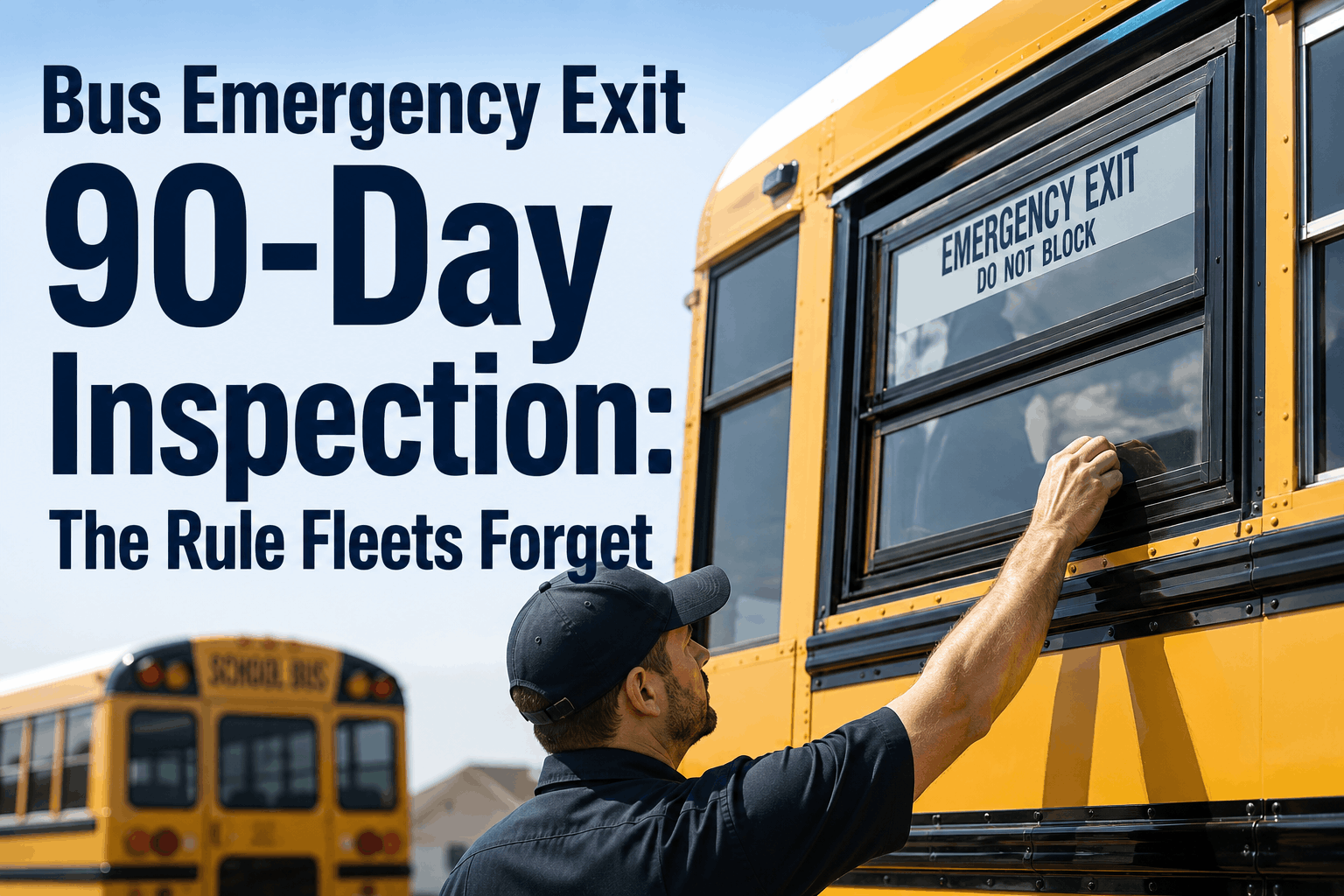
It's the regulation that auditors specifically ask for, and most fleets have no documentation of it. FMCSA 49 CFR 396.3 mandates that pushout windows, emergency doors, and emergency door marking lights on every bus be inspected every 90 days. Yet fleets routinely fail this requirement because they've never heard of it, don't track it, or assume it's part of the annual inspection (it's not). When FMCSA or FTA auditors ask "Show me your 90-day emergency exit inspection records," most fleet managers go blank. If you can't produce documentation, it's an audit deficiency. If you're missing documentation for multiple inspection periods, it escalates to a violation. This comprehensive guide explains why the 90-day emergency exit inspection exists, what triggers the requirement, exactly what must be tested, why it's separate from annual inspections, and how to automate compliance so it's never missed again.
Compliance Focus
Bus Emergency Exit 90-Day Inspection: The Rule Fleets Forget
FMCSA 49 CFR 396.3 requires 90-day emergency exit inspections. Learn why it's overlooked, what auditors look for, and how to automate compliance.
Why Fleets Miss This Requirement
The 90-day emergency exit inspection requirement lives in a regulatory gray zone. It's not as famous as the annual 49 CFR 396.17 inspection. It's not as visible as daily DVIR requirements. It's bus-specific (no other vehicle type has this requirement). So fleets either don't know about it, or they know about it vaguely but don't systematize it. Result: auditor asks for documentation, fleet scrambles, and discovers they have zero records.
Reason 1: Regulatory Obscurity
49 CFR 396.3 is shorter and less detailed than 396.17. It doesn't get the attention of the annual inspection requirement. Fleets hear "annual inspection" and think that covers everything.
Reason 2: Bus-Specific Rule
Trucks don't have emergency exit windows or special doors. Fleets with mixed commercial vehicles may not even realize the requirement applies only to buses.
Reason 3: Manual Scheduling
Without CMMS automation, 90-day inspection scheduling requires manual calendar management. Easy to forget. "We'll do it next month" becomes "We never did it."
Reason 4: Auditors Emphasize It
FTA and FMCSA auditors specifically ask about 90-day emergency exit inspections in triennial reviews and compliance audits. If documentation is missing, it's a finding. Fleets often discover the requirement when it's too late to document.
Why Buses Have This Unique Requirement
Buses carry large numbers of passengers. Emergency exits are critical safety features. Unlike a truck where one driver escapes easily, a bus with 40+ passengers needs multiple functional emergency exits. If one fails, passengers need alternatives. FMCSA mandates frequent checks to ensure emergency systems are never allowed to deteriorate. The 90-day interval (4 times per year) ensures problems are caught quickly — not waiting annually.
What Auditors Ask For
During compliance audit, auditor asks:
"Show me your 90-day emergency exit inspection records for the past 12 months."
What auditor expects to see:
Documentation showing: 4 inspections per bus (every 90 days), dates conducted, bus IDs, results (pass/fail), technician signature. Missing any inspection = deficiency finding.
What auditor actually sees (in most fleets):
"We... don't have specific documentation of 90-day inspections. We do it as part of the annual inspection." This is non-compliance. Annual inspection ≠ 90-day inspection.
Result if documentation is missing:
FTA deficiency finding. FMCSA non-compliance. Requirement to implement documented 90-day inspection program within 30–60 days.
The Fix: Automated 90-Day Scheduling in CMMS
Stop relying on memory. Implement in CMMS:
1
Create recurring work order: "90-Day Emergency Exit Inspection"
System auto-generates every 90 days for each bus. No manual scheduling needed.
2
Set alerts for 14 days before due
Technician gets notification: "Emergency exit inspection due in 14 days for Bus #23." Allows scheduling without rush.
3
Inspection form captures all required data
Date, bus ID, pushout windows (pass/fail), emergency doors (pass/fail), lights (pass/fail), technician signature. Form enforces completion — can't submit partial inspection.
4
Audit-ready reporting
When auditor asks for 90-day records, run CMMS report. Exports all 12 months of documented inspections in seconds. Perfect compliance documentation.
"FTA triennial review came up and auditor asked for 90-day emergency exit inspection documentation. We had nothing — literally zero records. Auditor explained the requirement, and we realized we'd been missing it for 3+ years. Major deficiency finding. Had to retroactively claim we couldn't document inspections, which looked terrible. Forced us to implement documented program immediately. Now CMMS auto-schedules 90-day inspections for all buses, captures results, stores documentation. Next audit will be clean. Lesson: the rules you don't know about will catch you."
— Compliance Officer, 60-bus transit agency, Illinois
Never Miss a 90-Day Deadline Again
Automate 90-day emergency exit inspections in CMMS. Audit-proof compliance is just a system implementation away.