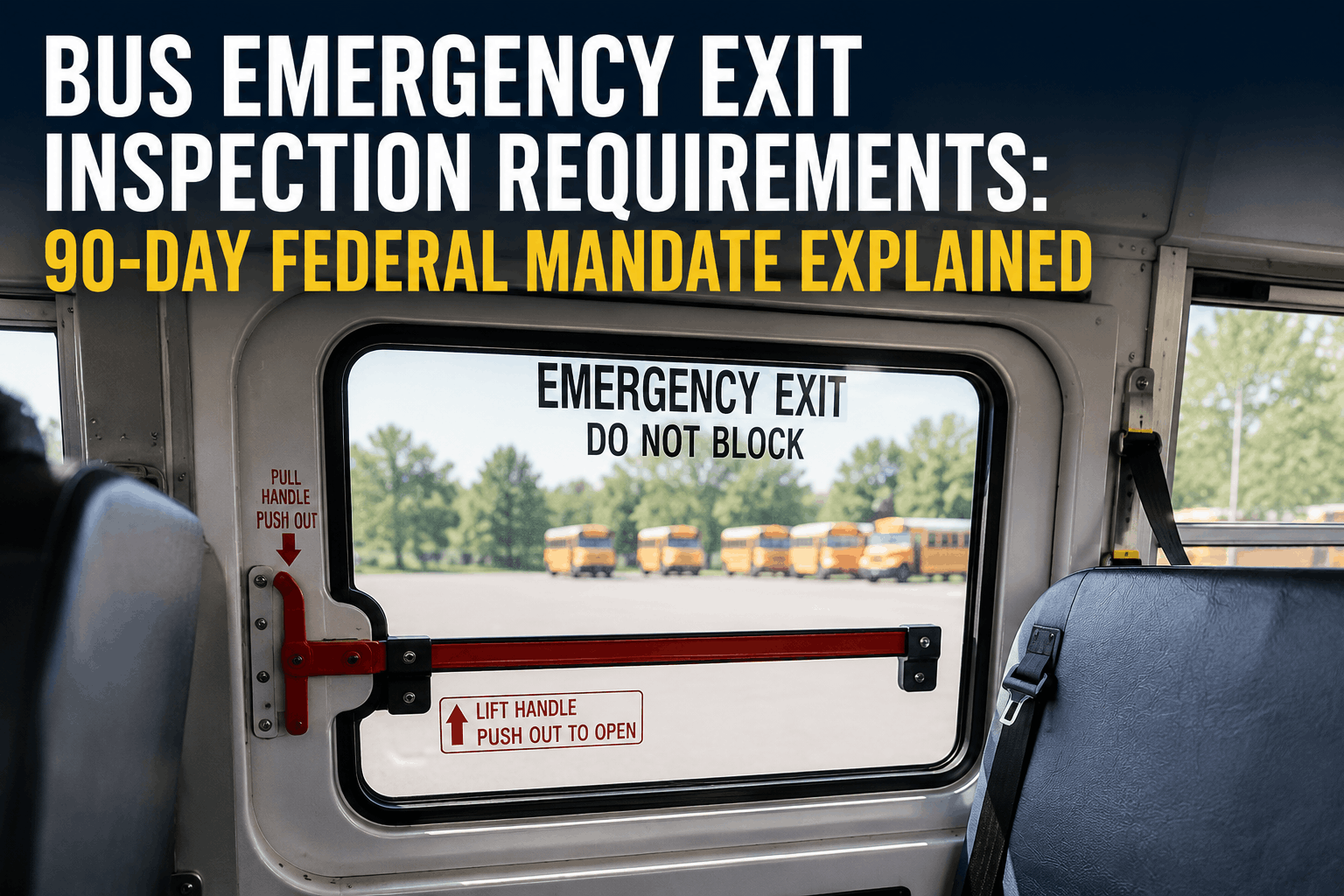
Federal law requires you to inspect pushout windows, emergency doors, and emergency door marking lights on every bus in your fleet at least every 90 days. This is not optional. It's mandated under 49 CFR 396.3 — a regulation most fleets either forget about or handle reactively. Miss this requirement and you're out of compliance, risking FTA audit findings, insurance complications, and liability exposure if an emergency exit fails when passengers need it. More critically: an inoperative emergency exit could trap passengers in an accident or fire scenario, creating potential loss-of-life liability and negligence claims. This guide explains the 90-day emergency exit inspection requirement in detail, what exactly must be tested, how to document it for compliance, how CMMS automates the scheduling, and what happens if an emergency exit fails the inspection.
Compliance Guide
Bus Emergency Exit Inspection Requirements: Understanding the 90-Day Federal Mandate
49 CFR 396.3 mandates 90-day inspections on all bus emergency exits. Learn what to test, how to document, avoid violations, and protect passenger safety.
The Regulation: 49 CFR 396.3 Explained
Federal law states: "Pushout windows, emergency doors, and emergency door marking lights in buses shall be inspected at least every 90 days." This is distinct from the annual comprehensive DOT inspection (49 CFR 396.17). The 90-day emergency exit inspection is bus-specific and frequent. It's a standalone requirement, which means even if your annual inspection is current, missing the 90-day check is a compliance violation. Record retention is also explicit: you must maintain written records of all 90-day tests conducted, retained for one year.
Frequency
Every 90 days minimum. Not annually — 90 days means 4 times per year for consistent coverage.
Applies To
ALL buses (school buses, transit buses, charter buses). No exemptions based on size or type.
What Must Be Tested
Pushout windows, emergency doors, emergency door marking lights. All three are required on each bus.
Documentation
Written record of each test. Date, bus ID, results (pass/fail), technician signature. Retained for 1 year minimum.
Responsibility
Fleet operator is responsible for ensuring inspections happen. Can be done by internal technicians or contracted service.
What to Inspect: The Three Emergency Systems
1. PUSHOUT WINDOWS (Roof/Upper Side)
Buses have pushout windows in the roof and/or upper sidewalls. During inspection, verify: (1) Window operates smoothly — pushes out completely without binding. (2) Frame undamaged — no cracks, bends, or deformation. (3) Locking mechanism engages/releases properly. (4) Hinges function without grinding. (5) No obstruction blocking egress path (no luggage, equipment, or cargo touching windows).
Test: Manually push window and verify full operation. Document: "Operable" or "Requires service." If inoperable, create immediate work order.
2. EMERGENCY DOORS (Rear Exit, Side Exits)
Buses have emergency exit doors (usually rear, sometimes side). Verify: (1) Door opens smoothly and completely (at least 90°). (2) Push-bar or release mechanism functions without effort. (3) Hinges working (no rust, no binding). (4) Latch mechanism engages securely when closed. (5) Door marking visible (required by law). (6) No obstructions blocking egress (cargo, seats, emergency equipment not blocking door swing).
Test: Operate door 3–5 times. Verify opens to minimum 90°. Document condition. If stuck/damaged, out-of-service bus until repaired.
3. EMERGENCY DOOR MARKING LIGHTS
Exit signs above/near emergency doors must illuminate. Verify: (1) Light turns on when bus is powered. (2) Bulb/LED is functional (not burnt out). (3) Lens clean (not obscured by dirt). (4) Marking clearly visible from passenger seating area. (5) Sign is readable in daylight and darkness.
Test: Turn on bus power and verify lights illuminate. If not, replace bulb or check circuit. Document: "Lighting functional" or "Bulb replaced."
How to Implement 90-Day Inspection Procedure
Step 1: Establish Schedule in CMMS
Create recurring work order: "90-Day Emergency Exit Inspection" with 90-day interval (repeating every 3 months). Assign to maintenance supervisor or lead technician. System auto-generates work order when due. Set alert 14 days before due date so technician has time to schedule.
Step 2: Create Inspection Checklist
Document: Bus ID, Date, Technician name. For each exit system (pushout windows, emergency doors, lights): Pass/Fail and notes. Example: "Rear emergency door: Opens smoothly, latch secure, marking light illuminated — PASS." If any item fails, automatically create work order for corrective action.
Step 3: Conduct Inspection (30 Minutes Per Bus)
Technician walks through: (1) Pushout windows — open/close each one, check frame condition. (2) Emergency doors — operate fully, test latch. (3) Exit lights — verify illumination. (4) Clear any obstructions near exits. (5) Document results. If any item inoperable, bus goes out-of-service until repaired.
Step 4: Document & Archive
Save inspection record in CMMS with date, results, technician signature. Retain for 1 year (CMMS auto-retains). If inspected and failed item found, document: date discovered, repair authorized, repair completed date, re-test result (pass/fail). This creates audit trail.
Common Defects Found During 90-Day Inspections
Pushout Window Stuck/Won't Open
Rust on hinges, paint binding mechanism, debris in frame, window warped from heat
Clean hinges and mechanism, apply lubricant (WD-40), replace if warped. Test before returning to service.
Emergency Door Won't Latch Securely
Worn latch mechanism, misaligned door, broken strike plate, stripped hardware
Adjust door alignment, replace latch mechanism if worn, ensure strike plate seated properly. Test multiple times.
Exit Light Not Illuminating
Burnt out bulb, loose connection, failed circuit, lens covered with dirt/condensation
Replace bulb, clean lens, check wiring. If circuit failed, diagnose electrical issue. Test in darkness to verify illumination.
Emergency Door Obstructed
Luggage, emergency supplies, worn cushions, or cargo blocking door swing or egress path
Clear obstruction. Reorganize storage. Ensure 3+ feet clearance in front of door for passenger egress.
What Happens if Exit Inspection Fails
Inoperable Exit Found During Inspection
Bus must be taken out-of-service immediately. Cannot operate with failed emergency exit. Create urgent work order. Repair and re-test before returning to service.
If passenger is injured and exit was inoperable at time of incident: fleet faces negligence liability. Documentation of inspection (proving it was tested and marked functional) is your defense. Lack of documentation = admission you didn't test = liability exposure.
90-Day Inspection Not Conducted (Compliance Violation)
FTA auditor or FMCSA inspector finds no record of 90-day test in past year. Violation issued.
Compliance violation = audit finding. Multiple violations may trigger corrective action plan. Reputational impact with FTA. Potential loss of federal funding eligibility if pattern of non-compliance.
Exit Failed During Emergency (Accident/Fire)
Passenger trapped due to inoperable exit. Injury or fatality results.
Catastrophic: wrongful death/injury lawsuit, criminal negligence investigation, massive liability exposure. Documentation of passing 90-day inspections is mitigation. Lack of documentation = gross negligence.
"We weren't systematically doing 90-day exit inspections. They were reactive — when someone complained about a stuck window, we'd fix it. FTA triennial review came and auditor asked for 90-day inspection records for the past 3 years. We had nothing documented. Deficiency finding. Had to scramble retroactively to document inspections (or admit we hadn't done them). Lesson learned: implement systematic 90-day inspection schedule in CMMS with auto-reminders. Now every bus is tested quarterly and documented. Compliance is automatic, auditor-proof."
— Operations Director, 65-bus transit agency, Washington
Protect Passengers & Ensure Compliance
90-day emergency exit inspections are non-negotiable. Automate with CMMS. Document comprehensively. Audit-proof your fleet.