The check engine light comes on at 6:40 AM, twenty minutes before the first route. Code P2463 -- DPF restriction. Your driver doesn't know what that means and shouldn't have to. What you know, standing in the shop with a bus that isn't going anywhere, is that a $250 sensor problem ignored for two months just turned into a filter that won't regenerate, a turbo that's taking on backpressure it wasn't built for, and a repair bill that's about to run somewhere between $2,500 and $10,000 depending on how far the damage spread before anyone caught it. Bus emissions maintenance is one of those systems that looks like it runs itself, right up until the morning it doesn't. The EGR valve, the diesel particulate filter, and the DEF/SCR system all interact with each other -- and a small problem in one almost always shows up as an expensive failure in another.
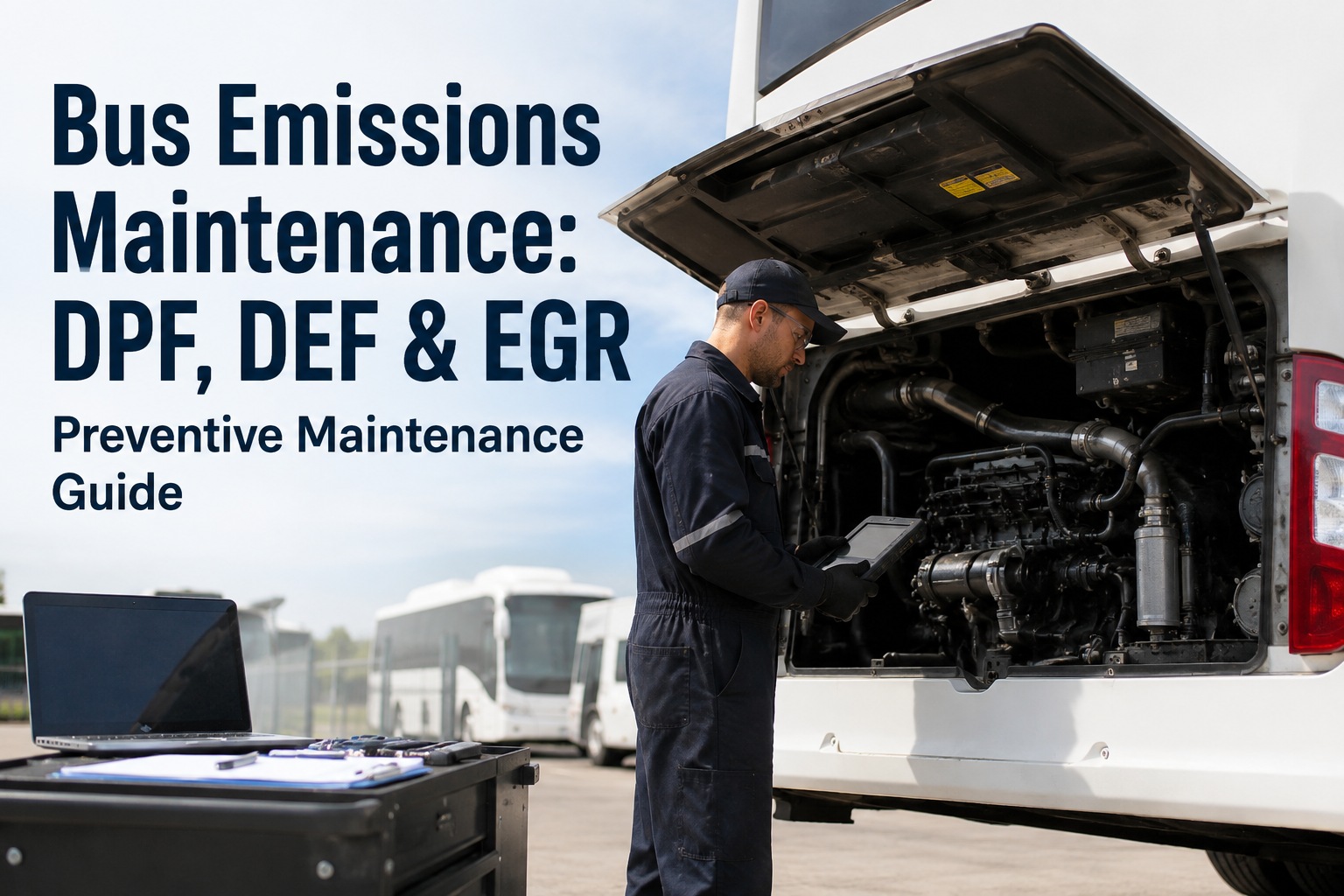
Bus Emissions Maintenance: DPF, DEF & EGR Preventive Maintenance Guide
How the diesel particulate filter, DEF/SCR system, and EGR valve actually fail -- and the preventive maintenance schedule that keeps a $10,000 repair from ever starting.
Why Bus Emissions Maintenance Is Really Three Systems, Not One
EGR, DPF, and SCR/DEF get treated as one line item on a lot of PM checklists, but they're three distinct systems that happen to sit in the same exhaust path -- and they feed each other's problems. The EGR system routes exhaust gas back into the intake to lower combustion temperatures and cut NOx, but that cooler, oxygen-deprived burn produces more soot, which loads the DPF faster. A DPF running near its soot ceiling can't complete regeneration cleanly, which pushes unburned fuel and heat downstream toward the SCR system, straining the catalyst that DEF fluid depends on to convert NOx into harmless nitrogen and water.
That's why a bus with a properly functioning EGR system still loads its DPF faster than the EPA emissions standard assumes under ideal conditions, and why a malfunctioning EGR can overwhelm a DPF's regeneration capacity entirely. Treat these as one connected system in your PM schedule, and you catch the $250 sensor fault before it becomes a $10,000 filter replacement. Book a demo to see EGR, DPF, and DEF tracked as one linked maintenance chain instead of three separate line items nobody cross-references.
The Failure Cascade: How a Small Miss Becomes a $10,000 Repair
Almost every catastrophic emissions repair starts small. Here's the chain that plays out on fleet after fleet when a minor issue goes unaddressed.
-
1
Short Routes Prevent Passive Regen
Stop-and-go school routes rarely hit the sustained highway exhaust temps a DPF needs to burn off soot passively.
No cost yet -
2
Soot Load Climbs Past 80-85%
The ECU can no longer initiate its own regeneration cycle. Forced, stationary regen becomes the only option.
$0 -- warning stage -
3
Forced Regens Become Frequent
More than one stationary forced regen a month signals an underlying injector, EGR, or turbo problem -- not just a busy route.
$300-$800 cleaning -
4
Ash Builds Where Soot Can't Burn Off
Oil or contaminant residue leaves ash that no regeneration cycle removes -- only professional cleaning or replacement clears it.
$2,500-$5,000 -
5
Filter Replacement, Possible Turbo Damage
Once soot and ash exceed the filter's capacity, backpressure can damage the turbocharger and force a full DPF replacement.
$5,000-$15,000
Every step in that chain is preventable at step one or two. Waiting until step four or five is what turns routine bus emissions maintenance into an emergency road call. Sign up free to get regen-frequency alerts before a small issue cascades into a five-figure repair.
Preventive Maintenance by System: DPF, DEF, and EGR
Each system has its own maintenance rhythm. Here's what belongs on your PM schedule for each one, and how often it typically needs attention on a school bus or transit duty cycle.
-
DPF
Diesel Particulate Filter
Monitor soot load percentage and regen frequency. Professional cleaning removes ash that regeneration can't touch. Urban routes typically need cleaning every 20,000-30,000 miles; highway-heavy routes can stretch to 40,000-60,000.
-
DEF
DEF / SCR System
Use only API-certified DEF fluid -- contaminated or low-quality fluid degrades the SCR catalyst permanently. Check DEF level and quality at every fill, and watch for derate warnings tied to sensor faults.
-
EGR
EGR Valve & Cooler
Inspect for carbon buildup and coolant contamination at every major service interval. A stuck-open EGR valve dilutes exhaust temps enough to make DPF regeneration nearly impossible.
Note the important shift here: in March 2026, the EPA issued guidance removing the requirement for dedicated DEF sensors, allowing NOx sensors to satisfy the same regulatory function -- a meaningful change for fleets dealing with sensor-related DEF faults, though it does not remove the requirement for the SCR system itself. Book a demo to see mileage-based DPF, DEF, and EGR intervals scheduled automatically by duty cycle instead of one blanket calendar date.
Warning Signs Your Emissions System Is Heading for Trouble
These patterns show up weeks before a bus actually strands on a route -- if someone's tracking them across the fleet instead of reacting to each one in isolation.
| Warning Sign | Likely Root Cause |
|---|---|
| Forced regen needed more than once a month | Injector fault, EGR malfunction, or duty cycle mismatch |
| Soot load rising 25%+ faster than fleet average | Upstream engine problem producing excess particulates |
| Regen cycles frequently interrupted | Driver behavior or route pattern preventing completion |
| Diagnostic codes P2463, P2459, or P244A | DPF restriction or regen frequency fault |
| DEF-related derate warning | Fluid quality issue or NOx/DEF sensor fault |
Catching a pattern like frequent forced regens two to four weeks earlier is often the entire difference between a $300 cleaning and a $10,000 filter replacement. Book a demo to see fleet-wide soot trend alerts flagged automatically before a single bus becomes a road call.
From a Shop Foreman Who's Seen the Cascade Play Out
"We had three buses forced-regen more than usual one month and nobody flagged it as a pattern -- each mechanic just logged the individual regen and moved on. Two months later one of those buses came in with a DPF so loaded with ash it had already started backing pressure into the turbo. That repair ran past $9,000. The frustrating part is the warning was there the whole time, just scattered across three different work orders instead of showing up as one trend on one bus."
Why Generic PM Scheduling Misses Emissions Failures
A calendar-based PM schedule treats every bus the same regardless of route type, which is exactly backward for emissions maintenance. A short in-town school route loads soot faster than a highway transit route, so the same fixed interval either services one bus too late or the other too often.
Soot Trend Tracking
Flags buses climbing faster than the fleet average so root causes get caught before the filter is at risk.
Forced Regen Alerts
Automatically flags a bus needing forced regen more than once a month for root-cause inspection.
Route-Aware PM Intervals
DPF and EGR service intervals adjust to actual duty cycle instead of one blanket mileage figure for the whole fleet.
Auto Work Orders
A flagged diagnostic code auto-generates a prioritized work order instead of waiting for the next scheduled inspection.
BusCMMS tracks DEF top-ups, EGR checks, and DPF cleaning on an automatic emissions compliance calendar, with alert-driven inspection scheduling and audit reports generated automatically for EPA and DOT reviews. Book a demo to see your emissions compliance calendar built for your fleet.
Bus Emissions Maintenance: The Bottom Line
DPF, DEF, and EGR aren't three separate checkboxes on a PM form -- they're one connected system where a small fault anywhere upstream shows up as an expensive failure downstream. Track soot trends and forced regen frequency instead of just logging each event, use only certified DEF fluid, inspect the EGR system at every major service, and let route-aware scheduling replace a fixed calendar date that doesn't know the difference between a school loop and a highway run. Get that right, and bus emissions maintenance stops being the surprise repair bill and goes back to being routine upkeep.
If your last emissions repair started as a code nobody connected to a pattern, there's a better way to catch it next time. Sign up free and put DPF, DEF, and EGR tracking on one automated schedule.
How often should a bus DPF be cleaned or serviced?
Cleaning intervals depend heavily on duty cycle. Urban school routes with frequent stops typically need DPF cleaning every 20,000-30,000 miles, while highway-heavy transit routes can stretch to 40,000-60,000 miles. Frequent forced regenerations -- more than once a month -- signal the filter needs attention sooner than the mileage interval suggests.
What causes a diesel particulate filter (DPF) to fail?
DPF failure usually starts upstream -- a malfunctioning EGR valve, a faulty injector, or short-trip driving that never reaches the exhaust temperatures needed for passive regeneration. Soot accumulates faster than the filter can burn it off, and any oil contamination leaves ash that no regeneration cycle can remove, eventually requiring professional cleaning or full replacement.
Does DEF fluid quality actually matter for bus maintenance?
Yes, significantly. Contaminated or non-API-certified DEF fluid can permanently degrade the SCR catalyst, and repair or replacement of a malfunctioning SCR system can cost more than $5,000. Using only certified DEF fluid is one of the simplest and most cost-effective steps in a bus emissions maintenance program.
How does the EGR system affect DPF and DEF performance?
The EGR system routes exhaust gas back into the intake to reduce combustion temperatures and NOx output, but this cooler combustion burns less cleanly and produces more soot, loading the DPF faster. A malfunctioning or stuck EGR valve can overwhelm the DPF's regeneration capacity and dilute exhaust temperatures enough to prevent regeneration from completing at all, which in turn stresses the downstream SCR/DEF system.
How can a CMMS help prevent costly emissions system failures?
A bus-specific CMMS tracks DPF soot load trends, forced regeneration frequency, DEF quality checks, and EGR service intervals per bus, flagging patterns like above-average soot accumulation before they cascade into filter or turbo damage. BusCMMS also auto-schedules emissions maintenance based on route-specific duty cycle rather than one fixed calendar interval, and generates audit-ready compliance reports automatically.