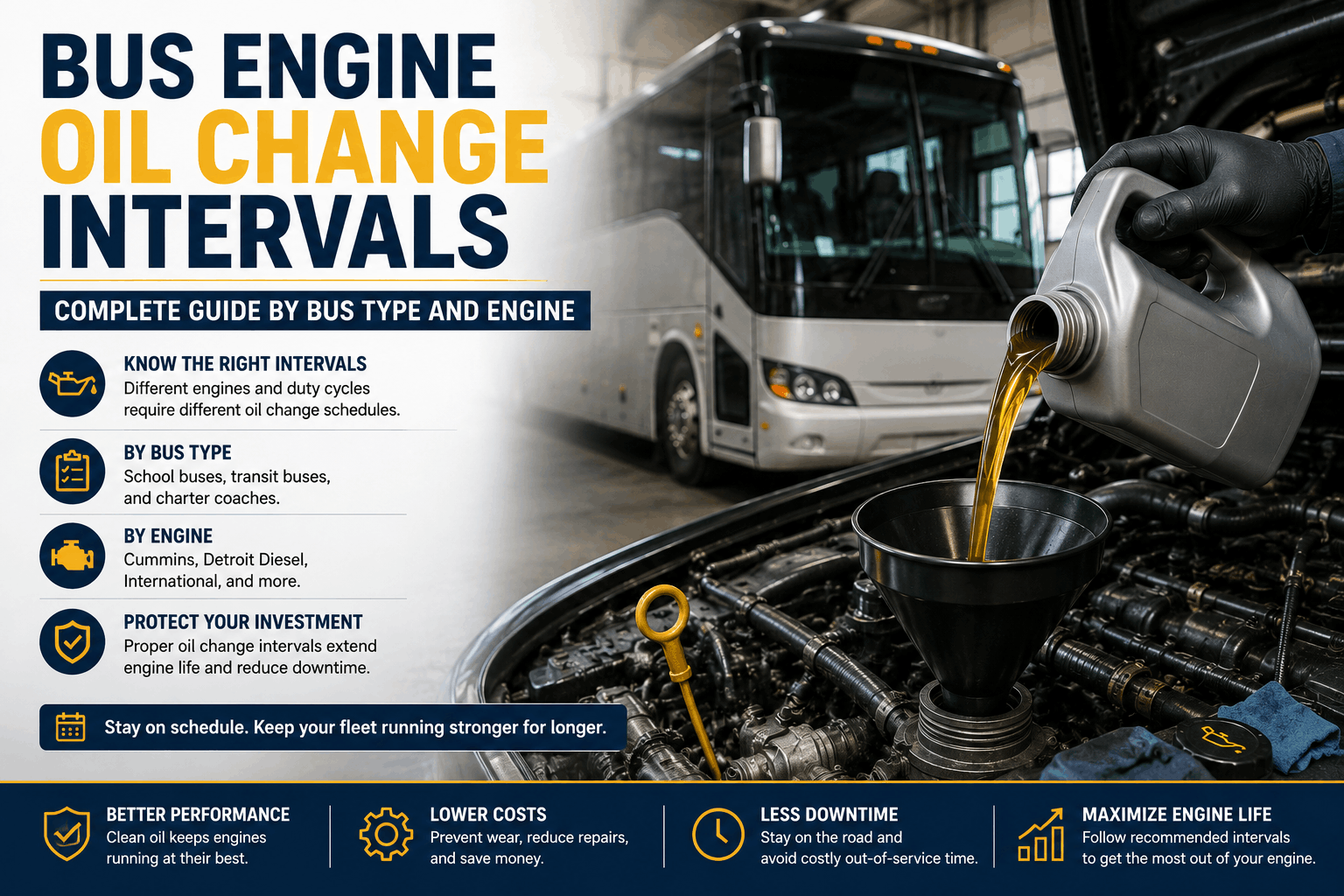
Oil change intervals are among the most fundamental maintenance decisions for bus fleets. Engine oil lubricates moving parts, reduces friction and heat, carries away contaminants, and protects against corrosion. As oil is used, it accumulates contaminants (dirt particles, combustion byproducts, moisture) and breaks down under heat stress. Eventually, the oil loses its ability to protect the engine. At that point, further operation without an oil change accelerates engine wear and increases failure risk. The correct oil change interval depends on engine type, driving conditions, climate, fuel quality, and maintenance practices. Different engine manufacturers (Cummins, Detroit Diesel, International) specify different intervals. A bus operating primarily in city conditions with frequent stops and starts accumulates soot faster than a bus operating on highway routes. A bus operating in cold climates with short routes might accumulate moisture in the oil faster than a bus in warm climates. A fleet using high-quality synthetic oil can extend intervals compared to conventional oil. A fleet operating in dust-laden environments might need more frequent changes than a fleet in clean environments. Knowing the correct oil change interval for your specific buses and operating conditions is essential for preventing engine damage and managing maintenance costs. Here's a complete guide to oil change intervals by engine type and duty cycle.
Engine Maintenance
Bus Engine Oil Change Intervals Guide
How often should you change bus engine oil? Complete interval guide by engine type (Cummins, Detroit, International) and duty cycle for school buses, transit buses, and charter coaches.
Cummins ISB
15,000 miles
Cummins ISL
20,000 miles
Detroit Diesel
15,000 miles
International DT
18,000 miles
1
Understanding Oil Breakdown and Contamination: Why Intervals Matter
How engine oil degrades: Engine oil degrades through multiple mechanisms. Thermal breakdown occurs when oil is exposed to high temperatures (normal engine operating temperatures are 200-220°F). The heat causes oil molecules to break apart, reducing viscosity and protective properties. Oxidation occurs when oil reacts with oxygen, creating varnish and sludge that accumulates on engine parts. Contamination occurs as oil picks up combustion byproducts (soot), dust particles, and moisture from the air. All these mechanisms reduce oil effectiveness over time and distance. Regular oil changes remove the degraded, contaminated oil and replace it with fresh oil before degradation becomes severe enough to damage the engine.
Soot and particulate accumulation: Diesel engines, which power almost all commercial buses, produce soot as a natural byproduct of combustion. Some soot mixes with oil, creating contamination. Heavy-duty diesel engines operating in city conditions produce more soot than engines operating on highway routes because city driving involves more acceleration, more combustion pressure spikes, and more incomplete combustion. A school bus or city transit bus operating in urban conditions accumulates soot faster than a charter coach operating on highway routes. A bus operating in a dusty environment (desert regions, unpaved roads, construction zones) accumulates dust particles faster than a bus in urban areas. These environmental and operational factors affect how quickly oil becomes contaminated and therefore affect optimal oil change intervals.
Moisture and water contamination: Engine oil can absorb water, which is produced during combustion and can condense in the crankcase. Moisture in oil creates several problems: it promotes corrosion of engine parts, it allows microbial growth (bacteria and fungi that degrade oil), and it reduces oil's ability to form a protective film on engine parts. This problem is particularly acute in fleets where buses operate short routes without reaching full operating temperature. Short routes prevent the engine from reaching hot enough temperatures to boil off accumulated moisture. A school district with short routes (5-10 minute bus rides to school) faces higher moisture contamulation risk than a transit agency with longer routes. Fleets with this challenge might need more frequent oil changes or should ensure buses run a periodic longer route at highway speeds to boil off moisture.
Viscosity and protection degradation: Oil viscosity (thickness) is critical for engine protection. Too thin and oil doesn't form a protective film between moving parts. Too thick and oil doesn't flow properly to all engine areas that need protection. As oil heats and degrades, its viscosity changes. Synthetic oils maintain stable viscosity over wider temperature ranges than conventional oils, which is why synthetic oils can support longer change intervals. An oil that started as 15W40 (15 weight at cold start, 40 weight at operating temperature) might thin out to 13W38 after 20,000 miles of use. This thinning reduces protection, especially in cold starts where the 15-weight protection is critical.
2
Cummins Engine Oil Change Intervals
Cummins ISB (Common in School Buses and Small Buses): The Cummins ISB (5.9 liter) is one of the most common diesel engines in school buses and small transit buses. Cummins specifies 15,000-mile oil change intervals for ISB engines under typical duty (mixed city and highway driving). This interval assumes use of high-quality diesel engine oil (ACEA E5 or equivalent rating). For buses in severe duty (continuous city driving with frequent stops, high-dust environments, or frequent towing), Cummins recommends reducing the interval to 12,000 miles. For buses in light duty (primarily highway operation), the interval can extend to 18,000 miles. The ISB also requires periodic oil analysis (sample oil, send to lab for testing) at 12,000-mile intervals to monitor oil condition and identify potential problems before they become failures.
Cummins ISL (Common in Transit Buses and Large Buses): The Cummins ISL (8.9 liter) is used in larger transit buses, charter coaches, and heavy-duty applications. Cummins specifies 20,000-mile intervals for ISL engines under normal duty. This longer interval compared to ISB reflects the larger displacement and more advanced fuel injection system. However, actual intervals should be adjusted based on duty: severe duty (city transit with frequent acceleration) requires 15,000 miles, light duty (highway coaches) can extend to 23,000 miles. The ISL requires oil analysis at 15,000-mile intervals. Many transit agencies operating ISL engines use synthetic oil, which allows extending intervals to 25,000-30,000 miles with oil analysis confirmation.
Cummins Westport and Natural Gas Engines: For fleets using Cummins Westport natural gas engines, oil change intervals are typically 15,000 miles with conventional oil or 25,000 miles with synthetic oil. Natural gas engines produce less soot than diesel engines, allowing extended intervals. However, moisture accumulation can be an issue with natural gas engines, so fleets should monitor for water contamination through oil analysis and ensure proper ventilation in the crankcase.
Oil type selection for Cummins engines: Cummins specifies engine oil grade and performance requirements (SAE viscosity and ACEA or API performance specifications). For ISB and ISL engines, typical recommendations are SAE 15W40 or 10W30 conventional diesel engine oil. Cummins approves synthetic oils meeting ACEA E5 or E7 specifications, which typically provide longer interval capability. Fleet operators should verify that any synthetic oil selected is Cummins-approved before using, as some synthetics may not be compatible with gasket materials or fuel injection systems.
3
Detroit Diesel (DDC) Oil Change Intervals
Detroit Diesel Series 60 (Common in Older Transit and School Buses): The Detroit Diesel Series 60 (12.7 liter) was the standard engine in transit buses and school buses for over 20 years, though newer buses are shifting to Cummins or other engines. Detroit specifies 15,000-mile oil change intervals for Series 60 engines under normal duty. For severe duty (high-idle applications, frequent short routes, dusty environments), Detroit recommends 12,000 miles. The Series 60 was manufactured with a particular compatibility with Detroit Diesel Proprietary (DDP) oils. Fleet operators should use oils approved by Detroit Diesel for Series 60 to ensure compatibility. Many older Series 60 engines in fleets today are approaching end of life, so extended intervals aren't recommended—stick to 15,000-mile intervals with regular oil analysis.
Detroit Diesel Series 40 (Older Smaller Buses): The Series 40 (6.0 liter) was used in smaller buses and school buses decades ago. Fewer of these engines remain in service as fleets modernize. For Series 40 engines still in operation, Detroit specifies 10,000-12,000-mile oil change intervals due to the engine's age and design limitations. These engines should receive conventional oil meeting Detroit's specifications—extending intervals with synthetic oil is not recommended due to potential compatibility issues with older gasket materials.
Detroit Diesel DD13, DD15 (Newer Engines): Newer Detroit engines (DD13 and DD15 introduced around 2009) have extended oil change intervals of 20,000 miles under normal duty, extending to 25,000 miles with synthetic oils and oil analysis confirmation. These newer engines are increasingly common in newer bus purchases. However, many fleets still operate Series 60 engines, which require more frequent changes, so fleet-wide interval policies must account for the mix of engine types in the fleet.
Detroit Diesel extended interval technology: Detroit Diesel developed an extended oil drain interval technology called "DDP Synthetic Plus" which, combined with on-board oil condition monitoring, allows intervals up to 25,000-35,000 miles. However, this requires electronic monitoring systems and compatible oils. Fleets considering extended intervals should verify that their specific buses have the required monitoring capability.
4
International Engine Oil Change Intervals
International DT 360 and DT 466 (Older School Buses and Medium Buses): International DT engines were commonly used in school buses and medium-duty buses. DT 360 (5.9 liter) and DT 466 (7.6 liter) specified oil change intervals of 10,000-12,000 miles under normal duty. These engines should receive conventional oil meeting International's engine oil specifications. Extending intervals with synthetic oil is not recommended for these older engines without consulting International or a knowledgeable technician, as gasket materials may not be compatible with modern synthetics.
International MaxForce DT (9.3 liter): The MaxForce DT introduced a newer technology with 15,000-mile oil change intervals. This larger displacement engine handles interval extensions better than older DT engines. MaxForce DT engines can use conventional oil at 15,000-mile intervals or synthetic oils at up to 20,000-mile intervals with oil analysis confirmation.
International DT 12 and Newer Engines: Newer International engines specified for bus applications (such as the DT 12) have extended intervals of 20,000-25,000 miles with conventional oil, extendable to 35,000 miles with synthetic oils and electronic oil condition monitoring. These engines are primarily in newer bus purchases. Older International engines in the field typically require 12,000-15,000 mile intervals.
Oil selection for International engines: International specifies SAE 15W40 conventional diesel engine oils meeting API CI-4 or higher specifications. Many International engines approve synthetic oils meeting ACEA E5 or E7 specifications. Fleet operators should verify specific oil requirements in the engine's service manual before using any oil product, particularly when considering synthetic oils in older engines.
5
Duty Cycle Adjustments and Environmental Factors
City Transit Duty (Severe Service): City transit buses operating in urban environments with frequent stops, acceleration, and idle periods face severe operating conditions. These buses accumulate soot rapidly due to high combustion pressure spikes during acceleration and incomplete combustion during idle periods. Recommended interval reduction: 15% shorter than manufacturer's normal specification. A 15,000-mile interval becomes 12,750 miles (round to 12,500). A 20,000-mile interval becomes 17,000 miles. City buses should receive oil analysis every 10,000 miles to monitor condition.
School Bus Duty (Mixed): School buses typically operate short routes (15-30 minutes each route, with substantial idle time between routes) but spend a portion of time on longer highway drives. Short routes mean engines don't reach full operating temperature, allowing moisture to accumulate. Follow the manufacturer's interval for your engine (typically 15,000 miles for ISB) but err toward the conservative side of the range. School buses might benefit from more frequent oil analysis to monitor moisture levels, particularly in cold climates where moisture accumulation is higher.
Highway Charter Coach Duty (Light Service): Charter coaches operating primarily on highway routes at steady speeds face the least severe operating conditions. Engines reach full operating temperature quickly and maintain it. Soot accumulation is minimal. Oil remains cleaner longer. Interval extension is possible: a 15,000-mile interval could extend to 18,000 miles, a 20,000-mile interval could extend to 23,000-25,000 miles. However, oil analysis confirmation is recommended before extending intervals beyond manufacturer specification.
High-altitude and cold-climate considerations: Buses operating at high altitudes (Denver, mountain regions) face thinner air and require more fuel and more combustion pressure to maintain power, increasing soot production. Reduce oil change intervals by 10% in high-altitude operations. Buses in cold climates where outside temperatures are frequently below 10°F should reduce intervals because moisture accumulation is higher and oil viscosity challenges are greater. A 15,000-mile interval in cold climates becomes 12,500-13,500 miles.
Dusty and harsh environment adjustments: Buses operating in dusty environments (desert regions, agricultural areas, construction zones) face higher air filter loading and more dust particle ingestion into the oil. These conditions require more frequent oil changes—reduce intervals by 20%. A 15,000-mile interval becomes 12,000 miles. Ensure air filters are being changed frequently (possibly more frequently than oil) to prevent excessive dust from entering the oil.
Synthetic oil interval extension opportunities: Synthetic oils offer superior oxidation resistance and maintain viscosity stability better than conventional oils, potentially supporting longer intervals. A fleet using high-quality synthetic oil might extend intervals 15-25% beyond conventional oil intervals. However, this should be confirmed through oil analysis—sampling oil at extended intervals and having it analyzed to ensure it hasn't degraded below protection minimums. The additional cost of synthetic oil might be offset by reduced oil change frequency, but should be economically evaluated for your specific situation.
6
Oil Analysis: Extending Intervals Safely and Monitoring Engine Health
What oil analysis reveals: Oil analysis (sampling used oil, sending to a laboratory, analyzing composition) reveals extensive information about engine health and oil condition: viscosity (is the oil thinner or thicker than it should be, indicating degradation?), Total Acid Number or TAN (how degraded is the oil?), Wear metals (how much iron, aluminum, copper, lead is in the oil, indicating bearing wear?), Contamination (water content, dust particles, fuel dilution?), and Oxidation resistance (how much longer can the oil be used?). This information allows fleets to know with confidence whether oil can be safely used longer or should be changed immediately. Instead of guessing whether 20,000 miles is safe (and potentially damaging the engine), oil analysis provides definitive information.
Establishing baseline oil condition: A fleet beginning an oil analysis program should sample oil at regular intervals (every 5,000 miles) until enough data is collected to establish a baseline for normal condition. A baseline of 5-10 samples over 50,000-100,000 miles shows normal wear patterns, normal oxidation rate, and normal contamination levels for your specific buses and operating conditions. Once baseline is established, future samples can be compared to baseline to detect abnormal trends (wear rate suddenly increasing, oxidation accelerating, contamination spiking).
Cost-benefit of oil analysis: A single oil analysis costs $25-$50 depending on the laboratory and how many parameters are analyzed. An oil change costs $150-$300 in parts and labor. For a fleet that changes oil every 15,000 miles and travels 100,000 miles per year, that's approximately 6-7 oil changes annually, costing $900-$2,100 in maintenance. Oil analysis every 10,000 miles (10 samples per year) costs $250-$500. If analysis reveals that oil can safely be used for 20,000 miles instead of 15,000, the fleet reduces from 6-7 changes to 5 changes annually, saving $150-$300 in oil change costs. The analysis cost is recovered, and extended intervals potentially save money while improving engine reliability through targeted maintenance.
Condition-based maintenance vs. time-based maintenance: Traditional oil change schedules are time-based (every 15,000 miles, regardless of condition). Oil analysis enables condition-based maintenance: extend the interval if the oil is in good condition, shorten it if degradation is accelerating. This optimizes maintenance costs and engine protection. A fleet might use condition-based maintenance for high-value engines (newer ISL engines), where analysis cost is justified by the value of the engine. For older, lower-value engines, time-based intervals are simpler and may be more economical.
Quick Reference: Oil Change Intervals by Engine
| Engine | Normal Duty | Severe Duty | Light Duty | Oil Type |
|---|---|---|---|---|
| Cummins ISB | 15,000 mi | 12,000 mi | 18,000 mi | 15W40 Diesel |
| Cummins ISL | 20,000 mi | 15,000 mi | 23,000 mi | 15W40 Diesel |
| Detroit Series 60 | 15,000 mi | 12,000 mi | 18,000 mi | DDP Oil |
| Detroit DD13/DD15 | 20,000 mi | 18,000 mi | 25,000 mi | 15W40 Diesel |
| International DT 466 | 12,000 mi | 10,000 mi | 15,000 mi | 15W40 Diesel |
| International DT 12 | 20,000 mi | 18,000 mi | 25,000 mi | 15W40 Diesel |
Note: Intervals are approximate and based on manufacturer recommendations. Always verify specific intervals in your engine's service manual. Severe duty and light duty adjustments are typical ranges; actual requirements depend on operating conditions. Synthetic oils may extend intervals by 15-25% with oil analysis confirmation.
Oil Change Interval Questions
Can we extend oil change intervals beyond the manufacturer's recommendation?
Only with oil analysis confirmation. Sample oil periodically and have it analyzed to verify it hasn't degraded below protection minimums. If analysis confirms the oil is still in good condition, intervals can be safely extended. However, extending intervals without analysis risks engine damage. Stick to manufacturer recommendations unless you're using oil analysis to confirm extended intervals are safe.
Is synthetic oil worth the cost for school buses?
Synthetic oil costs about 2-3x more than conventional oil per change. For school buses operating short routes, the additional cost might not justify synthetic unless you can extend intervals significantly. Calculate: if synthetic costs $100 more per change but allows extending from 15,000 to 20,000 miles, you reduce changes from 6 to 5 per year (on 100,000 annual miles), saving maybe $150 annually. The extra $600 in synthetic cost doesn't justify the $150 savings. However, for high-mileage buses where extended intervals are more valuable, synthetic might be economical.
What happens if we exceed the oil change interval?
Engine wear accelerates. Oil becomes increasingly contaminated and degraded, losing its protective properties. Metal-to-metal contact increases, causing wear particles to accumulate. Sludge deposits form on engine parts, reducing cooling and lubrication efficiency. Eventually (usually within 20-50% beyond recommended interval), the engine can suffer damage: bearing wear, valve sticking, piston ring damage. Prevention is far cheaper than repair. Never skip or significantly delay oil changes.
How do we monitor oil condition between changes?
Visual inspection: check oil level on dipstick—oil should be dark brown or black (not light tan, which indicates recent change). Smell: fresh oil has little smell, degraded oil smells burnt or acrid. Pour a few drops on a paper towel: fresh oil spreads easily, degraded oil might leave streaks or particles. For systematic monitoring, use oil analysis at 10,000-mile intervals during baseline establishment, then adjust frequency based on what analysis reveals.
Should we change intervals based on season?
No, not significantly. Winter conditions might increase moisture accumulation, suggesting slightly shorter intervals in cold climates, but this is a minor adjustment (5-10%). Don't schedule oil changes seasonally. Maintain consistent mileage-based intervals year-round. The exception: if buses operate differently in summer vs. winter (more highway in summer, more city in winter), adjust intervals based on duty cycle, not season.
What's the difference between conventional and synthetic diesel oils?
Conventional oils are refined from crude petroleum and have basic protective properties. Synthetic oils are engineered from chemical compounds and have superior oxidation resistance, maintain viscosity stability better across temperature extremes, and contain better additives for engine protection. Synthetics last longer before degrading, allowing extended intervals. However, they cost 2-3x more. The economic justification depends on interval extension and specific operating conditions.
How critical is matching the exact oil viscosity (15W40 vs. 10W30)?
Very critical. Oil viscosity is specified for a reason: it provides proper protection at operating temperatures while still flowing adequately at cold start. Using thinner oil (10W30 vs. specified 15W40) provides inadequate protection at operating temperature. Using thicker oil (20W50 vs. specified 15W40) doesn't flow properly at cold start, leaving engine parts unlubricated. Always use the exact viscosity specified in the engine service manual. Don't substitute based on price or availability.